Code Communication SWEN-610 Foundations of Software Engineering - - PowerPoint PPT Presentation

code communication
SMART_READER_LITE
LIVE PREVIEW

Code Communication SWEN-610 Foundations of Software Engineering - - PowerPoint PPT Presentation

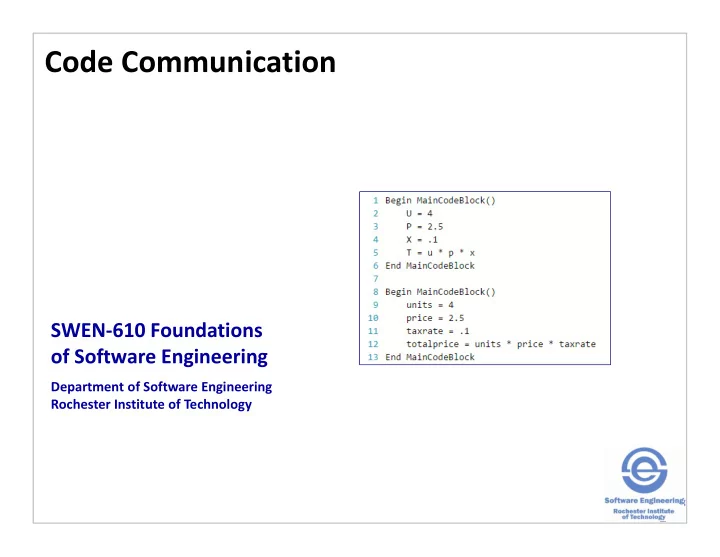
Code Communication SWEN-610 Foundations of Software Engineering Department of Software Engineering Rochester Institute of Technology How your code "reads" is critically important for the humans who will read it. Any fool can write

slide-1
SLIDE 1

SWEN-610 Foundations

  • f Software Engineering

Department of Software Engineering Rochester Institute of Technology

Code Communication

slide-2
SLIDE 2

How your code "reads" is critically important for the humans who will read it. Any fool can write code that a computer can

  • understand. Good programmers write code that

humans can understand.

Refactoring: Improving the Design of Existing Code Martin Fowler, et. al (1999)

2

slide-3
SLIDE 3

Code is read by humans as much as by machines. Code must be readable and understandable by all team members. Clear code communication includes:

  • A shared code style
  • Use of good, meaningful names
  • Component APIs are clearly documented
  • Algorithms are clarified using in-line comments
  • Indication of incomplete or broken code

3

slide-4
SLIDE 4

A shared code style is good etiquette. A code style includes:

  • Spaces vs tabs
  • Where to put curly-braces
  • Naming conventions

CamelCase for class names UPPER_CASE for constants lowerCamelCase for attribute and method names

  • And so on

Every team should choose a style and stick to it.

  • IDEs provide support for defining a code style
  • If your team cannot choose then we recommend

using Google Java style (see resources)

4

slide-5
SLIDE 5

Make names reflect what they mean and do. Dos:

  • Use class names from analysis and domain model
  • Use method names from Noun/Verb decomposition
  • Use names that reflect its purpose
  • Use method name that describe what it does not how

it does it

Don'ts:

  • Don't abbreviate; spell it out

pricePerUnit is better than pPU or worse just p

  • Don't use the same local variable for two purposes;

create a new variable with an appropriate name

  • Don't use "not" in a name; isValid is better than

isNotValid.

5

slide-6
SLIDE 6

Document your component's API. In Java the /** … */ syntax is used to denote a documentation for the thing it proceeds. For example:

/** * A single "guessing game". * * @author <a href='mailto:joecool@rit.edu'>Joe Cool</a> */ public class GuessGame

At a minimum you should document all public members.

  • Also good to document all (incl. private) methods
  • Document attributes with complex data structures

6

slide-7
SLIDE 7

A method's javadoc must explain how to use the

  • peration.

Every method must have an opening statement that expresses what it does.

  • Keep this statement concise
  • Additional statements can be added for clarification

Document the method signature

  • Use @return to describe what is returned
  • Use @param to describe each parameter
  • Use @throws to describe every exception explicitly

thrown by the method

Link to other classes

  • Use @link to link to classes
  • Use @linkplain in opening statement

7

slide-8
SLIDE 8

Example method javadocs.

/** * Get the {@linkplain GuessGame game} for the current user. * The user is identified by a {@linkplain Session browser session}. * * @param session * The HTTP {@link Session}, must not be null * * @return * An existing or new {@link GuessGame} * * @throws NullPointerException * when the session parameter is null */ public GuessGame get(final Session session)

8

Use @linkplain in the opening statement. Use @link in all

  • ther clauses.
slide-9
SLIDE 9

Use in-line comments to communicate algorithms and intention. Use in-line comments to describe an algorithm

  • Dos:

Use pseudo-code steps Explain complex data structures

  • Don'ts:

Don't repeat the code in English count++; // increment the count

Use comments to express issues and intentions

  • A TODO comment hints at a future feature
  • A FIX (or FIXME) comment points to a known bug

that is low priority

9