Co-Investigators Comparison of the PROMIS Physical OFAR (Orthopaedic - - PowerPoint PPT Presentation

co investigators
SMART_READER_LITE
LIVE PREVIEW

Co-Investigators Comparison of the PROMIS Physical OFAR (Orthopaedic - - PowerPoint PPT Presentation

5/8/2014 Co-Investigators Comparison of the PROMIS Physical OFAR (Orthopaedic Foot & Ankle Outcomes Research Network) Function CAT with the FFI and FAAM Ian Alexander, MD , Cleveland Clinic, Cleveland, OH Judith Baumhauer, MD , University of


slide-1
SLIDE 1

5/8/2014 1

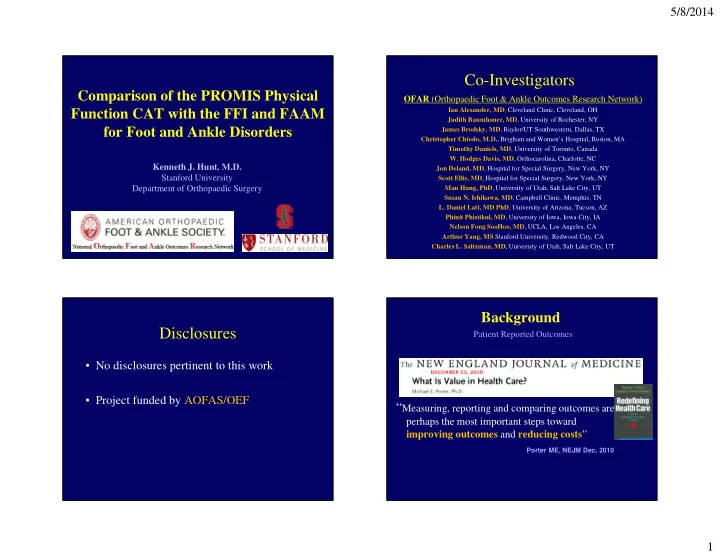
Comparison of the PROMIS Physical Function CAT with the FFI and FAAM for Foot and Ankle Disorders

Kenneth J. Hunt, M.D. Stanford University Department of Orthopaedic Surgery

Co-Investigators

OFAR (Orthopaedic Foot & Ankle Outcomes Research Network)

Ian Alexander, MD, Cleveland Clinic, Cleveland, OH Judith Baumhauer, MD, University of Rochester, NY James Brodsky, MD, Baylor/UT Southwestern, Dallas, TX Christopher Chiodo, M.D., Brigham and Women’s Hospital, Boston, MA Timothy Daniels, MD, University of Toronto, Canada

  • W. Hodges Davis, MD, Orthocarolina, Charlotte, NC

Jon Deland, MD, Hospital for Special Surgery, New York, NY Scott Ellis, MD, Hospital for Special Surgery, New York, NY Man Hung, PhD, University of Utah, Salt Lake City, UT Susan N. Ishikawa, MD, Campbell Clinic, Memphis, TN

  • L. Daniel Latt, MD PhD, University of Arizona, Tucson, AZ

Phinit Phisitkul, MD, University of Iowa, Iowa City, IA Nelson Fong SooHoo, MD, UCLA, Los Angeles, CA Arthur Yang, MS Stanford University, Redwood City, CA Charles L. Saltzman, MD, University of Utah, Salt Lake City, UT

Disclosures

  • No disclosures pertinent to this work
  • Project funded by AOFAS/OEF

“Measuring, reporting and comparing outcomes are

perhaps the most important steps toward improving outcomes and reducing costs”

Porter ME, NEJM Dec, 2010

Background

Patient Reported Outcomes

slide-2
SLIDE 2

5/8/2014 2

Outcomes

Radio- graphic Clinician Observed Patient Reported

Background

Patient Reported Outcomes

Outcomes

Radio- graphic Clinician Observed

Patient Reported

Assess Effectiveness Quality initiatives Value-based Reimbursement

Background

Patient Reported Outcomes

  • Wide range of clinical outcome measures

used in the evaluation of foot and ankle procedures and disorders

  • No broadly accepted consensus

AOFAS scale FAAM FFI SMFA AAOS LE PROMIS CATs SF-36 SF-12 EQ-5D Olerud Tegner VAS VISA FAOS

Background

Patient Reported Outcomes

  • 10 year review of Foot/Ankle Outcome Metrics

– 139 unique scales – 55 used more than once – 28 used 5 times or more

Background

Outcomes in Foot and Ankle

Hunt & Hurwit, 2013 JBJS

0.2 0.4 0.6

Top 5

Martin et al, 2007 J Orth Sports PT

slide-3
SLIDE 3

5/8/2014 3

  • Physical Function CAT

– Valid and reliable for lower extremity patients – Equal or Superior to SF-36 PF – Responsiveness not yet determined

1Hung et al., 2013 FAI 2Hung et al., 2014 FAI

Background

Outcomes in Foot and Ankle

Objectives

The aim of this study was to examine and compare PF CAT to FAAM and FFI

  • 1. Psychometric Properties

– Validity – Reliability – Responsiveness

  • 2. Efficiency (i.e., time for completion)
  • PRO Data collected through OFAR Network

– OFAR created in 2012 by AOFAS – Facilitate collection of PRO measures – Using PROMIS CATs

Methods

Data Collection 10 Pilot Sites

Methods

OFAR Network

slide-4
SLIDE 4

5/8/2014 4

  • Each of 10 sites:

– Enrolled patients undergoing surgery for: Ankle/Hindfoot

  • Ankle Arthritis
  • Ankle Instability
  • Flatfoot Deformity

Forefoot

  • Bunions
  • Hammer toe(s)
  • Hallux rigidus

Methods

Data Collection

  • Each of 10 sites:

– Enrolled patients undergoing surgery for: – PRO measures collected:

Methods

Data Collection Computer Adaptive Test

  • Physical Function CAT

Legacy Instruments

  • Foot and Ankle Ability

Measure (FAAM)

  • Foot Function Index (FFI)
  • Each of 10 sites:

– Enrolled patients undergoing surgery for: – PRO measures collected:

Methods

Data Collection

– Pre-operative survey – 6 month follow-up survey

Computer Adaptive Test

  • Physical Function CAT

Legacy Instruments

  • Foot and Ankle Ability

Measure (FAAM)

  • Foot Function Index (FFI)

311 total patients enrolled at 10 sites

Results

Total Enrollment

slide-5
SLIDE 5

5/8/2014 5

20 40 60 80

Ankle Instability Ankle Arthritis Hallux Valgus Hammertoe Hallux Rigidus Flatfoot

311 total patients enrolled at 10 sites

Results

Total Enrollment

# Patients

56% completed 6 month follow-up surveys

  • Construct validity:

– Rasch model – High for all instruments

  • Convergent validity

– Pearson correlation

Psychometric Properties

Results

PF CAT FAAM FFI PF CAT 1.000 0.785 0.792 FAAM 1.000 0.685 FFI 1.000

  • Reliability: High for all instruments

Person Reliability Item Reliability

PF CAT 0.96 0.99 FAAM 0.95 0.99 FFI 0.93 0.99

Results

Psychometric Properties

Results

  • Responsiveness:

30 35 40 45 50 55 Ankle Instability Ankle Arthritis Hallux Valgus Hammertoe Hallux Rigidus Flatfoot

Physical Function CAT

Pre-op Post-op

Average Function

* * * * * Psychometric Properties

slide-6
SLIDE 6

5/8/2014 6

Results

  • Responsiveness:

20 40 60 80 100 Ankle Instability Ankle Arthritis Hallux Valgus Hammertoe Hallux Rigidus Flatfoot

FAAM

Pre-op Post-op * * * * * Psychometric Properties

Results

  • Responsiveness:

20 40 60 80 100 Ankle Instability Ankle Arthritis Hallux Valgus Hammertoe Hallux Rigidus Flatfoot

Pre-op Post-op

Foot Function Index

Psychometric Properties Efficiency

Results

23.0 28.0 4.3 0.0 10.0 20.0 30.0

FFI FAAM PF CAT

Item count (# of questions)

Efficiency

Results

2:59 3:16 0:44 0:00 1:12 2:24 3:36

FFI FAAM PF CAT

Time to Complete Instrument

slide-7
SLIDE 7

5/8/2014 7

  • PROMIS Physical Function CAT

– Valid, reliable tool for foot/ankle disorders – Responsive to change at 6 months – More efficient than FFI and FAAM

  • fewest items and least time to completion
  • FFI

– Less sensitive to change at 6 months compared to FAAM and PF CAT

Summary

  • PROMIS Physical Function CAT

– Increasingly recognized outcomes tool – May augment legacy scales – Allow orthopaedic subspecialties to “speak the same language” for outcomes assessment

Conclusions

  • Our Ultimate Goals:

– Enhance our ability to assess patient outcomes – Improve quality and generalizability of

  • utcomes research

– Direct the conversation on quality assessment and appropriate allocation of health care resources

Conclusions

Thank You

OFAR Network AOFAS/OEF