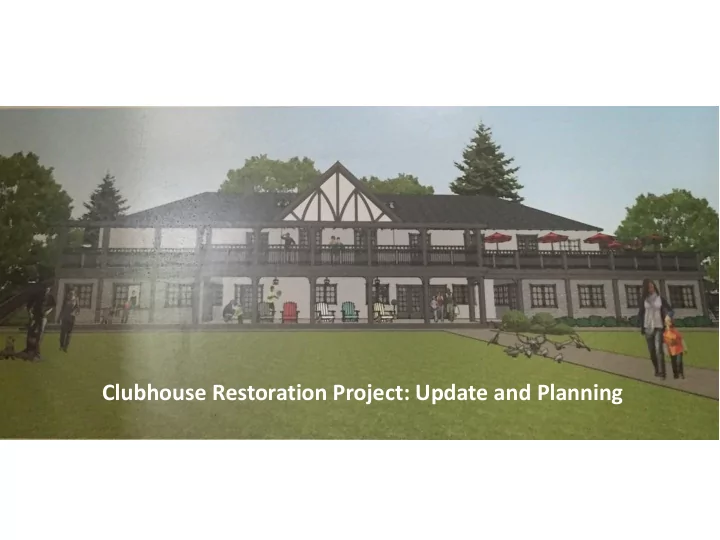
Clubhouse Restoration Project: Update and Planning In the - - PowerPoint PPT Presentation

clubhouse restoration project update and planning in the
SMART_READER_LITE
LIVE PREVIEW

Clubhouse Restoration Project: Update and Planning In the - - PowerPoint PPT Presentation

Clubhouse Restoration Project: Update and Planning In the beginning.. The OTLBCs First Golden Age on Cameron Avenue, 1923-1929 by Ross Eaman How did the clubhouse we are enjoying today get created 95 years ago by these 1920s members at a


slide-1
SLIDE 1

Clubhouse Restoration Project: Update and Planning

slide-2
SLIDE 2

In the beginning…..

slide-3
SLIDE 3

The OTLBC’s First Golden Age

  • n Cameron Avenue, 1923-1929

by Ross Eaman

How did the clubhouse we are enjoying today get created 95 years ago by these 1920s members at a cost (in today’s dollars) of $2 million?

slide-4
SLIDE 4

Suzanne Lenglen of France (1899-1938)

World champion 1914, 1921-23 Wimbledon 1919-23, 1925 French champion 1925-26 Olympic gold medalist 1920

Trivia question

Which of these players came to Ottawa in 1923 to celebrate the

  • pening of the OTLBC’s new facility on Cameron?

William T. (“Big Bill”) Tilden of U.S.A. (1893-1953) Wimbledon 1920 and 1921 U.S. champion 1920 to 1925

slide-5
SLIDE 5

In The Art of Lawn Tennis (1921), Tilden described Lenglen’s dashing style as follows: Her forehand drive is a full arm swing from the shoulder. It meets the ball just as Mlle. Lenglen springs in the air. The result is pictorially unique, but not good tennis. She looses [sic] speed and power by this freak. Mlle. Lenglen's speed of foot is marvelous. She runs fast and easily. She delights in acrobatic jumps, many of them unnecessary, at all times during her play.

slide-6
SLIDE 6

The official opening . . . Monday, June 4, 1923

At noon the temperature in Ottawa was 72 degrees Fahrenheit and it was King George VI’s birthday . . .

Photo of King George VI taken in April 1923

slide-7
SLIDE 7

Rockliffe Pavilion constructed in 1917 Rockcliffe Park Lookout in 1920s

slide-8
SLIDE 8

Street car in Britannia Park in 1920s Britannia, the “people’s playground”

slide-9
SLIDE 9

Tupper Lake, 1920 postcard Canadian Pacific train in Ottawa, c. 1912

slide-10
SLIDE 10

On Cameron “street” in what was then simply Ottawa South . . .

slide-11
SLIDE 11

Cameron Avenue was the club’s fifth location . . .

Elgin Street Cartier Square Patterson Avenue Third Avenue 1881 1888 1902 1907 1922

1884 1888 1916

The Ottawa Lawn Tennis Club The Ottawa Tennis and Lawn Bowling Association

slide-12
SLIDE 12

Lady Agnes Macdonald, wife of the Prime Minister

North end of Elgin Street in 1880s and the OLTC six blocks south Elgin between Lisgar and Cooper today

Knox Presbyterian Church

slide-13
SLIDE 13

Why did the Ottawa Lawn Tennis Club become the Ottawa Tennis and Lawn Bowling Association? When did the club switch from grass to clay?

Third Avenue on eve of First World War

  • following the initiative of the

Rideau Lawn Tennis Club (formed by disgruntled OTLBC members in 1912), the club created four clay courts during WWI and four more (across the street) in 1919 as a cost- saving measure

  • after moving to Patterson Avenue in 1902, the club was

threatened by an aggressive membership drive by the Royal Ottawa Golf club; to counter this challenge, it reorganized as the Ottawa Tennis and Lawn Bowling Association in 1905

slide-14
SLIDE 14

By the early 1920s, the OTLBC had over 500 tennis members, far too many for its Third Avenue courts . . . so the decision was taken to move to a 4.9 acre site on Cameron . . . which could now be reached by streetcar . . .

New “high level” Bank Street Bridge completed in 1912 Extension of street car line along Bank Street to Grove Avenue

slide-15
SLIDE 15

George A. Crain – who spearheaded the move to Cameron

  • J.A. Ewart designed the clubhouse and Ferguson

& Lambert were the general contractors

The large number of members in attendance gave their unanimous and enthusiastic support, financially and otherwise, to the Ottawa South extension scheme, particulars concerning which were laid before the meeting and fully discussed.

The Crain house at 285 Clemow

Who inspired this decision? Much of the credit must go to club president George A. Crain

The directors were praised for their efforts in pushing the club to the front, and past President George Crain came in for considerable praise, as well as Secretary Fred Tory.

Ottawa Journal, April 21, 1922 Ottawa Journal, April 24, 1924

slide-16
SLIDE 16

How did the OTLBC finance the expansion?

Cost of individual components Land 7,500 Clubhouse 26,000 Courts, greens, etc. 10,200 Total cost of project $43,700 Assets from sale of Third Avenue. $23,700 (after mortgage paid off

  • the difference of $20,000 was raised through the sale of

debentures paying six per cent interest

  • with annual expenditures of $6,300 and annual revenues
  • f $9,300, the plan was to buy them back over 15 years
slide-17
SLIDE 17

Clubhouse architect John Albert Ewart

John A. Ewart (1872-1964)

the doyen of Ottawa architects Transportation Building (1916-17) Ottawa South Public Library (1949-50) Glebe Collegiate Institute (1922-23) Southminster United Church (1931)

slide-18
SLIDE 18

How do we know that John A. Ewart was the architect?

  • there is no mention of the clubhouse in the entry for Ewart in the

Biographical dictionary of architects in Canada 1800-1950 nor in the inventory of his drawings in the National Archives of Canada

  • but from memories such as the one above and other indirect

evidence, we can safely assume he was the architect I remember our father, John Cossar Ewart, telling us that his Dad designed the clubhouse. Our Dad was born in 1911 and played his tennis there in his youth and indeed, introduced me to tennis at the club as well. We lived in the area of Alta Vista Drive and Cunningham Road so we didn’t get to venture to the tennis club too often unless we were visiting our grandparents

  • n Cameron Avenue.

Doug Ewart, grandson of John A. Ewart; email to Ross Eaman, January 14, 2018.

slide-19
SLIDE 19

A comparison of two buildings

  • Dominion architect David Ewart (d. 1921) owned the land between

Bank and Seneca from Sunnyside to the Rideau River and built a house on Cameron sometime before his son did; many features of

  • J. Ewart’s house are present in the clubhouse: roofline, protruding

façade, window proportions, stucco siding, and half-timber beams

Mansion at 114 Cameron Avenue built by John Albert Ewart in 1909 Our clubhouse at 176 Cameron constructed in 1922-23

slide-20
SLIDE 20

May 1923 – construction of new clubhouse complete

The design of the successful country club . . . should express ease, comfort and well-ordered gaiety. A club is primarily a social place and . . . requires a main lounge where members can relax during the day and entertain at

  • night. . . . Porches terraces or verandas should be placed as to give them

full views of the tennis courts. Aymar Enbury II, Architectural Forum (1925)

slide-21
SLIDE 21

Monday, June 4, 1923 – a special day for the OTLBC

2:10 pm – a brief thunderstorm hits the city 2:30 pm – with rain still falling, U.S. champion Bill Tilden beats former champion Lindley Murray 3-6, 6-4, 6-1 in an exciting exhibition tennis match at the OTLBC in front of 1,500 spectators; followed by a doubles exhibition match (Murray and Hardy beat Tilden and Crocker 4-6, 6-2, 6-3) 5:00 pm – George A. Crain introduces former mayor Harold Fisher who officially

  • pens the new clubhouse and grounds

7:30 pm – dinner at the Chateau Laurier to which all local tennis members are invited (cost $2); Tilden talks about importance

  • f a strong tennis program in Canada

Murray and Tilden

Chateau Laurier Hotel

slide-22
SLIDE 22

1923-1929

a brief golden age for the OTLBC on Cameron

  • most members came to the club by streetcar for five cents a ride
  • tea was served on Saturdays at 4:00 p.m. followed by a dance in the

evening

  • tennis was not played on Sundays until the mid-1920s and then only

after 1:00 p.m.

Myrtle Louise Barnes and Ewart Heppenstall, 1923 Aleta Watts, 1923 doubles champion with E. Crawley

Miss A. Watts became Mrs. Aleta Latham in 1926 when she married Walter Latham from Bell

  • Street. In 1932 she became my
  • mother. The Crawley name is

also well known in Ottawa. My mother told us she had met and spoken at length with Bill Tilden and other celebrities during their visit here in 1923. Email from Edward J. Latham to myself, April 1, 2018

slide-23
SLIDE 23
  • n Friday, October 18, 1929, the OTLBC organized the Ottawa Tennis

Ball at the Chateau Laurier for all city tennis players and their friends “as a fitting climax to a year of progress” (Ottawa Journal)

  • eleven days later – on “Black Tuesday” – the stock market crashed

and the world plunged into the Great Depression

The OTLBC on Labour Day, 1935

1923 – OTLBC had 534 tennis members (plus 100 on a waiting list) 1939 – only 123 full-time adult tennis members (61 men, 62 women), but 110 lawn bowling members Tennis Fees $8 women $10 men Lawn bowling fees $10 women $16 men 1949 – 510 members (217 men, 293 women)

slide-24
SLIDE 24

The Next 100 Years on Cameron Avenue June 4, 2023 A campaign to restore the building that houses our stories.

slide-25
SLIDE 25

Functional not Fancy Maintain the Character Community Asset and Gathering Place Multi-faceted Business Model

slide-26
SLIDE 26

How do we get there?

Construction Grade Drawings – shovel ready Phased Construction Approach – mitigate risk

slide-27
SLIDE 27

Clubhouse Campaign

2.6 Million Clubhouse Restoration Project

  • $1 Million capital assessment for members
  • $1 M fundraising (grants, member campaign, sponsorship)
  • $600,000 loan
slide-28
SLIDE 28

Business Plan for Four Season Space

OPPORTUNITIES

  • Two existing full time staff.
  • Strong business model in the summer – not from scratch
  • Save over $35,000 annually in sunk costs that are incurred when the

100 year old building STRATEGIC

  • Leveraging a currently underutilized asset that we already own – space

in Old Ottawa South

  • Keep connected to our membership over winter months with a

physical location for club events, special events, membership sales etc. Club loyalty and engagement.

  • Leverage the local community to engage with the new winter spaces.
  • Strategic partnerships that will also enhance summer months.

Net positive impact $90,000 annually

slide-29
SLIDE 29

Why is this taking so long?

slide-30
SLIDE 30

Fundraising Plan

slide-31
SLIDE 31

Recognition Opportunities

Upstairs Hall $500,000 Women’s and Men’s Changerooms $400,000 Balcony $150,000 Bowler’s Lounge/Board Room $125,000 Ground Floor Office Space $ 75,000 Courts $ 40,000

slide-32
SLIDE 32

Gifts to the OTLBC

Monthly and one-time gifts Multi-year pledges Legacy gifts in will and estate Blended gifts: commitments today and in estate

slide-33
SLIDE 33

Tradition of Visionary Leadership

slide-34
SLIDE 34

Impact on Communities

Ottawa South Neighborhood – Community asset, property values, green space maintained

01

Members – Four season clubhouse will generate revenue, save money

  • n annual repairs,

enhance value of OTLBC membership experience

02

Tennis – Oldest club in Canada, four season building to support long term development

  • f site

03

slide-35
SLIDE 35

Timeline – 6 years

2018 2023 2020

Restoration Complete Quiet Phase raise first $1M by 2019 Public Phase raise next $500,000 Begin construction Phase 1, 2

2019

Feb 2019 Cdn Heritage Grant Application Continue with Phase 3,4

slide-36
SLIDE 36

Key Messages for Campaign

  • There is not enough annual surplus to fund this campaign.
  • Without a clubhouse we lose the ability to generate revenue and the

club is not sustainable.

  • The building is past its lifespan – safety, deficiencies, band aid

solutions are expensive and ineffective (60 years of disrepair)

  • First milestone is to raise $1M by 2019
  • Goal is to complete restoration by 2023 – 100 year anniversary
  • We are unable to issue tax receipts to donors
  • Clubhouse Restoration has separate bank account from Capital Fund
  • Clubhouse Restoration fundraising is separate and in addition to

Capital Fund Fundraising and capital fund expenditures

  • Member support behind the project will be key to its success

Get involved | Make a donation | Volunteer

slide-37
SLIDE 37

The next 100 years on Cameron

slide-38
SLIDE 38

Your Questions and Comments

Is the Clubhouse Restoration a project that we are ready to support with volunteer time and donations? What questions would you have about the project, and how can we address them through

  • ur campaign materials?