Closing in on the velocity distribution of Dark Matter with direct - - PowerPoint PPT Presentation

closing in on the velocity distribution of dark matter
SMART_READER_LITE
LIVE PREVIEW

Closing in on the velocity distribution of Dark Matter with direct - - PowerPoint PPT Presentation

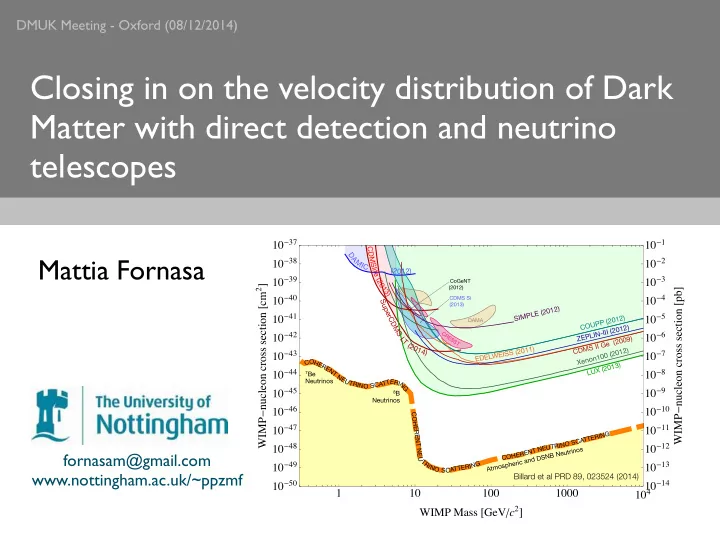
DMUK Meeting - Oxford (08/12/2014) Closing in on the velocity distribution of Dark Matter with direct detection and neutrino telescopes 10 - 37 10 - 1 C D D Mattia Fornasa A M 10 - 38 10 - 2 M I S C ( l 2 2 ) 0 1 i t e 10 - 39


slide-1
SLIDE 1

Closing in on the velocity distribution of Dark Matter with direct detection and neutrino telescopes

fornasam@gmail.com www.nottingham.ac.uk/~ppzmf

DMUK Meeting - Oxford (08/12/2014)

Mattia Fornasa

1 10 100 1000 104 10-50 10-49 10-48 10-47 10-46 10-45 10-44 10-43 10-42 10-41 10-40 10-39 10-38 10-37 10-14 10-13 10-12 10-11 10-10 10-9 10-8 10-7 10-6 10-5 10-4 10-3 10-2 10-1 WIMP Mass @GeVêc2D WIMP-nucleon cross section @cm2D WIMP-nucleon cross section @pbD

C O H E RE N T N E U TR I N O S C A T T E RI N G COHE RE N T NEU T RI NO S C AT T E R ING C O HE RE NT N E U T R I N O SC A T TER I N G

CDMS II Ge (2009) Xenon100 (2012)

C R E S S T CoGeNT (2012) CDMS Si (2013)

E D E L W E I S S ( 2 1 1 )

DAMA

SIMPLE (2012) ZEPLIN-III (2012) COUPP (2012) LUX (2013) D A M I C ( 2 1 2 ) C D M S l i t e ( 2 1 3 ) S u p e r C D M S L T ( 2 1 4 )

Billard et al PRD 89, 023524 (2014)

8B

Neutrinos Atmospheric and DSNB Neutrinos

7Be

Neutrinos

slide-2
SLIDE 2

Speed distribution f(v)

Mattia Fornasa (University of Nottingham) 2

  • Several theoretical models are

available for f(v)

  • Standard Halo Model (SHM) is the

most widely used

  • f(v) can also be derived from

N-body simulations

DMUK Meeting - Oxford (08/12/2014)

dR dER = ρ0 mχmN Z ∞

vmin

vf1(v) dσ dER dv .

vmin = s mNER 2µ2

χN

dσ dER = dσSD dER + dσSI dER η(vmin) = Z ∞

vmin

f1(v) v dv ,

Mao et al., Astrophys. J. 764 (2013) 35

slide-3
SLIDE 3

Determining f(v) with direct detection

Mattia Fornasa (University of Nottingham) 3

Express f(v) in terms of a handful of parameters and, assuming data from a set of future direct detection experiments, determine them alongside mχ, σSIp and σSDp

DMUK Meeting - Oxford (08/12/2014)

f(v) =

N

X

i=1

3gi W(v; ˜ vi, ∆v) (˜ vi + ∆v)3 − ˜ v3

i

f(v) = exp "N−1 X

k=0

akPk(2v/vmax − 1) #

Polynomial parametrisation Binned parametrisation

Kavanagh, Fornasa & Green (arXiv:1410.8051) Peter, PRD 83 (2011) 125029

mχ=30 GeV, σSIp=10-45cm2, σSDp=2×10-40cm2, SΗM

slide-4
SLIDE 4

The challenge of the low-speed tail

Mattia Fornasa (University of Nottingham) 4

DMUK Meeting - Oxford (08/12/2014)

Kavanagh, Fornasa & Green (arXiv:1410.8051)

mχ=30 GeV, σSIp=10-45cm2, σSDp=2×10-40cm2, SΗM

vmin [km/s]

slide-5
SLIDE 5

mχ=30 GeV, σSIp=10-45cm2, σSDp=2×10-40cm2, SΗM

Mattia Fornasa (University of Nottingham) 5

DMUK Meeting - Oxford (08/12/2014)

Polynomial parametrisation Binned parametrisation

Kavanagh, Fornasa & Green (arXiv:1410.8051)

slide-6
SLIDE 6

mχ=100 GeV, σSIp=10-45cm2, σSDp=2×10-40cm2, SΗM

Mattia Fornasa (University of Nottingham) 6

DMUK Meeting - Oxford (08/12/2014)

Polynomial parametrisation

  • A DM signal from neutrino telescope gives sensitivity to the low-speed tail of f(v)
  • Achieve a reconstruction of f(v) with an uncertainty of a factor 10 (3) for polynomial

(binned) parametrisation over a range 200-300 km/s wide

  • Binned par. cannot be used with direct detection only (solved by IceCube data)
  • Polynomial par. leads to very large uncertainties (solved by IceCube data)
  • Flexibility of the polynomial parametrisation corresponds to more degeneracy

Kavanagh, Fornasa & Green (arXiv:1410.8051)