Climbers Run Stream & Wildlife Habitat Restoration Project Fall - - PowerPoint PPT Presentation

climbers run stream wildlife habitat restoration project
SMART_READER_LITE
LIVE PREVIEW

Climbers Run Stream & Wildlife Habitat Restoration Project Fall - - PowerPoint PPT Presentation

Climbers Run Stream & Wildlife Habitat Restoration Project Fall 2014 Fall 2016 226 Frogtown Road, Pequea PA 17565 Greg Wilson Lydia Martin Conservation Officer Director of Education Donegal Trout Unlimited Lancaster County


slide-1
SLIDE 1

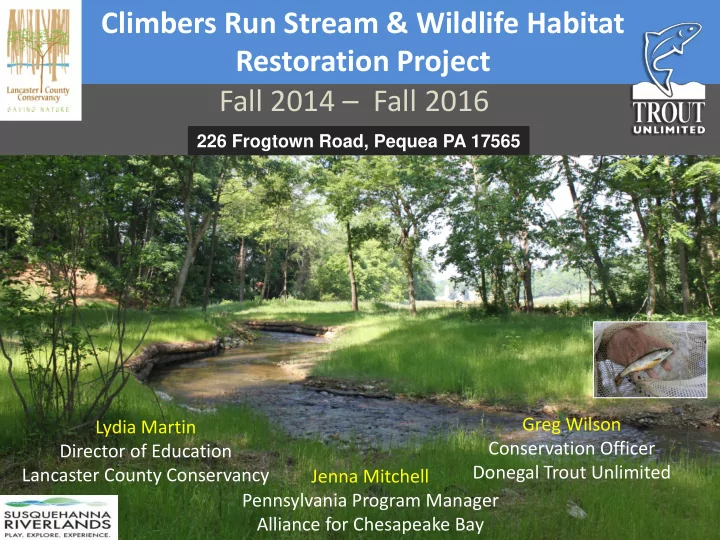
Climbers Run Stream & Wildlife Habitat Restoration Project Fall 2014 – Fall 2016

226 Frogtown Road, Pequea PA 17565

Lydia Martin Director of Education Lancaster County Conservancy Jenna Mitchell Pennsylvania Program Manager Alliance for Chesapeake Bay Greg Wilson Conservation Officer Donegal Trout Unlimited

slide-2
SLIDE 2

Before Photos

April 19, 2014

Erosion & sediments loads impacting stream & aquatic habitat for native brook trout

Bob Kutz, Adam Smith & Bryon Miller & Lydia Martin, LCC

Review of the project

Estimated start date for U.S. Fish & Wildlife Mid-Late January 2015

PARTNERS: Donegal Trout Unlimited & U.S. Fish & Wildlife Service

slide-3
SLIDE 3

March 3, 2015

Grade and stabilize the border between the LCC boundary and Martin property; these improvements will help with minimizing erosion along the steep banks

After Photo

slide-4
SLIDE 4

A few more before photos

Before Photos

April 19, 2014

Photos: Mike Burcin

Conditions in early spring while trying to walk along the stream; undercut banks; vegetation was dense throughout the understory

slide-5
SLIDE 5

February, 2015

slide-6
SLIDE 6

During Photos

February 11, 2015

Wood chips for trails, native plants, equipment use & professional services

Equipment & Materials

Engaging partners along the way

slide-7
SLIDE 7

“Never doubt that a small group of thoughtful, committed citizens can change the world; indeed, it's the only thing that ever has.” -Margaret Mead

Volunteers & Partners Critical to Support of Project Efforts

slide-8
SLIDE 8

Floodplain Mix along some areas of the riparian buffer

March 30, 2015

Goals to Restore & Increase Native Species Diversity, Reduce Erosion & Protect Water Quality

slide-9
SLIDE 9

32 to 38 tri-axles

  • f soil
  • A. Smith, U.S. Fish & Wildlife Service
slide-10
SLIDE 10

April 11, 2015

A community effort to plant native trees & shrubs

Volunteers from LCC, DTU, Sierra Club, Lancaster County Conservation District, PA Master Naturalists, & Scouts

Mascot Nelly on Trout Patrol!

slide-11
SLIDE 11

Students learn about macroinvertebrates Water Quality Volunteer Coalition (WQVC) teaching children and adults about water testing at Climbers Run Leaf packs are so cool!

Environmental Education & Research Opportunities Reach All Ages

WQVC Volunteers

slide-12
SLIDE 12

May 28, 2015

fallen logs, vernal pools & stream species diversity

Develop a Baseline of Existing Species & Habitat

slide-13
SLIDE 13

May 28, 2015 May 28, 2015

Life in and along the stream

Appreciating local biodiversity in natural areas

slide-14
SLIDE 14

Protecting natural areas takes planning, time & commitment for healthier ecosystems & communities

LCC, DTU and Scouts plant more native trees & shrubs

slide-15
SLIDE 15

BEHIND THE SCENES: A huge thanks to Garry & all DTU nursery volunteers who grew native plants for stream restoration work this year!

Saving nature through your support!

By the numbers: Nov 2014 – Nov 2016

DTU contributed approximately 850 native trees and shrubs from their nursery for the stream restoration project U.S. Fish & Wildlife Service donated 22 wildlife boxes for the project 350+ volunteers donated over 1,500 hours of volunteer service to plant trees/shrubs, remove invasive species, and clean up trash

slide-16
SLIDE 16

Pre-Condition of Stream & Riparian Buffer Post Stream & Riparian Buffer Restoration Direct & Indirect Benefits

Watershed Function

Highly eroded banks impacting downstream communities Floodplain restoration and structures reduce erosion and help stabilize stream bank conditions Reduction in sediment loads impacting waterways downstream to the Chesapeake Bay

Physical and Chemical Function

Degraded conditions influence health of eastern brook trout and aquatic species Improvement to water quality and support of physical and chemical function within the watershed Scientific model to observe and document restoration techniques and impact to aquatic and terrestrial species

Biological Function

Prolific invasive species reducing biodiversity through competition and altering ecosystem function Restore riparian vegetation communities, aquatic species and terrestrial wildlife Promote ecological sustainability and protection of special species in a PA Natural Heritage Area

Preserve Management

Limited ability to adequately manage riparian buffer due to invasive species and size of infestation Trash and debris along stream channel Removal of invasive species through adaptive management practices of highly disturbed areas Cleaner buffer without trash and debris potentially increasing erosion and contaminating water Access provides ongoing education, research, and stewardship opportunities to the public Promotes passive recreation uses Positive partnerships create

  • pportunities to safeguard stream &

wildlife habitat

Climbers Run Wildlife Habitat and Stream Restoration Project Overview
slide-17
SLIDE 17

Stream Restoration Signage

slide-18
SLIDE 18

Partnerships in Conservation

Conservation projects happen because people care and work together! Thank you for your support & commitment!

The Lancaster County Conservancy

www.lancasterconservancy.org

& Donegal Trout Unlimited

www.donegaltu.org

slide-19
SLIDE 19

Lancaster County Conservancy

Because clean air, fresh water and wild places are vital to every generation.

The Beauty of Climbers Run

Climbers Run Preserve, home of the Conservancy’s new research & education center, is

1 of 44 preserves

protected for public benefit.

wild brook trout stream

Susquehanna Riverlands Research & Education Center