Climate Change: Potential Impacts on Forest Ecosystems Thomas A. - - PowerPoint PPT Presentation

climate change potential impacts on forest ecosystems
SMART_READER_LITE
LIVE PREVIEW

Climate Change: Potential Impacts on Forest Ecosystems Thomas A. - - PowerPoint PPT Presentation

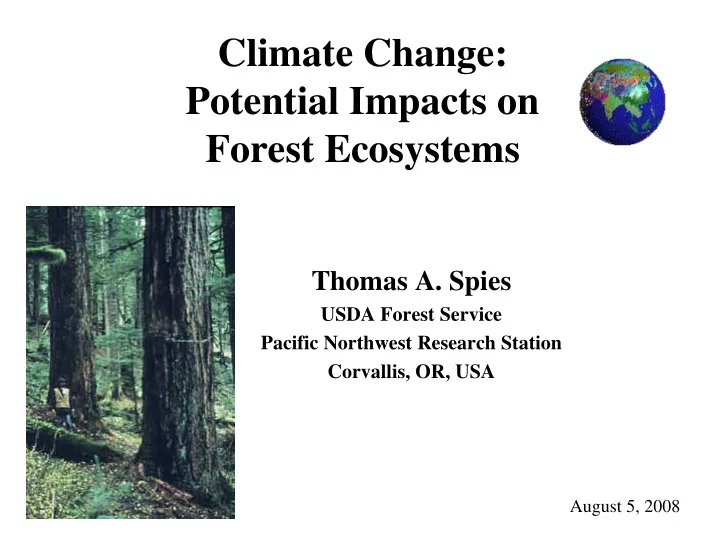
Climate Change: Potential Impacts on Forest Ecosystems Thomas A. Spies USDA Forest Service Pacific Northwest Research Station Corvallis, OR, USA August 5, 2008 Change in Mean Monthly Temperature (Degrees C) 2070-2099 vs 1961-1990 A1B B1

slide-1
SLIDE 1

Climate Change: Potential Impacts on Forest Ecosystems

Thomas A. Spies

USDA Forest Service Pacific Northwest Research Station Corvallis, OR, USA

August 5, 2008

slide-2
SLIDE 2

CSIRO MIROC HAD A2 A1B B1

Change in Mean Monthly Temperature (Degrees C) 2070-2099 vs 1961-1990

  • R. Neilson
slide-3
SLIDE 3

A2 A1B B1

CSIRO HAD MIROC

Percent Change in Precipitation 2070-2099 vs 1961-1990

  • R. Neilson
slide-4
SLIDE 4

Observed Simulated Historical

  • R. Neilson

Projections of Dynamic Global Vegetation Models

slide-5
SLIDE 5

MIROC3_MEDRES A2 A1B B1 HADCM3 CSIRO_MK3 Historical

  • R. Neilson
slide-6
SLIDE 6

MIROC3_MEDRES A2 A1B B1 HADCM3 CSIRO_MK3 percent

Percent Change in Vegetation Carbon 2070-2099 vs. 1961-1990.

  • R. Neilson
slide-7
SLIDE 7

MIROC3_MEDRES A2 A1B B1 HADCM3 CSIRO_MK3 percent

Percent Change Biomass consumed by Fire 2051-2100 vs. 1951-2000.

  • R. Neilson
slide-8
SLIDE 8

Types of Impacts

  • Direct

– Ecosystem productivity – Tree growth – Establishment – Ecotone/range movement – Phenology

  • Indirect

– Fire – Insects and Disease – Human responses (e.g. carbon sequestration)

slide-9
SLIDE 9

Major Uncertainty

  • Increased CO2 concentration can promote

higher productivity through more efficient photosynthesis But

  • Warmer temperatures increase moisture stress

and reduce photosynthesis But

  • But earlier start to growing season can boost

growth during time when soil is relatively wet

slide-10
SLIDE 10

From Boisvenue and Running 2006

Limits on vegetation net primary productivity

49 Studies: 37 Pos.; 5 Neg.; 7 no trend or mixed

slide-11
SLIDE 11

Examples of Ecological Changes

slide-12
SLIDE 12

Upward Movement of Ecotones

Beckage et al. 2008. PNAS

Shifts in Northern Hardwood/Boreal Forest Ecotone in Vermont

slide-13
SLIDE 13

Decline of High Elevation Meadows in the Oregon Coast Range

Meadow Increase (Road Related Disturbance) Meadow Decline (Forest Encroachment) Meadow No Change Marys Peak Meadow Change (1948-1994) ~40% Decline in Meadow Vegetation at Marys Peak ~65% Decline in Summit Meadow Extent Throughout Oregon Coast Range Since 1948 Zald (in revision) Plant Ecology

slide-14
SLIDE 14

Flowering Times Become Earlier And Species that Don’t Change in Flowering Time may Disappear

Rushing and Primack 2008

Changes in mean first flowering dates for 43 plant species around Thoreau’s Concord, MA

slide-15
SLIDE 15

Shifts in Plant Species in Mountains Vary with Life History

Lenoir et al. 2008 Shifts for in Optimum Elevation For Plant Species of French Alps in relation to life history: 1905-2005

slide-16
SLIDE 16

Changes in Tree Mortality in Old-growth Conifer Forests in the Sierra Nevada From Stephenson et al. 2007

Increased Mortality Mature Forests from Stress and Biotic Causes

slide-17
SLIDE 17

Kurz et al. 2008. Nature Interactions of Climate and Disturbance: Mountain Pine Beetle Outbreak

slide-18
SLIDE 18

Westerling et. al. 2006

Increasing Occurrence of Wildfires in Western US

slide-19
SLIDE 19

14 % (incl B & B) 3.6 % 3 % 9.5 % 2.3 % 0.4 % 0 % 0 % 0 %

Monitoring Old Forest Loss to Wildfire 1993-2003

Percent Loss of Older Forest on a Decadal Basis By Province

1.4 % 0 %

Moeur and Spies et al. 2005

slide-20
SLIDE 20

Potential Changes in Western Oregon

  • Tree lines move upward, loss of subalpine

meadows

  • More fire, especially southern areas and valley

margins

  • Earlier flowering and leaf out
  • Higher stress/mortality on dry sites
  • Species range shifts upwards and northwards
  • More insect and disease occurrence
  • Higher productivity on relatively moist sites
slide-21
SLIDE 21

Implications to Conservation

  • Change—good or bad?
  • Uncertainty—keep options open
  • Complexity of responses—holistic/multi-

scale perspective

slide-22
SLIDE 22

Implications to Conservation

  • Potential vegetation types and historical

range of variation (coarse filter approaches) less useful

  • Monitoring--targeted
  • Manage to increase resistance/resilience

– Density management – Assisted colonization

  • Integrated approaches are necessary
slide-23
SLIDE 23