SLIDE 1
Environment and Natural Resources Trust Fund 2011-2012 Request for Proposals (RFP)
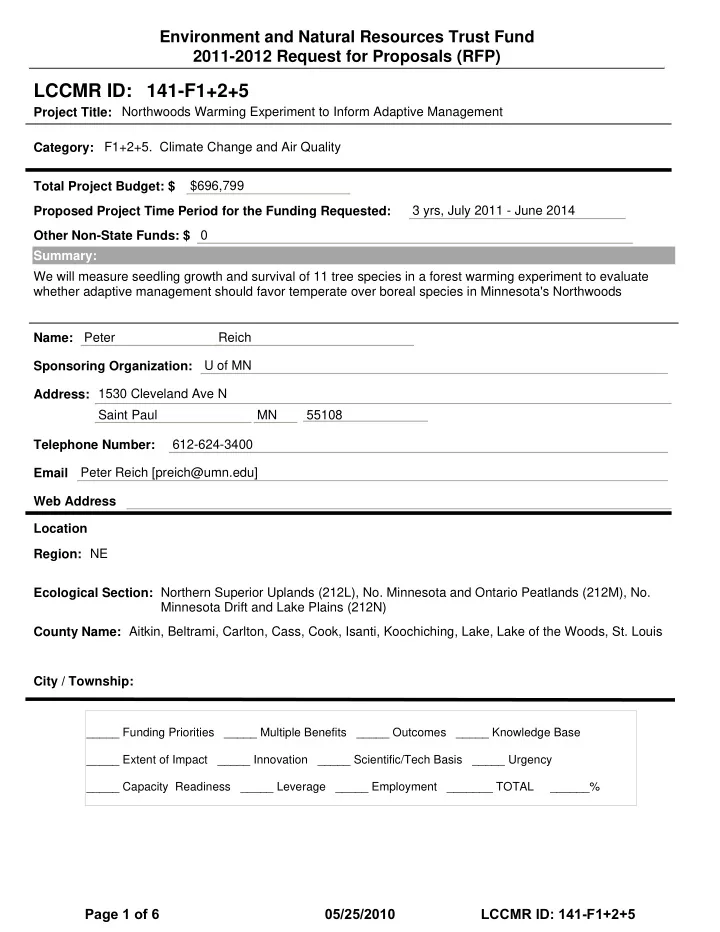
Northwoods Warming Experiment to Inform Adaptive Management $696,799 3 yrs, July 2011 - June 2014 Peter Reich U of MN 1530 Cleveland Ave N Saint Paul MN 55108 612-624-3400 Peter Reich [preich@umn.edu] Aitkin, Beltrami, Carlton, Cass, Cook, Isanti, Koochiching, Lake, Lake of the Woods, St. Louis We will measure seedling growth and survival of 11 tree species in a forest warming experiment to evaluate whether adaptive management should favor temperate over boreal species in Minnesota's Northwoods Project Title: Total Project Budget: $ Proposed Project Time Period for the Funding Requested: Other Non-State Funds: $ Name: Sponsoring Organization: Address: Telephone Number: Email Web Address County Name: City / Township: Region: Summary: NE Location Ecological Section: Northern Superior Uplands (212L), No. Minnesota and Ontario Peatlands (212M), No. Minnesota Drift and Lake Plains (212N)
_____ Funding Priorities _____ Multiple Benefits _____ Outcomes _____ Knowledge Base _____ Extent of Impact _____ Innovation _____ Scientific/Tech Basis _____ Urgency _____ Capacity Readiness _____ Leverage _____ Employment _______ TOTAL ______%
Category: F1+2+5. Climate Change and Air Quality
LCCMR ID: 141-F1+2+5
Page 1 of 6 05/25/2010 LCCMR ID: 141-F1+2+5
SLIDE 2 MAIN PROPOSAL PROJECT TITLE: Northwoods warming experiment to inform adaptive management I. PROJECT STATEMENT We will measure growth and survival of 11 tree species on 96 experimentally warmed forest plots to inform potential adaptive management strategies to keep northern Minnesota forests healthy in light of potential climate change. Specifically, our results will help to determine whether and when adaptive management should encourage replacement of boreal (Northwoods) species (e.g., spruces, aspen, birch) with native temperate species (e.g., oaks, maples). The project addresses this year’s LCCMR funding priority regarding the need to better understand how to adapt Minnesota’s ecosystems to climate change. To be effective, adaptive management must be based on scientific knowledge of likely climate change effects, which presently is lacking. Such knowledge will be especially important for Minnesota’s Northwoods, which make up the southern extent of the boreal forest in northeastern Minnesota (Map 1), as these are critical state resources considered especially vulnerable to climate change impacts. However, it is uncertain whether such impacts will be modest or extreme in the coming century. At present, knowledge is insufficient to enable informed decisions about whether or when to adaptively manage these forests to favor the historically dominant species or to favor species common further south which are presently rare in the north. Thus, we need to better understand climate change impacts on: (i) the capacity of these forests to regenerate the current mix of dominant Northwoods species, (ii) the potential for species that are native to central and southern Minnesota to replace the present Northwoods species, and (iii) the potential for detrimental invasion by temperate invasive woody species (e.g. buckthorn). In this project, we will advance such knowledge using a state-of-the-art experiment, B4WarmED (Boreal Forest Warming at an Ecotone in Danger) that manipulates temperature in an ecologically realistic
- utdoor field setting to directly assess impacts on regeneration of both boreal and temperate forest tree
- species. The B4WarmED experiment includes a total of 96 3-meter diameter plots in both forest
understory and in open sites near Cloquet and Ely, MN, with plants and soils either left at ambient temperature or raised by either 1.8°C or 3.6°C above ambient (see Map/Figures). Our overarching hypothesis is that experimental warming will improve tree seedling performance in all species during cool, wet years, but harm seedlings in dry, hot years, especially for the boreal species (e.g., spruce, aspen, birch). Thus, to fully understand the impacts of warming on tree regeneration will require multiple years of experimentation during which the ambient temperatures and precipitation vary, as is typical from year to year. The timing of the proposed research represents a key opportunity to meet this need: we propose to extend an existing experiment begun in 2009 with US Dept. of Energy funding (which expires 7-31-2011). The Trust Fund support will allow us to continue that work without interruption through the 2013 growing season. By project end in June 2014, we will have five years of data for tree seedlings planted in all five years, including multiple years of observation for cohorts of seedlings planted in the early years. Project results will inform the development of adaptive management strategies for Minnesota's northern forests by providing new knowledge of how the tree species composition of the Northwoods will change, as northern species shift their ranges and southern species invade the region in response to climate change. II. DESCRIPTION OF PROJECT RESULTS Activity 1: Experimentally heat 96 boreal forest plots to test tree seedling responses to potential climate warming. Budget: $255,000. Annually, new individuals of all species will be planted in all plots at both sites. These will include seeds
- f all species (Figure 1) in every plot in both years and an unspecified number of seedlings (with exact
Page 2 of 6 05/25/2010 LCCMR ID: 141-F1+2+5
SLIDE 3 number dependent upon survival of earlier plantings). From March to November of each year, we will warm plants and soils in treated plots using computer controlled infra-red heat lamps and buried heating cable, respectively. Year round, we will monitor temperatures and important environmental factors (e.g. radiation, soil moisture). Outcomes Completion Date
- 1. Maintain elevated temperatures on 96 3x3 meter plots
11/15/2013
- 2. Plant 96 plots with 11 tree species in 2012 and 2013
5/30/2013 Activity 2: Measure and analyze growth, physiology, and survival of boreal tree seedlings under experimental temperature regimes. Budget: $351,799. Annually, we will measure growth and survival of all species in all plots and assess composition of understory community. Throughout the season, we will measure key physiological processes including the timing of biological events such as budbreak (phenology), photosynthesis, respiration, and damage from cold or heat stress. By 2013, we will have data for more than 200,000 sown seeds and 15,000 planted seedlings. Outcomes Completion Date
- 1. Measure response of 11 species to climate warming, 2011-2013
11/15/2013
- 2. Analyze, interpret response of 11 species to climate warming, 2011-2013
11/15/2013 Activity 3: Communicate results via outreach and publications to managers of northern forests including presentations, workshops, management guides, reports; write scientific publications. Budget: $90,000. Data analysis will allow us to determine how experimental warming interacts with rainfall variability to affect tree seedling growth, physiology, and survival. Based on our biological data, we will develop adaptive management guidelines for boreal forest with climate change. Outcomes Completion Date
- 1. Final report, “Climate change impacts on MN’s Northwoods”
6/30/2014
- 2. Adaptation strategy guidelines
6/30/2014
- 3. Outreach via presentations, tours, workshops, web site 6/30/2014
- 4. Scientific publications written 6/30/2014
- III. PROJECT STRATEGY AND TIMELINE
- A. Project Partners. P. Reich (Project Manager, to receive part of ENTF funds). Other partners (not
receiving ENTF money): R. Montgomery; J. Oleksyn, Dept. Forest Resources, U. Minnesota; S. Hobbie, Dept EEB, U. Minnesota; R. Rich; University of Texas; L. Skinner, Supervisor, Invasive Species Unit and Ann Pierce, Supervisor, Conservation Management and Rare Resources Unit, Ecological Resources
- MNDNR. Additionally, other university and U.S. Forest Service scientists will cooperate on the project.
- B. Timeline Requirements. This is proposed as a 3-year project. Budget request is for 2 years, but spent
- ver 3 years, given that the start date falls mid-season for field work. The project start in July 2011
coincides with the last month of a current US DOE-funded project (2007-11) that built the warming facility and supports current activities.
- C. Long-Term Strategy. Results of this project will inform the development of climate change
adaptation strategies. For example, results will help us decide whether adaptive management aimed at encouraging replacement of true boreal species with native temperate species is recommended now, soon, in the far future or not at all.
Page 3 of 6 05/25/2010 LCCMR ID: 141-F1+2+5
SLIDE 4 BUDGET ITEM Personnel: 1 Faculty- summer salary 57000 1 Research associate- 50% time of $50,000 annual + 33.3% fringe 66650 1 Research coordinator-100% time of $40,000 annual + 41.1% fringe 112880 2 Graduate student summer salary - at 100% each summer 28000 1 Lead Technician -100% time of $30,000 annual + 41.1% fringe 84660 1 other technician - 20% time of $40,000 annual + 41.1% fringe 22566 4 Summer Interns- for four months/summer $11.50/hr for 536 hours for 2 summers 54243.2 5 student workers - at part time each academic year with work study funding 2800 Contracts: QWESTCOM & COMP TECH SERVICES. Provides sattelite internet link to remotely moniter and control the warming treatments at in real time by
- computer. Data is downloaded via this link to secure data storage at UMN so data
will not be lost in case of power failure. Equipment/Tools/Supplies: Tree seeds - MN collected within the laditudinal range of the experiment. 12,000 Field supplies: labels, sample bags, envelopes, vials, plot tags, data sheets, data storage, warming treatment parts, misc supplies, consumables for soil flux and photosythesis (batteries, drierite, etc.) 10000 Travel: From UMN Twin Cities campus to experimental sites in Cloquet and Ely and for travel between experimental sites. (580 miles roundtrip from UMN to Ely, 110 miles between sites, 270 miles round trip from UMN to Cloquet) Additional Budget Items: Electrical Power at both sites for warming treatments. 180000 Laboratory analysis for samples 20000 Repairs, maintenance and calibration on equipment for warming treatment delivery and scientific data collection. 4,000 $ TOTAL ENVIRONMENT & NATURAL RESOURCES TRUST FUND $ REQUEST SOURCE OF FUNDS AMOUNT Status Other Non-State $ Being Applied to Project During Project Period: Indicate any additional non-state cash $ to be spent on the project during the funding period. For
Indicate: Secured or Other State $ Being Applied to Project During Project Period: Indicate any additional state cash $ (e.g. bonding, other grants) to be spent on the project during the funding period. For each individual sum, list out the source of the funds, the amount, an
Indicate: Secured or Pending In-kind Services During Project Period: Indicate any in-kind services to be provided during the funding period. List type of service(s) and estimated value. In- kind services listed must be specific to the project.
tbd Remaining $ from Current ENTF Appropriation (if applicable): $330,000 awarded 2008 Subd_3p: "Climate change, CO2, and prairie/forest production". This largely supports an elevated CO2 experiment in grassland. A small portion supports travel to B4Warmed for soil-root carbon sampling, CO2 soil flux data collection and compilation. Project ends 6-30-2011. Additionally the current ENTF focuses on C sequestration, whereas the new proposal tests species responses to potential climate warming. 185,000 $ Unspent Funding History: US DOE-funded project (2007-11) $ 2,085,000 awarded to build the warming facility and support current activities through 7-31-2011 870,000 $ Unspent
428,799 $ 696,799 $ 22,000 $
2011-2012 Detailed Project Budget
- IV. TOTAL TRUST FUND REQUEST BUDGET 2 years funding (to be spent over 3 years)
204,000 $ AMOUNT 36,000 $ 6,000 $
Page 4 of 6 05/25/2010 LCCMR ID: 141-F1+2+5
SLIDE 5 Understory Open Control Boxes
Northwoods warming experiment to inform adaptive management
Warming via infra-red heat lamp and buried cable Warmed plot at Cloquet site Emergent White Pine seedling Location- latitude of B4Warmed sites Map 1.
Ely Cloquet
46.7⁰ 49.9⁰
approx limit
"Northern" forest
Fig C. 48-Plot layout for each site
40 m 60 m +3.6⁰ C +1.8⁰ C
Soil Cable Control
Fig A. Fig B.
Page 5 of 6 05/25/2010 LCCMR ID: 141-F1+2+5
SLIDE 6
Project Manager Qualifications and Organization Description Project Manager: Professor Peter B. Reich Regents Professor, Distinguished McKnight University Professor, and F.B. Hubachek, Sr., Professor of Tree Physiology and Forest Ecology Department of Forest Resources, University of Minnesota, St. Paul, MN 55108 E-mail: preich@umn.edu; Phone: 612-624-4270; FAX 612-625-5212 Professional Appointments and Preparation F.B. Hubachek, Sr., Professor, Dept of Forest Resources, U. Minnesota, 1991- Assistant/Associate Professor, Dept of Forestry, U. Wisconsin-Madison, 1985-1991 Post-doc (1985) and Ph.D. (1983) Cornell University M.S. (1977) University of Missouri B.A. (1974) Goddard College Honors, Professional Recognition and Service (Selected) BBVA Foundation Frontiers of Knowledge Award in Ecology and Conservation Biology Invited speaker > 125 symposium, conferences, and seminars; e.g., Harvard; Duke; Penn State; Princeton; Stanford; Texas A&M; Cornell; Michigan State; Washington Institute for Scientific Information (ISI) Science Citation Index, List of Top 10 Ecologists and Environmental Scientists in the World, 2002 – present Advisor to numerous Federal science and policy agencies Member of numerous editorial review boards and federal science agency panels Areas of Expertise Forest ecology and management; global environmental change and terrestrial ecosystem responses, including invasive species, climate, biodiversity, wildfire, elevated CO2 , and sustainability; carbon cycling; plant physiology, production; forest productivity, soil fertility and biogeochemistry. Systems studied: forests, woodlands, grasslands. Project Management Experience Lead PI or co-PI on forest and grassland science projects (total funding, >$19 million 2000- present, from federal [NSF, DOE, USDA, NASA], state, and private sources. Peer-reviewed publications: > 320 scientific articles and book chapters, including > 18 in high profile general journals (Nature, Science, etc.) as well as >275 in specialized technical journals Project Management Qualifications for this Project Background in forest ecology and management, including studies of forest change, forest dynamics, and invasive and exotic species. Extensive experience successfully leading science projects and managing large research teams. Organization Description The University of Minnesota is both the state land-grant university, with a strong tradition of education and public service, and the state's primary research university. Page 6 of 6 05/25/2010 LCCMR ID: 141-F1+2+5