Climate Applications and Services: Bridging the Gap between Climate - - PowerPoint PPT Presentation

climate applications and services bridging the gap
SMART_READER_LITE
LIVE PREVIEW

Climate Applications and Services: Bridging the Gap between Climate - - PowerPoint PPT Presentation

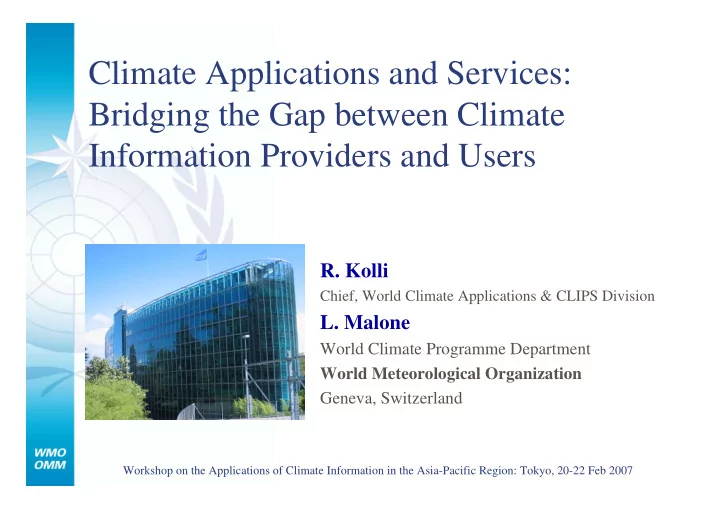
Climate Applications and Services: Bridging the Gap between Climate Information Providers and Users R. Kolli Chief, World Climate Applications & CLIPS Division L. Malone World Climate Programme Department World Meteorological Organization


slide-1
SLIDE 1

Workshop on the Applications of Climate Information in the Asia-Pacific Region: Tokyo, 20-22 Feb 2007

Climate Applications and Services: Bridging the Gap between Climate Information Providers and Users

  • R. Kolli

Chief, World Climate Applications & CLIPS Division

  • L. Malone

World Climate Programme Department World Meteorological Organization Geneva, Switzerland

slide-2
SLIDE 2

Workshop on the Applications of Climate Information in the Asia-Pacific Region: Tokyo, 20-22 Feb 2007

slide-3
SLIDE 3

Workshop on the Applications of Climate Information in the Asia-Pacific Region: Tokyo, 20-22 Feb 2007

slide-4
SLIDE 4

Workshop on the Applications of Climate Information in the Asia-Pacific Region: Tokyo, 20-22 Feb 2007

4

Outline

  • WMO’s climate activities; World Climate

Programme (WCP)

  • World Climate Applications and Services

Programme (WCASP) and the CLIPS Project

Training Regional Climate Outlook Forums User liaison

  • WMO Commission for Climatology; OPAGs

3 and 4

  • Concluding Remarks
slide-5
SLIDE 5

Workshop on the Applications of Climate Information in the Asia-Pacific Region: Tokyo, 20-22 Feb 2007

5

AREP Atmospheric Research and Environment Programme WWW World Weather Watch AMP Applications of Meteorology Programme HWRP Hydrology and Water Resources Programme ETRP Education and Training Programme DPM Natural Disaster Prevention and Mitigation Programme TCOP Technical Cooperation Programme RP Regional Programme WMOSP Space Programme

WCP

World Climate Programme

WMO

Programmes

slide-6
SLIDE 6

Workshop on the Applications of Climate Information in the Asia-Pacific Region: Tokyo, 20-22 Feb 2007

6

WMO’s Climate-Related Activities

Observations, data management and data

exchange

Research and predictions Climate products and services (for sector-

specific applications)

Capacity building, education and training Climate coordination

slide-7
SLIDE 7

Workshop on the Applications of Climate Information in the Asia-Pacific Region: Tokyo, 20-22 Feb 2007

7 Understanding Processes O bserving & Monitoring the Climate Developing Response O ptions

Surface, upper-air and ocean networks, satellite observations

Adapting Strategies

Climate diagnostics, Climate modelling Vulnerability assessment and socio-economic impacts

Climate Information and Applications

Water resources, health, energy, tourism and agriculture, etc.

Predicting Climate

Seasonal to interannual prediction, climate change projections Impact assessment, mitigation

  • f greenhouse gases

Integrated framework of WMO’s climate activities

slide-8
SLIDE 8

Workshop on the Applications of Climate Information in the Asia-Pacific Region: Tokyo, 20-22 Feb 2007

8

Emerging Opportunities: Towards Improved Societal Response and Sustainable Development

Relevant climate information is expected to enhance policy and

decision-making

Climate data Climate analysis and monitoring capabilities Specialized climate forecast products – Must become user centric Climate risk modelling tools – Critical for decision making

There is significant diversity in supply and demand of climate

information at national level

Needs, requirements and capabilities of providers Needs and requirements of the users related to policy and decision-

making

slide-9
SLIDE 9

Workshop on the Applications of Climate Information in the Asia-Pacific Region: Tokyo, 20-22 Feb 2007

9

WMO proactively pursues climate applications

  • Espoo Conference (Living with Climate Variability and

Change: July, 2006) highlights the role of users and decision makers in climate services.

  • Madrid Conference (Socio-economic Benefits of

Meteorological Services: March, 2007) highlights the quantification of socio-economic benefits of meteorological services.

  • ‘World Climate Conference Three’ under active pre-planning

discussions.

  • Based on a formal statement issued for the first time at the

UNFCCC COP-12 in 2006, the role of WMO and NMHSs has been officially recognized in the “Nairobi Programme of Work

  • n Impacts, Vulnerability and Adaptation to Climate Change”.
slide-10
SLIDE 10

Workshop on the Applications of Climate Information in the Asia-Pacific Region: Tokyo, 20-22 Feb 2007

10

WCP: Major Areas

  • Monitoring and understanding the global climate system
  • Collection, rescue and management of climate data
  • Detection & assessment of climate variability and change
  • Guidance, techniques and methodologies for climate information
  • Impacts of climate variability and change
  • Prediction of climate variations and improving prediction skill
  • Applications of climate knowledge and information
  • Focus on sustainable development and human well-being
  • Development of climate services
  • Early warning and climate alert systems
  • Capacity building, technology transfer and guidance
slide-11
SLIDE 11

Workshop on the Applications of Climate Information in the Asia-Pacific Region: Tokyo, 20-22 Feb 2007

11

WCP Strategies

  • Enhancing WMO’s role as the UN authoritative voice on the

state and behavior of the climate

  • Promotion of user-targeted climate services
  • Support delivery of accurate and reliable warnings of severe

climatic events

  • Increase awareness of the socio-economic benefits of climate

information and services

  • Promote understanding and modeling of the processes that

affect the climate

  • Support development of climate observations
  • Build and sustain effective global/regional and provider/user

partnerships

slide-12
SLIDE 12

Workshop on the Applications of Climate Information in the Asia-Pacific Region: Tokyo, 20-22 Feb 2007

12

A Seamless Climate Prediction Framework

Forecast Lead Time Forecast Lead Time

Warnings & Alert Warnings & Alert Coordination Coordination Watches Watches Forecasts Forecasts Threats Assessments Guidance Guidance Outlook Outlook Prediction Prediction Applications Transportation Transportation Transportation Protection of Life & Property Protection of Protection of Life & Property Life & Property Space Applications Space Space Applications Applications Recreation Recreation Recreation Ecosystem Ecosystem Ecosystem State/Local Planning State/Local State/Local Planning Planning Environment Environment Environment Water Management Water Water Management Management

Agriculture A Agriculture

griculture Water Resource Planning Water Resource Water Resource Planning Planning Energy Energy Energy Commerce Commerce Commerce Hydropower Hydropower Hydropower Fire Weather Fire Weather Fire Weather Health Health Health

Forecast Uncertainty Forecast Forecast Uncertainty Uncertainty

Initial Conditions Boundary Conditions

Minutes Hours Days 1 Week 2 Weeks Months Seasons Years

Weather Climate Variability

Scenarios

Anthropogenic Forcing

Climate Change. Adapted from: NOAA

Decades Centuries

slide-13
SLIDE 13

Workshop on the Applications of Climate Information in the Asia-Pacific Region: Tokyo, 20-22 Feb 2007

13

CAgM CCl

WCDMP

World Climate Data and Monitoring Programme

AgMP

Agricultural Meteorology Programme

WCASP

World Climate Applications and Services Programme & CLIPS Goals

improve databases & data management improve climate system monitoring efforts & awareness develop new data techniques for rescue

Goals

develop climate services increase awareness of benefits develop practical product methods increase utilization of information & predictions

Goals

to assist members in the provision

  • f meteorological and climate services

for agriculture to assist in sustainable development & economically viable agricultural systems

WCP World Climate Programme Department, WMO Climate Coordination Activities

slide-14
SLIDE 14

Workshop on the Applications of Climate Information in the Asia-Pacific Region: Tokyo, 20-22 Feb 2007

14

World Climate Applications and Services Programme

  • Applications of climate

information and prediction services to support human activities and sustainable development:

  • Economic efficiency
  • Human health and well being
  • Food production, food security
  • Water resources planning and

management

  • Renewable/efficient energy
  • Sustainable tourism
  • Urban and built environment
slide-15
SLIDE 15

Workshop on the Applications of Climate Information in the Asia-Pacific Region: Tokyo, 20-22 Feb 2007

15

Value of Climate Information and Services to Society

the nature of the dependence of socio-economic

activities on climatic factors

reliability of climate products including awareness of

the associated uncertainties and their implications to decision-making

accessibility of credible and useful climate information

for decision making

liaison between users and climate information

providers

the ability of users to act on the basis of climate

information

slide-16
SLIDE 16

Workshop on the Applications of Climate Information in the Asia-Pacific Region: Tokyo, 20-22 Feb 2007

16

WCASP Objectives

Development of user-targeted climate services Services for sustainable development at national,

regional and global levels

Contribute to strategies for adapting to, and mitigating,

the adverse impacts of climate and its variations

Increased user awareness and liaison Partnership with national/international agencies dealing

with application sectors

Development of practical methods and techniques

including climate prediction products

Implementation through CLIPS Project

slide-17
SLIDE 17

Workshop on the Applications of Climate Information in the Asia-Pacific Region: Tokyo, 20-22 Feb 2007

17

Climate Information and Prediction Services (CLIPS)

  • The term “climate services” refers to the delivery of climate

information and predictions from the scientific sources to end- users

  • A service is a service only when it is used; our goal is to make

people use climate services in real-world context

  • Climate information is just one of the elements in the decision

making matrix

  • Databases of information gathered over many years; NMHSs

have great potential to exploit these resources to provide “effective” climate services

  • Predictions of climate variability over the next season or two

(seasonal to interannual forecasts) are of immediate relevance

slide-18
SLIDE 18

Workshop on the Applications of Climate Information in the Asia-Pacific Region: Tokyo, 20-22 Feb 2007

18

CLIPS Objectives

  • To demonstrate the value and eventual socio-economic benefits
  • f climate information and prediction;
  • To provide an international framework to enhance and promote

climate information and prediction, including the establishment

  • f criteria to measure forecast quality and to permit model

inter-comparison;

  • To promote the development of operational climate prediction

at regional and national levels;

  • To support capacity building and regional/global collaboration

in operational user-targeted climate services

  • To facilitate the definition, development and the strengthening
  • f a global network of regional/national climate centres;
  • Collaboration with other WMO Programme and Institutions.
slide-19
SLIDE 19

Workshop on the Applications of Climate Information in the Asia-Pacific Region: Tokyo, 20-22 Feb 2007

19

CLIPS Main Activities

  • Enhance capacity of NMHSs in SIP and their

applications and create ownership of user-targeted climate services at the local level

  • Development of guidelines and methodologies for SIP

and applications in climate sensitive sectors and systems

  • Promote development of consensus-based

regional/global outlooks

  • Provide users with new climate products based on state-
  • f-art scientific understanding and establish links

between providers of and users of SIPs

  • Promote joint international research with WCRP and
  • ther international climate programmes
slide-20
SLIDE 20

Workshop on the Applications of Climate Information in the Asia-Pacific Region: Tokyo, 20-22 Feb 2007

20

Capacity Building

  • Establish and network CLIPS Focal Points
  • A global network of climate scientists/service providers specially

trained in climate science, statistical modelling and prediction, applications and project management.

  • These CLIPS Focal Points ensure national and regional coordination
  • f climate information and prediction products.
  • Biannual reporting of CLIPS activities by CLIPS Focal Points, and

sharing the reports through WMO portal.

  • Development of CLIPS Training Curriculum
  • Regional/sub-regional CLIPS Training Workshops
  • User-awareness development through workshops, projects and

Climate Outlook Forums

slide-21
SLIDE 21

Workshop on the Applications of Climate Information in the Asia-Pacific Region: Tokyo, 20-22 Feb 2007

21

Infrastructure and Forecasting

Access to Global Producing Centres; Regional Climate Centres; Examination of forecast presentation methods; Best practices; Downscaling and Regional Climate Models; Development of Regional Climate Outlook Forums; Joint activities with research programmes such as

WCRP to bring in state-of-art science into climate services.

slide-22
SLIDE 22

Workshop on the Applications of Climate Information in the Asia-Pacific Region: Tokyo, 20-22 Feb 2007

22

Applications

Coordination of demonstration and pilot projects; Involvement of Focal Points in demonstration and

pilot projects;

Partnership with application sectors at national,

regional and global levels

Examination of improved project design; Examination of impacts of climate services on

applications;

Examination of data requirements.

slide-23
SLIDE 23

Workshop on the Applications of Climate Information in the Asia-Pacific Region: Tokyo, 20-22 Feb 2007

23

Consensus Forecasting

Need for reliable and timely forecasts of climate variability, especially related to

ENSO.

Need for global infrastructure for coordinated climate forecasting. Coordinated and user-targeted climate forecast development needs the expertise

  • f:
  • ceanic, atmospheric, and social scientists,

regional experts in climate-forecast applications and sectoral users of climate information. Success relies on: Knowledge of global, regional and local aspects of the climate system, Seasonal-to-interannual climate-forecasting skills, Up-to-date modeling, computing and communications technology, Extensive input data from national observation systems and Understanding of the needs of the various users of the forecasts. Factoring of climate related uncertainties into decision-making processes

slide-24
SLIDE 24

Workshop on the Applications of Climate Information in the Asia-Pacific Region: Tokyo, 20-22 Feb 2007

24

Consensus Forecasting - Goals

Help users of climate forecasts make decisions on aspects of their lives that

are related to or dependent on climate variations.

Develop knowledge and appreciation of respective disciplines and

perspectives of each community of participants.

Overcome barriers to effective application of climate forecasts. Develop ‘end-to-end’ systems that: Produce/distribute forecasts that address the needs and requirements of

user sectors, with special attention to extreme climatic events;

Bring forecast producers and users together to collaborate; Allow iterative learning to help refine all of these objectives; and Focus climate research and application activities to serve the needs of

real user groups, using actual climate as it unfolds.

slide-25
SLIDE 25

Workshop on the Applications of Climate Information in the Asia-Pacific Region: Tokyo, 20-22 Feb 2007

25

WMO El Niño and La Niña Update

The WMO El Niño/La Niña Update is

a consensus report prepared in collaboration with the International Research Institute for Climate and Society (IRI) and with contributions from NMHSs, regional and global prediction/research centres and individual experts.

Seasonal climate outlooks, as produced

by NMHSs, provide detailed information on expected impacts, after considering other factors that influence regional climate.

In considering response strategies, it is

important to examine regional climate

  • utlooks and not to rely solely on the

presence of El Niño or La Niña.

The latest WMO El Niño/La

Niña Update, issued on December 1, 2006, says a “moderate” El Niño event is now established and is expected to continue until at least the first quarter of 2007.

Impacts already felt include

severe drought conditions over Australia and Indonesia, and extremely heavy rainfall over tropical eastern Africa.

Next Update under preparation;

expected in the first week of March, 2007.

slide-26
SLIDE 26

Workshop on the Applications of Climate Information in the Asia-Pacific Region: Tokyo, 20-22 Feb 2007

26

WMO El Niño and La Niña Updates: Partners

  • ACMAD
  • ADPC
  • BOM
  • CIIFEN
  • CLIVAR/IOC
  • CSIRO
  • CMA
  • COLA/IGES
  • DMC-Harare
  • ECMWF
  • ICPAC
  • Fiji Met. Svc.
  • IMD
  • INAMHI
  • IPRC
  • IRI
  • JMA
  • KMA
  • Mauritius Met. Svcs
  • Météo France
  • MetOffice
  • NOAA
  • NIWA
  • UCAR
slide-27
SLIDE 27

Workshop on the Applications of Climate Information in the Asia-Pacific Region: Tokyo, 20-22 Feb 2007

27

Regional Climate Outlook Forums (RCOFs)

  • A component of CLIPS
  • First established in 1996: Meeting in Victoria Falls, Zimbabwe.
  • Regional mechanism for the formulation and dissemination of

climate forecasts and outlooks

  • Bring together providers of and users of SIPs.
  • RCOFs, initiated just prior to the major 1997–1998 El Niño

event, constitute an important vehicle in developing regions for providing advance information on the likely climate features of the upcoming season, and for developing a consensus product from amongst the multiple available individual predictions.

  • RCOFs stimulate the development of climate capacity in the

NMHSs of the area, and do much to generate decisions and activities that mitigate adverse impacts of climate and help communities adapt to climate variability.

slide-28
SLIDE 28

Workshop on the Applications of Climate Information in the Asia-Pacific Region: Tokyo, 20-22 Feb 2007

28

CLIPS - RCOFs

  • Regular Forums in some

regions where NMHSs meet to develop regional consensus on SIPs.

  • More than 40 forums held

throughout the world, notably in Africa, South America and Asia.

slide-29
SLIDE 29

Workshop on the Applications of Climate Information in the Asia-Pacific Region: Tokyo, 20-22 Feb 2007

29

Consensus Forecast Process

Determine the critical time for development of the climate forecast for

the region in question;

Assemble a group of experts: Large scale prediction specialists, regional and local climate applications and forecast specialists, stakeholders representative of climate-sensitive sectors; Review current large scale (global and regional) climate anomalies

and the most recent forecasts for their evolution;

Review current climate conditions and their impacts at local, national

and regional levels, and national-scale forecasts;

slide-30
SLIDE 30

Workshop on the Applications of Climate Information in the Asia-Pacific Region: Tokyo, 20-22 Feb 2007

30

Consensus Forecast Process, cont’d

Considering all factors, produce a forecast with related output (e.g. maps of

temperature and precipitation anomalies) that will be applied and fine-tuned (downscaling) by NMHSs in the region to meet national needs;

Discuss applications of the forecast and related climate information to climate-

sensitive sectors in the region; consider practical products for development by NMHSs;

Develop strategies to effectively communicate the information to decision-makers

in all affected sectors;

Critique the session and its results: document achieved improvements to the process and any challenges

encountered,

Establish steps required to further improve the process for subsequent sessions.

slide-31
SLIDE 31

Workshop on the Applications of Climate Information in the Asia-Pacific Region: Tokyo, 20-22 Feb 2007

31

The Forum Proper (1 wk)

The Pre-Forum (4-6 wks)

Guidance

Initial Predictors Climate Forecasters

Ensemble Product

The Regional Climate Outlook Forum Process

  • Latest information on

the climate system

  • Global SST anomalies
  • ENSO Prediction
  • Other anomalies

Seasonal Forecast Experiments (Hind-cast)

Verification Dissemination NMHSs, etc.

slide-32
SLIDE 32

Workshop on the Applications of Climate Information in the Asia-Pacific Region: Tokyo, 20-22 Feb 2007

32 Central America West Coast of South America Caribbean West Africa Southern Africa Greater Horn of Africa Southeastern South America Pacific Asia

RCOFs Worldwide

slide-33
SLIDE 33

Workshop on the Applications of Climate Information in the Asia-Pacific Region: Tokyo, 20-22 Feb 2007

33 Source: FOCRAII (Asia), 7-9 April, 2005, BCC, CMA, Beijing, China

Seasonal Predictions for the summer of 2005: Asia

  • Precipitation:
  • MORE THAN NORMAL: the

Yangtze River Basin, Indochina Peninsula, northern Central Asia, and southern Japan

  • LESS THAN NORMAL: NE China,

Korean Peninsula, Northern Japan, and India

  • Air Temperature:
  • HIGHER THAN NORMAL: the

north of 40N latitude and tropical areas

  • LOWER THAN NORMAL: central

regions (e.g Eastern China)

  • Typhoons NW Pacific 2005:
  • 27 to 29 (around normal: CN = 28)
  • No of typhoons landing in China is

predicted to be 6 to 8 (near normal: CN =7)

slide-34
SLIDE 34

Workshop on the Applications of Climate Information in the Asia-Pacific Region: Tokyo, 20-22 Feb 2007

34

Source: 15th RCOF GHA, 2 – 4 March, 2005,Mombasa, Kenya

OUTLOOK (MAM):

  • ZI: NBN SSW Tanzania
  • ZII: ANN CN Tanzania; Rwanda;

Burundi; S.Uganda, CS Kenya

  • ZIII: NBN Kenya, CN Uganda, SW

Sudan, SE Ethiopia and Somalia

  • ZIV: NAN E Djibouti, W Ethiopia and

parts of eastern Sudan

  • ZV: NBN NW Ethiopia, SW Eritrea
  • ZVI: Climatology, N Sudan, much of

Eritrea and W Djibouiti

Seasonal Predictions for the summer of 2005: GHA

slide-35
SLIDE 35

Workshop on the Applications of Climate Information in the Asia-Pacific Region: Tokyo, 20-22 Feb 2007

35 Source: Island Climate Update (ICU), NIWA, NZ

Selected Seasonal Predictions for the summer (winter)

  • f 2005:

The Pacific Islands

slide-36
SLIDE 36

Workshop on the Applications of Climate Information in the Asia-Pacific Region: Tokyo, 20-22 Feb 2007

36 Source: CIIFEN: Centro International para la Investigaciön del Fenömeno de El Nino

Western South America (AMJ 20 05 )

slide-37
SLIDE 37

Workshop on the Applications of Climate Information in the Asia-Pacific Region: Tokyo, 20-22 Feb 2007

37

Climate Watches

A component of the World Climate Data and Monitoring Programme (WCDMP)

with cross-cutting implications for WCASP

Aim to enable an end user to take action to minimize the effects of an expected

adverse climate-related impact, rather than simply reacting to an observed climate anomaly.

A Climate Watch System can also be seen as an addition to an NMHS’s climate

forecasting system and to RCOF.

A Climate Watch will use climate forecasts and outlooks generated by RCOF, but

should be thought of as being a proactive alert of impending unfavourable climate anomalies specifically focused on the end user.

The Climate Watch is not intended to replace the RCOF or other climate

forecasting activities that NMHSs are already involved in.

NMHSs participating in RCOF may consider how the results of the RCOF in their

region can be integrated into the Climate Watches issued by the NMHSs and/or associated regional climate institutions.

slide-38
SLIDE 38

Workshop on the Applications of Climate Information in the Asia-Pacific Region: Tokyo, 20-22 Feb 2007

38

CLIPS on the Internet

http://www.wmo.int/web/wcp/clips2001/html/index.html

slide-39
SLIDE 39

Workshop on the Applications of Climate Information in the Asia-Pacific Region: Tokyo, 20-22 Feb 2007

39

Global producers of long-range forecasts

  • Centre for Weather Prediction and Climate Studies/National Institute for

Space Research (CPTEC/INPE)

  • Climate Prediction Center, National Centres for Environmental Prediction

(CPC/NCEP/NWS/NOAA)

  • European Centre for Medium-range Weather Forecasts (ECMWF)
  • International Research Institute for climate and society (IRI)
  • Japan Meteorological Agency (JMA)
  • Met Office (United Kingdom)
  • Météo-France
  • Meteorological Service of Canada (MSC)
  • Korean Meteorological Administration (KMA)
  • National Climate Centre of the China Meteorological Administration

(NCC/CMA)

  • South African Weather Service (SAWS)
  • World Meteorological Centre Melbourne
  • World Meteorological Centre Moscow
slide-40
SLIDE 40

Workshop on the Applications of Climate Information in the Asia-Pacific Region: Tokyo, 20-22 Feb 2007

40

Global Analysis and Prediction Centres Global Applications Centres International User Organizations National Meteorological Centres Sector support institutions National and local users Regional User Organizations Regional Analysis and Prediction Centres Regional Applications Centres Scientific and technical analysis and prediction Social and economic actions

INFORMATION FLOW FROM PRODUCERS TO END INFORMATION FLOW FROM PRODUCERS TO END-

  • USERS

USERS

slide-41
SLIDE 41

Workshop on the Applications of Climate Information in the Asia-Pacific Region: Tokyo, 20-22 Feb 2007

41

Climate-related Risk Management

Works best if it is:

  • driven by the needs and requirements expressed by relevant

decision sectors

  • developed within real-world decision contexts
  • enabled through facilitating institutions and policies
  • based on environmental, sectoral and socioeconomic data
  • based on tailored climate information
  • supported by local capacity
  • included in planning strategies that incorporate incentives
  • supported by sector-specific services from National

Meteorological and Hydrological Services and related institutions.

slide-42
SLIDE 42

Workshop on the Applications of Climate Information in the Asia-Pacific Region: Tokyo, 20-22 Feb 2007

42

CLIPS Initiatives

  • Capacity building:
  • The CLIPS Project will continue to facilitate workshops and training, as well as development of the

global network of CLIPS Focal Points.

  • Applications projects:
  • Pilot Application Projects, developed in collaboration with other WMO Programmes (i.e., Hydrology

and Water Resources, Agricultural Meteorology, Voluntary Cooperation), WMO Members and Regional Associations, address issues from production to dissemination of information and products, interpretation, use and evaluation of the Climate Outlook Forums.

  • Science and methodology:
  • CLIPS encourages dissemination of model intercomparisons by forecast producers; works to increase

temporal and spatial resolution of digital data for downscaling; helps establish operational methods for forecast verification; and helps set criteria for measurement of forecast quality.

  • Regional collaboration:
  • CLIPS works with the WMO Regional Associations to facilitate the implementation of RCCs. The

CLIPS Focal Points are instrumental in defining the requirements for the responsibilities of the RCCs.

  • CLIPS promotes the development and sustained real-time activities of RCOFs.
slide-43
SLIDE 43

Workshop on the Applications of Climate Information in the Asia-Pacific Region: Tokyo, 20-22 Feb 2007

43

WMO Technical Commission on

Climatology

Management Group Open Programme Area Groups Expert Teams Rapporteurs Implementation Coordination Team (ICT)

slide-44
SLIDE 44

Workshop on the Applications of Climate Information in the Asia-Pacific Region: Tokyo, 20-22 Feb 2007

44

2.1: CCl/CLIVAR/JCOMM ET on Climate Change Detection and Indices CCl: Albert KleinTank (Netherlands) CLIVAR: TBD 2.2: ET on Climate Monitoring including the use of Satellite and Marine Data and Products Zhang, Zuqiang (China)

OPAG 2 Monitoring and Analysis of Climate Variability and Change

Chair: Thomas Peterson (USA) Co-chair: Manola Brunet India (Spain)

2.3: Rapporteur on Climate Extremes Randall Cerveny (USA)

WMO COMMISSION FOR CLIMATOLOGY (CCl)

President

Pierre Bessemoulin (France)

Vice-president

Wang, Shourong (China)

OPAG: ET: Open Programme Area Group Expert Team 4.3: ET on Climate and Tourism Dan Scott (Canada) 4.2: ET on Climate and Energy David Wratt (New Zealand) 4.1: ET on Climate and Health Glenn McGregor (UK)

MANAGEMENT GROUP (MG)

4.4: ET on Urban and Building Climatology Sue Grimmond (UK)

Reporting to the President or Management Group:

5.1: Rapporteur on Climate–related Hazards (Member of the MG,TBD) 5.2: ET on the Guide to Climatological Practices (Ned Guttman, USA) 5.3: Gender Focal Point (Juliana Ukeje, Nigeria) 5.4: Rapporteur on GEOSS (Stephan Roesner, Germany)

  • 7. Implementation/Coordination Team (ICT): CCl VP; Co-Chairs of OPAGs 1, 2, 3, 4;

Chairpersons of the Working Groups on Climate-related Matters for RAs I, II, III, IV, V and VI.

Regional Representatives: RA III: Luis Molion (Brazil) RA V: Michael Coughlan (Australia) World Data Centres: Aleksandr Sterin (Russian Federation) OPAG 3 Climate Information and Prediction Services (CLIPS)

3.1: ET on Research Needs for Intraseasonal, Seasonal & Interannual Prediction Jean-Pierre Ceron (France) 3.2: ET on CLIPS Operations, Verification and Applications Services Operations: Philbert Tibaijuka (Tanzania) Verification: Simon Mason (USA) User Liaison: Jaakko Helminen (Finland)

Chair: Abdallah Mokssit (Morocco) Co-chair: José Luis Santos (Ecuador)

3.5: Rapporteur on Climate and Agrometeorology Roger Stone (Australia) 3.4: Rapporteur on Climate And Water Nakaegawa Tosiyuki (Japan) 3.3: ET on El Niño and La Niña Luc Maitrepierre (New Caledonia)

OPAG 1 Climate Data and Data Management

1.2: ET on Observing Requirements and Standards for Climate William Wright (Australia) 1.3: ET on Rescue, Preservation and Digitization of Climate Records Joe Elms (USA) 1.1 ET for Climate Data Management including Metadata Radim Tolasz (Czech Republic)

Chair: Raino Heino (Finland) Co-chair: Peter Ambenje (Kenya)

OPAG 4 Climate Applications and Services

Chair: Dong, Wenjie (China) Co-chair: Muhammed Kadi (Algeria)

Reporting to the OPAG Chairs:

  • 6. CCl Experts serving on teams of other

Technical Commissions
slide-45
SLIDE 45

Workshop on the Applications of Climate Information in the Asia-Pacific Region: Tokyo, 20-22 Feb 2007

45

CCl-XIV OPAG 3: CLIPS

  • ET 3.1 Research needs: intraseasonal, seasonal and interannual prediction
  • Sector-specific needs, verification and assessment of capabilities
  • Methodologies for creation and presentation of prediction products
  • Support to user decision process
  • ET 3.2 CLIPS Operations, Verification and User Liaison
  • Assess skill of climate predictions and potential to meet user requirements
  • Guide to best operational practices
  • Requirements of NMHSs, RCCs and users for verification information
  • Costs and benefits of of climate products and services; user needs
  • ET 3.3 El Niño/La Niña
  • Definitions and indices; Atlas of regional impacts; WMO Updates
  • Rapporteurs on Agrometeorology and on Hydrology
  • Coordinate with WCRP, AREP, CBS, CAS, DPM, Space/GEO, RCD

(LDCs and more), Global Producing Centres of LRF, and with OPAG 4

slide-46
SLIDE 46

Workshop on the Applications of Climate Information in the Asia-Pacific Region: Tokyo, 20-22 Feb 2007

46

CCl-XIV OPAG 4: Climate Applications and Services

  • ET 4.1 Climate and Health
  • Heat-Health Warning Systems
  • Health-related information & early warning systems; infectious diseases;

Health and climate change

  • ET 4.2 Climate and Energy
  • Climate services for energy development and operations
  • Climate aspects of renewable energy sources
  • ET 4.3 Climate and Tourism
  • Role of climate in touristic frequentation/destination
  • Sustainable tourism
  • ET 4.4 Urban and Building Climatology
  • Urban and building climate science; Education and Training
  • Urban modelling;
  • Partnership building; Guidelines; Technical Notes
  • Coordination with OPAG3 – CLIPS;
slide-47
SLIDE 47

Workshop on the Applications of Climate Information in the Asia-Pacific Region: Tokyo, 20-22 Feb 2007

47

Heat-Health Warning Systems

Goals:

  • Reduce mortality and morbidity associated with life-

threatening heatwaves

  • Strengthen WMO/NMHS partnerships with health and

social services (global, regional, national) for effective service delivery – Met forecasts alone are insufficient

  • Develop Guidance on and tools for:
  • early warning and detection of health effects of extreme

weather/ heat-waves;

  • national/local preparedness planning for extreme heat

events;

  • public/media outreach;
  • interventions to save lives.
slide-48
SLIDE 48

Workshop on the Applications of Climate Information in the Asia-Pacific Region: Tokyo, 20-22 Feb 2007

48

Heat related extra deaths in Europe, August 2003 PT map underlay UTC13:00 Aug 9 2003 heat load cold stress

slight extreme strong moderate slight comfortable moderate strong extreme

  • 7000
  • 2045
  • 1400
  • 150
  • 14805
  • 4175
  • 4230
slide-49
SLIDE 49

Workshop on the Applications of Climate Information in the Asia-Pacific Region: Tokyo, 20-22 Feb 2007

49

Status and Plans

  • Activities 2006:
  • Meeting of CCl Expert Team on Climate and Health, with partnering

agencies, 20-22 November 2006:

developed the outline of the HHWS Framework and Guidance; set up project deliverables; gained commitment of authors.

  • Developed a WCP/CCl/DPM project plan for multi-country multi-

agency demonstrations to lead to implementation of HHWS and scope the special needs for developing and least-developed countries (potential hosts to include Canada, France, India, China)

  • Planned for 2007:
  • Authors’ meeting, Feb 2007
  • Draft Guidance document to be available by Cg-XV
  • Resource mobilization for demonstration phase
  • Planning/organizing, with partners, of the demonstration activities
slide-50
SLIDE 50

Workshop on the Applications of Climate Information in the Asia-Pacific Region: Tokyo, 20-22 Feb 2007

50

Concluding Remarks

  • WCASP/CLIPS will continue to promote the development of climate services

with active participation of application sectors.

  • CLIPS Focal Point activity will be revitalized and expanded to accomplish

better involvement of application sectors.

  • CCl Expert Teams are charged with re-focused strategies to help develop the

regional/national capacities in developing climate services.

  • Application sectors will help climate information providers in quantifying the

value of climate services, and also in optimally packaging tailored climate information products for improved use in decisionmaking.

  • Networking between climate information providers, research, other agencies

and stakeholders is essential.

  • We need to leverage climate information to exploit opportunities afforded by

the climate as well as to manage the risks associated with adverse climate situations.

  • FOCRAII initiatives need to be expanded; Considering the common climate

information needs of Asian-Pacific countries, there is ample scope for the development of RCOFs (e.g., East Asia, Southeast Asia, South Asia).

slide-51
SLIDE 51

Workshop on the Applications of Climate Information in the Asia-Pacific Region: Tokyo, 20-22 Feb 2007

Thank You

For more information, please contact:

  • Dr. R. Kolli

Chief, World Climate Applications and Services Programme and CLIPs Project Tel: +41-22-730-8377 Fax: +41-22-730-8042 Email: RKolli@wmo.int