Click to edit Master title style Workplace Parking Levy (WPL) 1 - - PowerPoint PPT Presentation

click to edit master title style
SMART_READER_LITE
LIVE PREVIEW

Click to edit Master title style Workplace Parking Levy (WPL) 1 - - PowerPoint PPT Presentation

Click to edit Master title style Workplace Parking Levy (WPL) 1 Click to edit Master title style Legislation and Process Transport Act 2000 & WPL Regulations Local Traffic Authorities Must be desirable for directly or


slide-1
SLIDE 1

Click to edit Master title style

1
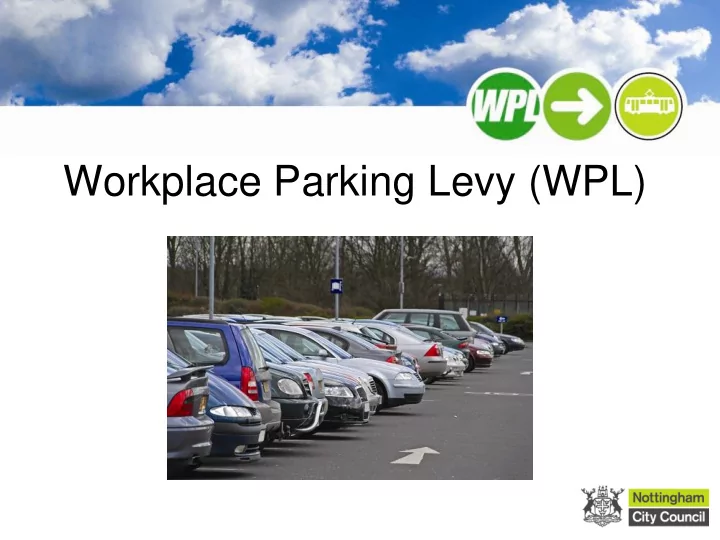
Workplace Parking Levy (WPL)

slide-2
SLIDE 2

Click to edit Master title style

2

Legislation and Process

  • Transport Act 2000 & WPL Regulations
  • Local Traffic Authorities
  • Must be “desirable for directly or indirectly facilitating the

achievement of local transport policies”

  • Net proceeds ring-fenced for transport policies
slide-3
SLIDE 3

Click to edit Master title style

3

  • Congestion costs Nottingham £160m a

year

  • 70% of peak period congestion is

commuters Solutions for the future:

  • Provide attractive alternatives to the car
  • Continue to develop high quality public

transport

  • Protect the city’s commerce and inward

investment

  • Improve the city’s environment and

sustainability

Congestion

slide-4
SLIDE 4

Click to edit Master title style

4

We looked at other funding options such as:

  • Core business rate retention
  • Increasing council taxes
  • Sale of assets
  • Lottery funding
  • European grants
  • Local Developer contributions
  • Road User Charging

Alternative funding options

slide-5
SLIDE 5

Click to edit Master title style

5

The thinking behind the scheme

  • The most serious congestion

problems in many towns and cities are associated with peak period commuting

  • The principal aim of the levy is to

provide an incentive to employers to discourage car commuting and use alternative modes of transport (including car-sharing)

  • This is achieved by imposing a

levy on employers relating to the amount of liable workplace parking places they provide.

slide-6
SLIDE 6

Click to edit Master title style

6

  • The WPL is a charge made on the

maximum number of liable workplace parking places provided by an employer

  • The WPL applies to all employers within

the Nottingham City Council administrative area

  • It is a charge on the employer, not the

employee

  • It is up to the employer whether or not to

reclaim some/all of the charge from their employees.

How does it work?

slide-7
SLIDE 7

Click to edit Master title style

7

100% discount:

  • Employers with 10 or fewer

workplace parking places

  • Emergency services
  • NHS frontline services
  • Places for Disabled Blue Badge

Holders Exemptions:

  • Customer places
  • Fleet vehicle places
  • Loading/unloading
  • Motorcycles etc.

How does it work?

slide-8
SLIDE 8

Click to edit Master title style

8

Revenue generation

  • The charge started on

1st April 2012 at £288 per parking place and is £402 for the 18/19 year

  • All funds generated are ring-

fenced by law for investment in Local Transport Plan

  • bjectives
slide-9
SLIDE 9

Click to edit Master title style

9

Public transport improvements

  • Extended the tram network

(NET Phase Two)

  • Redevelopment of Nottingham

Railway Station into a 21st century transport and business Hub

  • Maintaining and improving the

city’s Link bus service which serve some of the city’s key employment sites, hospitals and universities

slide-10
SLIDE 10

Click to edit Master title style

10

Economic and social benefits

Serves two of the three biggest employers in Greater Nottingham – The University of Nottingham and the Queens Medical Centre Provides access to around 1270 workplaces, to which around 55,000 employees commute Serves 20 of the 30 largest employers in Greater Nottingham which will be within 800m of a tram stop – focus on High Tech investment Generates long term employment growth of up to 8,000 jobs – boosts local economy by 300m.

slide-11
SLIDE 11

Click to edit Master title style

11

Performance

  • 100% compliance of liable employers

since year 1

  • >£53m revenue generated in first 6 years
  • >99.9% revenue collected
  • No Penalty Charge Notices Issued –

compliance focus

slide-12
SLIDE 12

Click to edit Master title style

12

Impacts

  • Approximately 3,500 employers hold a WPL licence
  • Less than 500 employers are liable for a WPL charge
  • The WPL scheme (charge) will have a relatively

modest impact on congestion

slide-13
SLIDE 13

Click to edit Master title style

13

Business support

A range of ongoing business support measures are available to employers and employees, these include:

  • Travel planning and smarter choices
  • Public transport and personal journey planning support
  • Car park management
  • Traffic management support
  • Parking management support grants available
  • Cycling infrastructure support grants available
slide-14
SLIDE 14

Click to edit Master title style

14

Academic Evaluation

  • Academic evaluation of the impacts of the WPL in partnership with

Loughborough University and with oversight from the Dept of Transport

  • Positive indicators
  • Since NET Phase Two began operating in August 2015 already

30% of users of the 2 new tram lines are former car users or are using park & ride.

  • Evaluation update: https://dspace.lboro.ac.uk/dspace-

jspui/bitstream/2134/26052/1/Thesis-2017-Dale.pdf

slide-15
SLIDE 15

Click to edit Master title style

15

Key Changes to Employer Behaviour Due to the WPL

  • A fall in the supply of Workplace Parking Places:

– Liable Workplace Parking Places fall by 17.5% prior to introduction – Liable places have continued to decline to 75% of their 2010 levels

  • In 2016 the cost of 53% of all liable workplace parking places were

passed on the employees by the liable employers.

  • The number of employers with Workplace Travel Plans has doubled

since the introduction of the WPL.

slide-16
SLIDE 16

Click to edit Master title style

16

Summary: Impact on Congestion

  • Congestion increased less in Nottingham (2010 -2015)

than in 3 out of 4 of the comparator cities

  • PT/Cycle Mode Share and Bus Patronage has increased

since 2010.

  • Time series analysis shows that the WPL has had a

statistically significant impact on congestion

  • Survey of 2000 commuters indicated that the outputs

from the WPL are important reasons for commuters switching away from the car.

  • Evidence that economic/population growth and

supressed demand for travel by car are offsetting this effect

slide-17
SLIDE 17

Click to edit Master title style

17

Summary: Impact on Inward Investment and Wider Economic Impact

  • An increase in Inward Investment indicators and

strong growth in jobs compared to other cities indicates that the WPL has not damaged inward investment.

  • Case study evidence suggests that the improved

public transport options and enhanced image act as an attractor to inward investors.

  • Long term strategy – too soon for full impacts
slide-18
SLIDE 18

Click to edit Master title style

18

Award Winning

Judges Quote: “Nottingham City Council is a sustainable transport exemplar and on a par with top European cities like Berlin and Vienna. It has achieved full public transport integration and brought in a unique Workplace Parking Levy and, in doing so, has succeeded in changing behaviour as well as transforming parts of the city into quieter, less polluted zones.”

slide-19
SLIDE 19

Click to edit Master title style

19

The Nottingham City Model

Nottingham's WPL

Quicker

Cheaper

Less risk