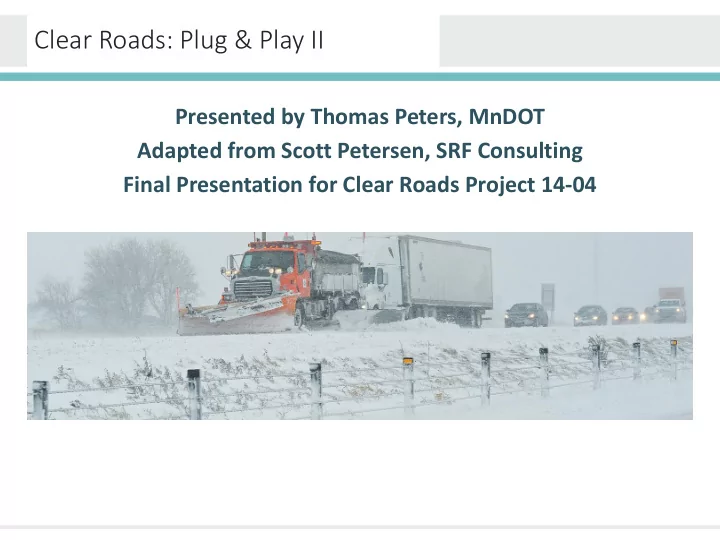
Clear Roads: Plug & Play II Presented by Thomas Peters, MnDOT - - PowerPoint PPT Presentation

clear roads plug play ii
SMART_READER_LITE
LIVE PREVIEW

Clear Roads: Plug & Play II Presented by Thomas Peters, MnDOT - - PowerPoint PPT Presentation

Clear Roads: Plug & Play II Presented by Thomas Peters, MnDOT Adapted from Scott Petersen, SRF Consulting Final Presentation for Clear Roads Project 14-04 Presentation Overview Description of Need Literature Review Agency Survey


slide-1
SLIDE 1

Clear Roads: Plug & Play II

Presented by Thomas Peters, MnDOT Adapted from Scott Petersen, SRF Consulting Final Presentation for Clear Roads Project 14-04

slide-2
SLIDE 2

Presentation Overview

  • Description of Need
  • Literature Review
  • Agency Survey Results
  • Industry Survey Results
  • Conclusion/Recommendations
slide-3
SLIDE 3

Description of Need

  • Agencies need a standardized way to communicate with the

plow fleet

  • Current software is generally proprietary and limits agency

and equipment interoperability

slide-4
SLIDE 4

Literature Review

Communication Diagram Cellular Radio Link Wi-Fi

slide-5
SLIDE 5

Literature Review

DOTs commonly use AVL/GPS systems for:

  • Snow Control Efficiency
  • Vehicle Routing Efficiency
  • Vehicle Tracking in Remote Areas
  • Recording Vehicle Usage History
  • Obtaining Real-time Road Conditions
  • Measuring Bed Weight and Material Usage
  • Capturing Roadway Images

Venner, M., GPS/AVL Technologies in Use at State DOTs. 2011.

slide-6
SLIDE 6

Literature Review

Example Protocol

Source: Edelstein, J. Message Syntax Summary and Data Dictionary. 2013.

slide-7
SLIDE 7

Communications Schematic

Spreader Controller Communications Office/Head End System Other Plug and Play Devices AVL Positioning Data Management Controller

On-Vehicle Devices

Non-Plug and Play Devices

slide-8
SLIDE 8

Agency Survey Results Vehicle Data Types

slide-9
SLIDE 9

Agency Survey Results Spreader Data Types

slide-10
SLIDE 10

Agency Survey Results Other Data Types

slide-11
SLIDE 11

Industry Survey

  • A survey was sent to freight industry representatives to learn about their

methods for communicating information between freight trucks and management systems.

  • The freight industry generally uses proprietary “cloud-based” network
  • perations centers to receive data from trucks.
slide-12
SLIDE 12

Industry Survey Results

  • Freight data is generally more basic than the needs identified by the

agencies:

  • Vehicle information directly accessible from the CAN bus
  • Location data
  • Driver and load data
slide-13
SLIDE 13

Industry Survey Results

  • Primarily two off-the-shelf proprietary vehicle information systems are

used by the large freight companies:

  • PeopleNet
  • Qualcomm’s Omnitracs
  • Some large freight companies have custom proprietary systems.
slide-14
SLIDE 14

Industry Survey Results

  • It is generally been considered to be in

the public’s interest to invest in open systems that encourage cooperation between vendors.

  • The needs of the winter maintenance

community appear to be more extensive than those of the freight industry.

Solutions developed for the freight industry do not currently meet the needs found during the agency survey

slide-15
SLIDE 15

Conclusion/Recommendations

Plug and Play should be a family of standards

Snow plows have disparate sources of data that do not interoperate. Future systems and standards are being currently developed and implemented. A new master protocol that carries all data types is not feasible and therefore a family of standards is recommended.

slide-16
SLIDE 16

Conclusion/Recommendations

Plug and Play Family of Standards

  • Plug and Play Clear Roads Universal In-Cab

Performance Specifications: Contains protocols for interconnecting AVL and spreader controller devices

  • NTCIP 1204: Contains many environmental

conditions as well as location

  • J2735 and J2945: Dedicated Short Range

Communications

  • MDSS protocols: Convey MDSS information

to/from the driver interface and the head end system

  • Future protocols that meet the needs of the

road/weather community

slide-17
SLIDE 17

Conclusion/Recommendations

FHWA Role

  • As automotive industry

communication standards are developed, FHWA will encourage them to go through the systems engineering process including requirements definition and to make sure the road/weather parameters are not overlooked.

State Procurement Role

  • As states develop procurement

documentation, encourage the industry to meet standards/protocols.

  • States need to develop

boilerplate procurement language that will facilitate the transition to Plug and Play standards.

slide-18
SLIDE 18

Contact

  • Plug and Play Phase II –

Clear Roads Project 14-04

  • Subcommittee Lead:

Allen Williams, Virginia DOT

  • Clear Roads Projects

Manager: Greg Waidley, Clear Roads

  • Principal Investigator:

Scott Petersen, SRF Consulting Group