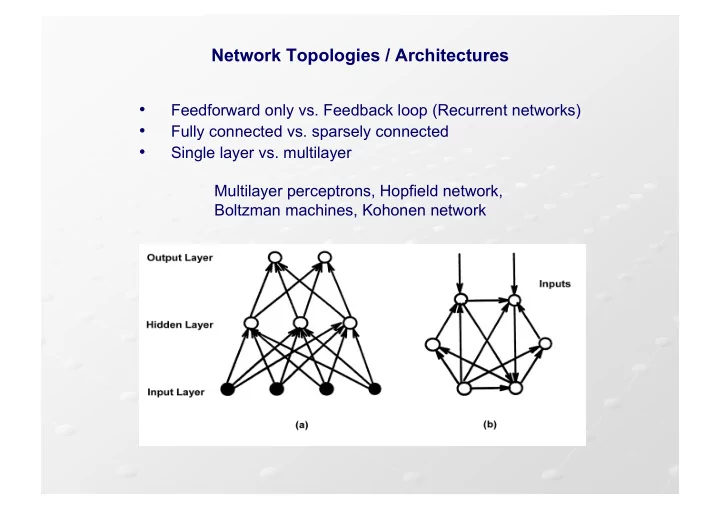
SLIDE 1 Network Topologies / Architectures
- Feedforward only vs. Feedback loop (Recurrent networks)
- Fully connected vs. sparsely connected
- Single layer vs. multilayer
Multilayer perceptrons, Hopfield network, Boltzman machines, Kohonen network
(a) A feedforward network and (b) a recurrent network
SLIDE 2
Classification Problems Given : 1) some “features” ( ) 2) some “classes” ( ) Problem : To classify an “object” according to its features
SLIDE 3 Example # 1
To classify an “object” as :
= “ watermelon ” = “ apple ” = “ orange ” According to the following features : = “ weight ” = “ color ” = “ size ” Example : weight = 80g color = green size = 10 cm³
“ apple ”
SLIDE 4 Example # 2
Problem : Establish whether a patient got the flu
{ “ flu ” , “ non-flu ” }
: Body temperature : Headache ? (yes / no) : Throat is red ? (yes / no / medium) :
SLIDE 5
Example # 3
Classes = { 0 , 1 } Features = x , y : both taking value in [ 0 , +∞ [ Idea : Geometric Representation
SLIDE 6
Neural Networks for Classification
A neural network can be used as a classification device . Input ≡ features values Output ≡ class labels Example : 3 features , 2 classes
SLIDE 7
Thresholds
We can get rid of the thresholds associated to neurons by adding an extra unit permanently clamped at -1 . In so doing, thresholds become weights and can be adaptively adjusted during learning.
SLIDE 8 Simple Perceptrons
A network consisting of one layer of M&P neurons connected in a feedforward way (i.e. no lateral or feedback connections).
- Capable of “learning” from examples (Rosenblatt)
- They suffer from serious computational limitations (Minsky and Papert, 1969)
SLIDE 9
Decision Regions
It’s an area wherein all examples of one class fall . Examples :
SLIDE 10
Linear Separability
A classification problem is said to be linearly separable if the decision regions can be separated by a hyperplane . Example : AND
X Y X AND Y 1 1 1 1 1
SLIDE 11
Limitations of Perceptrons
It has been shown that perceptrons can only solve linearly separable problems (Minsky and Papert , 1969) . Example : XOR (exclusive OR)
X Y X XOR Y 1 1 1 1 1 1
SLIDE 12
A View of the Role of Units
SLIDE 13 Convergence of Learning Algorithms
- If the problem is linearly separable, then the learning rule converges to an
appropriate set of weights in a finite number of steps (Nilsson 1965)
- In practice, one does not know whether the problem is linearly separable or not.
So decrease η with the number of iterations, letting η 0 . The convergence so obtained is artificial and does not necessarily yield a valid weight vector that will classify all patterns correctly
- Some variations of the learning algorithm, e.g. Pocket algorithm, (Gallant, 1986)
SLIDE 14 Multi–Layer Feedforward Networks
- Limitation of simple perceptron: can implement only linearly separable functions
- Add “ hidden ” layers between the input and output layer. A network with just one
hidden layer can represent any Boolean functions including XOR
- Power of multilayer networks was known long ago, but algorithms for training
- r learning, e.g. back-propagation method, became available only recently
(invented several times, popularized in 1986)
- Universal approximation power: Two-layer network can approximate any smooth
function (Cybenko, 1989; Funahashi, 1989; Hornik, et al.., 1989)