Classical/frequentist approach - z H 1 : NZT improves IQ Null: H 0 - - PDF document

classical frequentist approach z
SMART_READER_LITE
LIVE PREVIEW

Classical/frequentist approach - z H 1 : NZT improves IQ Null: H 0 - - PDF document

Classical frequentist statistical tests Statistical Rethinking, Richard McElreath Classical/frequentist approach - z H 1 : NZT improves IQ Null: H 0 : it does nothing In the general population, IQ is known to be distributed


slide-1
SLIDE 1

Statistical Rethinking, Richard McElreath

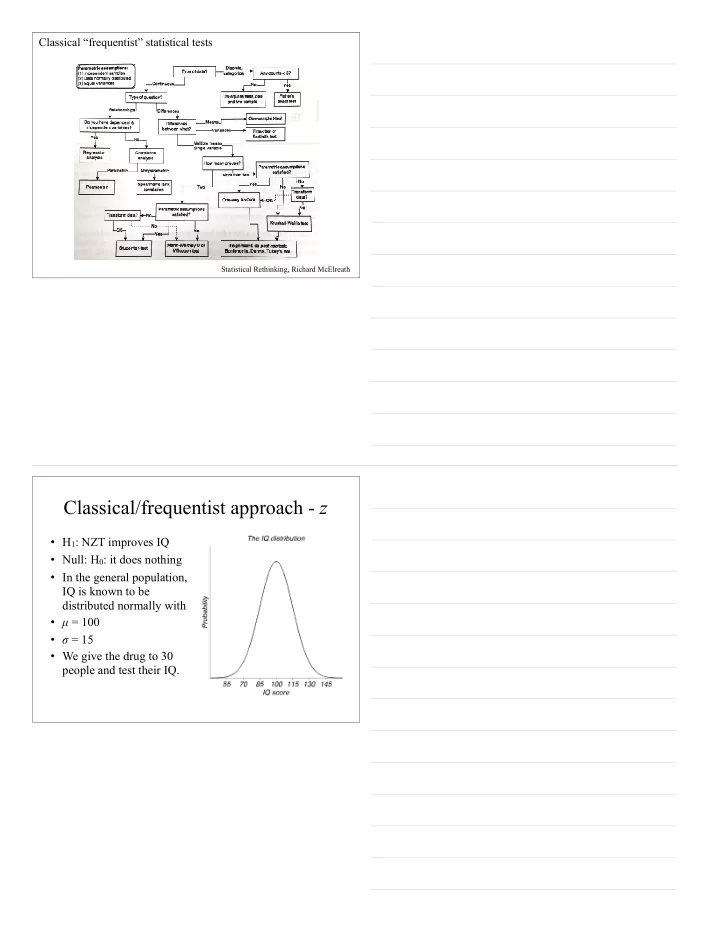
Classical “frequentist” statistical tests

Classical/frequentist approach - z

  • H1: NZT improves IQ
  • Null: H0: it does nothing
  • In the general population,

IQ is known to be distributed normally with

  • µ = 100
  • σ = 15
  • We give the drug to 30

people and test their IQ.

slide-2
SLIDE 2
  • µ = 100 (Population mean)
  • σ = 15 (Population standard deviation)
  • N = 30 (Sample contains scores from

30 participants)

  • x = 108.3 (Sample mean)
  • z = (x – µ)/SE = (108.3-100)/SE

(Standardized score)

  • SE = σ / √N = 15/√30 = 2.74
  • Error bar/CI: ±2 SE
  • z = 8.3/2.74 = 3.03
  • p = 0.0012
  • Significant?
  • One- vs. two-tailed test

The z-test

  • µ = 100 (Population mean)
  • σ = 15 (Population standard

deviation)

  • N = 30 (Sample contains scores from

30 participants)

  • x = 104.2 (Sample mean)
  • z = (x – µ)/SE = (104.2-100)/SE
  • SE = σ / √N = 15/√30 = 2.74
  • z = 4.2/2.74 = 1.53
  • p = 0.061
  • Significant?

What if the measured effect of NZT had been half that?

slide-3
SLIDE 3

Significance levels

  • Are denoted by the Greek letter α.
  • In principle, we can pick anything that we

consider unlikely.

  • In practice, the consensus is that a level of 0.05 or

1 in 20 is considered as unlikely enough to reject H0 and accept the alternative.

  • A level of 0.01 or 1 in 100 is considered “highly

significant” or really unlikely.

Does NZT improve IQ scores or not?

Reality Yes No Significant? Yes No

Correct Type I error α-error False alarm Correct Type II error β-error Miss

slide-4
SLIDE 4

Test statistic

  • We calculate how far the observed value of the

sample average is away from its expected value.

  • In units of standard error.
  • In this case, the test statistic is
  • Compare to a distribution, in this case z or N(0,1)

z = x − µ SE = x − µ σ / N

Common misconceptions

Is “Statistically significant” a synonym for:

  • Substantial
  • Important
  • Big
  • Real

Does statistical significance gives the

  • probability that the null hypothesis is true
  • probability that the null hypothesis is false
  • probability that the alternative hypothesis is true
  • probability that the alternative hypothesis is false

Meaning of p-value. Meaning of CI.

slide-5
SLIDE 5

Student’s t-test

  • σ not assumed known
  • Use


  • Why N-1? s is unbiased (unlike ML version), i.e.,

  • Test statistic is


  • Compare to t distribution for CIs and NHST
  • “Degrees of freedom” reduced by 1 to N-1

s2 = xi − x

( )

2 i=1 N

N −1

E(s2) = σ 2 t = x − µ0 s / N

The t distribution approaches the normal distribution for large N

x (z or t)

Probability

slide-6
SLIDE 6

The z-test for binomial data

  • Is the coin fair?
  • Lean on central limit theorem
  • Sample is n heads out of m tosses
  • Sample mean:
  • H0: p = 0.5
  • Binomial variability (one toss):
  • Test statistic:


  • Compare to z (standard normal)
  • For CI, use

ˆ p = n / m

σ = pq, where q = 1− p

z = ˆ p − p0 p0q0 / m

±zα /2 ˆ p ˆ q / m

Many varieties of frequentist univariate tests

  • goodness of fit
  • test of independence
  • test a variance using
  • F to compare variances (as a ratio)
  • Nonparametric tests (e.g., sign, rank-order, etc.)

χ 2 χ 2 χ

2

slide-7
SLIDE 7

The Gaussian

  • parameterized by mean and stdev (position / width)
  • joint density of two indep Gaussian RVs is circular! [easy]
  • product of two Gaussian dists is Gaussian! [easy]
  • conditionals of a Gaussian are Gaussian! [easy]
  • sum of Gaussian RVs is Gaussian! [moderate]
  • all marginals of a Gaussian are Gaussian! [moderate]
  • central limit theorem: sum of many RVs is Gaussian! [hard]
  • most random (max entropy) density with this variance! [moderate]

true mean: [0 0.8] true cov: [1.0 -0.25

  • 0.25 0.3]

sample mean: [-0.05 0.83] sample cov: [0.95 -0.23

  • 0.23 0.29]

700 samples Measurement (sampling) Inference true density

slide-8
SLIDE 8

Correlation: summary of data cloud shape

+ + -

  • Correlation and regression

TLS (largest eigenvector) Least-squares regression

“Regression to the mean”

slide-9
SLIDE 9

−5 5 −5 5 corr=−0.80 −5 5 −5 5 corr=−0.40 −5 5 −5 5 corr=0.00 −5 5 −5 5 corr=0.40 −5 5 −5 5 corr=0.80

Correlation and regression

Statistical independence a stronger assumption uncorrelatedness

⇒ All independent variables are uncorrelated ⇒ Not all uncorrelated variables are independent:

r =

Independence implies uncorrelated, but uncorrelated doesn’t imply independent!

slide-10
SLIDE 10

https://www.autodeskresearch.com/publications/samestats

More extreme examples !

Correlation between variables does not explain their relationship

slide-11
SLIDE 11

Null Hypothesis: Distribution of normalized dot product of pairs of Gaussian vectors in N dimensions:

N=3 N=8

−1 −0.5 0.5 1 0.2 0.4 0.6 0.8 1 1.2 −1 −0.5 0.5 1 0.2 0.4 0.6 0.8 1 1.2 −1 −0.5 0.5 1 0.5 1 1.5

N=4 N=16

−1 −0.5 0.5 1 0.02 0.04 0.06 0.08 −1 −0.5 0.5 1 0.01 0.02 0.03 0.04 0.05 −1 −0.5 0.5 1 0.005 0.01 0.015 0.02 0.025

N=32 N=64

Correlation in N dimensions

(1 − d2)

N−3 2

sin(theta)^(N-2)

1 2 3 0.5 1 1.5 2 1 2 3 0.5 1 1.5 1 2 3 0.2 0.4 0.6 0.8 1 1 2 3 0.2 0.4 0.6 0.8 1 2 3 0.2 0.4 0.6 0.8 1 2 3 0.2 0.4 0.6 0.8 1

Distribution of angles of pairs of Gaussian vectors

2D 3D 4D 6D 10D 18D

slide-12
SLIDE 12 Sociology doctorates awarded (US) Worldwide non-commercial space launches

Worldwide non-commercial space launches

correlates with

Sociology doctorates awarded (US)

Sociology doctorates awarded (US) Worldwide non-commercial space launches 1997 1998 1999 2000 2001 2002 2003 2004 2005 2006 2007 2008 2009 1997 1998 1999 2000 2001 2002 2003 2004 2005 2006 2007 2008 2009 500 Degrees awarded 550 Degrees awarded 600 Degrees awarded 650 Degrees awarded 700 Degrees awarded 40 Launches 50 Launches 30 Launches 60 Launches tylervigen.com Number of people killed by venomous spiders Spelling Bee winning word

Letters in Winning Word of Scripps National Spelling Bee

correlates with

Number of people killed by venomous spiders

Number of people killed by venomous spiders Spelling Bee winning word 1999 2000 2001 2002 2003 2004 2005 2006 2007 2008 2009 1999 2000 2001 2002 2003 2004 2005 2006 2007 2008 2009 0 deaths 5 deaths 10 deaths 15 deaths 5 letters 10 letters 15 letters tylervigen.com Bedsheet tanglings Cheese consumed

Per capita cheese consumption

correlates with

Number of people who died by becoming tangled in their bedsheets

Bedsheet tanglings Cheese consumed 2000 2001 2002 2003 2004 2005 2006 2007 2008 2009 2000 2001 2002 2003 2004 2005 2006 2007 2008 2009 200 deaths 400 deaths 600 deaths 800 deaths 28.5lbs 30lbs 31.5lbs 33lbs tylervigen.com

Correlation does not imply causation

http://www.tylervigen.com/spurious-correlations

Correlation does not imply causation

  • Beware selection bias
  • Correlation does not provide a direction for causality.

For that, you need additional (temporal) information.

  • More generally, correlations are often a result of

hidden (unmeasured, uncontrolled) variables…

Example: conditional independence:

p(A,B | H) = p(A | H) p(B | H)

A B H [on board: In Gaussian case, connections are explicit in the Precision Matrix]

+ +
slide-13
SLIDE 13

Another example: Simpson’s paradox

+

  • A

B H +

Milton Friedman’s Thermostat

O = outside temperature (assumed cold) I = inside temperature (ideally, constant) E = energy used for heating Statistical observations:

  • O and I uncorrelated
  • I and E uncorrelated
  • O and E anti-correlated

Some nonsensical conclusions:

  • O and E have no effect on I, so shut off heater to save money!
  • I is irrelevant, and can be ignored. Increases in E cause decreases in O.
  • O

I E

+ +

  • O

I E

True interactions: Statistical interactions, P=C-1:

Statistical summary cannot replace scientific reasoning/experiments!

slide-14
SLIDE 14

Summary: misinterpretations of Correlation

  • Correlation => dependency, but non-correlation

does not imply independence

  • Correlation does not imply data lie on a line

(subspace), with noise perturbations

  • Correlation does not imply causation (temporally, or

by direct influence)

  • Correlation is only a descriptive statistic, and cannot

replace the need for scientific reasoning/experiment

  • Optimization failures (e.g., local minima)


[prefer convex objective, test with simulations]

  • Overfitting [use cross-validation to select

complexity, or to control regularization]

  • Experimental variability (due to finite noisy

measurements) [use math/distributional assumptions, or simulations, or bootstrapping]

  • Model failures

Taxonomy of model-fitting errors

slide-15
SLIDE 15

statAnMod - 9/12/07 - E.P. Simoncelli

Optimization...

Smooth (C2) Convex Quadratic Closed-form, and unique Iterative descent, (possible local minima) Iterative descent, unique Heuristics, exhaustive search, (pain & suffering)

Bootstrapping

  • “The Baron had fallen to the bottom of a deep lake.

Just when it looked like all was lost, he thought to pick himself up by his own bootstraps” 


[Adventures of Baron von Munchausen, by Rudolph Erich Raspe]

  • A (re)sampling method for computing estimator

distribution (incl. stdev error bars or confidence intervals)

  • Idea: instead of running experiment multiple times,

resample (with replacement) from the existing

  • data. Compute an estimate from each of these

“bootstrapped” data sets.

slide-16
SLIDE 16

[Efron & Tibshirani ’98] [New York Times, 27 Jan 1987] Histogram of bootstrap estimates:

0.2 0.4 0.6 0.8 1 200 400 600 800 1000 1200 1400 Boostrapped Original 95% conf

=> with 95% confidence,

[Efron & Tibshirani ’98]

slide-17
SLIDE 17

Cross-validation

(1) Randomly partition data into a “training” set, and a “test” set. (2) Fit model to training set. Measure error on test set. (3) Repeat (many times) (4) Choose model that minimizes the cross-validated (test) error

A resampling method for constraining a model. Widely used to identify/avoid over-fitting.

5 10 15 20 10

−2

10 10

2

10

4

10

6

polynomial degree MSE fit error x−val error true degree true error

train error test error

Using cross-validation to select the degree of a polynomial model:

slide-18
SLIDE 18

arg min

~

  • ||~

y − X~ ||2 arg min

~

  • ||~

y − X~ ||2 + ||~ ||2

Ridge regression

(a.k.a. Tikhonov regularization)

Equivalent formulation: negative log posterior, assuming Gaussian likelihood & prior Ordinary least squares regression: “Regularized” least squares regression: Choose lambda by cross-validation

0.2 0.4 0.6 0.8 1 −2 −1 1 2 3 4 5 data LS reg Ridge reg

7th-order polynomial regression:

Fix notation OLS, Ridge. Redo figure: align ellipse with axes

5 10 15 20 25 0.0 0.2 0.4 0.6 0.8 λ Linear MSE Ridge MSE Ridge Bias^2 Ridge Var

Linear regression: Squared bias ≈ 0.006 Variance ≈ 0.627

  • Pred. error ≈ 1 + 0.006 + 0.627
  • Pred. error ≈ 1.633

Ridge regression, at its best: Squared bias ≈ 0.077 Variance ≈ 0.403

  • Pred. error ≈ 1 + 0.077 + 0.403
  • Pred. error ≈ 1.48

from http://www.stat.cmu.edu/~ryantibs/datamining/

slide-19
SLIDE 19

arg min

~

  • ||~

y − X~ ||2 + X

k

|k|

L1 regularization

(a.k.a. least absolute shrinkage and selection operator - LASSO)

L1 norm (still convex)

Using an absolute error regularization term promotes binary selection of regressors:

modify figure: align ellipse with axes, to show that some betas are turned
  • ff