Bayesian Methods for Parameter Estimation Bayesian vs Frequentist - - PowerPoint PPT Presentation

bayesian methods for parameter estimation bayesian vs
SMART_READER_LITE
LIVE PREVIEW

Bayesian Methods for Parameter Estimation Bayesian vs Frequentist - - PowerPoint PPT Presentation

Bayesian Methods for Parameter Estimation Bayesian vs Frequentist Inference Frequentist Chris Williams, Division of Informatics Assumes that there is an unknown but fixed parameter University of Edinburgh Estimates with some


slide-1
SLIDE 1

Bayesian Methods for Parameter Estimation

Chris Williams, Division of Informatics University of Edinburgh Overview

  • Introduction to Bayesian Statistics: Learning a Probability
  • Learning the mean of a Gaussian
  • Readings: Tipping chapter 8; Jordan ch 5; Heckerman tutorial section 2

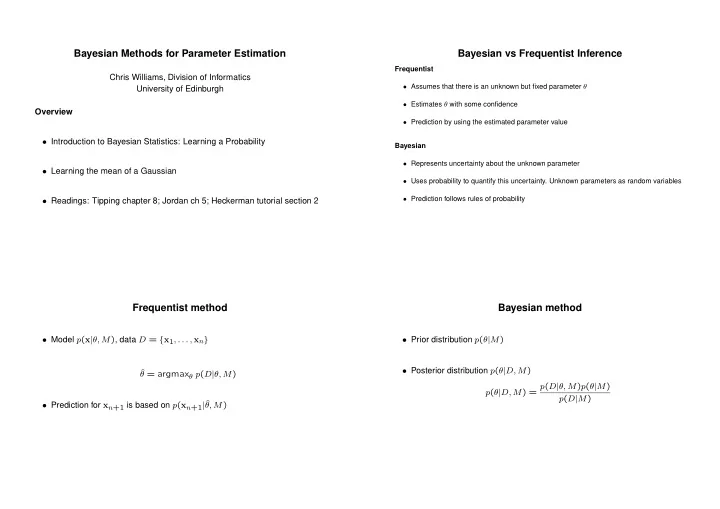
Bayesian vs Frequentist Inference

Frequentist

  • Assumes that there is an unknown but fixed parameter θ
  • Estimates θ with some confidence
  • Prediction by using the estimated parameter value

Bayesian

  • Represents uncertainty about the unknown parameter
  • Uses probability to quantify this uncertainty. Unknown parameters as random variables
  • Prediction follows rules of probability

Frequentist method

  • Model p(x|θ, M), data D = {x1, . . . , xn}

ˆ θ = argmaxθ p(D|θ, M)

  • Prediction for xn+1 is based on p(xn+1|ˆ

θ, M)

Bayesian method

  • Prior distribution p(θ|M)
  • Posterior distribution p(θ|D, M)

p(θ|D, M) = p(D|θ, M)p(θ|M) p(D|M)

slide-2
SLIDE 2
  • Making predictions

p(xn+1|D, M) =

  • p(xn+1, θ|D, M) dθ

=

  • p(xn+1|θ, D, M)p(θ|D, M) dθ

=

  • p(xn+1|θ, M)p(θ|D, M) dθ

Interpretation: average of predictions p(xn+1|θ, M) weighted by p(θ|D, M)

  • Marginal likelihood (important for model comparison)

p(D|M) =

  • P(D|θ, M)P(θ|M) dθ

Bayes, MAP and Maximum Likelihood

p(xn+1|D, M) =

  • p(xn+1|θ, M)p(θ|D, M) dθ
  • Maximum a posteriori value of θ

θMAP = argmaxθ p(θ|D, M) Note: not invariant to reparameterization (cf ML estimator)

  • If posterior is sharply peaked about the most probable value θMAP then

p(xn+1|D, M) ≃ p(xn+1|θMAP, M)

  • In the limit n → ∞, θMAP converges to ˆ

θ (as long as p(ˆ θ) = 0)

  • Bayesian approach most effective when data is limited, n is small

Learning probabilities: thumbtack example

Frequentist Approach

  • The probability of heads θ is un-

known

  • Given iid data, estimate θ using

an estimator with good proper- ties (e.g. ML estimator)

heads tails Likelihood

  • Likelihood for a sequence of heads and tails

p(hhth . . . tth|θ) = θnh(1 − θ)nt

  • MLE

ˆ θ = nh nh + nt

slide-3
SLIDE 3

Learning probabilities: thumbtack example

Bayesian Approach: (a) the prior

  • Prior density p(θ), use beta distribution

p(θ) = Beta(αh, αt) ∝ θαh−1(1 − θ)αt−1 for αh, αt > 0

  • Properties of the beta distribution

E[θ] =

  • θp(θ) =

αh αh + αt

Examples of the Beta distribution

0.1 0.2 0.3 0.4 0.5 0.6 0.7 0.8 0.9 1 0.5 1 1.5 2 2.5 3 3.5 0.1 0.2 0.3 0.4 0.5 0.6 0.7 0.8 0.9 1 0.2 0.4 0.6 0.8 1 1.2 1.4 1.6 1.8 2

Beta(0.5,0.5) Beta(1,1)

0.1 0.2 0.3 0.4 0.5 0.6 0.7 0.8 0.9 1 0.2 0.4 0.6 0.8 1 1.2 1.4 1.6 1.8 0.1 0.2 0.3 0.4 0.5 0.6 0.7 0.8 0.9 1 0.5 1 1.5 2 2.5 3 3.5 4 4.5

Beta(3,2) Beta(15,10) Bayesian Approach: (b) the posterior p(θ|D) ∝ p(θ)p(D|θ) ∝ θαh−1(1 − θ)αt−1θnh(1 − θ)nt ∝ θαh+nh−1(1 − θ)αt+nt−1

  • Posterior is also a Beta distribution ∼ Beta(αh + nh, αt + nt)
  • The Beta prior is conjugate to the binomial likelihood (i.e. they have the

same parametric form)

  • αh and αt can be thought of as imaginary counts, with α = αh + αt as

the equivalent sample size Bayesian Approach: (c) making predictions

x x x θ

1 2 n

xn+1

p(Xn+1 = heads|D, M) =

  • p(Xn+1 = heads|θ)p(θ|D, M) dθ

=

  • θ Beta((αh + nh, αt + nt) dθ

= αh + nh α + n

slide-4
SLIDE 4

Beyond Conjugate Priors

  • The thumbtack came from a magic shop → a mixture prior

p(θ) = 0.4Beta(20, 0.5) + 0.2Beta(2, 2) + 0.4Beta(0.5, 20)

Generalization to multinomial variables

  • Dirichlet prior

p(θ1, . . . , θr) = Dir(α1, . . . , αr) ∝

r

  • i=1

θαi−1

i

with

  • i

θi = 1, αi > 0

  • αi’s are imaginary counts, α =

i αi is equivalent sample size

  • Properties

E(θi) = αi α

  • Dirichlet distribution is conjugate to the multinomial likelihood
  • Posterior distribution

p(θ|n1, . . . , nr) ∝

r

  • i=1

θαi+ni−1

i

  • Marginal likelihood

p(D|M) = Γ(α) Γ(α + n)

r

  • i=1

Γ(αi + ni) Γ(αi)

slide-5
SLIDE 5

Inferring the mean of a Gaussian

  • Likelihood

p(x|µ) ∼ N(µ, σ2)

  • Prior

p(µ) ∼ N(µ0, σ2

0)

  • Given data D = {x1, . . . , xn}, what is p(µ|D)?

p(µ|D) ∼ N(µn, σ2

n)

with x = 1 n

n

  • i=1

xi µn = nσ2 nσ2

0 + σ2x +

σ2 nσ2

0 + σ2µ0

1 σ2

n

= n σ2 + 1 σ2

  • See Tipping §8.3.1 for details

Comparing Bayesian and Frequentist approaches

  • Frequentist: fi x θ, consider all possible data sets generated with θ fi xed
  • Bayesian: fi x D, consider all possible values of θ
  • One view is that Bayesian and Frequentist approaches have different

defi nitions of what it means to be a good estimator