SLIDE 4 4CSLL5 Parameter Estimation (Supervised and Unsupervised) Unsupervised Maximum Likelihood (re-)Estimation The EM Algorithm
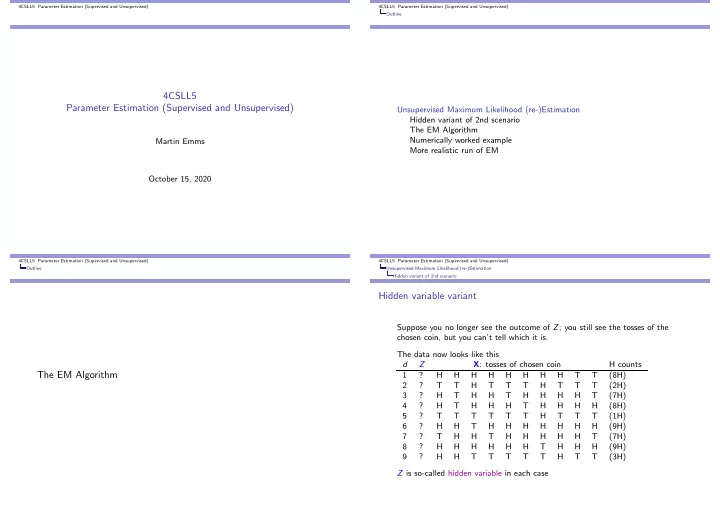
recall the observed data for our 3rd scenario, with coin-choice hidden: d Z X: tosses of chosen coin H counts 1 ? H H H H H H H H T T (8H) 2 ? T T H T T T H T T T (2H) 3 ? H T H H T H H H H T (7H) 4 ? H T H H H T H H H H (8H) 5 ? T T T T T T H T T T (1H) 6 ? H H T H H H H H H H (9H) 7 ? T H H T H H H H H T (7H) 8 ? H H H H H H T H H H (9H) 9 ? H H T T T T T H T T (3H)
4CSLL5 Parameter Estimation (Supervised and Unsupervised) Unsupervised Maximum Likelihood (re-)Estimation The EM Algorithm
E step for coin example
In the E-step you should picture each data point Xd as split into virtual population of Z = a and Z = b versions, with γd(Z) as the virtual counts 1 : X1 : (8H, 2T)
(z = b, X1) γ1(b) = 0.12 X6 : (9H, 1T)
(z = b, X6) γ6(b) = 0.08 X2 : (2H, 8T) (z = a, X2) γ2(a) = 0.34 (z = b, X2) γ2(b) = 0.66 X7 : (7H, 3T) (z = a, X7) γ7(a) = 0.83 (z = b, X7) γ7(b) = 0.17 X3 : (7H, 3T) (z = a, X3) γ3(a) = 0.83 (z = b, X3) γ3(b) = 0.17 X8 : (9H, 1T) (z = a, X8) γ8(a) = 0.92 (z = b, X8) γ8(b) = 0.08 X4 : (8H, 2T) (z = a, X4) γ4(a) = 0.88 (z = b, X4) γ4(b) = 0.12 X9 : (3H, 7T) (z = a, X9) γ9(a) = 0.45 (z = b, X9) γ9(b) = 0.55 X5 : (1H, 9T) (z = a, X5) γ5(a) = 0.25 (z = b, X5) γ5(b) = 0.75
1the γd(Z) numbers above assume θa = 0.5, θh|a = 0.4, θh|b = 0.3 4CSLL5 Parameter Estimation (Supervised and Unsupervised) Unsupervised Maximum Likelihood (re-)Estimation The EM Algorithm
Example calc of γ1(Z)
d = 1 : p(Z = a, HHHHHHHHTT) = 0.5 × (0.4)8 × (0.6)2 = 1.17965 × 10⁻⁴ d = 1 : p(Z = b, HHHHHHHHTT) = 0.5 × (0.3)8 × (0.7)2 = 1.60744 × 10⁻⁵ d = 1 : sum = 0.000134039 γ1(a) = p(Z = a, HHHHHHHHTT)
- z P(Z = z, HHHHHHHHTT) = 1.17965 × 10⁻⁴
sum = 0.880077 γ1(b) = p(Z = b, HHHHHHHHTT)
- z P(Z = z, HHHHHHHHTT) = 1.60744 × 10⁻⁵
sum = 0.119923
4CSLL5 Parameter Estimation (Supervised and Unsupervised) Unsupervised Maximum Likelihood (re-)Estimation The EM Algorithm
M step for coin example
In the M step you treat the γd(Z) values as if they were genuine counts and re-estimate parameters in the usual common-sense fashion based on relative frequencies. As a mental trick to help visualize you might consider all the preceding γd(Z) as multiplied by 100 – effectively each single d is being treated as split out into 100 virtual versions, with γd(Z) × 100 for each Z alternative the ’common-sense’ re-estimation of the parameters obtained this way represent a maximum likelihood estimate for any complete corpus that exhibits the same ratios as the obtained virtual corpus.