Frequentist Statistics and Hypothesis Testing 18.05 Spring 2018 - - PowerPoint PPT Presentation
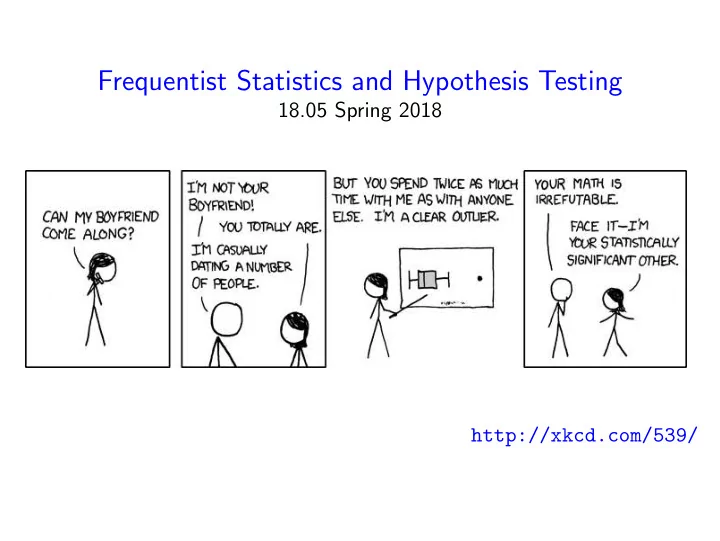
Frequentist Statistics and Hypothesis Testing 18.05 Spring 2018 http://xkcd.com/539/ Agenda Introduction to the frequentist way of life. What is a statistic? NHST ingredients; rejection regions Simple and composite hypotheses z -tests, p
Agenda
Introduction to the frequentist way of life. What is a statistic? NHST ingredients; rejection regions Simple and composite hypotheses z-tests, p-values
April 9, 2018 2 / 23
Frequentist school of statistics
Dominant school of statistics in the 20th century. p-values, t-tests, χ2-tests, confidence intervals. Defines probability as long-term frequency in a repeatable random experiment.
◮ Yes: probability a coin lands heads. ◮ Yes: probability a given treatment cures a certain disease. ◮ Yes: probability distribution for the error of a measurement.
Rejects the use of probability to quantify incomplete knowledge, measure degree of belief in hypotheses.
◮ No: prior probability for the probability an unknown coin lands heads. ◮ No: prior probability on the efficacy of a treatment for a disease. ◮ No: prior probability distribution for the unknown mean of a normal
distribution.
April 9, 2018 3 / 23
The fork in the road
Probability (mathematics) Statistics (art) P(H|D) = P(D|H)P(H) P(D) Everyone uses Bayes’ formula when the prior P(H) is known. PPosterior(H|D) = P(D|H)Pprior(H) P(D) Likelihood L(H; D) = P(D|H)
Bayesian path Frequentist path
Bayesians require a prior, so they develop one from the best information they have. Without a known prior frequen- tists draw inferences from just the likelihood function.
April 9, 2018 4 / 23
Disease screening redux: probability
The test is positive. Are you sick?
0.001 H = sick 0.999 H = healthy 0.99 D = pos. test neg. test 0.01 D = pos. test neg. test P(H) P(D | H)
The prior is known so we can use Bayes’ Theorem. P(sick | pos. test) = 0.001 · 0.99 0.001 · 0.99 + 0.999 · 0.01 ≈ 0.1
April 9, 2018 5 / 23
Disease screening redux: statistics
The test is positive. Are you sick? ?
H = sick
?
H = healthy 0.99 D = pos. test neg. test 0.01 D = pos. test neg. test P(H) P(D | H)
The prior is not known. Bayesian: use a subjective prior P(H) and Bayes’ Theorem. Frequentist: the likelihood is all we can use: P(D | H)
April 9, 2018 6 / 23
Concept question
Each day Jane arrives X hours late to class, with X ∼ uniform(0, θ), where θ is unknown. Jon models his initial belief about θ by a prior pdf f (θ). After Jane arrives x hours late to the next class, Jon computes the likelihood function φ(x|θ) and the posterior pdf f (θ|x). Which of these probability computations would the frequentist consider valid?
- 1. none
- 5. prior and posterior
- 2. prior
- 6. prior and likelihood
- 3. likelihood
- 7. likelihood and posterior
- 4. posterior
- 8. prior, likelihood and posterior.
April 9, 2018 7 / 23
Concept answer
answer: 3. likelihood Both the prior and posterior are probability distributions on the possible values of the unknown parameter θ, i.e. a distribution on hypothetical
- values. The frequentist does not consider them valid.
The likelihood φ(x|θ) is perfectly acceptable to the frequentist. It represents the probability of data from a repeatable experiment, i.e. measuring how late Jane is each day. Conditioning on θ is fine. This just fixes a model parameter θ. It doesn’t require computing probabilities of values of θ.
April 9, 2018 8 / 23
Statistics are computed from data
Working definition. A statistic is anything that can be computed from random data. A statistic cannot depend on the true value of an unknown parameter. A statistic can depend on a hypothesized value of a parameter. Examples of point statistics Data mean Data maximum (or minimum) Maximum likelihood estimate (MLE) A statistic is random since it is computed from random data. We can also get more complicated statistics like interval statistics.
April 9, 2018 9 / 23
Concept questions
Suppose x1, . . . , xn is a sample from N(µ, σ2), where µ and σ are unknown. Is each of the following a statistic?
- 1. Yes
- 2. No
- 1. The median of x1, . . . , xn.
- 2. The interval from the 0.25 quantile to the 0.75 quantile
- f N(µ, σ2).
- 3. The standardized mean
¯ x−µ σ/√n.
- 4. The set of sample values less than 1 unit from ¯
x.
April 9, 2018 10 / 23
Concept answers
- 1. Yes. The median only depends on the data x1, . . . , xn.
- 2. No. This interval depends only on the distribution parameters µ and σ.
It does not consider the data at all.
- 3. No. this depends on the values of the unknown parameters µ and σ.
- 4. Yes. ¯
x depends only on the data, so the set of values within 1 of ¯ x can all be found by working with the data.
April 9, 2018 11 / 23
NHST ingredients
Null hypothesis: H0 Alternative hypothesis: HA Test statistic: x Rejection region: reject H0 in favor of HA if x is in this region
x f(x|H0)
- 3
3 x1 x2 reject H0 reject H0 don’t reject H0
p(x|H0) or f (x|H0): null distribution
April 9, 2018 12 / 23
Choosing rejection regions
Coin with probability of heads θ. Test statistic x = the number of heads in 10 tosses. H0: ‘the coin is fair’, i.e. θ = 0.5 HA: ‘the coin is biased, i.e. θ = 0.5 Two strategies:
- 1. Choose rejection region then compute significance level.
- 2. Choose significance level then determine rejection region.
***** Everything is computed assuming H0 *****
April 9, 2018 13 / 23
Table question
Suppose we have the coin from the previous slide.
- 1. The rejection region is bordered in red, what’s the significance
level?
x p(x | H0) .05 .15 .25 3 4 5 6 7 1 2 8 9 10 x 1 2 3 4 5 6 7 8 9 10 p(x|H0) .001 .010 .044 .117 .205 .246 .205 .117 .044 .010 .001
- 2. Given significance level α = .05 find a two-sided rejection region.
April 9, 2018 14 / 23
Solution
- 1. α = 0.11
x 1 2 3 4 5 6 7 8 9 10 p(x|H0) .001 .010 .044 .117 .205 .246 .205 .117 .044 .010 .001
- 2. α = 0.05
x 1 2 3 4 5 6 7 8 9 10 p(x|H0) .001 .010 .044 .117 .205 .246 .205 .117 .044 .010 .001
April 9, 2018 15 / 23
Concept question
The null and alternate pdfs are shown on the following plot
x f(x|H0) f(x|HA) . reject H0 region non-reject H0 region R1 R2 R3 R4
The significance level of the test is given by the area of which region?
- 1. R1
- 2. R2
- 3. R3
- 4. R4
- 5. R1 + R2
- 6. R2 + R3
- 7. R2 + R3 + R4.
answer: 6. R2 + R3. This is the area under the pdf for H0 above the rejection region.
April 9, 2018 16 / 23
z-tests, p-values
Suppose we have independent normal Data: x1, . . . , xn; with unknown mean µ, known σ Hypotheses: H0: xi ∼ N(µ0, σ2) HA: Two-sided: µ = µ0, or one-sided: µ > µ0 z-value: standardized x: z = x − µ0 σ/√n Test statistic: z Null distribution: Assuming H0: z ∼ N(0, 1). p-values: Right-sided p-value: p = P(Z > z | H0) (Two-sided p-value: p = P(|Z| > z | H0)) Significance level: For p ≤ α we reject H0 in favor of HA. Note: Could have used x as test statistic and N(µ0, σ2) as the null distribution.
April 9, 2018 17 / 23
Visualization
Data follows a normal distribution N(µ, 152) where µ is unknown. H0: µ = 100 HA: µ > 100 (one-sided) Collect 9 data points: ¯ x = 112. So, z = 112 − 100 15/3 = 2.4. Can we reject H0 at significance level 0.05?
z f(z|H0) ∼ N(0, 1) z0.05 2.4 reject H0 non-reject H0 z0.05 = 1.64 α = pink + red = 0.05 p = red = 0.008
April 9, 2018 18 / 23
Board question
H0: data follows a N(5, 102) HA: data follows a N(µ, 102) where µ = 5. Test statistic: z = standardized x. Data: 64 data points with x = 6.25. Significance level set to α = 0.05. (i) Find the rejection region; draw a picture. (ii) Find the z-value; add it to your picture. (iii) Decide whether or not to reject H0 in favor of HA. (iv) Find the p-value for this data; add to your picture. (v) What’s the connection between the answers to (ii), (iii) and (iv)?
April 9, 2018 19 / 23
Solution
The null distribution f (z | H0) ∼ N(0, 1) (i) The rejection region is |z| > 1.96, i.e. 1.96 or more standard deviations from the mean. (ii) Standardizing z = x − 5 5/4 = 1.25 1.25 = 1. (iii) Do not reject since z is not in the rejection region. (iv) Use a two-sided p-value p = P(|Z| > 1) = .32.
z f(z|H0) ∼ N(0, 1) −1.96 1.96 reject H0 reject H0 non-reject H0 z0.025 = 1.96 z0.975 = −1.96 α = red = 0.05 z = 1
April 9, 2018 20 / 23
Solution continued
(v) The z-value not being in the rejection region tells us exactly the same thing as the p-value being greater than the significance, i.e., don’t reject the null hypothesis H0.
April 9, 2018 21 / 23
Board question
Two coins: probability of heads is 0.5 for C1; and 0.6 for C2. We pick one at random, flip it 8 times and get 6 heads.
- 1. H0 = ’The coin is C1’
HA = ’The coin is C2’ Do you reject H0 at the significance level α = 0.05?
- 2. H0 = ’The coin is C2’
HA = ’The coin is C1’ Do you reject H0 at the significance level α = 0.05?
- 3. Do your answers to (1) and (2) seem paradoxical?
Here are binomial(8,θ) tables for θ = 0.5 and 0.6.
k 1 2 3 4 5 6 7 8 p(k|θ = 0.5) .004 .031 .109 .219 .273 .219 .109 .031 .004 p(k|θ = 0.6) .001 .008 .041 .124 .232 .279 .209 .090 .017
April 9, 2018 22 / 23
Solution
- 1. Since 0.6 > 0.5 we use a right-sided rejection region.
Under H0 the probability of heads is 0.5. Using the table we find a one sided rejection region {7, 8}. That is we will reject H0 in favor of HA only if we get 7 or 8 heads in 8 tosses. Since the value of our data x = 6 is not in our rejection region we do not reject H0.
- 2. Since 0.6 > 0.5 we use a left-sided rejection region.
Now under H0 the probability of heads is 0.6. Using the table we find a
- ne sided rejection region {0, 1, 2}. That is we will reject H0 in favor of
HA only if we get 0, 1 or 2 heads in 8 tosses. Since the value of our data x = 6 is not in our rejection region we do not reject H0.
- 3. The fact that we don’t reject C1 in favor of C2 or C2 in favor of C1
reflects the asymmetry in NHST. The null hypothesis is the cautious
- choice. That is, we only reject H0 if the data is extremely unlikely when
we assume H0. This is not the case for either C1 or C2.
April 9, 2018 23 / 23