Clarion Hotel Air Sola, 9 th June 2016 Debris Cap Horizontal x-mas - - PowerPoint PPT Presentation

clarion hotel air
SMART_READER_LITE
LIVE PREVIEW

Clarion Hotel Air Sola, 9 th June 2016 Debris Cap Horizontal x-mas - - PowerPoint PPT Presentation

WIF Well Integrity Workshop Clarion Hotel Air Sola, 9 th June 2016 Debris Cap Horizontal x-mas tree TCI ITC with plug AWV MIV THI Tbghng plug CIV1 WOV PT AMV PMV PT XOV Jan Saeby, Norske Shell, HXT extension WIF Chairman B 10


slide-1
SLIDE 1

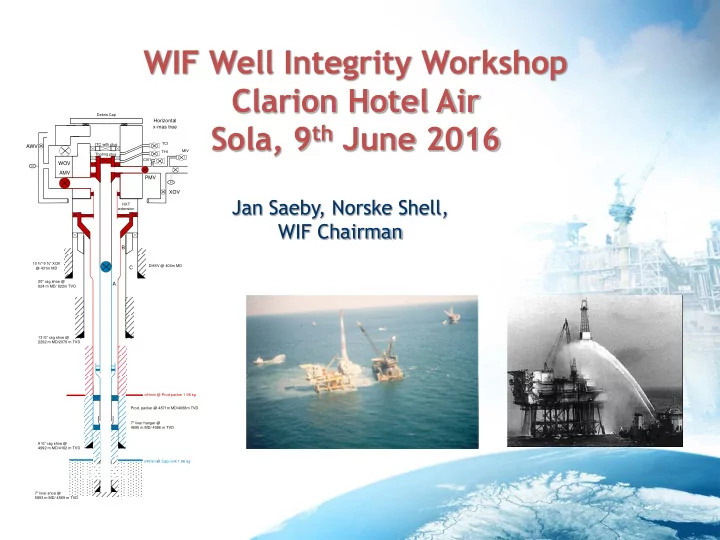
WIF Well Integrity Workshop Clarion Hotel Air Sola, 9th June 2016

Jan Saeby, Norske Shell, WIF Chairman

A B C

13 ⅜" csg shoe @ 2292 m MD/2079 m TVD 10 ¾"-9 ⅝" XOV @ 431m MD 9 ⅝" csg shoe @ 4992 m MD/4162 m TVD 7" liner hanger @ 4895 m MD/ 4086 m TVD

  • Prod. packer @ 4871m MD/4068m TVD

DHSV @ 400m MD 7" liner shoe @ 5893 m MD/ 4569 m TVD σHmin @ Cap rock 1.96 sg 20" csg shoe @ 824 m MD/ 822m TVD

AWV PMV AMV Horizontal x-mas tree XOV WOV

Tbghng plug Debris Cap ITC with plug

PT PT

TCI THI MIV HXT extension CIV1 σHmin @ Prod packer 1.96 sg

slide-2
SLIDE 2

Agenda

  • Well Integrity History and Background
  • WIF Organisational Setup and Members
  • General activities/priorities and Task Forces
  • Guideline Review and Reporting
  • Achievements and Comments
slide-3
SLIDE 3

Well Integrity History and Background

  • Prior to 1990, Well Integrity Management during the operational phase was
  • ften neglected, ad hoc and lots of wells on NCS and elsewhere were

experiencing serious WI issues

  • In some cases serious leaks and also Blow Outs were experienced due to poor

WI, leading to serious accidents with people injuries and fatalities, material damages, environmental discharges and loss of production.

  • There was little structured approach towards WI. WI was not included as prime

focus of the industry like drilling, production and other HSE aspects, i.e. It was not very “sexy” to work on WI

  • After 1990, and encouraged/enforced by authorities, Operating companies

started to put more structured Well Integrity Management systems in place

  • Norsok D-010 adopted the “2 barrier philosophy” with colour coded Well Barrier

Diagrams (blue/red colours for primary and secondary barriers)

  • Since +/- 2000, the industry started to put web-based WIMS systems in place
  • PSA Survey in 2006 showed that the industry was still having problems with

knowing the WI status of their wells

  • Followed up with creation of WIF forum and other measures (regular reporting,

regulations updates, audits etc....)

slide-4
SLIDE 4

Well Integrity Statistical Failures

Number of wells with well integrity problem 29 4 2 1 8 9 2 1 2 1 1 1 2 4 8 Wellhead DHSV Conductor ASV Tubing GLV Casing Cement Packer Pack off Chemical inj. line TRSV Fluid barrier Design Formation

Ca t e r or y ba r r i e r e l e me nt f a i l ur e

Number of wells 5 10 15 20 25 30 35

Age and category of barrier element failure

2 4 6 8 10 12 14 16 0 to 4 5 to 9 10 to 14 15 to 19 20 to 24 25 to 29 Age in years Number of wells

Wellhead DHSV Conductor ASV Tubing GLV Casing Cement Packer Pack off Chemical inj.line TRSV Fluid barrier Design Formation

Well Integrity according to Norsok:

  • Drilling/side-track activities
  • Well testing activities
  • Completion activities
  • Production/Operations incl. closed

in wells

  • Well interventions (workover,

suspensions, stimulations, pumping

  • perations abandonment, wireline, CT,

snubbing)

Well integrity failure statistics by age and barrier element failures. From PSA pilot study of well on the NCS in 2006 indicated 18% of the wells had leaks or well integrity issues.

<

slide-5
SLIDE 5

WIF – Organisational Setup

Norwegian Oil and Gas Operating Companies in Norway Drilling Managers Forum (DMF) Well Integrity Forum (WIF) Plug and Abandon Forum (PAF) Norwegian Petroleum Directorate (NPD - OD) Petroleum Safety Authority (PSA - Ptil) Ministry of Oil and Energy (OED) Facilitator: Tove Rørhuus Ministry of Labour and Social Affairs

slide-6
SLIDE 6

WIF - Mandate

Purpose: Network to secure and contribute to Industry objectives related to WI matters Scope:

  • place to discuss industry and regulatory requirements and guidelines
  • share experiences
  • identify common goals
  • cooperate to solve common WI challenges during lifecycle of wells

Focus Areas:

  • Contribute to high industry HSE standards
  • Monitor, influence and promote cost effective framework conditions, including

regulatory requirements and industry norms such as best practices, guidelines & standards

  • Promote close cooperation with authorities (PSA – Ptil)

=> with main focus on WI in the operational (and final abandonment) phase

slide-7
SLIDE 7

WIF members 2016, Who are we?

  • Monthly meetings w/facilitator, MOM’s, host on rotation between the companies
  • Mandated by and reporting to DMF
  • 13 operating companies as members (mainly WI specialists)
  • Set up of task forces to work on various issues
  • Approved Yearly Action Plan and Budget
  • Liaising with PSA, Universities, Research institutes, Norsk Standard, ISO....
  • Tove Rørhuus replaced Jan Krokeide as facilitator end 2014

Workgroup member Company Anders Hjellen Ryan Graham BP Kristian Lundemo Centrica Thomas Vold Thomas Berge ConocoPhillips Egil Aune Olaf.Sissener Det norske Morten Perander Eni Gulnara M Shafikova ExxonMobil

Mehryar Nasseri Karstein Hagenes

ENGIE (GDF Suez E&P Norge AS) Jan Sæby (leader) Jan-Erik Sandvik Norske Shell Jan Egil Asbjørnsen Preben Randhol (Vara: Steffen Kristiansen) Statoil Knut Stanghelle Repsol Ståle Johnsen Total Pål Skjelstad Wintershall Paal Ludvik Jørgensen Lundin Rørhuus, Tove WIF/Facilitator

Month Day/Date Host 2016 January Tuesday 26th ConocoPhillips February Wednesday 24th Wintershall-Bergen March Tuesday 15th Lundin -Oslo April Tuesday 26th BP May Tuesday 24th Centrica June Thursday 9th WIF workshop in June 2016 June Tuesday 21th Eni August Tuesday 23th Norske Shell September Tuesday 27th Engie October Tuesday 25th Total November Tuesday 22th Det Norske December Tuesday 13th Statoil

slide-8
SLIDE 8

WIF General Activities

  • Main WIF activities:
  • Working out WI guidelines for the industry (e.g. Guideline 117 and 135)
  • Reviewing Case studies for cross lateral learnings
  • Discussing, follow up and reporting of WI incidents
  • Ensure consistency in reporting (well categorisation for RNNP)
  • Maintain contact with relevant authorities (e.g. PSA)
  • Review regulatory changes and standard updates (Norsok, ISO....)
  • Propose changes and improvements to Norsok D-010 and other standards
  • Focus on WI training and learnings
  • Yearly Well Integrity seminars/workshops organised for the industry (Operating

Companies)

  • Contact w/other Industry Forums: DMF and PAF
  • Sister forum in UK: WLCPF (Well Life Cycle Practices Forum – set up in 2010)
slide-9
SLIDE 9

WIF – Major Achievements

  • Norwegian Oil and Gas, Industry Guideline 117 for Well Integrity written by WIF
  • 1. Well Integrity Training
  • 2. Well Handover Documentation
  • 3. Well Barrier Schematics for the Operational Phase
  • 4. Well Integrity Well Categorisation (WI Colour Coding reporting system)
  • 5. Well Integrity Management System (WIMS)
  • 6. Sustained Casing Pressure
  • Norwegian Oil and Gas, Industry Guideline 135, Classification of Well Control

Incidents, Chapter 4 written by WIF (Guideline for Well Integrity Incidents, classification and reporting)

  • Development of WI Compendium for use in Universities (UiS and NTNU)
  • Input to Norsok D-010 Updates, other Industry Standards (ISO) and regulatory

changes

  • Review and follow up on PSA reporting and industry trends (RNNP)
  • Annual WI Industry Workshops/Seminars to share learnings and improve general

WI understanding

slide-10
SLIDE 10

WIF – Well Categorisation

 Developed in 2007, Annual reporting to PSA from 2008 onwards (RNNP reporting)  Focus on Well Barrier Envelopes consisting of Individually tested and verified Well Barrier Elements  Firmly establishes the “2 Barrier Philosophy” as the Industry standard  Gradually accepted as a “Best Practice” in the Industry  Significant improvements in Well Integrity Management and overall safety But:  Problems w/consistency in reporting  WIF working on clarifications and improvements, including risk level

Categorisation Basis

(based on Norwegian PSA guidelines) A well with another significant issue is YELLOW

Category Principle Example

Red One barrier has failed, the other is degraded or has not been

  • verified. Or leak to surface

Completion leak rate above acceptance

  • criteria. Production casing integrity not proven

Orange One barrier has failed, the other is intact. Or a single failure may lead to a leak to surface Completion leak rate above acceptance

  • criteria. Production casing integrity proven

Yellow One of two barriers is degraded or has not been verified; the

  • ther is intact.

Completion leak rate within acceptance

  • criteria. Production casing integrity proven

Green No or minor integrity issue SSSV leak rate within acceptance criteria
slide-11
SLIDE 11

RNNP Reporting, Industry WI trends

  • Annual snapshot since 2008, 1911 wells reported in

2015

  • Consistency in reporting according to guideline 117

has improved considerably

  • Reporting has been based on both D-010 Rev 3

and Rev 4, - different requirements may change colors

  • The number of “red” and “orange” wells has

decreased over the last few years

  • «Red» and «orange» wells are often low risk wells

that have been secured and are awaiting repair or abandonment

slide-12
SLIDE 12

Well Integrity Incident Reporting, Guideline 135 Revision

No. BLOWOUT OR MAJOR HC RELEASE LEVEL 1 1 Loss of all well barriers, uncontrolled outflow 2 Casing leak below production packer into formation above reservoir. Packer set in uncemented casing. Release to environment. 3 Tubing and production casing leak resulting in leakage to an annulus not qualified as a barrier. Release to environment. 4 Loss of gas lift gas containment Resulting in high amount of HC gas threatening the whole facility. HC RELEASE LEVEL 2 1 Release of gas lift gas with functioning ASV. 2 Flowline rupture and failure of XT valves resulting in large amount of HC release until DHSV closes.

  • 1. CROSSFLOW

LEVEL 3 1 Casing leak below production packer into formation above caprock. Packer set in uncemented casing. No potential for breaching to surface. 2 Leak through cement into formation above cap rock. No potential for breaching to surface. 3 Leak of gas lift gas through production casing into

  • formation. No potential for breaching to surface.
  • 2. LEAK

1 Failure of DHSV and MMV stem packing resulting in HC release to environment 2 Gas lift leak into WH void and external leak through exit block. 3 Accumulated HC in B-annulus released through WH. If large amount of HC released evaluate to raise to Level 2 or 1 4 Tubing to annulus communication (TTAC) below DHSV and small leakage through XT valves to sea. 5 Leak in TH neck seal and XT/WH connection (ring gasket). 6 Leak in control line with small release to installation.

  • 3. DUAL BARRIER FAILURE

1 DHSV, HMV & PMV failed but HC contained by valves down stream 2 Casing leak below production packer into formation above reservoir. Packer set in uncemented casing. Resulting in HC in an annulus not qualified as barrier.

slide-13
SLIDE 13

WIF – Categorisation of Wells, Risk Assessment

  • Risk Matrix developed by task force during

2014/2015

  • Being tested by WIF members
  • No publication planned yet, reporting

consistency may be difficult

slide-14
SLIDE 14

WIF – Member Feedback

Why has WIF been successful in achieving results:

  • Good set up in WIF (w/13 operating companies), good facilitator and use of small

task forces contribute to success of the group

  • Use of simple colour coding concepts (WI categorisation and WI incidents)
  • Readable and simple to follow WI guidelines, picked up by the industry
  • Good dialogue w/PSA and authorities, universities etc.
  • Consistency in group, continuity of members
  • Having motivated and dedicated people to take the lead/responsibility of task force

work, able to give input and work on WI issues

  • Experienced team members believing in what they are doing and that they can have

impact on the industry to improve WI understanding and make a safer business

  • Believing that results can be achieved by educating both industry people and

students alike

  • Patience, dedication, time, persuasion
  • Challenging and good subject
  • WIF work is often referred to and the achievements has been recognised by

authorities and industry in general

slide-15
SLIDE 15

Final comments

  • We believe our work on WI Management on the NCS is giving results,

it makes our wells and operations safer and prevents accidents...

  • Work done by WIF over the past years has changed focus and attitude

in the industry, not only in Norway, but in many countries worldwide

  • Norway is leading the way: «Look to Norway and the NCS»
  • But accident still happens and our improvement journey continues.....
slide-16
SLIDE 16
slide-17
SLIDE 17

Workshop Agenda

8.30-9.00 Registration 9.00-9.15 Mingling and Coffee 9.15-9.30 Welcome Agenda & Safety – Tove Rørhus 9.30-10.00 Introduction to Workshop – Jan Sæby Well Integrity Quiz – Pål Skjelstad 10.00-11.30 Workshop Cases (1) – Jan Egil Asbjørnsen 11.30-12.30 LUNCH 12.30-14.00 Workshop Cases (2) – Thomas Vold 14.00-14.20 Coffee Break/Networking 14.20-15.20 Workshop Cases (3) – Pål Skjelstad & Jan Sæby 15.20-16.00 Wrap Up – Jan Sæby Results of Quiz – Pål Skjelstad