Civil Military Cooperation through FUA (Flexible Use of Airspace) - - PowerPoint PPT Presentation

civil military cooperation through fua flexible use of
SMART_READER_LITE
LIVE PREVIEW

Civil Military Cooperation through FUA (Flexible Use of Airspace) - - PowerPoint PPT Presentation

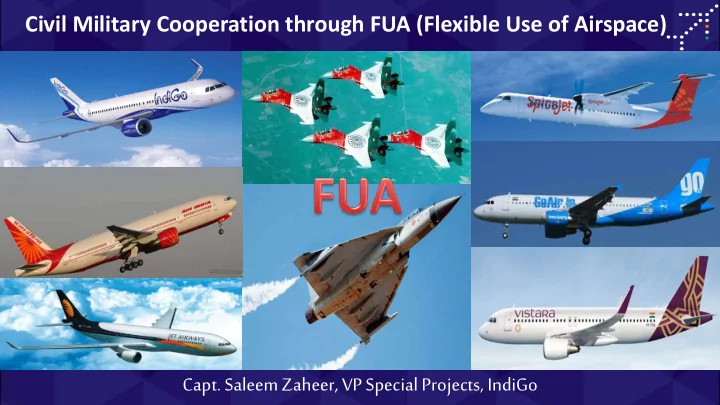
Civil Military Cooperation through FUA (Flexible Use of Airspace) Capt. Saleem Zaheer, VP Special Projects, IndiGo Why is airspace sharing necessary? Over 300 million and growing middle class driving consumption and fueling growth India is

slide-1
SLIDE 1

Civil Military Cooperation through FUA (Flexible Use of Airspace)

  • Capt. Saleem Zaheer, VP Special Projects, IndiGo
slide-2
SLIDE 2

Why is airspace sharing necessary?

  • Over 300 million and growing middle class driving consumption and fueling growth
  • India is expected to become the 5th largest consumer economy by 2025

from the 12th largest in 2007

  • 600 million people expected to be in upper and middle income bracket by 2025

Source: McKinsey

slide-3
SLIDE 3

Rail to Air Substitution Supportive of Demand

Substitution from rail to air

8,400

million

81 million

< 1% of rail passengers

2015 Passengers

Increasing Disposable Income Changing Consumer Preference Large Market Potential

slide-4
SLIDE 4

IATA Forecast: 2016-2034

  • The five fastest-increasing markets in terms of additional passengers

per year over the forecast period (2016-2034) will be:

  • China (758 million new passengers for a total of 1.2B passengers )
  • US (523 million new passengers for a total of 1.16B billion)
  • India (275 million new passengers for a total of 378 million)
  • Indonesia (132 million new passengers for a total of 219 million)
  • Brazil (104 million new passengers for a total of 202 million)
  • India will displace the UK as the third-largest market world-wide in

2026

slide-5
SLIDE 5

Other Forecasts

  • DGCA India, 2016:

Monthly DGCA reports show Indian passenger numbers growing 20 – 25% YOY

  • CAPA forecasts YOY growth from 81 million pax in FY 16 to 100

million in FY 17 (23% growth)

  • Boeing Current Market Outlook, October 2015: India will need

1740 new airliners by 2034

  • Airbus: India will need 1300 new airliners by 2032
slide-6
SLIDE 6

CAPA – AIRLINE A/C ADDITIONS 2015-2025

slide-7
SLIDE 7

A Reasonable Prediction

  • It would be fair to say that there will be 600 airliners operating

in India by December 2018, 30 months from today

  • A 50% increase from today’s 440 airliners
  • All using the same finite, limited Indian airspace

Effectively managing these numbers in the service of the travelling public is our challenge

slide-8
SLIDE 8
  • Air Traffic Management (ATM) improvements represent the

greatest near-term environmental opportunities for significant reductions in aviation fuel burn and CO2 emissions Air Traffic Management: An Environmental Solution for Aviation Cutting flight times by one minute per flight on a global basis would save 4.8 million tons of CO2 every year (IATA)

 By using more fuel efficient routes  By more effectively sharing airspace between military and civil users

slide-9
SLIDE 9

Formation of NHLAPB & NAMAC

October 2013:

  • Formation of National High Level Airspace Policy Body (NHLAPB) for

airspace

  • Chaired by Secretary, Ministry of Civil Aviation
  • With representation from Ministry of Defence, Indian Air Force, Indian Navy,

Indian Space Research Organization, Airports Authority of India and Directorate General of Civil Aviation

  • National Airspace Management & Advisory Committee (NAMAC)

in early 2014

  • Includes Airline Members
slide-10
SLIDE 10

Flexible Use of Airspace

  • 1. The FUA Concept provides the Air Traffic Management (ATM) system with the

potential to increase capacity

  • 3. The FUA Concept allows the maximum shared use of airspace through enhanced

civil/military co-ordination

  • 2. FUA came into existence to manage increasing traffic flow – both civil and military
  • 4. Concept strives for airspace segregation that is temporary and based on real use for

a specified time period

slide-11
SLIDE 11

Benefits Reaped Due To Implementation of FUA

slide-12
SLIDE 12

Period Fuel Savings (KG) Cost Savings (INR)/USD Reduced CO2 Emission (Ton) NOV 2014 to MAR 2016 748000 4.75 Cr/ 0.7 Million 2400

Conditional Route J1-CDR 2 Kolkata - Jaipur

slide-13
SLIDE 13

Period Fuel Savings (Kgs) Cost Savings (INR)/(USD) Reduced CO2 Emission (Ton) SEP 2015 to MAR 2016 67000 40 lac/59000 212

Conditional Route J2-CDR 2 Nagpur -Pune

slide-14
SLIDE 14

Period Fuel Savings (Kgs) Cost Savings (INR)/(USD) Reduced Co2 Emission (Ton) JUN 2015 to MAR 2016 57000 38 lac/57000 179

Conditional Route J4-CDR2 Kolkata-Hyderabad

slide-15
SLIDE 15

Q16 & Q17 Route Overflying OZAR Airspace Conditional Route

Period Fuel Savings (Kgs) Cost Savings (INR)/(USD) Reduced CO2 Emission (Ton) MAR 2015 to MAR 2016 3,70,000 2.4Cr/0.3 Million 1147

slide-16
SLIDE 16

Conditional Route J8-CDR2 Dimapur - Kumbhigram

Period - Only Sundays Fuel Savings (Kgs) Cost Savings (INR)/USD Reduced CO2 Emission (Ton) OCT 2015 to MAR 2016 8000 5.7lacs/8500 28

slide-17
SLIDE 17

CO2 Reduction and Fuel Savings (The MAGIC of saving 100Kg per flight)

APR 2016

  • No. of Flights/Year

Fuel Saving /Year/ (Tons) Fuel Savings /Year (INR)/USD CO2 Reduction/Year (Tons) 245,000 24,500 116 Cr/17.4 Million 77,200 APR 2015

  • No. of Flights/Year

Fuel Saving /Year/ (Tons) Fuel Savings /Year (Rs) CO2 Reduction/Year (Tons) 210,000 21,000 155 Cr/23.2 Million 66,200

slide-18
SLIDE 18

What more can be done with Civil Military Cooperation?

slide-19
SLIDE 19
slide-20
SLIDE 20

Direct Route Between PK and CHG

There is only one route to fly to/from Jammu and Srinagar. In case connectivity between PK and CHG is made available and the traffic is bifurcated from DPN so that inbound traffic to Jammu and Srinagar follows DPN-PK-SNG and Outbound traffic follows SNG-PK-CHG-DPN This will not only ease the traffic density but also help all Airlines in getting optimum level hence less fuel burn and less CO2 emissions.

slide-21
SLIDE 21

Approach Corridor Through Hindon Airspace

slide-22
SLIDE 22

Proposal for BPL-AAE-RASKI

slide-23
SLIDE 23
  • No. of Flights per month

570

Saving Per Flight Distance

11 NM

Predicted Fuel Saving/Year=4,51,400 Kgs Reduced CO2 Emissions= 1425 Ton

slide-24
SLIDE 24

Controllers FAM Flights

  • 1. Every year airlines as a best practice take civil controllers for

familiarization flights to different airports

  • 2. 80 controllers were approved in 2015
  • 3. 100 controllers on domestic flights and 20 for international

flights have been approved in 2016

  • 4. We would be extremely pleased to welcome Air Force/Navy

controllers in our cockpits

slide-25
SLIDE 25

Thank You

Any Questions