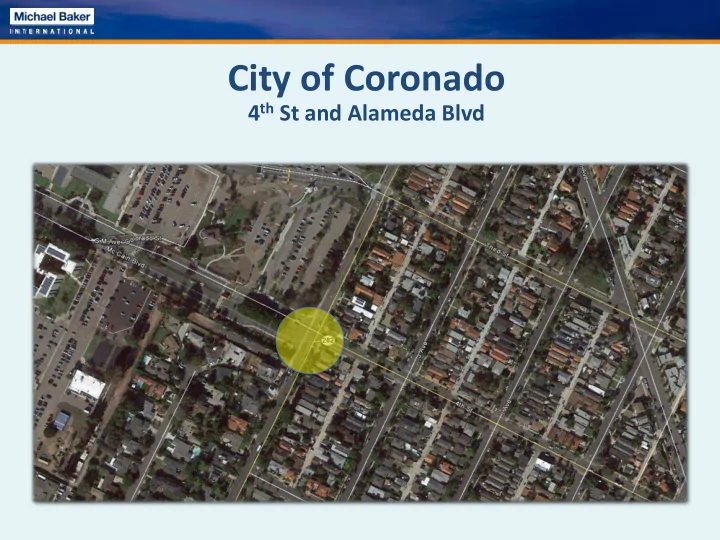
City of Coronado 4 th St and Alameda Blvd
Michael Baker International Full-Service Civil Engineering Firm Public Works Department (Transportation Engineering Ryan Zellers, PE, TE Planning and Design) Registered Civil and Traffic Engineer, 19 years of experience Registered Civil Engineer, 4 years of experience Blanca Soto, PE
4 th St and Alameda Blvd (Existing All-Way Stop)
Warrants and Operations Volumes warrant a traffic signal Existing All-Way stop • LOS = F, Delay = 58.1 sec Traffic Signal, 2017 (PM Peak Hour) • LOS = C, Delay = 22.6 sec Traffic Signal, 2030 (PM Peak Hour) • LOS = D, Delay = 51.5 sec
Traffic Signal Configuration
Traffic Signal Plan
Traffic Signal Plan (Enlarged)
Traffic Signal Operations/Timing Shared through-right turn lane leaving base ½-street closure will be done on the Navy side Traffic signal timing is a function of the controlling jurisdiction (Caltrans) Optimized based on peak traffic flows Different timings for various days, times, and events Video detection with adv. loops (on Navy base) Coordination also controlled by Caltrans (3/4-mile maximum for vehicle platoons)
Queuing Results Understanding 50 th % and 95 th % Queuing 2017 Queuing Results • NB Alameda 50% / 95% = 86’ (4 cars ) / 166’ (7 cars) • SB Alameda Left 50% / 95% = 154’ (6 cars) / 255’ (10 cars) • SB Alameda Through 50% / 95% = 101’ (4 cars) / 158’ (7 cars) 2030 Queuing Results • NB Alameda 50% / 95% = 137' (6 cars) / 226' (9 cars) • SB Alameda Left 50% / 95% = 249' (10449 cars) / 449' (17 cars) • SB Alameda Through 50% / 95% = 135' (6 cars) / 201' (8 cars)
Benefits and Issues Platoons create downstream gaps in traffic Platoon “wave” will affect all 4 th Street side streets Change in traffic patterns may arise, but depends on individual driver preferences Efficiency better and overall delay reduced Peak traffic times could be compressed Signal timing adjustments to balance side street priority
Decorative Signal Poles Caltrans approved manufacturer 10-15% increase in equipment cost
Questions?
Recommend
More recommend