City of Cape May Water System Master Plan Review Presentation to - - PowerPoint PPT Presentation

city of cape may water system master plan review
SMART_READER_LITE
LIVE PREVIEW

City of Cape May Water System Master Plan Review Presentation to - - PowerPoint PPT Presentation

City of Cape May Water System Master Plan Review Presentation to Mayor & Council Council Work Session March 3, 2020 Thomas R. Thornton, PE, CME Mark A. Tompeck, PE, DBIA, ENV SP Brian T. Dougherty, PE Water System Master Plan Scope

slide-1
SLIDE 1

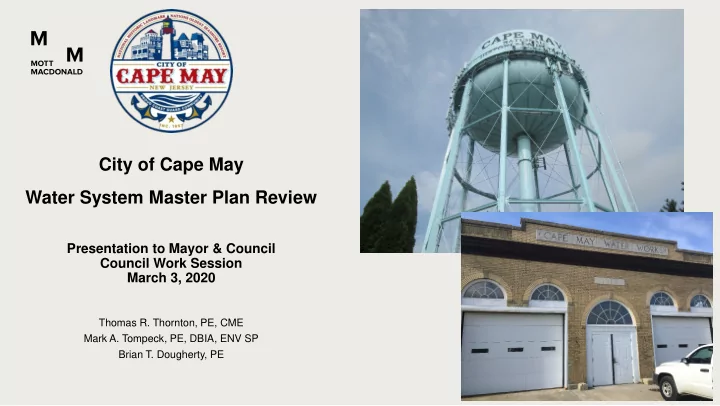
City of Cape May Water System Master Plan Review

Presentation to Mayor & Council Council Work Session March 3, 2020

Thomas R. Thornton, PE, CME Mark A. Tompeck, PE, DBIA, ENV SP Brian T. Dougherty, PE

slide-2
SLIDE 2

Mott MacDonald March 3, 2020

Water System Master Plan Scope

  • City’s goal is to continue to provide water supply that is:
  • Safe – meets all current/proposed drinking water quality standards & regulations
  • Adequate – satisfactory capacity and pressure for public consumption and fire protection
  • Reliable – minimizing the potential for service interruptions
  • Economical - cost-effective system operation and improvements
  • Objectives of Master Plan:
  • Assess current system condition
  • Review regulatory compliance for system operation & water quality
  • Evaluate production capabilities & distribution system
  • Master Plan Result:
  • Comprehensive assessment system assets and operations
  • Recommendations for future improvements
slide-3
SLIDE 3

Mott MacDonald March 3, 2020

Water System Master Plan Contents

  • Overview & History
  • Water Demand Analysis
  • Water Allocation Evaluation
  • Review of Source Water Quality
  • Review of Operations and Maintenance
  • Assessment of Water Distribution & Storage
  • Assessment of Water Production & Treatment
  • Recommended Capital Improvement Program
slide-4
SLIDE 4

Mott MacDonald March 3, 2020

Water System History

  • Water Supply Timeline
  • 1910 – 1940 – City supplied by shallow, unconfined wells
  • 1940 – 1950 – City supplied by Cohansey Aquifer Well Nos. 1 and 2
  • Well Nos. 1 & 2 were located in the City; eventually abandoned due to high chloride levels
  • 1940’s – Coast Guard base added to service area when their also had to be abandoned.
  • 1950 – 1998 – City supplied by Cohansey Aquifer Well Nos. 3, 4 & 5
  • Wells were located further inland – Well No. 3 at WTP and Well Nos. 4&5 along railroad in Lower Twp.
  • 1972 – Cape May Point and West Cape May added to service area after their wells failed
  • 1994 – Well No. 3 taken off line due to water quality
  • 1997 – Well No. 4 taken off line due to water quality
  • 1998 – City supplied by Desalination Facility
  • 2017 – City constructs Well No. 8
slide-5
SLIDE 5

Mott MacDonald March 3, 2020

Water System Overview

  • Cape May City Municipal Water System
  • Consists of source, treatment, transmission, distribution and storage infrastructure.
  • Serves approx. 5,000 permanent customers in Cape May City and wholesale customers:
  • Cape May Point
  • West Cape May
  • US Coast Guard Base
  • System Demands
  • Average Day Demand = 1.1 million gallons per day (MGD)
  • Maximum Day Demand = 2.91 MGD
  • Summer Demands = 4 times normal ‘off-season’ demand
  • Non-revenue (unaccounted-for) water is approx. 16%
  • Future Demand projections show a minor increase (5%) in demands over 10 years
slide-6
SLIDE 6

Mott MacDonald March 3, 2020

Water Allocation Evaluation

  • Water Allocation Process
  • Regulated by NJDEP Bureau of Water Allocation
  • Details operating limits and criteria for monitoring & reporting
  • City’s Permit in effect to Sept. 2026
  • Allocation Permit Conditions & Surplus/Deficit Analysis

Parameter Historical Maximum Demand Allocation Permit Limits Surplus (+) / Deficit (-) Annual Allocation - All Wells (MGY) 574.20 838.00 +263.80 Monthly Allocation - All Wells (MGM) 91.23 115.00 +23.77 Annual Allocation Cohansey Aquifer (MGY) 112.63 160.00 +47.37 Annual Allocation Atlantic City 800-Ft Sand Aquifer (MGY) 462.95 678.00 +215.05

slide-7
SLIDE 7

Mott MacDonald March 3, 2020

Assessment of Distribution & Storage Facilities

  • Distribution System:
  • 190,000 ft (36 miles) of 1” to 16” water main piping
  • Two water storage tanks
  • Canning House Lane Standpipe – 1,000,000 gallons total capacity (450,000 gallons effective capacity)
  • Madison & Columbia Ave Elevated Tank – 700,000 gallons capacity
  • Transmission Mains
  • Stimpson Lane Transmission (10” & 12”) – supply W. Cape May & Cape May Point
  • Broadway Transmission Main (12”) – supply to downtown & W. Cape May
  • Cape Island Creek Transmission Main (16”) – crosses Cape Island Creek and marsh areas
  • System Evaluation
  • Developed WaterGEMS hydraulic model to analyze system performance
  • Analyzed both summer and winter conditions
  • Water storage assessment to confirm compliance with Water Supply Management Act
slide-8
SLIDE 8

Mott MacDonald March 3, 2020

Assessment of Distribution & Storage Facilities

slide-9
SLIDE 9

Mott MacDonald March 3, 2020

Assessment of Distribution & Storage Facilities

  • Findings
  • Wholesale metering improvements
  • Current W. Cape May metering is calculated using 6 different meters
  • Connections from Broadway Transmission Main
  • Storage Analysis
  • Existing 1.15 MG effective storage in 2 tanks is adequate
  • Modeling analysis to review system performance (flow & pressure) & fire protection capability
  • Identified 4 primary distribution improvements
  • Approx. 12,000 LF of improvements to upsize mains and complete loops to improve flows
  • Identified transmission improvements
  • Cape Island Creek 16” ACP Transmission Main rehabilitation
  • Transfer ownership of Broadway Transmission Main & construct paralled main on Park Boulevard
slide-10
SLIDE 10

Mott MacDonald March 3, 2020

Review of Operations and Maintenance

  • Water Quality Accountability Act (N.J.S.A. 58:31-1):
  • Enacted July 21, 2017 & Effective October 19, 2017; Administrative code still under development
  • Applies to water purveyors with more than 500 service connections
  • Intent is to improve safety, reliability, and administrative oversight of water infrastructure
  • Requirements:
  • Maintenance requirements for valves & hydrants
  • Locate & GPS all valves / Exercise <12” every 4 years / Exercise 12”> every 2 years
  • Locate & GPS all hydrants / test all hydrants annually
  • Record keeping for maintenance activities
  • Mitigation plans for NJDEP violations
  • Asset Management Plan
  • Annual Certification
slide-11
SLIDE 11

Mott MacDonald March 3, 2020

Review of Operations and Maintenance

  • WQAA Compliance
  • Valves & hydrants – GPS located as part of GIS development
  • Record Keeping – capabilities in GIS and MM-Fit
  • Asset Management Plan – completed (Water Master Plan)
  • Recommendations
  • Implement computerized maintenance management system (CMMS)
  • Develop formal valve inspection and maintenance program
  • Utilize GIS to record maintenance information for valve and hydrants
slide-12
SLIDE 12

Mott MacDonald March 3, 2020

Review of Source Water Quality

  • Atlantic City 800-Foot Sand Aquifer
  • Elevated sodium & chloride (above NJDEP Recommended Upper Limit (RUL))
  • Water quality has been and is expected to remain relatively stable
  • Operation of Well No. 8 will impact aquifer and current monitoring program should continue
  • Cohansey Aquifer
  • Elevated iron (above NJDEP RUL)
  • Elevated sodium & chloride (above NJDEP RULs)

with upward historical trend

  • Should not be considered a viable long-term water

supply source

slide-13
SLIDE 13

Mott MacDonald March 3, 2020

Assessment of Water Supply & Treatment Facilities

  • Water Supply provided by 2 sources:
  • Desalination Facility
  • Supplied by Well Nos. 6 & 7 – 1,000 GPM permitted capacity
  • Desalination system – 68% recovery ratio
  • Well No. 5
  • Sequestering treatment for elevated iron
  • High Service Pumps
  • Can pump from standpipe or Lower Twp.

interconnection into distribution system

slide-14
SLIDE 14

Mott MacDonald March 3, 2020

Assessment of Water Supply & Treatment Facilities

  • Assessment of Water Supply & Treatment includes:
  • Condition Assessment – performed on all facilities
  • Review of Firm Capacity
  • NJDEP Safe Drinking Water Regulation – System must have firm capacity to meet peak demands
  • Firm capacity deficit = 0.30 MGD

Source Feed Rate (MGD) Recovery Ratio Production Rate (MGD) Desal Train 1 1.44 0.68 0.98 Desal Train 2 1.44 0.68 0.98 Well No. 5

  • 1.01

Total Production Capacity 2.96 Firm Production Capacity 1.96 Current Maximum Month Average Day Demand 2.26 Surplus (+) / Deficit (-)

  • 0.30
slide-15
SLIDE 15

Mott MacDonald March 3, 2020

Assessment of Water Supply & Treatment Facilities

  • Desalination Facility
  • Rated for 2 MGD
  • Supplied by Well Nos. 6 & 7 (Well No. 8 is backup)
  • Utilizes Reverse Osmosis (RO) technology
  • Consists of two RO membrane trains
  • Desalination System Equipment
  • Anti-scalant chemical feed system
  • Cartridge Filters – 4 filters, rated for 500 GPM each
  • Feed pumps – 3 vertical pumps, 1,000 GPM & 200 Hp each
  • Membranes – 2 skids, 26 pressure vessels per skid
  • Clean-in-Place System – chemical feed to clean membrane 2x per yr.
  • Post-Treatment chemical feed – lime feed and calcium hypochlorite
slide-16
SLIDE 16

Mott MacDonald March 3, 2020

Assessment of Water Supply & Treatment Facilities

slide-17
SLIDE 17

Mott MacDonald March 3, 2020

Assessment of Water Supply & Treatment Facilities

  • Recommended Improvements
  • Need to address firm capacity deficit
  • Expand Desalination Facility & add third RO train
  • Replacement of Existing Equipment
  • Major equipment has been in service for over 20 years.
  • Start planning for replacements. Capital Improvements include 4 projects to replace desal. equipment

Source Feed Rate (MGD) Recovery Ratio Production Rate (MGD) Desal Train 1 1.44 0.68 0.98 Desal Train 2 1.44 0.68 0.98 Desal Train 3 1.44 0.68 0.98 Well No. 5

  • 0.98

Total Production Capacity 3.92 Firm Production Capacity 2.94 Future Maximum Month Average Day Demand 2.41 Surplus (+) / Deficit (-) +0.53

slide-18
SLIDE 18

Mott MacDonald March 3, 2020

Assessment of Water Supply & Treatment Facilities

slide-19
SLIDE 19

Mott MacDonald March 3, 2020

Recommended Capital Improvement Program

  • Top Ten Capital Improvement Projects:
  • 80% dedicated to improving capacity and reliability of Desalination Facility
  • 15% dedicated to transmission and distribution projects

Project Rank Primary Need Project Description Cost Time Frame 1 Capacity Expansion of Desalination Facility $7,400,000 Short Term 2 Reliability Cape Island Creek Transmission Main Rehabilitation $670,000 Short Term 3 Renewal / Replacement Desal Facility Feed Pump Upgrades $135,000 Short Term 4 Renewal / Replacement Desal Facility Membrane Replacements $400,000 Long Term 5 Renewal / Replacement Desal Facility Membrane Skid Replacements $2,730,000 Long Term 6 Renewal / Replacement Desal Facility Cartridge Filter Housing Replacements $330,000 Long Term 7 Renewal / Replacement Well No. 6 Pump Replacement $240,000 Short Term 8 Renewal / Replacement Well No. 7 Pump Replacement $240,000 Short Term 9 Capacity Distribution System Upgrades – Washington/Lafayette/5th $845,000 Short Term 10 Capacity Distribution System Upgrades - Delaware Ave $695,000 Short Term

slide-20
SLIDE 20

Mott MacDonald March 3, 2020

Recommended Capital Improvement Program

  • Annual Capital Improvements:
  • ACP Water Main Replacements
  • 6,700 LF ACP to be replaced – 350 LF replacement per year for 20 years
  • Valve Replacement Program
  • 175 valves exercised per year and assumed 15% will require replacement
  • Water Service Replacement Program
  • 180 galvanized services in system to be replaced over 10 years
  • Water Main Replacement Program
  • 73,000 LF cast iron to be replaced – 1,500 LF replacement per year for 50 years
  • Over 10 years, average renewal spending = $960,000 per year
  • Water Supply Management Act Rules - planned infrastructure to be 10% of water revenues
slide-21
SLIDE 21

Mott MacDonald March 3, 2020

Recommended Capital Improvement Program

  • Report includes detailed project sheets for each recommendation with:
  • Project justification;
  • implementation schedules;
  • regulatory considerations; and
  • estimated construction costs as well as legal, engineering & administrative costs
  • Capital Program Summary:

Project Time Frame Time Frame Budget Estimated Annual Every year (2019 – 2028) $960,000 (Annual) $9,600,000 (Total) Short-Term With 1 – 4 years (2019 – 2022) $10,780,000 Long-Term 5 – 10 years (2023 – 2028) $8,805,000 Total $29,185,000

slide-22
SLIDE 22

Mott MacDonald March 3, 2020

Recommended Capital Improvement Program

Annual Renewal, 32.9% Renewal / Replacement, 14.0% Capacity, 32.0% Reliability, 8.3% Operational Efficiency, 0.6% Regulatory, 12.3%

Capital Improvement Plan – Area of Need

slide-23
SLIDE 23

Mott MacDonald March 3, 2020

Recommended Capital Improvement Program

  • Other Recommendations (Programs/Studies/Operational):
  • Implement computerized maintenance management system (CMMS)
  • Develop Valve Inspection and Maintenance Program
  • Perform AWWA Water Audit – review of non-revenue (unaccounted-for) water
  • Conduct Leak Detection and Mitigation Program
  • Annual Interconnection Testing Program
  • Continue quarterly source water quality monitoring
slide-24
SLIDE 24

Thank you