Managing the Edge: BiodiverCities: Cape Town Cape Town City with a - - PowerPoint PPT Presentation

managing the edge
SMART_READER_LITE
LIVE PREVIEW

Managing the Edge: BiodiverCities: Cape Town Cape Town City with a - - PowerPoint PPT Presentation

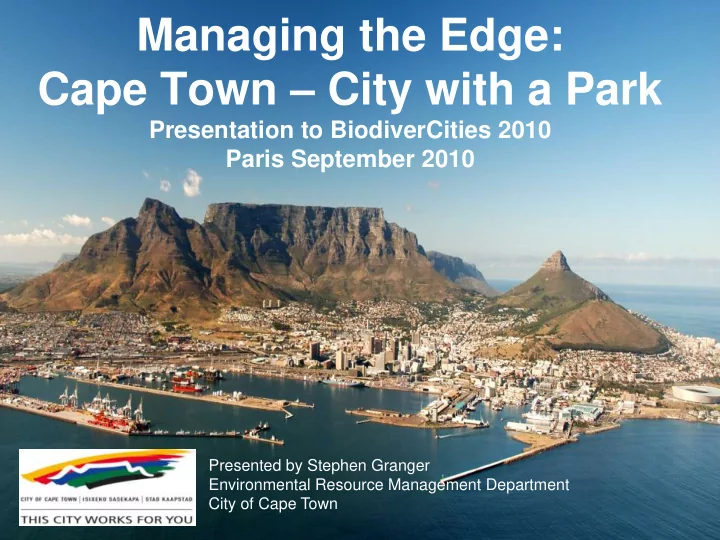
Managing the Edge: BiodiverCities: Cape Town Cape Town City with a Park Presentation to BiodiverCities 2010 Paris September 2010 Presented by Stephen Granger Environmental Resource Management Department City of Cape Town BiodiverCities:

slide-1
SLIDE 1

BiodiverCities: Cape Town

Managing the Edge: Cape Town – City with a Park

Presentation to BiodiverCities 2010 Paris September 2010

Presented by Stephen Granger Environmental Resource Management Department City of Cape Town

slide-2
SLIDE 2

BiodiverCities: Cape Town

slide-3
SLIDE 3

BiodiverCities: Cape Town

slide-4
SLIDE 4

BiodiverCities: Cape Town

The City of Cape Town

Facts and Figures

  • Area 2 477 km² - Unicity 2000
  • 3,5 million inhabitants, growing

population due to migration

  • Table Mountain and Robben

Island as world famous landmarks

  • Meeting of ecotones – a real

BiodiverCity

slide-5
SLIDE 5

BiodiverCities: Cape Town

The City of Cape Town

  • “Mother City” , “Gateway to

Africa” and “Fairest Cape in all the World”

  • Rich history, embracing

diversity of cultures

  • Liberal tradition – often in
  • pposition to ruling party
  • Africa’s most visited city
  • Proud 2010 FIFA World Cup

Host City

slide-6
SLIDE 6

BiodiverCities: Cape Town

One Of The

“Places Of A Lifetime”

– National Geographic Traveler

One Of The World’s Most

Sustainable Cities

  • Ethisphere Institute

Africa's Leading Destination

– World Travel Awards

2nd best city in the world –

US Travel & Leisure

Favourite Foreign City – UK

Telegraph

slide-7
SLIDE 7

BiodiverCities: Cape Town

Wonder of the World - extravagance of life’s diversity

  • Cape Floral Kingdom less than 90 000 square

kms – size of Portugal

  • 8600 plant species, 5800 endemics
  • British Isles, 3.5 times larger, have only 1500

plants, fewer than 20 endemics

slide-8
SLIDE 8

BiodiverCities: Cape Town

The City of Cape Town

World Bio & Heritage Hotspot

  • Urban Biodiversity Hotspot
  • Part of Cape Floral Kingdom
  • Two Biospheres
  • Two World Heritage Sites
  • One National Park
slide-9
SLIDE 9

BiodiverCities: Cape Town

The City of Cape Town

World Bio & Heritage Hotspot

  • 261 biodiversity sites of

special value

  • Over 3000 floral spp
slide-10
SLIDE 10

BiodiverCities: Cape Town

City’s involvement with TMNP

slide-11
SLIDE 11

BiodiverCities: Cape Town

Cape Town: World Biodiversity Hotspot – enjoy the ride…

slide-12
SLIDE 12

BiodiverCities: Cape Town

slide-13
SLIDE 13

BiodiverCities: Cape Town

slide-14
SLIDE 14

BiodiverCities: Cape Town

slide-15
SLIDE 15

BiodiverCities: Cape Town

slide-16
SLIDE 16

BiodiverCities: Cape Town

slide-17
SLIDE 17

BiodiverCities: Cape Town

slide-18
SLIDE 18

BiodiverCities: Cape Town

slide-19
SLIDE 19

BiodiverCities: Cape Town

slide-20
SLIDE 20

BiodiverCities: Cape Town

slide-21
SLIDE 21

BiodiverCities: Cape Town

slide-22
SLIDE 22

BiodiverCities: Cape Town

slide-23
SLIDE 23

BiodiverCities: Cape Town

slide-24
SLIDE 24

BiodiverCities: Cape Town

slide-25
SLIDE 25

BiodiverCities: Cape Town

slide-26
SLIDE 26

BiodiverCities: Cape Town The Cape Lowlands of the City of Cape Town has the highest concentration of threatened plants per area of remaining vegetation in the world

Some Cape Town facts:

Cape Peninsula with its 2285 plant species in an expanse smaller than London Table Mountain alone has almost 1500 species in 57 square kilometers

slide-27
SLIDE 27

BiodiverCities: Cape Town

Way forward: Managing an urban park

11 of the 21 critically endangered vegetation types in SA are contained within the City of Cape Town

slide-28
SLIDE 28

BiodiverCities: Cape Town

Lourensford Alluvium Fynbos - CR 7% remains 3% conserved TARGET: 30%

slide-29
SLIDE 29

BiodiverCities: Cape Town

Cape Flats Dune Strandveld – EN 45% remains 13% conserved TARGET: 24%

slide-30
SLIDE 30

BiodiverCities: Cape Town

Cape Flats Sand Fynbos - CR

14% remains 1% conserved TARGET: 30%

slide-31
SLIDE 31

BiodiverCities: Cape Town

Historical Vegetation

2009 vegetation

Transformation: 2/3 agriculture 1/3 urbanization

slide-32
SLIDE 32

BiodiverCities: Cape Town

City’s Biodiversity Strategies / IMEP

Biodiversity Strategy

  • Cape Town - global urban biodiversity

hotspot without parallel

  • The CFK is one of richest floral kingdoms

but also the most threatened.

  • The City has committed itself to develop and

implement a Biodiversity Strategy

  • City’s biod a GCG - needs partners to

ensure its conservation

slide-33
SLIDE 33

BiodiverCities: Cape Town

City’s Biodiversity Strategies / IMEP

Biodiversity Strategy: a systematic plan

  • f action to accomplish a specific goal

:

  • Background, context, legislation,

strategy framework

  • Vision, goal, principles,

management structure

  • 7 Strategic objectives, targets,

reporting and review

slide-34
SLIDE 34

BiodiverCities: Cape Town

City of CT Biodiversity Strategy

Vision: To be a City that leads by example in the protection and enhancement of

  • biodiversity. A City within which

biodiversity plays an important role, where the rights of future generations to healthy complete and vibrant biodiversity is entrenched and to be a City that actively protects its biological wealth and prioritizes long term responsibility over short term gains.

slide-35
SLIDE 35

BiodiverCities: Cape Town

Erica turgida EW Erica verticillata EW Erica margaritacea CR Ixia versicolor CR Leucadendron macowanii CR Leucadendron levisanus CR Serruria trilopha CR

Implementation

  • Stewardship
  • Rates rebates:
  • Development Contributions
  • Land Owner Levies
  • Biodiversity Offsets
  • Mechanisms to manage
  • International connections …
slide-36
SLIDE 36

BiodiverCities: Cape Town

slide-37
SLIDE 37

BiodiverCities: Cape Town

Creation of LAB – a global cities and biodiversity network

Could the 5 step LAB project add further value beyond CT’s biod strategy ?

slide-38
SLIDE 38

BiodiverCities: Cape Town

Biodiversity Assessment

First comprehensive assessment

slide-39
SLIDE 39

BiodiverCities: Cape Town Biodiversity Network = Terrestrial + Wetlands

Terrestrial

Cape Town Bionet

slide-40
SLIDE 40

BiodiverCities: Cape Town

Durban Commitment

  • Recognises that biodiversity is variety of life on earth on which

human wellbeing is dependent

  • Collective responsibility to reverse biodiversity loss
  • Regularly publish state of biodiversity reports
  • Develop and implement long term strategy
  • Actively engage with all stakeholders
  • Participate in ICLEI LAB initiative as global network
slide-41
SLIDE 41

BiodiverCities: Cape Town

Local Biodiversity Strategic Action Plan (LBSAP)

  • LBSAP = Prioritisation and plan to secure

remnants (3 - 5 Year time frame)

  • Implementation and Action Plan:
  • Funding proposal:- 4 land negotiators (w partners)
  • Divide City into 4 focus areas
  • Identify priority nodes per district
  • Communicate with land owners and asses options
  • Develop action plans for each site.
  • Tackle all public (State and Provincial) land in a

holistic approach

  • Council has formally adopted Cape Town LBSAP
slide-42
SLIDE 42

BiodiverCities: Cape Town

5 LAB Projects

Green Goal Action

  • Biodiversity showcase garden
  • Links two 2010 targets
  • Communicate importance of

Cape Town’s biodiversity – focus

  • n CEPA
  • Walk through four different

vegetation types

slide-43
SLIDE 43

BiodiverCities: Cape Town

City’s involvement with TMNP

slide-44
SLIDE 44

BiodiverCities: Cape Town

City – Park Relationship: Heads of Agreement

  • Pre-1998 – need to consolidate land
  • wnership
  • Local; provincial and national interests
  • Contract between local and national

government parties: April 1998

  • Allocation of LA land to establish a

National Park (CPNP – TMNP)

  • Cooperative governance – relationship
  • f trust
  • Establishing “mechanisms for liaison”
slide-45
SLIDE 45

BiodiverCities: Cape Town

City – Park Relationship: Heads of Agreement

  • Four schedules for land transfer
  • Land together with staff and other

assets

  • Proclamation as national park in terms
  • f National Parks Act 57/1976
slide-46
SLIDE 46

BiodiverCities: Cape Town

City – Park Relationship: Heads of Agreement

  • Funding mechanism to establish park

as going concern

  • R10.1 m in year one; R13m in year

four

  • Another four years with funding

reduced by 25% pa

  • Further funding on basis of project

partnerships

slide-47
SLIDE 47

BiodiverCities: Cape Town

City – Park Relationship: Heads of Agreement

  • Management Plan and EMS; Review

mechanism

  • TMNP subject to local and national

planning legislation

  • Infrastructure and access
  • Principles for further negotiation
  • Dispute resolution
slide-48
SLIDE 48

BiodiverCities: Cape Town

City – Park Relationship: Bilateral Arrangements

  • High-level Bilateral arrangement: quarterly meeting
  • Sector working groups (Focal Points) and quarterly

meetings

  • Biodiversity, Fire, Infrastructure, HoA and Land,

Education and Coms, Coastal, Finance, Tourism and visitor safety, Economic Develop, Heritage, Housing

  • Reporting mechanism Focal Points to Bilateral Meeting
  • Site visits linked to Bilateral Meetings
  • Workshops to identify implementation projects
slide-49
SLIDE 49

BiodiverCities: Cape Town

City – Park Relationship: Bilateral Arrangements

City Councillors Park Management Focal Point Forum

Senior City Officials Senior Park Officials

Projects Workshop

Mayco Core Mayco Specialists Subcouncil Representatives

Housing & Aliens & Finance Economic Settlement Biodiversity Tourism & Fire HoA & Land Marine & Coastal VisitorSafety Transfer Infrastrucure Education & Land Use, Env., Communication Spatial Planning & Heritage

slide-50
SLIDE 50

BiodiverCities: Cape Town

City – Park collaboration

Top ten projects Identifying key focus areas

  • Access and funding: Wildcard incentive
  • Strand Street Quarry
  • Heads of Agreement Resolution
  • Environmental Education and communication
  • Visitor Safety
slide-51
SLIDE 51

BiodiverCities: Cape Town

City – Park collaboration

Top ten projects Identifying key focus areas

  • Outstanding Land Issues
  • Emerging Economic Opportunities: traders
  • Millers Point Master Plan
  • Source to Sea: Prinskasteels River
  • Marine and Coastal: Boat ramp management
slide-52
SLIDE 52

BiodiverCities: Cape Town

Management of interface zone

  • Park in City; City in Park
  • National Park in urban context:
  • Biosphere principles
slide-53
SLIDE 53

BiodiverCities: Cape Town

Management of interface zone

Management objectives

  • Biodiversity…
  • Heritage…
  • Ecotourism…
  • Equity and access…
slide-54
SLIDE 54

BiodiverCities: Cape Town

slide-55
SLIDE 55

BiodiverCities: Cape Town

slide-56
SLIDE 56

BiodiverCities: Cape Town

slide-57
SLIDE 57

BiodiverCities: Cape Town

slide-58
SLIDE 58

BiodiverCities: Cape Town

slide-59
SLIDE 59

BiodiverCities: Cape Town

slide-60
SLIDE 60

BiodiverCities: Cape Town

slide-61
SLIDE 61

BiodiverCities: Cape Town

slide-62
SLIDE 62

BiodiverCities: Cape Town

Management of interface zone

  • IZ offers range of ecosystem

gds and services

  • Responsibilities and

mandates

  • Area of jurisdiction
  • Cooperation between land
  • wners essential for

success

  • Managing the edge is

getting many people edgy!

slide-63
SLIDE 63

BiodiverCities: Cape Town

Value of Biodiversity

  • Economic value of functioning ecosystems (e.g. clean water and air)
  • Intrinsic value through its mere existence
  • Contribution to tourism
  • Consumptive use value (e.g. harvesting)
  • Educational value
  • Social value through recreation and open space
  • Aesthetic value through beauty and scenic drives
  • Spiritual value
  • Bequest value – value of retaining biodiversity for future generations
  • Option value – the value of retaining biodiversity for future use
slide-64
SLIDE 64

BiodiverCities: Cape Town

Management of interface zone

Examples of Cooperation (good, bad and ugly!)

  • Fire Management: Circumpeninsula firebreak and

joint funding

  • Alien vegetation: common biodiversity

goals, plantations quo vadis??

  • Safety and Security – joint cooperation
  • Economic developmt – job creation: paths,

invasive clearing, guides, monitors

slide-65
SLIDE 65

BiodiverCities: Cape Town

slide-66
SLIDE 66

BiodiverCities: Cape Town

Debate on interface zone issues heating up!

slide-67
SLIDE 67

BiodiverCities: Cape Town

slide-68
SLIDE 68

BiodiverCities: Cape Town

Management of interface zone

Examples of Cooperation (good, bad and ugly!)

  • Problem animals or problem people?
  • High-use zones, events and recreation
  • Infrastructure – water storage and treatment, roads,
  • Environmental Education and communication
slide-69
SLIDE 69

BiodiverCities: Cape Town

slide-70
SLIDE 70

BiodiverCities: Cape Town

Management of interface zone

Case Study: Baboon Management

  • Chacma baboon: iconic species;

largest herbivore in ecosystem

  • Chacma baboon: res nullis
  • 13 - 16 troops in Peninsula
  • Biodiversity, economic and social

benefits

  • Baboon – people conflicts
slide-71
SLIDE 71

BiodiverCities: Cape Town

Management of interface zone

Case Study: Baboon Management

  • Encroachment of baboon habitat
  • Methods in controlling baboons
  • Baboon Monitors: differing

approaches – high success rate

  • Management protocols: science

vs emotion

  • Speciation, disease and

relocation

slide-72
SLIDE 72

BiodiverCities: Cape Town

Management of interface zone

Case Study: Baboon Management

  • Inter-governmental cooperation in baboon

management

  • BMT and BLG - working with civil society
  • Owls vs Baboons: what can we afford?
  • Intergovernmental Forum and Protocol: seeking a

way forward

  • Joint responsibility – seeking understanding of

mandates

slide-73
SLIDE 73

BiodiverCities: Cape Town

Way forward: Managing an urban park

MAYOR’s SPEECH TO COUNCIL “...the critical issue of achieving a balance in Cape Town between providing important urban development for an ever-increasing population and protecting the nature resources ...which are so important for our

  • wn recreation and the City’s economy in the

long term”

slide-74
SLIDE 74

BiodiverCities: Cape Town

“ Living in close proximity to wild areas is undoubtedly at privilege, but also a challenge, but it is important that we respond to those challenges with energy and conviction that the future of our city

  • and its grandchildren - is at stake”
slide-75
SLIDE 75

BiodiverCities: Cape Town

“ a percentage of income received at the gates ... should be ploughed back into the maintenance of the park interface, including the management of animals that might cross park boundaries...”

slide-76
SLIDE 76

BiodiverCities: Cape Town

  • “We have invited our colleagues at

SANParks and PGWC (including Cape Flats Nature) to join us in seeking a declaratory order from court to assign mandates indicating the areas of responsibility, including funding, for baboon management.... I have to tell you that, regrettably, none of the agencies have agreed to do so to date”

slide-77
SLIDE 77

BiodiverCities: Cape Town

Managing the interface zone? No worries mate…

slide-78
SLIDE 78

BiodiverCities: Cape Town

Way forward: Managing an urban park

declaration of war?

slide-79
SLIDE 79

BiodiverCities: Cape Town

  • Questions for discussion

1

What ecosystem goods and services could be provided by an urban protected area? How can these contribute to the resilience of that urban area? Can the protection of these services be justified in the light of other pressing demands for land? To what extent should city authorities be investing in the protection of these goods and services?

2

Should the city take responsibility for negative impacts caused by harmful city to park flow vectors (eg crime, waste, invasive species)? Should the park for reverse flow vectors (eg harmful animals, fire, geologically-based impacts)

slide-80
SLIDE 80

BiodiverCities: Cape Town

Questions for discussion

  • 3 Are there unique principles and objectives governing the

management of an urban park and can these assist in finding a way forward regarding management of the interface zone / edge effect?

  • 4 How should the financial obligations relating to the interface zone be

secured?