CITRIX SYSTEMS, INC. (Exact name of registrant as specified in its - - PDF document

citrix systems inc
SMART_READER_LITE
LIVE PREVIEW

CITRIX SYSTEMS, INC. (Exact name of registrant as specified in its - - PDF document

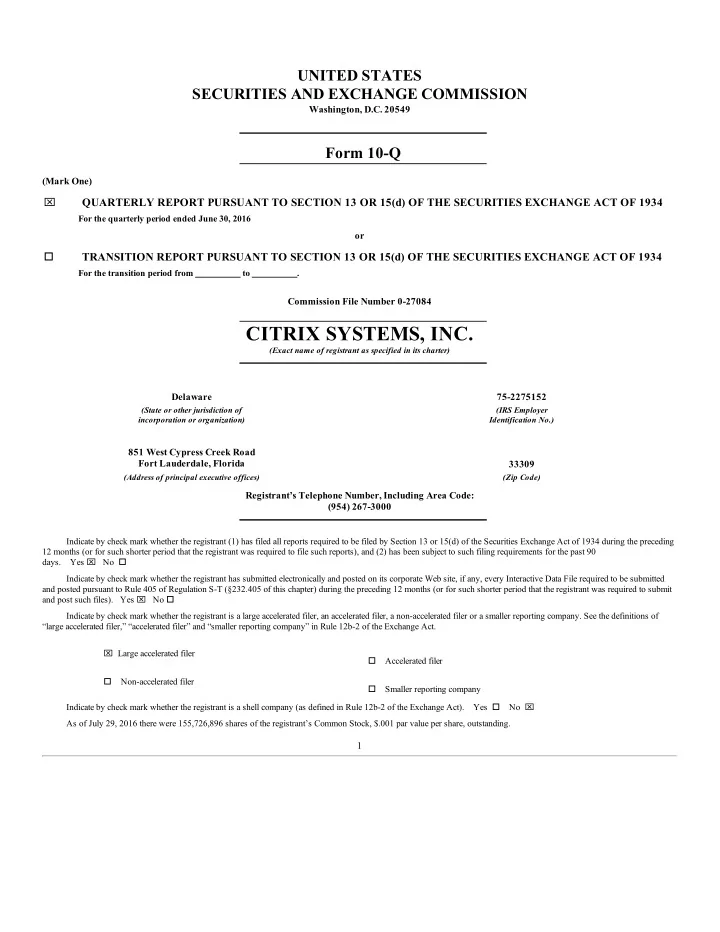
UNITED STATES SECURITIES AND EXCHANGE COMMISSION Washington, D.C. 20549 Form 10-Q (Mark One) x QUARTERLY REPORT PURSUANT TO SECTION 13 OR 15(d) OF THE SECURITIES EXCHANGE ACT OF 1934 For the quarterly period ended June 30, 2016 or o


slide-1
SLIDE 1

UNITED STATES SECURITIES AND EXCHANGE COMMISSION

Washington, D.C. 20549

Form 10-Q

(Mark One)

x QUARTERLY REPORT PURSUANT TO SECTION 13 OR 15(d) OF THE SECURITIES EXCHANGE ACT OF 1934

For the quarterly period ended June 30, 2016

  • r
  • TRANSITION REPORT PURSUANT TO SECTION 13 OR 15(d) OF THE SECURITIES EXCHANGE ACT OF 1934

For the transition period from to .

Commission File Number 0-27084

CITRIX SYSTEMS, INC.

(Exact name of registrant as specified in its charter)

Delaware 75-2275152

(State or other jurisdiction of incorporation or organization) (IRS Employer Identification No.)

851 West Cypress Creek Road Fort Lauderdale, Florida 33309

(Address of principal executive offices) (Zip Code)

Registrant’s Telephone Number, Including Area Code: (954) 267-3000

Indicate by check mark whether the registrant (1) has filed all reports required to be filed by Section 13 or 15(d) of the Securities Exchange Act of 1934 during the preceding 12 months (or for such shorter period that the registrant was required to file such reports), and (2) has been subject to such filing requirements for the past 90

  • days. Yes x No o

Indicate by check mark whether the registrant has submitted electronically and posted on its corporate Web site, if any, every Interactive Data File required to be submitted and posted pursuant to Rule 405 of Regulation S-T (§232.405 of this chapter) during the preceding 12 months (or for such shorter period that the registrant was required to submit and post such files). Yes x No o Indicate by check mark whether the registrant is a large accelerated filer, an accelerated filer, a non-accelerated filer or a smaller reporting company. See the definitions of “large accelerated filer,” “accelerated filer” and “smaller reporting company” in Rule 12b-2 of the Exchange Act. x Large accelerated filer

  • Accelerated filer
  • Non-accelerated filer
  • Smaller reporting company

Indicate by check mark whether the registrant is a shell company (as defined in Rule 12b-2 of the Exchange Act). Yes o No x As of July 29, 2016 there were 155,726,896 shares of the registrant’s Common Stock, $.001 par value per share, outstanding.

1

slide-2
SLIDE 2

CITRIX SYSTEMS, INC. Form 10-Q For the Quarterly Period Ended June 30, 2016 CONTENTS

Page Number

PART I: FINANCIAL INFORMATION Item 1. Condensed Consolidated Financial Statements Condensed Consolidated Balance Sheets: June 30, 2016 (Unaudited) and December 31, 2015 (Derived from audited financial statements) 3 Condensed Consolidated Statements of Income: Three and Six Months ended June 30, 2016 and 2015 (Unaudited) 4 Condensed Consolidated Statements of Comprehensive Income: Three and Six Months ended June 30, 2016 and 2015 (Unaudited) 5 Condensed Consolidated Statements of Cash Flows: Six Months ended June 30, 2016 and 2015 (Unaudited) 6 Notes to Condensed Consolidated Financial Statements (Unaudited) 7 Item 2. Management’s Discussion and Analysis of Financial Condition and Results of Operations 33 Item 3. Quantitative and Qualitative Disclosures About Market Risk 47 Item 4. Controls and Procedures 47 PART II: OTHER INFORMATION Item 1. Legal Proceedings 48 Item 1A. Risk Factors 48 Item 2. Unregistered Sales of Equity Securities and Use of Proceeds 50 Item 5. Other Information 50 Item 6. Exhibits 51 Signature 52 2

slide-3
SLIDE 3

PART I: FINANCIAL INFORMATION ITEM 1. CONDENSED CONSOLIDATED FINANCIAL STATEMENTS

CITRIX SYSTEMS, INC. CONDENSED CONSOLIDATED BALANCE SHEETS June 30, 2016 December 31, 2015 (Unaudited) (Derived from audited financial statements) (In thousands, except par value) Assets Current assets: Cash and cash equivalents $ 666,232 $ 368,518 Short-term investments, available-for-sale 684,599 502,852 Accounts receivable, net of allowances of $5,694 and $7,719 at June 30, 2016 and December 31, 2015, respectively 504,420 669,276 Inventories, net 11,509 10,521 Prepaid expenses and other current assets 135,031 132,784 Total current assets 2,001,791 1,683,951 Long-term investments, available-for-sale 854,486 891,964 Property and equipment, net 365,804 373,817 Goodwill 1,962,169 1,962,722 Other intangible assets, net 260,668 283,418 Deferred tax assets, net 214,505 215,196 Other assets 54,791 56,449 Total assets $ 5,714,214 $ 5,467,517 Liabilities and Stockholders' Equity Current liabilities: Accounts payable $ 72,639 $ 95,396 Accrued expenses and other current liabilities 315,259 317,468 Income taxes payable 27,682 18,351 Current portion of deferred revenues 1,211,103 1,249,754 Total current liabilities 1,626,683 1,680,969 Long-term portion of deferred revenues 425,979 414,314 Convertible notes 1,329,478 1,311,071 Other liabilities 90,029 87,717 Commitments and contingencies Stockholders' equity: Preferred stock at $.01 par value: 5,000 shares authorized, none issued and outstanding — — Common stock at $.001 par value: 1,000,000 shares authorized; 301,356 and 299,113 shares issued and

  • utstanding at June 30, 2016 and December 31, 2015, respectively

301 299 Additional paid-in capital 4,697,059 4,566,919 Retained earnings 3,678,986 3,474,625 Accumulated other comprehensive loss (21,900) (28,527) 8,354,446 8,013,316 Less - common stock in treasury, at cost (146,285 and 145,296 shares at June 30, 2016 and December 31, 2015, respectively) (6,112,401) (6,039,870) Total stockholders' equity 2,242,045 1,973,446 Total liabilities and stockholders' equity $ 5,714,214 $ 5,467,517 See accompanying notes.

3

slide-4
SLIDE 4

CITRIX SYSTEMS, INC. CONDENSED CONSOLIDATED STATEMENTS OF INCOME (Unaudited)

Three Months Ended June 30, Six Months Ended June 30, 2016 2015 2016 2015 (In thousands, except per share information)

Revenues: Product and licenses $ 219,618 $ 204,974 $ 421,823 $ 388,255 Software as a service 201,646 177,584 399,494 346,948 License updates and maintenance 386,864 377,161 779,882 748,458 Professional services 34,852 37,040 67,459 73,900 Total net revenues 842,980 796,759 1,668,658 1,557,561 Cost of net revenues: Cost of product and license revenues 33,623 24,290 65,018 48,974 Cost of services and maintenance revenues 95,029 89,733 187,611 178,923 Amortization of product related intangible assets 15,670 18,728 30,785 37,085 Impairment of product related intangible assets — — — 375 Total cost of net revenues 144,322 132,751 283,414 265,357 Gross margin 698,658 664,008 1,385,244 1,292,204 Operating expenses: Research and development 124,761 140,203 248,720 284,844 Sales, marketing and services 298,449 296,258 591,197 602,663 General and administrative 97,136 79,872 187,915 161,898 Amortization of other intangible assets 7,286 10,992 14,680 20,433 Restructuring 4,016 14,534 50,081 48,485 Separation 13,923 — 28,610 — Total operating expenses 545,571 541,859 1,121,203 1,118,323 Income from operations 153,087 122,149 264,041 173,881 Interest income 4,164 2,841 7,915 5,675 Interest expense 11,196 11,001 22,351 22,121 Other expense, net (272) (3,262) (1,275) (11,111) Income before income taxes 145,783 110,727 248,330 146,324 Income tax expense 24,885 7,452 43,969 14,162 Net income $ 120,898 $ 103,275 $ 204,361 $ 132,162 Earnings per share: Basic $ 0.78 $ 0.64 $ 1.32 $ 0.82 Diluted $ 0.77 $ 0.64 $ 1.31 $ 0.82 Weighted average shares outstanding: Basic 154,998 161,085 154,485 160,347 Diluted 156,666 162,027 156,258 161,674 See accompanying notes. 4

slide-5
SLIDE 5

CITRIX SYSTEMS, INC. CONDENSED CONSOLIDATED STATEMENTS OF COMPREHENSIVE INCOME (Unaudited)

Three Months Ended June 30, Six Months Ended June 30, 2016 2015 2016 2015 (In thousands)

Net income $ 120,898 $ 103,275 $ 204,361 $ 132,162 Other comprehensive income: Available for sale securities: Change in net unrealized gains (losses) 1,793 (896) 5,892 1,298 Less: reclassification adjustment for net (gains) losses included in net income (270) (136) (292) (68) Net change (net of tax effect) 1,523 (1,032) 5,600 1,230 Cash flow hedges: Change in unrealized (losses) gains (2,218) 2,347 4 (3,344) Less: reclassification adjustment for net (gains)losses included in net income (142) 5,421 1,023 9,668 Net change (net of tax effect) (2,360) 7,768 1,027 6,324 Other comprehensive (loss) income (837) 6,736 6,627 7,554 Comprehensive income $ 120,061 $ 110,011 $ 210,988 $ 139,716 See accompanying notes. 5

slide-6
SLIDE 6

CITRIX SYSTEMS, INC. CONDENSED CONSOLIDATED STATEMENTS OF CASH FLOWS (Unaudited)

Six Months Ended June 30, 2016 2015 (In thousands) Operating Activities Net income $ 204,361

$

132,162 Adjustments to reconcile net income to net cash provided by operating activities: Depreciation, amortization and other 149,019 150,960 Stock-based compensation expense 87,920 65,003 Excess tax benefit from stock-based compensation (10,308) (1,924) Deferred income tax benefit (9,508) (5,554) Effects of exchange rate changes on monetary assets and liabilities denominated in foreign currencies (2,242) 9,318 Other non-cash items 2,819 8,335 Total adjustments to reconcile net income to net cash provided by operating activities 217,700 226,138 Changes in operating assets and liabilities, net of the effects of acquisitions: Accounts receivable 164,000 168,851 Inventories (1,463) (771) Prepaid expenses and other current assets (15,565) (3,381) Other assets 1,790 (6,023) Income taxes, net 34,399 8,380 Accounts payable (29,020) 38 Accrued expenses and other current liabilities 17,238 (20,082) Deferred revenues (22,316) (18,319) Other liabilities (2,797) 6,025 Total changes in operating assets and liabilities, net of the effects of acquisitions 146,266 134,718 Net cash provided by operating activities 568,327 493,018 Investing Activities Purchases of available-for-sale investments (907,498) (1,048,809) Proceeds from sales of available-for-sale investments 446,932 834,578 Proceeds from maturities of available-for-sale investments 322,100 333,633 Purchases of property and equipment (76,677) (80,005) Cash paid for acquisitions, net of cash acquired — (251,184) Cash paid for licensing agreements and technology (24,836) (9,334) Other 544 (1,058) Net cash used in investing activities (239,435) (222,179) Financing Activities Proceeds from issuance of common stock under stock-based compensation plans 30,559 43,419 Proceeds from credit facility — 95,000 Repayment of credit facility — (95,000) Repayment of acquired debt — (7,569) Excess tax benefit from stock-based compensation 10,308 1,924 Stock repurchases, net (28,689) (172,132) Cash paid for tax withholding on vested stock awards (43,842) (28,321) Net cash used in financing activities (31,664) (162,679) Effect of exchange rate changes on cash and cash equivalents 486 (5,996) Change in cash and cash equivalents 297,714 102,164 Cash and cash equivalents at beginning of period 368,518 260,149 Cash and cash equivalents at end of period $ 666,232

$

362,313

See accompanying notes.

6

slide-7
SLIDE 7

CITRIX SYSTEMS, INC. NOTES TO CONDENSED CONSOLIDATED FINANCIAL STATEMENTS (Unaudited)

  • 1. BASIS OF PRESENTATION

The accompanying unaudited condensed consolidated financial statements of Citrix Systems, Inc. (the “Company”) have been prepared in accordance with accounting principles generally accepted in the United States for interim financial information and with the instructions to Form 10-Q and Rule 10-01 of Regulation S-X. Accordingly, they do not include all of the information and notes required by accounting principles generally accepted in the United States for complete financial statements. All adjustments, which, in the opinion of management, are considered necessary for a fair presentation of the results of

  • perations for the periods shown, are of a normal recurring nature and have been reflected in the condensed consolidated financial statements and

accompanying notes. The results of operations for the periods presented are not necessarily indicative of the results expected for the full year or for any future period partially because of the seasonality of the Company’s business. Historically, the Company’s revenue for the fourth quarter of any year is typically higher than the revenue for the first quarter of the subsequent year. The information included in these condensed consolidated financial statements should be read in conjunction with “Management’s Discussion and Analysis of Financial Condition and Results of Operations” contained in this report and the consolidated financial statements and accompanying notes included in the Company’s Annual Report on Form 10-K for the year ended December 31, 2015. The condensed consolidated financial statements of the Company include the accounts of its wholly-owned subsidiaries in the Americas, Europe, the Middle East and Africa (“EMEA”), and Asia-Pacific. All significant transactions and balances between the Company and its subsidiaries have been eliminated in consolidation. As part of its continued transformation, effective January 1, 2016, the Company reorganized a part of its business by creating a new Cloud Services business unit that primarily includes the ShareFile product line. Prior to 2016, the ShareFile product line was included within the Company's Workflow Cloud products under the Mobility Apps segment. The Company's management has changed how it views the business primarily due to operational initiatives announced in 2015, which include increased emphasis and investments in core enterprise products for secure and reliable application and data

  • delivery. As a result, the Company realigned its Cloud Services products and services to be included in the Enterprise and Service Provider segment effective

January 1, 2016 in contemplation of the strategic shift and the proposed separation of the GoTo family of products. See Notes 18 and 20 for more information

  • n the Company's proposed separation of its GoTo business.

The Company’s revenues are derived from its Enterprise and Service Provider products, which primarily include its Workspace Services, Delivery Networking and Cloud Services products and related license updates and maintenance and professional services, and from its Mobility Apps products, which primarily include Communications Cloud and Workflow Cloud products. Enterprise and Service Provider and Mobility Apps business units constitute the Company's two reportable segments. See Note 9 for more information on the Company's segments.

  • 2. SIGNIFICANT ACCOUNTING POLICIES

Use of Estimates The preparation of financial statements in conformity with accounting principles generally accepted in the United States requires management to make estimates and assumptions that affect the amounts reported in the condensed consolidated financial statements and accompanying notes. Significant estimates made by management include the provision for doubtful accounts receivable, the provision to reduce obsolete or excess inventory to market, the provision for estimated returns, as well as sales allowances, the assumptions used in the valuation of stock-based awards, the assumptions used in the discounted cash flows to mark certain of its investments to market, the valuation of the Company’s goodwill, net realizable value of product related and other intangible assets, the fair value of convertible senior notes, the provision for lease losses, the provision for income taxes and the amortization and depreciation periods for intangible and long-lived assets. While the Company believes that such estimates are fair when considered in conjunction with the condensed consolidated financial position and results of operations taken as a whole, the actual amounts of such items, when known, will vary from these estimates. Available-for-sale Investments Short-term and long-term available-for-sale investments as of June 30, 2016 and December 31, 2015 primarily consist of agency securities, corporate securities, municipal securities and government securities. Investments classified as available-for-sale are stated at fair value with unrealized gains and losses, net of taxes, reported in Accumulated other comprehensive loss. The Company classifies its available-for-sale investments as current and non-current based

  • n their actual remaining time to maturity. The Company does not recognize changes in the fair value of its available-for-sale investments in income unless a

decline in value is considered other-than-temporary in accordance with the authoritative guidance. 7

slide-8
SLIDE 8

The Company’s investment policy is designed to limit exposure to any one issuer depending on credit quality. The Company uses information provided by third parties to adjust the carrying value of certain of its investments to fair value at the end of each period. Fair values are based on a variety of inputs and may include interest rates, known historical trades, yield curve information, benchmark data, prepayment speeds, credit quality and broker/dealer

  • quotes. See Note 5 for investment information.

Revenue Recognition Net revenues include the following categories: Product and licenses, SaaS, License updates and maintenance and Professional services. Product and licenses revenues primarily represent fees related to the licensing of the Company’s software and hardware appliances. These revenues are reflected net of sales allowances, cooperative advertising agreements, partner incentive programs and provisions for returns. SaaS revenues consist primarily of fees related to

  • nline service agreements, which are recognized ratably over the contract term, which is typically 12 months. In addition, SaaS revenues may also include

set-up fees, which are recognized ratably over the contract term or the expected customer life, whichever is longer. License updates and maintenance revenues consist of fees related to the Subscription Advantage program and maintenance fees, which include technical support and hardware and software

  • maintenance. Subscription Advantage is a renewable program that provides subscribers with immediate access to software upgrades, enhancements and

maintenance releases when and if they become available during the term of the contract. Subscription Advantage and maintenance fees are recognized ratably over the term of the contract, which is typically 12 to 24 months. The Company capitalizes certain third-party commissions related to Subscription Advantage, maintenance and support renewals. The capitalized commissions are amortized to Sales, marketing and services expense at the time the related deferred revenue is recognized as revenue. Hardware and software maintenance and support contracts are typically sold separately. Hardware maintenance includes technical support, the latest software upgrades when and if they become available, and replacement of malfunctioning appliances. Dedicated account management is available as an add-on to the program for a higher level of service. Software maintenance includes unlimited technical support, immediate access to software upgrades, enhancements and maintenance releases when and if they become available during the term of the contract during the term of the contract. Professional services revenues are comprised of fees from consulting services related to the implementation of the Company’s products and fees from product training and certification, which are recognized as the services are provided. The Company recognizes revenue when it is earned and when all of the following criteria are met: persuasive evidence of the arrangement exists; delivery has occurred or the service has been provided and the Company has no remaining obligations; the fee is fixed or determinable; and collectability is probable. The majority of the Company’s product and license revenue consists of revenue from the sale of software products. Software sales generally include a perpetual license to the Company’s software and is subject to the industry specific software revenue recognition guidance. In accordance with this guidance, the Company allocates revenue to license updates related to its stand-alone software and any other undelivered elements of the arrangement based on vendor specific objective evidence (“VSOE”) of fair value of each element and such amounts are deferred until the applicable delivery criteria and other revenue recognition criteria described above have been met. The balance of the revenues, net of any discounts inherent in the arrangement, is recognized at the outset

  • f the arrangement using the residual method as the product licenses are delivered. If management cannot objectively determine the fair value of each

undelivered element based on VSOE of fair value, revenue recognition is deferred until all elements are delivered, all services have been performed, or until fair value can be objectively determined. For hardware appliance and software transactions, the arrangement consideration is allocated to stand-alone software deliverables as a group and the non-software deliverables based on the relative selling prices using the selling price hierarchy in the revenue recognition guidance. The selling price hierarchy for a deliverable is based on its VSOE if available, third-party evidence of selling price ("TPE") if VSOE is not available, or estimated selling price ("ESP") if neither VSOE nor TPE is available. The Company then recognizes revenue on each deliverable in accordance with its policies for product and service revenue recognition. VSOE of selling price is based on the price charged when the element is sold separately. In determining VSOE, the Company requires that a substantial majority of the selling prices fall within a reasonable range based on historical discounting trends for specific products and

  • services. TPE of selling price is established by evaluating competitor products or services in stand-alone sales to similarly situated customers. However, as the

Company’s products contain a significant element of proprietary technology and its solutions offer substantially different features and functionality, the comparable pricing of products with similar functionality typically cannot be obtained. Additionally, as the Company is unable to reliably determine what competitors products’ selling prices are on a stand-alone basis, the Company is not typically able to determine TPE. The estimate of selling price is established considering multiple factors including, but not limited to, pricing practices in different geographies and through different sales channels and competitor pricing strategies. The Citrix Service Provider ("CSP") program provides subscription-based services in which the CSP partners host software services to their end users. The fees from the CSP program are recognized based on usage and as the CSP services are provided to their end users. 8

slide-9
SLIDE 9

For the Company’s non-software transactions, it allocates the arrangement consideration based on the relative selling price of the deliverables. For the Company’s hardware appliances, it uses ESP as its selling price. For the Company’s support and services, it generally uses VSOE as its selling price. When the Company is unable to establish selling price using VSOE for its support and services, the Company uses ESP in its allocation of arrangement consideration. The Company’s Mobility Apps products and a majority of Cloud Services are considered hosted service arrangements per the authoritative guidance, or

  • SaaS. Generally, the Company’s Mobility Apps products are sold separately and not bundled with the Enterprise and Service Provider business unit’s

products and services. In the normal course of business, the Company is not obligated to accept product returns from its distributors under any conditions, unless the product item is defective in manufacture. The Company establishes provisions for estimated returns, as well as other sales allowances, concurrently with the recognition of revenue. The provisions are established based upon consideration of a variety of factors, including, among other things, recent and historical return rates for both specific products and distributors and the impact of any new product releases and projected economic conditions. Product returns are provided for in the condensed consolidated financial statements and have historically been within management’s expectations. Allowances for estimated product returns amounted to approximately $1.2 million and $1.4 million at June 30, 2016 and December 31, 2015, respectively. The Company also records estimated reductions to revenue for customer programs and incentive offerings, including volume-based incentives. The Company could take actions to increase its customer incentive offerings, which could result in an incremental reduction to revenue at the time the incentive is offered. Foreign Currency The functional currency for all of the Company’s wholly-owned foreign subsidiaries is the U.S. dollar. Monetary assets and liabilities of such subsidiaries are remeasured into U.S. dollars at exchange rates in effect at the balance sheet date, and revenues and expenses are remeasured at average rates prevailing during the year. Effective January 1, 2015, the functional currency of the Company’s wholly-owned foreign subsidiaries of its Mobility Apps business unit became the U.S. dollar as a result of a reorganization in the foreign subsidiaries' operations. Prior to January 1, 2015, the functional currency of the Company’s wholly-owned foreign subsidiaries of its Mobility Apps business unit was the currency of the country in which each subsidiary is located. The Company translated assets and liabilities of these foreign subsidiaries at exchange rates in effect at the balance sheet date and included accumulated net translation adjustments in equity as a component of Accumulated other comprehensive loss. The change in functional currency is applied on a prospective basis, therefore any gains and losses that were previously recorded in Accumulated other comprehensive loss remain unchanged from January 1, 2015. Foreign currency transaction gains and losses are the result of exchange rate changes on transactions denominated in currencies other than the functional currency, including U.S. dollars. The remeasurement of those foreign currency transactions is included in determining net income or loss for the period of

  • exchange. See Note 9 for information on the Company's Enterprise and Service Provider and Mobility Apps business units.

Accounting for Stock-Based Compensation Plans The Company has various stock-based compensation plans for its employees and outside directors and accounts for stock-based compensation arrangements in accordance with the authoritative guidance, which requires the Company to measure and record compensation expense in its condensed consolidated financial statements using a fair value method. See Note 7 for further information regarding the Company’s stock-based compensation plans.

  • 3. EARNINGS PER SHARE

Basic earnings per share is calculated by dividing income available to stockholders by the weighted-average number of common shares outstanding during each period. Diluted earnings per share is computed using the weighted-average number of common and dilutive common share equivalents

  • utstanding during the period. Dilutive common share equivalents consist of shares issuable upon the exercise or settlement of stock awards (calculated

using the treasury stock method) during the period they were outstanding. 9

slide-10
SLIDE 10

The following table sets forth the computation of basic and diluted net income per share (in thousands, except per share information):

Three Months Ended Six Months Ended June 30, June 30, 2016 2015 2016 2015

Numerator: Net income $ 120,898 $ 103,275 $ 204,361 $ 132,162 Denominator: Denominator for basic earnings per share - weighted-average shares outstanding 154,998 161,085 154,485 160,347 Effect of dilutive employee stock awards 1,668 942 1,773 1,327 Denominator for diluted earnings per share - weighted-average shares outstanding 156,666 162,027 156,258 161,674 Basic earnings per share $ 0.78 $ 0.64 $ 1.32 $ 0.82 Diluted earnings per share $ 0.77 $ 0.64 $ 1.31 $ 0.82 Anti-dilutive weighted-average shares from stock awards 296 2,426 574 2,514 The weighted-average number of shares outstanding used in the computation of basic and diluted earnings per share does not include the effect of the potential outstanding common stock from the Company's Convertible Senior Notes (the "Convertible Notes") and warrants. The effects of these potentially

  • utstanding shares were not included in the calculation of diluted earnings per share because the effect would have been anti-dilutive.

The Company uses the treasury stock method for calculating any potential dilutive effect of the conversion spread on its Convertible Notes on diluted earnings per share, if applicable, as upon conversion, the Company will pay cash up to the aggregate principal amount of the Convertible Notes to be converted and pay or deliver, as the case may be, cash, shares of common stock or a combination of cash and shares of common stock, at the Company’s election, in respect of the remainder, if any, of the Company’s conversion obligation in excess of the aggregate principal amount of the Convertible Notes being converted. The conversion spread will have a dilutive impact on diluted earnings per share when the average market price of the Company’s common shares for a given period exceeds the conversion price of $90.00 per share. For the three and six months ended June 30, 2016 and 2015, the Convertible Notes have been excluded from the computation of diluted earnings per share as the effect would be anti-dilutive since the conversion price of the Convertible Notes exceeded the average market price of the Company’s common stock. In addition, the Company uses the treasury stock method for calculating any potential dilutive effect related to the warrants. See Note 10 to the Company's condensed consolidated financial statements for detailed information on the Convertible Notes offering. Common shares potentially issuable of 213,037 and 509,140 from stock options for the three and six months ended June 30, 2016 are excluded from the calculation of diluted earnings per share because the weighted average exercise price of $84.37 and $83.17, respectively, was greater than the average market price of common stock for the period.

  • 4. ACQUISITIONS AND DIVESTITURES

2016 Asset Acquisition On January 8, 2016, the Company acquired certain monitoring technology assets from a privately-held company for total cash consideration of $23.6

  • million. The acquisition provides a monitoring solution for Citrix's products as it relates to Microsoft Windows applications and desktop delivery. The

identifiable intangible assets acquired related primarily to product technologies. 2016 Divestiture On February 29, 2016, the Company sold its CloudPlatform and CloudPortal Business Manager products to Persistent Telecom Solutions, Inc. The agreement included contingent consideration in the form of an earnout provision based on revenue for a period of five years following the closing date. Any income associated with the contingent consideration will be recognized if the earnout provisions are met. No earnout provisions were met during the six months ended June 30, 2016, therefore no income was recognized during the six months ended June 30, 2016. 10

slide-11
SLIDE 11

2015 Acquisitions Sanbolic On January 8, 2015, the Company acquired all of the issued and outstanding securities of Sanbolic, Inc. (“Sanbolic”). The Company expected the Sanbolic technology would reduce the complexity of Microsoft Windows application delivery and desktop virtualization deployments. Sanbolic became part of the Company's Enterprise and Service Provider segment. The total cash consideration for this transaction was approximately $89.4 million, net of $0.2 million cash acquired. Transaction costs associated with the acquisition were $0.5 million. No transaction costs were recorded during the three months ended June 30, 2015 and the Company expensed $0.2 million during the six months ended June 30, 2015, and are included in General and administrative expense in the accompanying condensed consolidated statements of income. In addition, in connection with the acquisition, the Company assumed non-vested stock units which were converted into the right to receive, in the aggregate, up to 37,057 shares of the Company's common stock, for which the vesting period began on the closing of the transaction. During the fourth quarter of 2015, management performed a comprehensive operational review which included an evaluation of all of the Company's products. In connection with this review, management determined that the Sanbolic technology was a non-core solution and that the related product offerings will no longer be developed. As a result, the Company impaired the remaining carrying value of the intangible assets related to this acquisition in the fourth quarter of 2015. Grasshopper On May 18, 2015, the Company acquired all of the membership interests of Grasshopper Group, LLC (“Grasshopper”), a leading provider of cloud- based phone solutions for small businesses. With the acquisition, the Company will expand its breadth of communication and collaboration solutions for small businesses, including GoToMeeting, GoToTraining, GoToWebinar and OpenVoice. Grasshopper became part of the Mobility Apps segment. Total cash consideration for this transaction was approximately $161.5 million, net of $3.6 million cash acquired. No transaction costs were recorded during the three months ended June 30, 2015 and the Company expensed $0.3 million, during the six months ended June 30, 2015, and are included in General and administrative expense in the accompanying condensed consolidated statements of income. In addition, in connection with the acquisition, the Company assumed non-vested stock units which were converted into the right to receive, in the aggregate, up to 105,765 shares of the Company's common stock, for which the vesting period commenced on the closing of the transaction.

  • 5. INVESTMENTS

Available-for-sale Investments Investments in available-for-sale securities at fair value were as follows for the periods ended (in thousands):

June 30, 2016 December 31, 2015 Description of the Securities Amortized Cost Gross Unrealized Gains Gross Unrealized Losses Fair Value Amortized Cost Gross Unrealized Gains Gross Unrealized Losses Fair Value

Agency securities $ 538,278 $ 1,278 $ (125) $ 539,431 $ 530,981 $ 757 $ (1,216) $ 530,522 Corporate securities 783,996 1,865 (295) 785,566 699,210 90 (1,929) 697,371 Municipal securities 3,888 18 — 3,906 14,872 14 (8) 14,878 Government securities 209,826 356 — 210,182 152,376 9 (340) 152,045 Total $ 1,535,988 $ 3,517 $ (420) $ 1,539,085 $ 1,397,439 $ 870 $ (3,493) $ 1,394,816 The change in net unrealized gains (losses) on available-for-sale securities recorded in Other comprehensive income includes unrealized gains (losses) that arose from changes in market value of specifically identified securities that were held during the period, gains (losses) that were previously unrealized, but have been recognized in current period net income due to sales, as well as prepayments of available-for-sale investments purchased at a premium. This reclassification has no effect on total comprehensive income or equity and was not material for all periods presented. See Note 13 for more information related to comprehensive income. The average remaining maturities of the Company’s short-term and long-term available-for-sale investments at June 30, 2016 were approximately six months and three years, respectively. 11

slide-12
SLIDE 12

Realized Gains and Losses on Available-for-sale Investments For the three and six months ended June 30, 2016, the Company received proceeds from the sales of available-for-sale investments of $212.7 million and $446.9 million, respectively, and for the three and six months ended June 30, 2015, it received proceeds from the sales of available-for-sale investments

  • f $401.7 million and $834.6 million, respectively.

The Company had realized gains on the sales of available-for-sale investments during the three and six months ended June 30, 2016 of $0.3 million and $0.5 million, respectively, and for the three and six months ended June 30, 2015, it had realized gains on the sales of available-for-sale investments of $0.3 million and $0.4 million, respectively. For the three and six months ended June 30, 2016, the Company had realized losses on available-for-sale investments of $0.1 million and $0.3 million, respectively, and for the three and six months ended June 30, 2015, it had realized losses of $0.1 million and $0.3 million, respectively, primarily related to sales of these investments during the period. All realized gains and losses related to the sales of available-for-sale investments are included in Other expense, net, in the accompanying condensed consolidated statements of income. Unrealized Losses on Available-for-Sale Investments The gross unrealized losses on the Company’s available-for-sale investments that are not deemed to be other-than-temporarily impaired as of June 30, 2016 and December 31, 2015 were $0.4 million and $3.5 million, respectively. Because the Company does not intend to sell any of its investments in an unrealized loss position and it is more likely than not that it will not be required to sell the securities before the recovery of its amortized cost basis, which may not occur until maturity, it does not consider the securities to be other-than-temporarily impaired. Cost Method Investments The Company held direct investments in privately-held companies of approximately $20.5 million and $19.9 million as of June 30, 2016 and December 31, 2015, respectively, which are accounted for based on the cost method and are included in Other assets in the accompanying condensed consolidated balance sheets. The Company periodically reviews these investments for impairment. If the Company determines that an other-than-temporary impairment has occurred, it will write-down the investment to its fair value. For the three months ended June 30, 2016, no cost method investments were determined to be impaired. For the six months ended June 30, 2016, certain cost method investments with a combined carrying value of $1.0 million were determined to be impaired and written down to their estimated fair value of $0.7 million, respectively. Accordingly, the Company recorded $0.3 million in impairment charges during the six months ended June 30, 2016, which are included in Other expense, net in the accompanying condensed consolidated financial statements. For the three and six months ended June 30, 2015, the Company determined that certain cost method investments were impaired and recorded a charge of $2.5 million and $3.0 million, respectively, which were included in Other expense, net in the accompanying condensed consolidated statements of income.

  • 6. FAIR VALUE MEASUREMENTS

The authoritative guidance defines fair value as an exit price, representing the amount that would either be received to sell an asset or be paid to transfer a liability in an orderly transaction between market participants. As such, fair value is a market-based measurement that should be determined based

  • n assumptions that market participants would use in pricing an asset or liability. As a basis for considering such assumptions, the guidance establishes a

three-tier fair value hierarchy, which prioritizes the inputs used in measuring fair value as follows:

  • Level 1. Observable inputs such as quoted prices in active markets for identical assets or liabilities;
  • Level 2. Inputs, other than the quoted prices in active markets, that are observable either directly or indirectly; and
  • Level 3. Unobservable inputs in which there is little or no market data, which require the reporting entity to develop its own assumptions.

Available-for-sale securities included in Level 2 are valued utilizing inputs obtained from an independent pricing service (the “Service”) which uses quoted market prices for identical or comparable instruments rather than direct observations of quoted prices in active markets. The Service applies a four level hierarchical pricing methodology to all of the Company’s fixed income securities based on the circumstances. The hierarchy starts with the highest priority pricing source, then subsequently uses inputs obtained from other third-party sources and large custodial institutions. The Service’s providers utilize a variety of inputs to determine their quoted prices. These inputs may include interest rates, known historical trades, yield curve information, benchmark data, prepayment speeds, credit quality and broker/dealer quotes. Substantially all of the Company’s available-for-sale investments are valued utilizing inputs

  • btained from the Service and accordingly are categorized as Level 2

12

slide-13
SLIDE 13

in the table below. The Company periodically independently assesses the pricing obtained from the Service and historically has not adjusted the Service's pricing as a result of this assessment. Available-for-sale securities are included in Level 3 when relevant observable inputs for a security are not available. The Company’s assessment of the significance of a particular input to the fair value measurement requires judgment and may affect the classification of assets and liabilities within the fair value hierarchy. In certain instances, the inputs used to measure fair value may meet the definition of more than one level

  • f the fair value hierarchy. The input with the lowest level priority is used to determine the applicable level in the fair value hierarchy.

Assets and Liabilities Measured at Fair Value on a Recurring Basis

As of June 30, 2016 Quoted Prices In Active Markets for Identical Assets (Level 1) Significant Other Observable Inputs (Level 2) Significant Unobservable Inputs (Level 3) (In thousands)

Assets: Cash and cash equivalents: Cash $ 347,336 $ 347,336 $ — $ — Money market funds 317,750 317,750 — — Corporate securities 1,146 — 1,146 — Available-for-sale securities: Agency securities 539,431 — 539,431 — Corporate securities 785,566 — 784,315 1,251 Municipal securities 3,906 — 3,906 — Government securities 210,182 — 210,182 — Prepaid expenses and other current assets: Foreign currency derivatives 2,624 — 2,624 — Total assets $ 2,207,941 $ 665,086 $ 1,541,604 $ 1,251 Accrued expenses and other current liabilities: Foreign currency derivatives 4,246 — 4,246 — Total liabilities $ 4,246 $ — $ 4,246 $ —

As of December 31, 2015 Quoted Prices In Active Markets for Identical Assets (Level 1) Significant Other Observable Inputs (Level 2) Significant Unobservable Inputs (Level 3) (In thousands)

Assets: Cash and cash equivalents: Cash $ 261,962 $ 261,962 $ — $ — Money market funds 102,968 102,968 — — Corporate securities 3,588 — 3,588 — Available-for-sale securities: Agency securities 530,522 — 530,522 — Corporate securities 697,371 — 695,809 1,562 Municipal securities 14,878 — 14,878 — Government securities 152,045 — 152,045 — Prepaid expenses and other current assets: Foreign currency derivatives 1,063 — 1,063 — Total assets $ 1,764,397 $ 364,930 $ 1,397,905 $ 1,562 Accrued expenses and other current liabilities: Foreign currency derivatives 3,678 — 3,678 — Total liabilities $ 3,678 $ — $ 3,678 $ — 13

slide-14
SLIDE 14

The Company’s fixed income available-for-sale security portfolio generally consists of investment grade securities from diverse issuers with a minimum credit rating of A-/A3 and a weighted-average credit rating of AA-/Aa3. The Company values these securities based on pricing from the Service, whose sources may use quoted prices in active markets for identical assets (Level 1 inputs) or inputs other than quoted prices that are observable either directly or indirectly (Level 2 inputs) in determining fair value, and accordingly, the Company classifies all of its fixed income available-for-sale securities as Level 2. The Company measures its cash flow hedges, which are classified as Prepaid expenses and other current assets and Accrued expenses and other current liabilities, at fair value based on indicative prices in active markets (Level 2 inputs). Assets Measured at Fair Value on a Non-recurring Basis Using Significant Unobservable Inputs (Level 3) During the three months ended June 30, 2016, no cost method investments were determined to be impaired. During the six months ended June 30, 2016, certain cost method investments with a combined carrying value of $1.0 million were determined to be impaired and written down to their estimated fair value of $0.7 million. Accordingly, the Company recorded $0.3 million in impairment charges during the six months ended June 30, 2016, which are included in Other expense, net in the accompanying condensed consolidated financial statements. For the three and six months ended June 30, 2015, the Company determined that certain cost method investments were impaired and recorded a charge of $2.5 million and $3.0 million, respectively, which were included in Other expense, net in the accompanying condensed consolidated financial statements. In determining the fair value of cost method investments, the Company considers many factors including but not limited to operating performance of the investee, the amount of cash that the investee has on-hand, the ability to obtain additional financing and the overall market conditions in which the investee operates. The fair value of the cost method investments represent a Level 3 valuation as the assumptions used in valuing these investments were not directly or indirectly observable. For certain intangible assets where the unamortized balances exceeded the undiscounted future net cash flows, the Company measures the amount of the impairment by calculating the amount by which the carrying values exceed the estimated fair values, which are based on projected discounted future net cash

  • flows. These non-recurring fair value measurements are categorized as Level 3 significant unobservable inputs. See Note 8 to the Company's condensed

consolidated financial statements for detailed information related to Goodwill and Other Intangible Assets. In connection with the change in segment composition, during the first quarter of 2016, the Company performed an assessment of its goodwill reporting units and determined that the recent Cloud Services reorganization resulted in the identification of three goodwill reporting units. The identification of these reporting units triggered a reallocation of goodwill as of January 1, 2016 based on the relative fair value approach. The fair value of each reporting unit was determined using a combination of the market approach and the income approach. Under the market approach, fair value is based on revenue and earnings multiples for guideline public companies and guideline transactions in the reporting unit's peer group. Specific to the income approach, key assumptions used include forecasts of revenue and expenses over an extended period of time, tax rates, long term growth rates and estimated costs of debt and equity capital to discount the projected cash flows. This non-recurring fair value measurement was categorized as Level 3, as significant unobservable inputs were used in the valuation analysis. Certain of these assumptions involve significant judgment, are based on management’s estimate of current and forecasted market conditions and are sensitive and susceptible to change. For Level 3 measurements, significant increases or decreases in long-term growth rates or discount rates in isolation or in combination could result in a significantly lower or higher fair value measurement. See Note 8 to the Company's condensed consolidated financial statements for detailed information related to Goodwill and Other Intangible Assets. Additional Disclosures Regarding Fair Value Measurements The carrying value of accounts receivable, accounts payable and accrued expenses approximate their fair value due to the short maturity of these items. As of June 30, 2016, the fair value of the Convertible Notes, which was determined based on inputs that are observable in the market (Level 2) based on the closing trading price per $100 as of the last day of trading for the quarter ended June 30, 2016, and carrying value of debt instruments (carrying value excludes the equity component of the Company’s Convertible Notes classified in equity) was as follows (in thousands):

Fair Value Carrying Value

Convertible Senior Notes $ 1,611,797 $ 1,329,478 14

slide-15
SLIDE 15
  • 7. STOCK-BASED COMPENSATION

The Company’s stock-based compensation program is a long-term retention program that is intended to attract and reward talented employees and align stockholder and employee interests. As of June 30, 2016, the Company had one stock-based compensation plan under which it was granting equity

  • awards. The Company is currently granting stock-based awards from its 2014 Equity Incentive Plan (the "2014 Plan"). In December 2014, the Company's

Board of Directors approved the 2015 Employee Stock Purchase Plan (the “2015 ESPP”), which was approved by stockholders at the Company's Annual Meeting of Stockholders held on May 28, 2015. The 2015 ESPP has replaced the Company's Amended and Restated 2005 Employee Stock Purchase Plan (as amended, the "2005 ESPP"). In connection with certain of the Company’s acquisitions, the Company has assumed certain plans from acquired companies. The Company’s Board of Directors has provided that no new awards will be granted under the Company’s acquired stock plans. Awards previously granted under the Company's superseded and expired stock plans that are still outstanding typically expire between five and ten years from the date of grant and will continue to be subject to all the terms and conditions of such plans, as applicable. The Company’s superseded and expired stock plans include the Amended and Restated 2005 Equity Incentive Plan and the 2005 ESPP. Under the terms of the 2014 Plan, the Company is authorized to grant incentive stock options (“ISOs”), non-qualified stock options (“NSOs”), non- vested stock, non-vested stock units, stock appreciation rights (“SARs”), and performance units and to make stock-based awards to full and part-time employees of the Company and its subsidiaries or affiliates, where legally eligible to participate, as well as to consultants and non-employee directors of the

  • Company. SARs and ISOs are not currently being granted. Currently, the 2014 Plan provides for the issuance of 29,000,000 shares of common stock. In

addition, shares of common stock underlying any awards granted under the Company’s Amended and Restated 2005 Equity Incentive Plan, as amended, that are forfeited, canceled or otherwise terminated (other than by exercise) are added to its shares of common stock available for issuance under the 2014 Plan. Under the 2014 Plan, NSOs must be granted at exercise prices no less than fair market value on the date of grant. Non-vested stock awards may be granted for such consideration in cash, other property or services, or a combination thereof, as determined by the Company’s Compensation Committee of its Board of

  • Directors. Stock-based awards are generally exercisable or issuable upon vesting. The Company’s policy is to recognize compensation cost for awards with
  • nly service conditions and a graded vesting schedule on a straight-line basis over the requisite service period for the entire award. As of June 30, 2016, there

were 21,980,489 shares of common stock reserved for issuance pursuant to the Company’s stock-based compensation plans including authorization under its 2014 Plan to grant stock-based awards covering 16,526,939 shares of common stock. Under the 2015 ESPP, all full-time and certain part-time employees of the Company are eligible to purchase common stock of the Company twice per year at the end of a six-month payment period (a “Payment Period”). During each Payment Period, eligible employees who so elect may authorize payroll deductions in an amount no less than 1% nor greater than 10% of his or her base pay for each payroll period in the Payment Period. At the end of each Payment Period, the accumulated deductions are used to purchase shares of common stock from the Company up to a maximum of 12,000 shares for any one employee during a Payment Period. Shares are purchased at a price equal to 85% of the fair market value of the Company's common stock, on either the first business day of the Payment Period or the last business day of the Payment Period, whichever is lower. Employees who, after exercising their rights to purchase shares of common stock in the 2015 ESPP, would own shares representing 5% or more of the voting power of the Company’s common stock, are ineligible to continue to participate under the 2015 ESPP. The 2015 ESPP provides for the issuance of a maximum of 16,000,000 shares of common stock. As

  • f June 30, 2016, 3,872,661 shares had been issued under the 2005 ESPP. As of June 30, 2016, 527,367 shares have been issued under the 2015 ESPP. The

Company recorded stock-based compensation costs related to its employee stock purchase plans of $2.5 million and $5.2 million for the three and six months ended June 30, 2016, respectively, and the Company recorded stock-based compensation costs of $1.3 million and $2.9 million for the three and six months ended June 30, 2015, respectively. The Company used the Black-Scholes model to estimate the fair value of its Employee Stock Purchase Plan awards with the following weighted- average assumptions:

Six Months Ended June 30, 2016

Expected volatility factor 0.41 Risk free interest rate 0.35% Expected dividend yield 0% Expected life (in years) 0.5 The Company determined the expected volatility factor by considering the implied volatility in six-month market-traded options of the Company's common stock based on third party volatility quotes. The Company's decision to use implied volatility was based upon the availability of actively traded

  • ptions on the Company's common stock and its assessment that

15

slide-16
SLIDE 16

implied volatility is more representative of future stock price trends than historical volatility. The risk-free interest rate was based on a U.S. Treasury instrument whose term is consistent with the expected term of the stock options. The Company's expected dividend yield input was zero as it has not historically paid, nor expects in the future to pay, cash dividends on its common stock. The expected term is based on the term of the purchase period for grants made under the ESPP. Stock-Based Compensation The detail of the total stock-based compensation recognized by income statement classification is as follows (in thousands):

Three Months Ended Six Months Ended Income Statement Classifications June 30, 2016 June 30, 2015 June 30, 2016 June 30, 2015

Cost of services and maintenance revenues $ 880 $ 742 $ 1,650 $ 1,292 Research and development 12,546 9,079 22,622 22,336 Sales, marketing and services 14,204 10,465 26,594 21,161 General and administrative 18,193 10,506 37,054 20,214 Total $ 45,823 $ 30,792 $ 87,920 $ 65,003 Non-vested Stock Units Performance, Market Performance and Service Condition Stock Units In January 2016, the Company granted its Chief Executive Officer 220,235 non-vested stock units that vest based on certain target performance conditions; and in March 2016, the Company granted senior level employees 234,816 non-vested stock units that vest based on certain target performance

  • conditions. The attainment level under the awards will be based on the Company's compound annualized total return to stockholders over a three-year

performance period, with 100% of such stock units earned if the Company achieves total shareholder return of 10% over the performance period. Further, if the Company achieves annualized total shareholder return of less than 10% during the performance period, the awardees may earn all or a portion of the target award, but not in excess of 100% of such stock units, depending upon the Company’s relative total shareholder return compared to companies listed in the S&P Computer Software Select Index. If the Company's compound annualized total shareholder return is 5% or above, the number of non-vested stock units earned will be based on interpolation, with the maximum number of non-vested stock units earned capped at 200% of the target number of non-vested stock units for a compound annualized total return to stockholders of 30% over a three-year performance period as set forth in the award agreement. Within sixty days following an interim measurement period of 18 months, the Compensation Committee will determine the number of restricted stock units that would be deemed earned based on performance to date, and up to 33% of the target award may be earned based on such performance; however, any stock units that are deemed earned will remain subject to continued service vesting until the end of the three-year performance period, or a change in control, if

  • earlier. Within sixty days following the conclusion of the performance period, the Company’s Compensation Committee will determine the number of

restricted stock units that would vest upon the final day of the performance period based on the Company’s performance during the period and in accordance with the terms of the award. On the vesting date, the greater of the full period restricted stock units, or the interim earned restricted stock units, will vest in one installment. In March 2015, the Company granted senior level employees non-vested stock unit awards representing, in the aggregate, 393,464 non-vested stock units that vest based on certain target market performance and service conditions. The number of non-vested stock units underlying the award will be determined within sixty days of the calendar year following the end of a three-year performance period ending December 31, 2017. The attainment level under the award will be based on the Company's total return to stockholders over the performance period compared to the return on the Nasdaq Composite Total Return Index (the "XCMP"). If the Company's return is positive and meets or exceeds the indexed return, the number of non-vested stock units earned will be based on interpolation, with the maximum number of non-vested stock units earned pursuant to the award capped at 200% of the target number of non-vested stock units set forth in the award agreement if the Company's return exceeds the indexed return by 40% or more. If the Company's return over the performance period is positive but underperforms the index, a number of non-vested stock units will be issued, below the target award, based on interpolation; however, no non-vested stock units will be issued if the Company's return underperforms the index by more than 20% over the performance

  • period. In the event the Company's return to stockholders is negative but still meets or exceeds the indexed return, only 75% of the target award shall be
  • issued. If the awardee is not employed by the Company at the end of the performance period; the extent to which the awardee will vest in the award, if at all,

is dependent upon the timing and character of the termination as provided in the award agreement. Each non-vested stock unit, upon vesting, represents the right to receive one share of the Company's common stock. 16

slide-17
SLIDE 17

The market condition requirements are reflected in the grant date fair value of the award, and the compensation expense for the award will be recognized assuming that the requisite service is rendered regardless of whether the market conditions are achieved. The grant date fair value of the non- vested performance stock unit awards was determined through the use of a Monte Carlo simulation model, which utilized multiple input variables that determined the probability of satisfying the market condition requirements applicable to each award as follows:

March 2016 Grant January 2016 Grant March 2015 Grant

Expected volatility factor 0.29 - 0.39 0.29 - 0.37 0.14 - 0.29 Risk free interest rate 0.91% 1.10% 0.85% Expected dividend yield 0% 0% 0% For the March 2016 and January 2016 grants, the range of expected volatilities utilized was based on the historical volatilities of the Company's common stock and the average of its peer group. The Company chose to use historical volatility to value these awards because historical stock prices were used to develop the correlation coefficients between the Company and its peer group in order to model the stock price movements. The volatilities used were calculated over a three year period, which is commensurate with the awards’ performance period at the date of grant. The risk free interest rate was based on the implied yield available on U.S. Treasury zero-coupon issues with remaining terms equivalent to the performance period. The Company does not intend to pay dividends on its common stock in the foreseeable future. Accordingly, the Company used a dividend yield of zero in its model. The estimated fair value

  • f each award as of the date of grant was $66.18 for the March 2016 grant and $49.68 for the January 2016 grant.

For the March 2015 grant, the range of expected volatilities utilized was based on the historical volatilities of the Company's common stock and the

  • XCMP. The Company chose to use historical volatility to value these awards because historical stock prices were used to develop the correlation coefficients

between the Company and the XCMP in order to model the stock price movements. The volatilities used were calculated over a 2.76 year period, which was the remaining term of the performance period at the date of grant. The risk free interest rate was based on the implied yield available on U.S. Treasury zero- coupon issues with remaining terms equivalent to the remaining performance period. The Company does not intend to pay dividends on its common stock in the foreseeable future. Accordingly, the Company used a dividend yield of zero in its model. The estimated fair value of the award as of the date of grant was $61.01. Service Based Stock Units The Company also awards senior level employees, certain other employees and new non-employee directors non-vested stock units granted under the 2014 Plan that vest based on service. The majority of these non-vested stock unit awards generally vest 33.33% on each anniversary subsequent to the date of the award. The Company also assumes non-vested stock units in connection with certain of its acquisitions. The assumed awards have the same three year vesting schedule. Each non-vested stock unit, upon vesting, represents the right to receive one share of the Company’s common stock. In addition, the Company awards non-vested stock units to all of its continuing non-employee directors. These awards vest monthly in 12 equal installments based on service and, upon vesting, each stock unit represents the right to receive one share of the Company's common stock. Performance Stock Units During 2015, the Company awarded certain senior level employees non-vested performance stock units granted under the 2014 Plan. The number of non-vested stock units underlying each award will be determined within sixty days of the calendar year following completion of the one-year performance period ending December 31, 2016 and will be based on achievement of a specific corporate financial performance goal determined at the time of the award. The number of non-vested stock units issued will be based on a graduated slope, with the maximum number of non-vested stock units issuable pursuant to the award capped at 100% of the base number of non-vested stock units set forth in the award agreement. The Company is required to estimate the attainment expected to be achieved related to the defined performance goals and the number of non-vested stock units that will ultimately be awarded in order to recognize compensation expense over the vesting period. Each non-vested stock unit, upon vesting, represents the right to receive one share of the Company’s common stock. If the performance goals are not met, no compensation cost will be recognized and any previously recognized compensation cost will be reversed. 17

slide-18
SLIDE 18

Unrecognized Compensation Related to Stock Units As of June 30, 2016, the number of all non-vested stock units outstanding, including market performance and service condition awards and service- based awards, including service-based awards assumed in connection with acquisitions, were 5,151,781. As of June 30, 2016, there was $277.1 million of total unrecognized compensation cost related to non-vested stock units. The unrecognized cost is expected to be recognized over a weighted-average period

  • f 2.05 years. See Note 4 for more information regarding the Company's acquisitions.

Non-vested Stock During the six months ended June 30, 2016, the Company granted non-vested stock awards of 118,588 shares to certain executive officers which typically vest between one to three years from the date of grant, subject to the holder’s continued employment with the Company. Non-vested stock is issued and outstanding upon grant; however, award holders are restricted from selling the shares until they vest. If the vesting conditions are not met, the award will be forfeited. Compensation expense is measured based on the closing market price of the Company’s common stock at the date of grant and is recognized on a straight-line basis over the vesting period. For the three and six months ended June 30, 2016, the Company recognized $2.8 million and $5.4 million, respectively, of stock-based compensation expense related to non-vested stock awards. At June 30, 2016, there was approximately $9.5 million of total unrecognized compensation expense related to these awards, which is expected to be recognized over a weighted average period of 1.86 years.

  • 8. GOODWILL AND OTHER INTANGIBLE ASSETS

Goodwill The Company accounts for goodwill in accordance with the authoritative guidance, which requires that goodwill and certain intangible assets are not amortized, but are subject to an annual impairment test. There was no impairment of goodwill or indefinite lived intangible assets as a result of the annual impairment test analysis completed during the fourth quarter of 2015. There were no indicators of impairment during the six months ended June 30, 2016. See Note 4 for more information regarding the Company's acquisitions and Note 9 for more information regarding the Company's segments. As part of its continued transformation, effective January 1, 2016, the Company reorganized a part of its business by creating a new Cloud Services business unit, which resulted in a change in segment composition. In connection with this change, during the first quarter of 2016, the Company performed an assessment of its goodwill reporting units and determined that the recent Cloud Services reorganization resulted in the identification of three goodwill reporting units (Enterprise and Service Provider excluding Cloud Services, Cloud Services and Mobility Apps). The identification of these reporting units triggered a reallocation of goodwill as of January 1, 2016 based on the relative fair value approach. The Company’s reportable segments remain unchanged. The following table presents the change in goodwill allocated to the Company’s reportable segments during the six months ended June 30, 2016 (in thousands):

Balance at January 1, 2016 Additions Other Balance at June 30, 2016

Enterprise and Service Provider $ 1,581,805

(1)

$ — $ (553) (2) $ 1,581,252 Mobility Apps 380,917

(1)

— — 380,917 Consolidated $ 1,962,722 $ — $ (553) $ 1,962,169

(1) Beginning balance as of January 1, 2016 adjusted to reflect the Company’s re-alignment of its reporting unit structure. The change resulted in a goodwill

reallocation of $86.5 million from the Mobility Apps segment into the Enterprise and Service Provider segment.

(2) Amount relates to goodwill associated with the sale of the Company’s CloudPlatform and CloudPortal Business Manager products and to adjustments to

the preliminary purchase price allocation associated with 2015 acquisitions. See Note 4 for more information regarding the Company's acquisitions and divestitures. Intangible Assets The Company has intangible assets which were primarily acquired in conjunction with business combinations and technology purchases. Intangible assets with finite lives are recorded at cost, less accumulated amortization. Amortization is computed over the estimated useful lives of the respective assets, generally three to seven years, except for patents, which are amortized over the lesser of their remaining life or ten years. In-process R&D is initially capitalized at fair value as an intangible asset with an indefinite life and assessed for impairment thereafter. When in-process R&D projects are completed, 18

slide-19
SLIDE 19

the corresponding amount is reclassified as an amortizable intangible asset and is amortized over the asset's estimated useful life. Intangible assets consist of the following (in thousands):

June 30, 2016 December 31, 2015 Gross Carrying Amount Accumulated Amortization Gross Carrying Amount Accumulated Amortization

Product related intangible assets $ 605,300 $ 497,550 $ 589,847 $ 476,141 Other 447,522 294,604 447,816 278,104 Total $ 1,052,822 $ 792,154 $ 1,037,663 $ 754,245 Amortization of product-related intangible assets, which consists primarily of product-related technologies and patents, was $15.7 million and $18.7 million for the three months ended June 30, 2016 and 2015, respectively, and $30.8 million and $37.1 million for the six months ended June 30, 2016 and 2015, respectively, and is classified as a component of Cost of net revenues in the accompanying condensed consolidated statements of income. Amortization of other intangible assets, which consist primarily of customer relationships, trade names and covenants not to compete was $7.3 million and $11.0 million for the three months ended June 30, 2016 and 2015, respectively, and $14.7 million and $20.4 million for the six months ended June 30, 2016 and 2015, respectively, and is classified as a component of Operating expenses in the accompanying condensed consolidated statements of income. The Company monitors its intangible assets for indicators of impairment. If the Company determines that an impairment has occurred, it will write- down the intangible asset to its fair value. For certain intangible assets where the unamortized balances exceeded the undiscounted future net cash flows, the Company measures the amount of the impairment by calculating the amount by which the carrying values exceed the estimated fair values, which are based

  • n projected discounted future net cash flows.

Estimated future amortization expense of intangible assets with finite lives as of June 30, 2016 is as follows (in thousands): Year ending December 31, Amount 2016 (remaining six months) $ 42,903 2017 67,709 2018 59,841 2019 37,300 2020 19,297 Thereafter 33,618 Total $ 260,668

  • 9. SEGMENT INFORMATION

The Enterprise and Service Provider and the Mobility Apps business units constitute the Company’s two reportable segments. The Company does not engage in intercompany revenue transfers between segments. The Company’s chief operating decision maker (“CODM”) evaluates the Company’s performance based primarily on profitability from its Enterprise and Service Provider and Mobility Apps products. The Company's CEO is the CODM. Segment profit for each segment includes certain research and development, sales, marketing and services and general and administrative expenses directly attributable to the segment as well as other corporate costs allocated to the segment and excludes certain expenses that are managed outside of the reportable

  • segments. Costs excluded from segment profit primarily consist of certain restructuring charges, stock-based compensation costs, charges or benefits related

to significant litigation that are not anticipated to be ongoing costs, amortization and impairment of product and other related intangible assets, net interest and other expense, net and separation costs. Accounting policies of the Company’s segments are the same as its consolidated accounting policies. As part of its continued transformation, effective January 1, 2016, the Company reorganized a part of its business by creating a new Cloud Services business unit that primarily includes the ShareFile product line. Prior to 2016, the ShareFile product line was included within the Company's Workflow Cloud products under the Mobility Apps segment. The Company's CODM has changed how it views the business primarily due to operational initiatives announced in 2015, which include increased emphasis and investments in core enterprise products for secure and reliable application and data delivery. As a result, the Company realigned its Cloud Services products and services to the Enterprise and Service Provider segment effective January 1, 2016 in contemplation of the strategic shift and the proposed separation of the GoTo family of products. 19

slide-20
SLIDE 20

See Notes 18 and 20 for more information on the Company's proposed separation of its GoTo business. In addition, previously reported segment results have been recast to conform to the 2016 presentation. Net revenues and segment profit, classified by the Company’s two reportable segments were as follows (in thousands):

Three Months Ended Six Months Ended June 30, June 30, 2016 2015 2016 2015

Net revenues: Enterprise and Service Provider $ 673,987 $ 643,913 $ 1,332,760 $ 1,257,038 Mobility Apps 168,993 152,846 335,898 300,523 Consolidated $ 842,980 $ 796,759 $ 1,668,658 $ 1,557,561 Segment profit: Enterprise and Service Provider $ 206,154 $ 160,729 $ 411,940 $ 278,600 Mobility Apps 33,651 36,464 64,178 65,680 Unallocated expenses(1): Amortization and impairment

  • f intangible assets

(22,956) (29,720) (45,465) (57,893) Stock-based compensation (45,823) (30,792) (87,920) (65,003) Restructuring (4,016) (14,534) (50,081) (48,485) Separation (13,923) — (28,610) — Other — — — 982 Net interest and other expense, net (7,304) (11,420) (15,712) (27,557) Consolidated income before income taxes $ 145,783 $ 110,727 $ 248,330 $ 146,324

(1) Represents expenses presented to management on a consolidated basis only and not allocated to the operating segments.

20

slide-21
SLIDE 21

Revenues by Product Grouping Revenues by product grouping for the Company’s Enterprise and Service Provider and Mobility Apps business units were as follows (in thousands):

Three Months Ended Six Months Ended June 30, June 30, 2016 2015 2016 2015

Net revenues: Enterprise and Service Provider Workspace Services revenues(1) $ 411,862 $ 404,300 $ 812,778 $ 793,663 Delivery Networking revenues(2) 194,898 175,271 390,368 338,240 Cloud Services revenues(3) 32,312 24,918 62,044 46,695 Professional services(4) 34,852 37,040 67,459 73,900 Other 63 2,384 111 4,540 Total Enterprise and Service Provider revenues 673,987 643,913 1,332,760 1,257,038 Mobility Apps revenues 168,993 152,846 335,898 300,523 Total net revenues $ 842,980 $ 796,759 $ 1,668,658 $ 1,557,561

(1) Workspace Services revenues are primarily comprised of sales from the Company’s windows app delivery products, which include XenDesktop and

XenApp, and the Company's mobile app delivery products, which include XenMobile and related license updates and maintenance and support.

(2) Delivery Networking revenues primarily include NetScaler, ByteMobile Smart Capacity and CloudBridge products and related license updates and

maintenance and support.

(3) Cloud Services revenues primarily include ShareFile, Podio and Citrix Workspace Cloud products. (4) Professional services revenues are primarily comprised of revenues from consulting services and product training and certification services.

Revenues by Geographic Location The following table presents revenues by segment and geographic location, for the following periods (in thousands):

Three Months Ended Six Months Ended June 30, June 30, 2016 2015 2016 2015

Net revenues: Enterprise and Service Provider Americas $ 402,684 $ 362,672 $ 791,370 $ 702,518 EMEA 205,064 208,676 411,995 413,358 Asia-Pacific 66,239 72,565 129,395 141,162 Total Enterprise and Service Provider revenues 673,987 643,913 1,332,760 1,257,038 Mobility Apps Americas 143,257 127,680 284,078 250,626 EMEA 21,446 20,374 42,532 40,186 Asia-Pacific 4,290 4,792 9,288 9,711 Total Mobility Apps revenues 168,993 152,846 335,898 300,523 Total net revenues $ 842,980 $ 796,759 $ 1,668,658 $ 1,557,561 21

slide-22
SLIDE 22
  • 10. CONVERTIBLE SENIOR NOTES

Convertible Notes Offering During 2014, the Company completed a private placement of approximately $1.44 billion principal amount of 0.500% Convertible Notes due 2019. The net proceeds from this offering were approximately $1.42 billion, after deducting the initial purchasers’ discounts and commissions and the estimated

  • ffering expenses payable by the Company. The Company used approximately $82.6 million of the net proceeds to pay the cost of the Bond Hedges

described below (after such cost was partially offset by the proceeds to the Company from the Warrant Transactions described below). The Company used the remainder of the net proceeds from the offering and a portion of its existing cash and investments to purchase an aggregate of approximately $1.5 billion of its common stock, as authorized under its share repurchase program. The Company used approximately $101.0 million to purchase shares of common stock from certain purchasers of the Convertible Notes in privately negotiated transactions concurrently with the closing of the offering, and the remaining $1.4 billion to purchase additional shares of common stock through an Accelerated Share Repurchase ("ASR") which the Company entered into with Citibank, N.A. (the “ASR Counterparty”) on April 25, 2014 (the “ASR Agreement”). The Convertible Notes are governed by the terms of an indenture, dated as of April 30, 2014 (the “Indenture”), between the Company and Wilmington Trust, National Association, as trustee (the “Trustee”). The Convertible Notes are the senior unsecured obligations of the Company and bear interest at a rate

  • f 0.500% per annum, payable semi-annually in arrears on April 15 and October 15 of each year. The Convertible Notes will mature on April 15, 2019, unless

earlier repurchased or converted. Upon conversion, the Company will pay cash up to the aggregate principal amount of the Convertible Notes to be converted and pay or deliver, as the case may be, cash, shares of common stock or a combination of cash and shares of common stock, at the Company’s election, in respect of the remainder, if any, of the Company’s conversion obligation in excess of the aggregate principal amount of the Convertible Notes being converted. As of June 30, 2016, none of the conditions allowing holders of the Notes to convert had been met. The conversion rate for the Convertible Notes is 11.1111 shares of common stock per $1,000 principal amount of Convertible Notes, which corresponds to a conversion price of approximately $90.00 per share of common stock. The conversion rate is subject to adjustment from time to time upon the occurrence of certain events, including, but not limited to, the issuance of certain stock dividends on common stock, the issuance of certain rights or warrants, subdivisions, combinations, distributions of capital stock, indebtedness, or assets, the payment of cash dividends and certain issuer tender or exchange offers. Depending upon the structure of the separation of the GoTo business as determined by the Company, the holders of the Convertible Notes may be entitled to conversion rights and/or an adjustment in the conversion price of the Convertible Notes in connection with the proposed RMT transaction with

  • LogMeIn. See Notes 18 and 20 for more information related to the separation of the GoTo business.

The Company may not redeem the Convertible Notes prior to the maturity date and no “sinking fund” is provided for the Convertible Notes, which means that the Company is not required to periodically redeem or retire the Convertible Notes. Upon the occurrence of certain fundamental changes involving the Company, holders of the Convertible Notes may require the Company to repurchase for cash all or part of their Convertible Notes in principal amounts of $1,000 or an integral multiple thereof at a repurchase price equal to 100% of the principal amount of the Convertible Notes to be repurchased, plus accrued and unpaid interest to, but excluding, the fundamental change repurchase date. In accounting for the issuance of the Convertible Notes, the Company separated the Convertible Notes into liability and equity components. The carrying amount of the liability component was calculated by measuring the estimated fair value of a similar liability that does not have an associated convertible feature. The carrying amount of the equity component representing the conversion option was determined by deducting the fair value of the liability component from the face value of the Convertible Notes as a whole. The excess of the principal amount of the liability component over its carrying amount ("debt discount") is amortized to interest expense over the term of the Convertible Notes using the effective interest method with an effective interest rate of 3.0 percent per annum. The equity component is not remeasured as long as it continues to meet the conditions for equity classification. In accounting for the transaction costs related to the Convertible Note issuance, the Company allocated the total amount incurred to the liability and equity components based on their relative values. Issuance costs attributable to the $1.3 billion liability component are being amortized to expense over the term of the Convertible Notes, and issuance costs attributable to the $162.9 million equity component are included along with the equity component in stockholders' equity. Additionally, a deferred tax liability of $8.2 million related to a portion of the equity component transaction costs which are deductible for tax purposes is included in Other liabilities in the accompanying condensed consolidated balance sheets. 22

slide-23
SLIDE 23

The Convertible Notes consist of the following (in thousands):

June 30, 2016 December 31, 2015

Liability component Principal $ 1,437,500 $ 1,437,500 Less: note discount and issuance costs (108,022) (126,429) Net carrying amount 1,329,478 1,311,071 Equity component * $ 162,869 $ 162,869 * Recorded in the condensed consolidated balance sheet within additional paid-in capital. The following table includes total interest expense recognized related to the Convertible Notes (in thousands):

Three Months Ended Six Months Ended June 30, June 30, 2016 2015 2016 2015

Contractual interest expense $ 1,797 $ 1,797 $ 3,594 $ 3,594 Amortization of debt issuance costs 1,015 992 2,024 1,974 Amortization of debt discount 8,222 7,980 16,383 15,900 $ 11,034 $ 10,769 $ 22,001 $ 21,468 See Note 6 to the Company's condensed consolidated financial statements for fair value disclosures related to the Company's Convertible Notes. Convertible Note Hedge and Warrant Transactions In connection with the pricing of the Convertible Notes, the Company entered into convertible note hedge transactions relating to approximately 16.0 million shares of common stock (the "Bond Hedges"), with JPMorgan Chase Bank, National Association, London Branch; Goldman, Sachs & Co.; Bank of America, N.A.; and Royal Bank of Canada (the “Option Counterparties”) and also entered into separate warrant transactions (the "Initial Warrant Transactions") with each of the Option Counterparties relating to approximately 16.0 million shares of common stock. The Bond Hedges are generally expected to reduce the potential dilution upon conversion of the Convertible Notes and/or offset any payments in cash, shares of common stock or a combination of cash and shares of common stock, at the Company’s election, that the Company is required to make in excess of the principal amount of the Convertible Notes upon conversion of any Convertible Notes, as the case may be, in the event that the market price per share of common stock, as measured under the terms of the Bond Hedges, is greater than the strike price of the Bond Hedges, which initially corresponds to the conversion price of the Convertible Notes and is subject to anti-dilution adjustments substantially similar to those applicable to the conversion rate of the Convertible Notes. The Warrant Transactions will separately have a dilutive effect to the extent that the market value per share of common stock, as measured under the terms of the Warrant Transactions, exceeds the applicable strike price of the warrants issued pursuant to the Warrant Transactions (the “Warrants”). The initial strike price of the Warrants is $120.00 per share. The Warrants will expire in ratable portions on a series of expiration dates commencing after the maturity of the Convertible Notes. The Bond Hedges and Warrants are not marked to market. The value of the Bond Hedges and Warrants were initially recorded in stockholders' equity and continue to be classified within stockholders' equity. As of June 30, 2016, no warrants have been exercised. Aside from the initial payment of a premium to the Option Counterparties under the Bond Hedges, which amount is partially offset by the receipt of a premium under the Warrant Transactions, the Company is not required to make any cash payments to the Option Counterparties under the Bond Hedges and will not receive any proceeds if the Warrants are exercised. 23

slide-24
SLIDE 24
  • 11. CREDIT FACILITY

Effective January 7, 2015, the Company entered into a Credit Facility with a group of financial institutions (the “Lenders”). The Credit Facility provides for a five year revolving line of credit in the aggregate amount of $250.0 million, subject to continued covenant compliance. The Company may elect to increase the revolving credit facility by up to $250.0 million if existing or new lenders provide additional revolving commitments in accordance with the terms of the Credit Agreement. A portion of the revolving line of credit (i) in the aggregate amount of $25.0 million may be available for issuances of letters of credit and (ii) in the aggregate amount of $10.0 million may be available for swing line loans, as part of, not in addition to, the aggregate revolving

  • commitments. The Credit Facility bears interest at LIBOR plus 1.10% and adjusts in the range of 1.00% to 1.30% above LIBOR based on the ratio of the

Company’s total debt to its adjusted earnings before interest, taxes, depreciation, amortization and certain other items (“EBITDA”) as defined in the

  • agreement. In addition, the Company is required to pay a quarterly facility fee ranging from 0.125% to 0.20% of the aggregate revolving commitments under

the Credit Facility and based on the ratio of the Company’s total debt to the Company’s consolidated EBITDA. The weighted average interest rate for the period that amounts were outstanding under the Credit Facility was 1.82%. As of June 30, 2016, there were no amounts outstanding under the Credit Facility. The Credit Agreement contains certain financial covenants that require the Company to maintain a consolidated leverage ratio of not more than 3.5:1.0 and a consolidated interest coverage ratio of not less than 3.0:1.0. In addition, the Credit Agreement contains customary affirmative and negative covenants, including covenants that limit or restrict the ability of the Company to grant liens, merge, dissolve or consolidate, dispose of all or substantially all of its assets, pay dividends during the existence of a default under the Credit Agreement, change its business and incur subsidiary indebtedness, in each case subject to customary exceptions for a credit facility of this size and type. The Company was in compliance with these covenants as of June 30, 2016.

  • 12. DERIVATIVE FINANCIAL INSTRUMENTS

Derivatives Designated as Hedging Instruments As of June 30, 2016, the Company’s derivative assets and liabilities primarily resulted from cash flow hedges related to its forecasted operating expenses transacted in local currencies. A substantial portion of the Company’s overseas expenses are and will continue to be transacted in local currencies. To protect against fluctuations in operating expenses and the volatility of future cash flows caused by changes in currency exchange rates, the Company has established a program that uses foreign exchange forward contracts to hedge its exposure to these potential changes. The terms of these instruments, and the hedged transactions to which they relate, generally do not exceed 12 months. Generally, when the dollar is weak, foreign currency denominated expenses will be higher, and these higher expenses will be partially offset by the gains realized from the Company’s hedging contracts. Conversely, if the dollar is strong, foreign currency denominated expenses will be lower. These lower expenses will in turn be partially offset by the losses incurred from the Company’s hedging contracts. The change in the derivative component in Accumulated other comprehensive loss includes unrealized gains or losses that arose from changes in market value of the effective portion of derivatives that were held during the period, and gains or losses that were previously unrealized but have been recognized in the same line item as the forecasted transaction in current period net income due to termination or maturities of derivative contracts. This reclassification has no effect on total comprehensive income or equity. The total cumulative unrealized loss on cash flow derivative instruments was $1.2 million at June 30, 2016 and $2.3 million at December 31, 2015, and is included in Accumulated other comprehensive loss in the accompanying condensed consolidated balance sheets. See Note 13 for more information related to comprehensive income. The net unrealized loss as of June 30, 2016 is expected to be recognized in income over the next 12 months at the same time the hedged items are recognized in income. Derivatives not Designated as Hedging Instruments A substantial portion of the Company’s overseas assets and liabilities are and will continue to be denominated in local currencies. To protect against fluctuations in earnings caused by changes in currency exchange rates when remeasuring the Company’s balance sheet, it utilizes foreign exchange forward contracts to hedge its exposure to this potential volatility. These contracts are not designated for hedge accounting treatment under the authoritative guidance. Accordingly, changes in the fair value of these contracts are recorded in Other expense, net. 24

slide-25
SLIDE 25

Fair Values of Derivative Instruments

Asset Derivatives Liability Derivatives (In thousands) June 30, 2016 December 31, 2015 June 30, 2016 December 31, 2015 Derivatives Designated as Hedging Instruments Balance Sheet Location Fair Value Balance Sheet Location Fair Value Balance Sheet Location Fair Value Balance Sheet Location Fair Value

Foreign currency forward contracts Prepaid expenses and other current assets $1,487 Prepaid expenses and other current assets $436 Accrued expenses and other current liabilities $2,770 Accrued expenses and other current liabilities $2,895

Asset Derivatives Liability Derivatives (In thousands) June 30, 2016 December 31, 2015 June 30, 2016 December 31, 2015 Derivatives Not Designated as Hedging Instruments Balance Sheet Location Fair Value Balance Sheet Location Fair Value Balance Sheet Location Fair Value Balance Sheet Location Fair Value

Foreign currency forward contracts Prepaid expenses and other current assets $1,137 Prepaid expenses and other current assets $627 Accrued expenses and other current liabilities $1,476 Accrued expenses and other current liabilities $783 The Effect of Derivative Instruments on Financial Performance

For the Three Months Ended June 30, (In thousands) Derivatives in Cash Flow Hedging Relationships Amount of (Loss) Gain Recognized in Other Comprehensive (Loss)Income (Effective Portion) Location of Gain (Loss) Reclassified from Accumulated Other Comprehensive Loss into Income (Effective Portion) Amount of Gain (Loss) Reclassified from Accumulated Other Comprehensive Loss (Effective Portion) 2016 2015 2016 2015

Foreign currency forward contracts $ (2,360) $ 7,768 Operating expenses $ 142 $ (5,421)

For the Six Months Ended June 30, (In thousands) Derivatives in Cash Flow Hedging Relationships Amount of Gain Recognized in Other Comprehensive (Loss) Income (Effective Portion) Location of Loss Reclassified from Accumulated Other Comprehensive Loss into Income (Effective Portion) Amount of Loss Reclassified from Accumulated Other Comprehensive Loss (Effective Portion) 2016 2015 2016 2015

Foreign currency forward contracts $ 1,027 $ 6,324 Operating expenses $ (1,023) $ (9,668) There was no material ineffectiveness in the Company’s foreign currency hedging program in the periods presented. 25

slide-26
SLIDE 26

For the Three Months Ended June 30, (In thousands) Derivatives Not Designated as Hedging Instruments Location of Loss Recognized in Income on Derivative Amount of Loss Recognized in Income on Derivative 2016 2015

Foreign currency forward contracts Other expense, net $ (1,992) $ (1,147)

For the Six Months Ended June 30, (In thousands) Derivatives Not Designated as Hedging Instruments Location of (Loss) Gain Recognized in Income on Derivative Amount of (Loss) Gain Recognized in Income on Derivative 2016 2015

Foreign currency forward contracts Other expense, net $ (3,965) $ 489 Outstanding Foreign Currency Forward Contracts As of June 30, 2016, the Company had the following net notional foreign currency forward contracts outstanding (in thousands):

Foreign Currency Currency Denomination

Australian Dollar AUD 10,000 Brazilian Real BRL 7,700 Pounds Sterling GBP 20,117 Canadian Dollar CAD 1,775 Chinese Yuan Renminbi CNY 35,700 Danish Krone DKK 28,455 Euro EUR 13,557 Hong Kong Dollar HKD 32,500 Indian Rupee INR 368,570 Japanese Yen JPY 1,441,169 Singapore Dollar SGD 10,227 Swiss Franc CHF 33,100

  • 13. COMPREHENSIVE INCOME

The changes in Accumulated other comprehensive loss by component, net of tax, are as follows:

Foreign currency Unrealized (loss) gain on available- for-sale securities Unrealized (loss) gain on derivative instruments Other comprehensive loss

  • n pension liability

Total (In thousands)

Balance at December 31, 2015 $ (16,346) $ (2,900) $ (2,255) $ (7,026) $ (28,527) Other comprehensive income before reclassifications — 5,892 4 — 5,896 Amounts reclassified from accumulated other comprehensive loss — (292) 1,023 — 731 Net current period other comprehensive income — 5,600 1,027 — 6,627 Balance at June 30, 2016 $ (16,346) $ 2,700 $ (1,228) $ (7,026) $ (21,900) Income tax expense or benefit allocated to each component of other comprehensive loss is not material. 26

slide-27
SLIDE 27

Reclassifications out of Accumulated other comprehensive loss are as follows:

For the Three Months Ended June, 2016 (In thousands) Details about accumulated other comprehensive loss components Amount reclassified from accumulated other comprehensive loss, net of tax Affected line item in the Condensed Consolidated Statements of Income

Unrealized net gains on available-for-sale securities $ (270) Other expense, net Unrealized net gains on cash flow hedges (142) Operating expenses * $ (412)

For the Six Months Ended June 30, 2016 (In thousands) Details about accumulated other comprehensive loss components Amount reclassified from accumulated other comprehensive loss, net of tax Affected line item in the Condensed Consolidated Statements of Income

Unrealized net gains on available-for-sale securities $ (292) Other expense, net Unrealized net losses on cash flow hedges 1,023 Operating expenses * $ 731 * Operating expenses amounts allocated to Research and development, Sales, marketing and services, and General and administrative are not individually significant.

  • 14. INCOME TAXES

The Company’s net unrecognized tax benefits totaled approximately $58.9 million and $54.6 million as of June 30, 2016 and December 31, 2015,

  • respectively. All amounts included in the balance at June 30, 2016 for tax positions would affect the annual effective tax rate if recognized. The Company

has $1.9 million accrued for the payment of interest and penalties as of June 30, 2016. The Company and one or more of its subsidiaries are subject to federal income taxes in the United States, as well as income taxes of multiple state and foreign jurisdictions. With few exceptions, the Company is no longer subject to U.S. federal, state and local, or non-U.S. income tax examinations by tax authorities for years prior to 2012. In the ordinary course of global business, there are transactions for which the ultimate tax outcome is uncertain; thus, judgment is required in determining the worldwide provision for income taxes. The Company provides for income taxes on transactions based on its estimate of the probable

  • liability. The Company adjusts its provision as appropriate for changes that impact its underlying judgments. Changes that impact provision estimates

include such items as jurisdictional interpretations on tax filing positions based on the results of tax audits and general tax authority rulings. Due to the evolving nature of tax rules combined with the large number of jurisdictions in which the Company operates, it is possible that the Company’s estimates of its tax liability and the realizability of its deferred tax assets could change in the future, which may result in additional tax liabilities and adversely affect the Company’s results of operations, financial condition and cash flows. At June 30, 2016, the Company had approximately $212.3 million in net deferred tax assets. The authoritative guidance requires a valuation allowance to reduce the deferred tax assets reported if, based on the weight of the evidence, it is more likely than not that some portion or all of the deferred tax assets will not be realized. The Company reviews deferred tax assets periodically for recoverability and makes estimates and judgments regarding the expected geographic sources of taxable income and gains from investments, as well as tax planning strategies in assessing the need for a valuation allowance. During the quarter ended June 30, 2016, the Company did not record a change in the Company's valuation allowance. The Company is required to estimate its income taxes in each of the jurisdictions in which it operates as part of the process of preparing its condensed consolidated financial statements. The Company maintains certain strategic management and operational activities in overseas subsidiaries and its foreign earnings are taxed at rates that are generally lower than in the United States. The Company does not expect to remit earnings from its foreign subsidiaries. The Company’s effective tax rate was approximately 17.1% and 6.7% for the three months ended June 30, 2016 and 2015, respectively and 17.7% and 9.7% for the six months ended June 30, 2016 and 2015, respectively. The increase in the effective tax rate when comparing the three months ended June 30, 2016 to the three months ended June 30, 2015 and the six months ended June 30, 2016 to the six months 27

slide-28
SLIDE 28

ended June 30, 2015, was primarily due to the impact of settling the IRS examination for the tax years 2011 and 2012 that closed during the quarter ended June 30, 2015. The Company’s effective tax rate generally differs from the U.S. federal statutory rate of 35% due primarily to lower tax rates on earnings generated by the Company’s foreign operations that are taxed primarily in Switzerland. The Company has not provided for U.S. taxes for those earnings because it plans to reinvest all of those earnings indefinitely outside the United States. From time to time, there may be other items that impact the Company's effective tax rate, such as the items specific to the current period discussed above.

  • 15. TREASURY STOCK

Stock Repurchase Program The Company’s Board of Directors authorized an ongoing stock repurchase program with a total repurchase authority granted to the Company of $6.3 billion, of which $400.0 million was approved in January 2016. The Company may use the approved dollar authority to repurchase stock at any time until the approved amount is exhausted. The objective of the Company’s stock repurchase program is to improve stockholders’ returns. At June 30, 2016, approximately $404.0 million was available to repurchase common stock pursuant to the stock repurchase program. All shares repurchased are recorded as treasury stock. A portion of the funds used to repurchase stock over the course of the program was provided by net proceeds from the Convertible Notes

  • ffering, as well as proceeds from employee stock option exercises and the related tax benefit. The Company is authorized to make open market purchases of

its common stock using general corporate funds through open market purchases, pursuant to a Rule 10b5-1 plan or in privately negotiated transactions. During the three months ended June 30, 2016, the Company had no open market purchases. During the six months ended June 30, 2016, the Company expended approximately $28.7 million on open market purchases under the stock repurchase program, repurchasing 426,300 shares of outstanding common stock at an average price of $67.30. During the three months ended June 30, 2015, the Company expended approximately $47.2 million on open market purchases under the stock repurchase program, repurchasing 711,385 shares of outstanding common stock at an average price of $66.36. During the six months ended June 30, 2015, the Company expended approximately $172.1 million on open market purchases under the stock repurchase program, repurchasing 2,693,500 shares of

  • utstanding common stock at an average price of $63.91.

Shares for Tax Withholding During the three months ended June 30, 2016, the Company withheld 134,771 shares from stock units that vested, totaling $11.0 million, to satisfy minimum tax withholding obligations that arose on the vesting of stock units. During the six months ended June 30, 2016, the Company withheld 563,609 shares from stock units that vested, totaling $43.9 million, to satisfy minimum tax withholding obligations that arose on the vesting of stock units. During the three months ended June 30, 2015, the Company withheld 33,356 shares from stock units that vested, totaling $2.1 million, to satisfy minimum tax withholding obligations that arose on the vesting of stock units. During the six months ended June 30, 2015, the Company withheld 445,822 shares from stock units that vested, totaling $28.3 million, to satisfy minimum tax withholding obligations that arose on the vesting of stock units. These shares are reflected as treasury stock in the Company’s condensed consolidated balance sheets and the related cash outlays do not reduce the Company’s total stock repurchase authority.

  • 16. COMMITMENTS AND CONTINGENCIES

Leases The Company leases certain office space and equipment under various operating leases. In addition to rent, the leases require the Company to pay for taxes, insurance, maintenance and other operating expenses. Certain of these leases contain stated escalation clauses while others contain renewal options. The Company recognizes rent expense on a straight-line basis over the term of the lease, excluding renewal periods, unless renewal of the lease is reasonably assured. 28

slide-29
SLIDE 29

Legal Matters The Company accrues a liability for legal contingencies when it believes that it is both probable that a liability has been incurred and that it can reasonably estimate the amount of the loss. The Company reviews these accruals and adjusts them to reflect ongoing negotiations, settlements, rulings, advice of legal counsel and other relevant information. To the extent new information is obtained and the Company's views on the probable outcomes of claims, suits, assessments, investigations or legal proceedings change, changes in the Company's accrued liabilities would be recorded in the period in which such determination is made. For the Other Matters referenced below, the amount of liability is not probable or the amount cannot be reasonably estimated; and, therefore, accruals have not been made. In addition, in accordance with the relevant authoritative guidance, for matters in which the likelihood of material loss is at least reasonably possible, the Company provides disclosure of the possible loss or range of loss. If a reasonable estimate cannot be made, however, the Company will provide disclosure to that effect. In April 2014, John Calma, ostensibly on behalf of the Company, filed a shareholder derivative complaint against certain of the directors of the Company (and the Company as a nominal defendant) in the Court of Chancery of the State of Delaware (the "Court"). The complaint alleges breach of fiduciary duty, waste of corporate assets and unjust enrichment related to stock awards that they received under the Company's director compensation

  • program. The complaint seeks the recovery of monetary damages and other relief for damages allegedly caused to the Company. In May 2016, the parties

filed with the Court a Stipulation of Compromise and Settlement regarding this matter, which is subject to Court approval. The Court has scheduled a settlement hearing for September 9, 2016. Whether or not the settlement is approved by the Court, the Company believes that its directors and the Company have meritorious defenses to these allegations and that it is not reasonably possible that the ultimate outcome of this suit will materially and adversely affect the Company's business, financial condition, results of operations or cash flows. Due to the nature of the Company's business, the Company is subject to patent infringement claims, including current suits against it or one or more of its wholly-owned subsidiaries alleging infringement by various Company products and services. The Company believes that it has meritorious defenses to the allegations made in its pending cases and intends to vigorously defend these lawsuits; however, it is unable currently to determine the ultimate outcome

  • f these or similar matters or the potential exposure to loss, if any. In addition, the Company is a defendant in various litigation matters generally arising out
  • f the normal course of business. Although it is difficult to predict the ultimate outcomes of these cases, the Company believes that it is not reasonably

possible that the ultimate outcomes will materially and adversely affect its business, financial position, results of operations or cash flows. Guarantees The authoritative guidance requires certain guarantees to be recorded at fair value and requires a guarantor to make disclosures, even when the likelihood of making any payments under the guarantee is remote. For those guarantees and indemnifications that do not fall within the initial recognition and measurement requirements of the authoritative guidance, the Company must continue to monitor the conditions that are subject to the guarantees and indemnifications, as required under existing generally accepted accounting principles, to identify if a loss has been incurred. If the Company determines that it is probable that a loss has been incurred, any such estimable loss would be recognized. The initial recognition and measurement requirements do not apply to the provisions contained in the majority of the Company’s software license agreements that indemnify licensees of the Company’s software from damages and costs resulting from claims alleging that the Company’s software infringes the intellectual property rights of a third party. The Company has not made payments pursuant to these provisions. The Company has not identified any losses that are probable under these provisions and, accordingly, the Company has not recorded a liability related to these indemnification provisions. 29

slide-30
SLIDE 30
  • 17. RESTRUCTURING

2015 Other Restructuring Program On November 17, 2015, the Company announced the implementation of a restructuring program designed to simplify the Company’s enterprise go-to- market motion and roles while improving coverage, reflect changes in the Company’s product focus, and balance resources with demand across the Company’s marketing, general and administration areas. The 2015 Other Restructuring Program eliminated approximately 700 full-time positions, of which 350 were communicated in 2015 and 350 in the first quarter of 2016. During the three and six months ended June 30, 2016, the Company incurred costs of $4.2 million and $43.2 million, respectively, associated with the program. The majority of these charges are related to employee severance, outplacement, professional service fees, and facility closing costs. The majority of the activities related to the 2015 Other Restructuring Program were substantially completed as of the end of the first quarter of 2016. As of June 30, 2016, total charges related to the 2015 Other Restructuring Program incurred since inception were $73.0 million. 2015 Restructuring Program On January 28, 2015, the Company announced the implementation of a restructuring program designed to increase strategic focus and operational efficiency and began to execute against the program in February 2015. As a result, the Company eliminated approximately 700 full-time positions in the first half of 2015. Costs incurred related to this program during the three months ended June 30, 2016 were not significant. During the six months ended June 30, 2016, the Company incurred costs of $7.0 million, primarily related to employee severance arrangements and the consolidation of leased facilities. The majority of the activities related to the 2015 Restructuring Program were substantially completed by the end of 2015. As of June 30, 2016, total charges related to the 2015 Restructuring Program incurred since inception were $75.9 million. 2014 Restructuring Program During the first quarter of 2014, the Company announced the implementation of the 2014 Restructuring Program to better align resources to strategic

  • initiatives. As a result, the Company reduced its headcount by approximately 325 full-time positions since inception. The pre-tax charges incurred were

primarily related to severance and other costs directly related to the reduction of the Company's workforce. The activities under the 2014 Restructuring Program were substantially completed as of the end of the first quarter of 2015. As of June 30, 2016, total charges related to the 2014 Restructuring Program incurred since inception were $22.0 million, primarily related to employee severance and related costs. Restructuring Charges by Segment Restructuring charges by segment consists of the following (in thousands):

Three Months Ended June 30, Six Months Ended June 30, 2016 2015 2016 2015

2014 Restructuring Program Enterprise and Service Provider $ (177) $ 1,176 $ (177) $ 2,010 Mobility Apps — — — 50 2015 Restructuring Program Enterprise and Service Provider 43 13,111 7,092 45,866 Mobility Apps — 247 (79) 559 2015 Other Restructuring Program Enterprise and Service Provider 3,713 — 42,220 — Mobility Apps 437 — 1,025 — Total restructuring charges $ 4,016 $ 14,534 $ 50,081 $ 48,485 30

slide-31
SLIDE 31

Restructuring accruals The activity in the Company’s restructuring accruals for the six months ended June 30, 2016 is summarized as follows (in thousands):

2014 Restructuring Program 2015 Restructuring Program 2015 Other Restructuring Program Total

Balance at January 1, 2016 $ 1,121 $ 22,694 $ 16,581 $ 40,396 Employee severance and related costs — 72 39,421 39,493 Consolidation of leased facilities — 7,082 3,822 10,904 Payments (9) (5,728) (51,107) (56,844) Reversal of previous charges (177) (141) — (318) Balance at June 30, 2016 $ 935 $ 23,979 $ 8,717 $ 33,631 As of June 30, 2016, the $33.6 million in outstanding restructuring accruals primarily relates to the Enterprise and Service Provider segment.

  • 18. PROPOSED SEPARATION OF GOTO BUSINESS

The Company announced in November 2015 that it was pursuing a plan to spinoff its GoTo family of products into a separate, publicly traded

  • company. The company established as a result of the spinoff would be made up of the following products and services: GoToAssist, GoToMeeting,

GoToMyPC, GoToTraining, GoToWebinar, Grasshopper and OpenVoice. The proposed separation, which was intended to be a tax-free spinoff to the Company's stockholders, was expected to be completed in the second half of 2016. The proposed spinoff was subject to certain conditions, including, among

  • thers, obtaining final approval from the Company's Board of Directors, receipt of a favorable opinion and/or rulings with respect to the tax-free nature of the

transaction for federal income tax purposes and the effectiveness of a Form 10 filing with the SEC. The Company has incurred significant costs in connection with the planned separation of its GoTo business. These costs relate primarily to third-party advisory and consulting services, retention payments to certain employees, incremental stock-based compensation and other costs directly related to the

  • separation. Costs related to employee retention or stock-based compensation are classified on a basis consistent with their regular compensation charges and

included within Cost of net revenues, Research and development, Sales, marketing and services, or General and administrative expense in the condensed consolidated statements of income as applicable. Costs other than those related to employees are included within Separation expense in the condensed consolidated statements of income. During the three and six months ended June 30, 2016, the Company incurred approximately $13.9 million and $28.6 million, respectively, related to separation costs. The Company expects to incur additional separation costs in 2016 and 2017 until it completes the separation of the GoTo business. The Company currently expects to incur, in the aggregate, approximately $120.0 million to $130.0 million in separation costs, although that estimate is subject to a number of assumptions and uncertainties and the actual amount of separation costs could differ materially from this estimate. These estimates do not include potential tax related charges or potential capital expenditures which may be incurred related to the proposed

  • transaction. These additional costs could be significant. See Note 20 for further information.
  • 19. RECENT ACCOUNTING PRONOUNCEMENTS

In March 2016, the Financial Accounting Standards Board issued an accounting standard update on the accounting of stock-based compensation. The guidance requires the recognition of the income tax effects of awards in the income statement when the awards vest or are settled, thus eliminating additional paid in capital pools. The guidance also allows for the employer to repurchase more of an employee’s shares for tax withholding purposes without triggering liability accounting. In addition, the guidance allows for a policy election to account for forfeitures as they occur rather than on an estimated basis. The new guidance is effective for annual reporting periods beginning after December 15, 2016. Early adoption is permitted. The Company is currently evaluating the potential impact of this standard on its financial position and results of operations. In February 2016, the Financial Accounting Standards Board issued an accounting standard update on the accounting of leases. The new guidance requires that lessees in a leasing arrangement recognize a right-of-use asset and a lease liability for most leases (other than leases that meet the definition of a short-term lease). The liability will be equal to the present value of lease payments. The asset will be based on the liability, subject to adjustment, such as for initial direct costs. The new guidance is effective for annual reporting periods beginning after December 15, 2018. Early adoption is permitted. The new standard must be adopted using a modified retrospective transition, and provides for certain practical expedients. Transition will require 31

slide-32
SLIDE 32

application of the new guidance at the beginning of the earliest comparative period presented. The Company is currently evaluating the potential impact of this standard on its financial position and results of operations. In April 2015, the Financial Accounting Standards Board issued an accounting standard update on the presentation of debt issuance costs. The new guidance requires that debt issuance costs related to a recognized debt liability be presented in the balance sheet as a direct deduction from the carrying amount of that debt liability, consistent with debt discounts. The Company adopted this standard effective January 1, 2016 and retroactively adjusted the long-term debt liability presented as of December 31, 2015 by reducing the long-term debt liability by the amount of the deferred financing costs of $13.9 million and reducing the deferred financing costs asset included in other assets on the condensed consolidated balance sheets by a corresponding amount. The adoption of this standard did not have a material impact on the Company's consolidated financial position, results of operations and cash flows. In April 2015, Financial Accounting Standards Board issued an accounting standard update on customer's accounting for fees paid in a cloud computing arrangement. The amendments in this update provide guidance about whether a cloud computing arrangement includes a software license. If a cloud computing arrangement includes a software license, the customer should account for the software license element of the arrangement consistent with

  • ther software licenses. If a cloud computing arrangement does not include a software license, the customer should account for the arrangement as a service
  • contract. The Company adopted this standard effective January 1, 2016 on a prospective basis. Adoption of this standard did not have a material impact on

the Company's financial position and results of operations. In May 2014, the Financial Accounting Standards Board issued an accounting standard update on revenue recognition. The new guidance creates a single, principle-based model for revenue recognition and expands and improves disclosures about revenue. In July 2015, the Financial Accounting Standards Board issued an accounting standard update that defers the effective date of the new revenue recognition standard by one year. The new guidance is effective for annual reporting periods beginning on or after December 15, 2017, and must be adopted using either a full retrospective approach for all periods presented in the period of adoption or a modified retrospective approach. The Company has initiated an assessment of its systems, data and processes related to the implementation of this accounting standard, which is expected to be completed during 2016. The Company is currently evaluating the potential impact of this standard on its financial position and results of operations.

  • 20. SUBSEQUENT EVENT

On July 26, 2016, the Company entered into definitive agreements with GetGo, Inc., its wholly-owned subsidiary (“GetGo”), and LogMeIn, Inc., a Delaware corporation (“LogMeIn”), with respect to a Reverse Morris Trust (RMT) transaction. Subject to the terms and conditions of those agreements, (1) the Company will transfer its GoTo business to GetGo, (2) after which, the Company will distribute to its stockholders all of the issued and outstanding shares

  • f common stock of GetGo held by the Company, at the Company’s sole option, by way of a pro rata dividend or an exchange offer, and (3) immediately after

the distribution, Lithium Merger Sub, Inc., a wholly-owned subsidiary of LogMeIn, will merge with and into GetGo, with GetGo as the surviving corporation. In connection with the merger, GetGo (which at that time will hold the GoTo business) will become a wholly-owned subsidiary of LogMeIn, and GetGo’s stockholders will receive an aggregate of approximately 26.9 million shares of LogMeIn common stock. Completion of the transaction is subject to the satisfaction or waiver of customary closing conditions, including receipt of approval of LogMeIn stockholders, regulatory approvals and opinions of tax

  • counsel. The proposed transaction, which is intended to be tax-free to the Company and its stockholders for U.S. federal income tax purposes, is expected to

be completed in the first quarter of 2017. See Note 18 for more information related to the GoTo products and services. 32

slide-33
SLIDE 33

ITEM 2. MANAGEMENT’S DISCUSSION AND ANALYSIS OF FINANCIAL CONDITION AND RESULTS OF OPERATIONS Our operating results and financial condition have varied in the past and could in the future vary significantly depending on a number of factors. From time to time, information provided by us or statements made by our employees contain “forward-looking” information that involves risks and uncertainties. In particular, statements contained in this Quarterly Report on Form 10-Q, and in the documents incorporated by reference into this Quarterly Report on Form 10-Q, that are not historical facts, including, but not limited to, statements concerning new products, research and development, offerings of products and services, market positioning and opportunities, headcount, customer demand, distribution and sales channels, financial information and results of operations for future periods, product and price competition, strategy and growth initiatives, seasonal factors, restructuring activities, international operations, investment transactions and valuations of investments and derivative instruments, reinvestment or repatriation of foreign earnings, fluctuations in foreign exchange rates, tax matters, tax rates, the expected benefits of acquisitions, changes in domestic and foreign economic conditions and credit markets, liquidity and debt obligations, share repurchase activity, litigation and intellectual property matters, the completion and timing of the proposed separation of

  • ur GoTo business and subsequent merger with LogMeIn, the expected strategic, operational and competitive benefits of the proposed separation of our

GoTo business, the effect of the separation on Citrix, its shareholders, customers, partners and employees, and expected benefits from our strategic and

  • perational review and related initiatives, constitute forward-looking statements and are made under the safe harbor provisions of Section 27A of the

Securities Act of 1933, as amended, or the Securities Act, and Section 21E of the Securities Exchange Act of 1934, as amended. These statements are neither promises nor guarantees. Our actual results of operations and financial condition have varied and could in the future vary materially from those stated in any forward-looking statements. The factors described in Part I, Item 1A, “Risk Factors,” in our Annual Report on Form 10-K for the year ended December 31, 2015, as may be updated in Part II, Item 1A in this Quarterly Report on Form 10-Q, among others, could cause actual results to differ materially from those contained in forward-looking statements made in this Quarterly Report on Form 10-Q, in the documents incorporated by reference into this Quarterly Report

  • n Form 10-Q or presented elsewhere by our management from time to time. Such factors, among others, could have a material adverse effect upon our

business, results of operations and financial condition. We caution readers not to place undue reliance on any forward-looking statements, which only speak as of the date made. We undertake no obligation to update any forward-looking statement to reflect events or circumstances after the date on which such statement is made. Overview Management’s discussion and analysis of financial condition and results of operations is intended to help the reader understand our financial condition and results of operations. This section is provided as a supplement to, and should be read in conjunction with, our financial statements and the accompanying notes to our condensed consolidated financial statements included in this Quarterly Report on Form 10-Q for the three months and six ended June 30, 2016. The results of operations for the periods presented in this report are not necessarily indicative of the results expected for the full year or for any future period, due in part to the seasonality of our business. Historically, our revenue for the fourth quarter of any year is typically higher than our revenue for the first quarter of the subsequent year. Our vision is to power a world where people, organizations and things are securely connected and accessible to make the extraordinary possible. We accomplish this by building and selling the world’s best integrated technology services for secure delivery of apps and data anytime, anywhere, as a service in the Citrix Cloud. We market and license our products directly to customers, over the Web, and through systems integrators, or SIs, in addition to indirectly through value- added resellers, or VARs, value-added distributors, or VADs, original equipment manufacturers, or OEMs and service providers. Executive Summary Our products and services mobilize desktops, apps, data, and people to help our customers drive value. We continue driving innovation in the datacenter with our products and services across both physical and software defined networking platforms while powering some of the world’s largest clouds and giving enterprises the capabilities to combine best-in-class application networking services on a single, consolidated footprint. Our work with Citrix Service Providers, or CSPs, to deliver XenApp in the cloud and our cloud-based offering of XenMobile are how we’re meeting customer demand for subscription-based services for the delivery of apps - from Windows to web to mobile. During the first half of 2016, we experienced solid progress with the operational initiatives introduced during 2015, which included restructuring programs, changes in our field and channel strategies and continued focus on our core strategy, the secure delivery of apps and data. In November 2015, we announced the implementation of a restructuring program focused on the simplification of our enterprise go-to-market motion and roles while improving coverage, reflecting changes in our product focus, and balancing 33

slide-34
SLIDE 34

resources with demand across our marketing, general and administration areas. The 2015 Other Restructuring Program eliminated approximately 700 full- time positions. During the three and six months ended June 30, 2016, we incurred costs of $4.2 million and $43.2 million, respectively, primarily related to employee severance, outplacement, professional service fees, and facility closing costs. The majority of the activities related to the 2015 Other Restructuring Program were substantially completed as of the end of the first quarter of 2016. In November 2015, we announced a plan to spinoff our GoTo family of products into a separate, publicly traded company. In January 2016, we announced that Kirill Tatarinov was appointed President and Chief Executive Officer, effective January 25, 2016. Mr. Tatarinov also joined our Board of Directors as a director at that time. In July 2016, we announced that we, along with GetGo, our wholly-owned subsidiary, and LogMeIn had entered into definitive agreements with respect to a Reverse Morris Trust (RMT) transaction. Subject to the terms and conditions of those agreements, (1) we will transfer our GoTo business to GetGo, (2) after which, we will distribute to our stockholders all of the issued and outstanding shares of common stock of GetGo held by us, and (3) immediately after such distribution, a wholly-owned subsidiary of LogMeIn will merge with and into GetGo, with GetGo as the surviving corporation. Completion of the transaction is subject to the satisfaction or waiver of customary closing conditions, including receipt of approval of LogMeIn stockholders, regulatory approvals and opinions of tax counsel. The proposed transaction, which is intended to be tax-free to our stockholders and us for U.S. federal income tax purposes, is expected to be completed in the first quarter of 2017. See Note 18 for more information related to the GoTo products and services. Summary of Results For the three months ended June 30, 2016 compared to the three months ended June 30, 2015, a summary of our results included:

  • Product and licenses revenue increased 7% to $219.6 million;
  • Software as a service revenue increased 14% to $201.6 million;
  • License updates and maintenance revenue increased 3% to $386.9 million;
  • Professional services revenue decreased 6% to $34.9 million;
  • Gross margin as a percentage of revenue remained consistent;
  • Operating income increased 25% to $153.1 million; and
  • Diluted net income per share increased 20% to $0.77.

The increase in our Product and licenses revenue was driven by higher sales of our Delivery Networking products, primarily NetScaler. Our Software as a service revenue increased primarily due to increased sales of our Communications Cloud products, led by GoToMeeting and Grasshopper, and our Cloud Services products, led by ShareFile. The increase in License updates and maintenance revenue was driven by increased sales of software maintenance contracts across our Workspace Services products and increased sales of hardware maintenance, partially offset by a decrease in our Subscription Advantage and technical and premier support resulting from new software maintenance offerings implemented in 2015. The decrease in Professional services revenue was primarily due to decreased product training and certification and implementation services related to our Workspace Services products as a result of changes in our field and channel strategies. We currently expect total revenue to increase when comparing the third quarter of 2016 to the third quarter of 2015 and when comparing the 2016 fiscal year to the 2015 fiscal year. The increase in gross margin was not significant. The increase in operating income and diluted net income per share was primarily due to the increase in total revenue and lower operating expenses in the second quarter of 2016, primarily as a result of cost savings from our restructuring activities, partially offset by separation costs incurred in conjunction with the planned separation of our GoTo

  • business. Also contributing to the increase in diluted net income per share is the impact of share repurchases during 2015, which reduced our weighted-

average shares outstanding. 2016 Asset Acquisition On January 8, 2016, we acquired certain monitoring technology assets from a privately-held company for total cash consideration of $23.6 million. The acquisition provides a monitoring solution for Citrix's products as it relates to Microsoft Windows applications and desktop delivery. The identifiable intangible assets acquired related primarily to product technologies. 2016 Divestiture On February 29, 2016, we sold our CloudPlatform and CloudPortal Business Manager products to Persistent Telecom Solutions, Inc. The agreement included contingent consideration in the form of an earnout provision based on revenue for a period of five years following the closing date. Any income associated with the contingent consideration will be recognized if the earnout provisions are met. 2015 Acquisitions Sanbolic On January 8, 2015, we acquired all of the issued and outstanding securities of Sanbolic, Inc. ("Sanbolic"). We expected the Sanbolic technology would reduce the complexity of Microsoft Windows application delivery and desktop virtualization deployments. Sanbolic became part of our Enterprise and Service Provider segment. The total cash consideration for this transaction was approximately $89.4 million, net of $0.2 million cash acquired. Transaction costs associated with the acquisition were $0.5 million. No transaction costs were recorded during the three months ended June 30, 2015 and we expensed $0.2 million during the six months ended June 30, 2015, and are included in General and administrative expense in the accompanying condensed consolidated statements of income. In addition, in connection with the acquisition, we assumed non-vested stock units which were converted into the right to receive, in the aggregate, up to 37,057 shares of our common stock, for which the vesting period began on the closing of the transaction. During the fourth quarter of 2015, management performed a comprehensive operational review which included an evaluation of all our products. In connection with this review, management determined that the Sanbolic technology was a non-core solution and that the related product offerings will no longer be developed. As a result, we impaired the remaining carrying value of the intangible assets related to this acquisition in the fourth quarter of 2015. Grasshopper On May 18, 2015, we acquired all of the membership interests of Grasshopper Group, LLC ("Grasshopper"), a leading provider of cloud-based phone

slide-35
SLIDE 35

solutions for small businesses. With the acquisition, we will expand our breadth of communication and collaboration solutions for small businesses, including GoToMeeting, GoToTraining, GoToWebinar and OpenVoice. Grasshopper became part of our Mobility Apps segment. Total cash consideration for this transaction was approximately $161.5 million, net of $3.6 million cash acquired. No transaction costs were recorded during the three months ended June 30, 2015 and we expensed $0.3 million, during the six months ended June 30, 2015, and are included in General and administrative expense in the accompanying condensed consolidated statements of income. In addition, in connection with the acquisition, we assumed non-vested stock units which were converted into the right to receive, in the aggregate, up to 105,765 shares of our common stock, for which the vesting period commenced on the closing of the transaction. Critical Accounting Policies and Estimates Our discussion and analysis of financial condition and results of operations are based upon our condensed consolidated financial statements, which have been prepared in accordance with accounting principles generally accepted in the United States. The preparation of these financial statements requires us to make estimates and judgments that affect the reported amounts of assets, liabilities, revenues and expenses, and related disclosure of contingent

  • liabilities. We base these estimates on our historical experience and on various other assumptions that we believe to be reasonable under the circumstances,

and these estimates form the basis for our judgments concerning the carrying values of assets and liabilities that are not readily apparent from other sources. We periodically evaluate these estimates and judgments based on available information and experience. Actual results could differ from our estimates under different assumptions and conditions. If actual results significantly differ from our estimates, our financial condition and results of operations could be materially impacted. For more information regarding our critical accounting policies and estimates please refer to “Management’s Discussion and Analysis of Financial Condition and Results of Operations—Critical Accounting Policies and Estimates” contained in our Annual Report on Form 10-K for the year ended December 31, 2015, or the Annual Report, and Note 2 to our condensed consolidated financial statements included in this Quarterly Report on Form 10-Q. There have been no material changes to the critical accounting policies disclosed in the Annual Report. 34

slide-36
SLIDE 36

Results of Operations The following table sets forth our unaudited condensed consolidated statements of income data and presentation of that data as a percentage of change from period-to-period (in thousands):

Three Months Ended Six Months Ended Three Months Ended

Six Months Ended

June 30, June 30, June 30, 2016 June 30, 2016 2016 2015 2016 2015

  • vs. June 30, 2015
  • vs. June 30, 2015

Revenues: Product and licenses

$ 219,618 $ 204,974 $ 421,823 $ 388,255 7.1 % 8.6 %

Software as a service

201,646 177,584 399,494 346,948 13.5 15.1

License updates and maintenance

386,864 377,161 779,882 748,458 2.6 4.2

Professional services

34,852 37,040 67,459 73,900 (5.9) (8.7)

Total net revenues

842,980 796,759 1,668,658 1,557,561 5.8 7.1

Cost of net revenues: Cost of product and license revenues

33,623 24,290 65,018 48,974 38.4 32.8

Cost of services and maintenance revenues

95,029 89,733 187,611 178,923 5.9 4.9

Amortization of product related intangible assets

15,670 18,728 30,785 37,085 (16.3) (17.0)

Impairment of product related intangible assets

— — — 375 * (100.0)

Total cost of net revenues

144,322 132,751 283,414 265,357 8.7 6.8

Gross margin

698,658 664,008 1,385,244 1,292,204 5.2 7.2

Operating expenses: Research and development

124,761 140,203 248,720 284,844 (11.0) (12.7)

Sales, marketing and services

298,449 296,258 591,197 602,663 0.7 (1.9)

General and administrative

97,136 79,872 187,915 161,898 21.6 16.1

Amortization of other intangible assets

7,286 10,992 14,680 20,433 (33.7) (28.2)

Restructuring

4,016 14,534 50,081 48,485 (72.4) 3.3

Separation

13,923 — 28,610 — * *

Total operating expenses

545,571 541,859 1,121,203 1,118,323 0.7 0.3

Income from operations

153,087 122,149 264,041 173,881 25.3 51.9

Interest income

4,164 2,841 7,915 5,675 46.6 39.5

Interest expense

11,196 11,001 22,351 22,121 1.8 1.0

Other expense, net

(272) (3,262) (1,275) (11,111) (91.7) (88.5)

Income before income taxes

145,783 110,727 248,330 146,324 31.7 69.7

Income tax expense

24,885 7,452 43,969 14,162 233.9 210.5

Net income

$ 120,898 $ 103,275 $ 204,361 $ 132,162 17.1 54.6 * not meaningful 35

slide-37
SLIDE 37

Revenues Net revenues of our Enterprise and Service Provider business unit include Product and licenses, License updates and maintenance, Professional services and SaaS revenues related to our Cloud Services products. Product and licenses primarily represent fees related to the licensing of the following major products:

  • Workspace Services is primarily comprised of our Windows App Delivery products which include XenDesktop and XenApp, our Mobile App

Delivery products which include XenMobile products and Workspace Suite; and

  • Delivery Networking primarily includes NetScaler, ByteMobile Smart Capacity, and CloudBridge; and
  • Our CSP program provides subscription-based services in which the CSP partners host software services to their end users. The fees from the CSP

program are recognized based on usage and as the CSP services are provided to their end users. In addition, we offer incentive programs to our VADs and VARs to stimulate demand for our products. Product and license revenues associated with these programs are partially offset by these incentives to our VADs and VARs. License updates and maintenance consists of:

  • Our Subscription Advantage program, an annual renewable program that provides subscribers with automatic delivery of unspecified software

upgrades, enhancements and maintenance releases when and if they become available during the term of the subscription, for which fees are recognized ratably over the term of the contract, which is typically 12 to 24 months; and

  • Our maintenance fees, which include technical support and hardware and software maintenance, and which are recognized ratably over the contract

term; and Professional services are comprised of:

  • Fees from consulting services related to implementation of our products, which are recognized as the services are provided; and
  • Fees from product training and certification, which are recognized as the services are provided.

Our SaaS revenues, which are recognized ratably over the contractual term, primarily consist of fees related to our Mobility Apps and Cloud Services products including:

  • Communications Cloud products, which primarily include GoToMeeting, GoToWebinar, GoToTraining and Grasshopper; and
  • Workflow Cloud products, which primarily include GoToMyPC and GoToAssist; and
  • Cloud Services products, which primarily include ShareFile.

Three Months Ended Six Months Ended

Three Months Ended Six Months Ended

June 30, June 30, June 30, 2016 June 30, 2016 2016 2015 2016 2015

  • vs. June 30, 2015
  • vs. June 30, 2015

(In thousands)

Product and licenses $ 219,618 $ 204,974 $ 421,823 $ 388,255 $ 14,644 $ 33,568 Software as a service 201,646 177,584 399,494 346,948 24,062 52,546 License updates and maintenance 386,864 377,161 779,882 748,458 9,703 31,424 Professional services 34,852 37,040 67,459 73,900 (2,188) (6,441) Total net revenues $ 842,980 $ 796,759 $ 1,668,658 $ 1,557,561 $ 46,221 $ 111,097 Product and Licenses The increase in Product and licenses revenue for the three and six months ended June 30, 2016 compared to the three and six months ended June 30, 2015 was primarily due to higher sales of our Delivery Networking products, primarily NetScaler. These Product and licenses revenue results were primarily due to the progress made on initiatives implemented in 2015 to our field and channel strategies and increased focus on our core strategy as discussed in the Executive Summary Overview above. We currently expect Product and licenses revenue to decrease when comparing the third quarter of 2016 to the third quarter of 2015 as a result of our product portfolio rationalization actions taken in the second half of 2015. 36

slide-38
SLIDE 38

Software as a Service Software as a service revenue increased for the three months ended June 30, 2016 compared to the three months ended June 30, 2015 primarily due to increased sales of our Communications Cloud products of $17.9 million, led by GoToMeeting and Grasshopper, and increased sales of our Cloud Services products of $6.7 million, led by ShareFile. Software as a service revenue increased for the six months ended June 30, 2016 compared to the six months ended June 30, 2015 primarily due to increased sales of our Communications Cloud products of $38.8 million, led by GoToMeeting and Grasshopper, and increased sales of our Cloud Services products of $14.5 million, led by ShareFile. We currently expect Software as a service revenue to increase when comparing the third quarter of 2016 to the third quarter of 2015. License Updates and Maintenance Effective February 16, 2015, we introduced Software Maintenance across all Citrix software products and discontinued our existing Premier Support

  • ffering. As a result, we have experienced declines in Subscription Advantage and Premier Support revenues, with a corresponding increase in sales of our

software maintenance offerings as customers adopt the new solution. License updates and maintenance revenue increased for the three months ended June 30, 2016 compared to the three months ended June 30, 2015 primarily due to increased sales of software maintenance contracts across our Workspace Services products of $71.6 million and increased sales of hardware maintenance products of $3.7 million, partially offset by a decrease in our Subscription Advantage product of $52.0 million and our technical and premier support of $13.6 million. License updates and maintenance revenue increased for the six months ended June 30, 2016 compared to the six months ended June 30, 2015 primarily due to increased sales of software maintenance contracts across our Workspace Services products of $142.7 million and increased sales of hardware maintenance of $12.7 million, partially offset by a decrease in our Subscription Advantage product of $99.7 million and our technical and premier support of $24.3 million. These results are due to our new Software Maintenance offering discussed above. We currently expect License updates and maintenance revenue to increase when comparing the third quarter of 2016 to the third quarter of 2015. Professional Services The decrease in Professional services revenue when comparing the three and six months ended June 30, 2016 to the three and six months ended June 30, 2015 was primarily due to decreased product training and certification and implementation services related to our Workspace Services products as a result of changes in our field and channel strategies. We currently expect Professional services revenue to decrease when comparing the third quarter of 2016 to the third quarter of 2015 due to our continued effort to enhance our field and channel engagement. Deferred Revenue Deferred revenues are primarily comprised of License updates and maintenance revenue from maintenance fees, which include software and hardware maintenance, our Subscription Advantage product and technical support. Deferred revenues also include SaaS revenue from annual service agreements for

  • ur online services and Professional services revenue primarily related to our consulting contracts. Deferred revenues decreased approximately $27.0 million

as of June 30, 2016 compared to December 31, 2015 primarily due to a decrease in sales of technical and premier support of $16.9 million, a decrease in sales

  • f our software maintenance offerings of $7.6 million, and a decrease in sales of our hardware maintenance offerings of $6.7 million. Decreases are partially
  • ffset by an increase in sales of SaaS revenue of $11.5 million. We currently anticipate that deferred revenues will remain consistent throughout the

remainder of 2016. International Revenues International revenues (sales outside the United States) accounted for approximately 40.6% and 40.5% of our net revenues for the three and six months ended June 30, 2016, respectively, and 43.0% and 43.4% of our net revenues for the three and six months ended June 30, 2015, respectively. The decrease in

  • ur international revenues as a percentage of our net revenues for the periods presented is primarily due to increased sales in the United States. See Note 9 to
  • ur condensed consolidated financial statements for detailed information on net revenues by geography.

37

slide-39
SLIDE 39

Segment Revenues Our revenues are derived from sales of Enterprise and Service Provider products which include Workspace Services products, Delivery Networking products, Cloud Services products and related License updates and maintenance and Professional services and SaaS from our Mobility Apps business unit’s Communications Cloud and Workflow Cloud products. The Enterprise and Service Provider and the Mobility Apps business units constitute our two reportable segments. As part of our continued transformation, effective January 1, 2016, we reorganized a part of our business by creating a new Cloud Services business unit that primarily includes the ShareFile product line. Prior to 2016, the ShareFile product line was included within our Workflow Cloud products under the Mobility Apps segment. Management has changed how it views the business primarily due to operational initiatives announced in 2015, which include increased emphasis and investments in core enterprise products for secure and reliable application and data delivery. As a result, we realigned

  • ur Cloud Services products and services to the Enterprise and Service Provider segment effective January 1, 2016 in contemplation of the strategic shift and

the proposed separation of the GoTo family of products. See Notes 18 and 20 of our condensed consolidated financial statements for additional information

  • n the proposed separation of our GoTo business.

An analysis of our reportable segment net revenue is presented below (in thousands):

Three Months Ended Three Months Ended June 30, June 30, 2016 2016 2015

  • vs. June 30, 2015

Enterprise and Service Provider $ 673,987 $ 643,913 4.7% Mobility Apps 168,993 152,846 10.6% Net revenues $ 842,980 $ 796,759 5.8% With respect to our segment revenues, the increase in net revenues for the comparative periods presented was due primarily to the factors previously discussed above. See Note 9 of our condensed consolidated financial statements for additional information on our segment revenues. Cost of Net Revenues

Three Months Ended Six Months Ended Three Months Ended

Six Months Ended

June 30, June 30, June 30, 2016 June 30, 2016 2016 2015 2016 2015

  • vs. June 30, 2015 vs. June 30, 2015

(In thousands)

Cost of product and license revenues $ 33,623 $ 24,290 $ 65,018 $ 48,974 $ 9,333 $ 16,044 Cost of services and maintenance revenues 95,029 89,733 187,611 178,923 5,296 8,688 Amortization of product related intangible assets 15,670 18,728 30,785 37,085 (3,058) (6,300) Impairment of product related intangible assets — — — 375 — (375) Total cost of net revenues $ 144,322 $ 132,751 $ 283,414 $ 265,357 $ 11,571 $ 18,057 Cost of product and license revenues consists primarily of hardware, shipping expense, royalties, product media and duplication, manuals and packaging materials. Cost of services and maintenance revenues consists primarily of compensation and other personnel-related costs of providing technical support and consulting, as well as the costs related to providing our Mobility Apps, which includes the cost to support the voice and video offerings in our Communications Cloud products. Also included in Cost of net revenues is amortization of product related intangible assets and impairment of product related intangible assets. Cost of product and license revenues increased for the three and six months ended June 30, 2016 compared to the three and six months ended June 30, 2015 primarily due to increased sales of our Delivery Networking products, many of which contain hardware components that have a higher cost than our

  • ther software products. We currently expect a decrease in Cost of product and license revenues when comparing the third quarter of 2016 to the third quarter
  • f 2015 consistent with the expected decrease in Product and licenses revenue.

Cost of services and maintenance revenues increased for the three months ended June 30, 2016 compared to the three months ended June 30, 2015 primarily due to an increase in sales of our Communications Cloud products of $6.7 million and 38

slide-40
SLIDE 40

support and maintenance costs related to our Workspace Services and Delivery Networking products of $2.2 million, partially offset by a decrease in implementation services of $5.1 million related to sales of our Workspace Services products. Cost of services and maintenance revenues increased for the six months ended June 30, 2016 compared to the six months ended June 30, 2015 primarily due to an increase in sales of our Communications Cloud products of $15.7 million, partially offset by a decrease in implementation services of $8.0 million related to sales of our Workspace Services products. We currently expect Cost of services and maintenance revenues to increase when comparing the third quarter of 2016 to the third quarter of 2015, consistent with the expected increases in Software as a service revenue and License updates and maintenance revenue as discussed above. Amortization of product-related intangible assets decreased for the three and six months ended June 30, 2016 compared to the three and six months ended June 30, 2015 primarily due to the impairments of certain acquired intangible assets in 2015. Gross Margin Gross margin as a percentage of revenue was 82.9% for the three months ended June 30, 2016 and 83.3% for the three months ended June 30, 2015. Gross margin as a percentage of revenue was 83.0% for the six months ended June 30, 2016 and 82.9% for the six months ended June 30, 2015. The change in gross margin when comparing the three and six months ended June 30, 2016 to June 30, 2015 was not significant. Operating Expenses Foreign Currency Impact on Operating Expenses The functional currency for all of our wholly-owned foreign subsidiaries is the U.S. dollar. A substantial majority of our overseas operating expenses and capital purchasing activities are transacted in local currencies and are therefore subject to fluctuations in foreign currency exchange rates. In order to minimize the impact on our operating results, we generally initiate our hedging of currency exchange risks up to 12 months in advance of anticipated foreign currency expenses. When the dollar is weak, the resulting increase to foreign currency denominated expenses will be partially offset by the gain in our hedging contracts. When the dollar is strong, the resulting decrease to foreign currency denominated expenses will be partially offset by the loss in our hedging contracts. There is a risk that there will be fluctuations in foreign currency exchange rates beyond the timeframe for which we hedge our risk. Research and Development Expenses

Three Months Ended Six Months Ended

Three Months Ended Six Months Ended

June 30, June 30, June 30, 2016 June 30, 2016 2016 2015 2016 2015

  • vs. June 30, 2015
  • vs. June 30, 2015

(In thousands)

Research and development $ 124,761 $ 140,203 $ 248,720 $ 284,844 $ (15,442) $ (36,124) Research and development expenses consisted primarily of personnel related costs and facility and equipment costs directly related to our research and development activities. We expensed substantially all development costs included in the research and development of our products. Research and development expenses decreased during the three and six months ended June 30, 2016 compared to the three and six months ended June 30, 2015 primarily due to a decrease in compensation and other employee-related costs of primarily related to a net decrease in headcount resulting from restructuring initiatives. Sales, Marketing and Services Expenses

Three Months Ended Six Months Ended

Three Months Ended Six Months Ended

June 30, June 30, June 30, 2016 June 30, 2016 2016 2015 2016 2015

  • vs. June 30, 2015
  • vs. June 30, 2015

(In thousands)

Sales, marketing and services $ 298,449 $ 296,258 $ 591,197 $ 602,663 $ 2,191 $ (11,466) Sales, marketing and services expenses consisted primarily of personnel related costs, including sales commissions, pre-sales support, the costs of marketing programs aimed at increasing revenue, such as brand development, advertising, trade 39

slide-41
SLIDE 41

shows, public relations and other market development programs and costs related to our facilities, equipment and information systems that are directly related to our sales, marketing and services activities. Sales, marketing and services expenses increased during the three months ended June 30, 2016 compared to the three months ended June 30, 2015 primarily due to an increase in variable compensation of $4.4 million due to an increase in sales, and an increase in stock-based compensation of $3.7 million, partially offset by a decrease in compensation and other employee-related costs as a result of restructuring initiatives of $6.1 million. Sales, marketing and services expenses decreased during the six months ended June 30, 2016 compared to the six months ended June 30, 2015 primarily due to a decrease in compensation and other employee-related costs as a result of restructuring initiatives of $31.4 million, partially offset by an increase in variable compensation of $8.7 million due to an increase in sales, an increase in marketing program costs of $8.6 million related to various marketing campaigns and events, and in increase in stock-based compensation of $5.4 million. General and Administrative Expenses

Three Months Ended Six Months Ended Three Months Ended

Six Months Ended

June 30, June 30, June 30, 2016 June 30, 2016 2016 2015 2016 2015

  • vs. June 30, 2015 vs. June 30, 2015

(In thousands)

General and administrative $ 97,136 $ 79,872 $ 187,915 $ 161,898 $ 17,264 $ 26,017 General and administrative expenses consisted primarily of personnel related costs and expenses related to outside consultants assisting with information systems, as well as accounting and legal fees. General and administrative expenses increased for the three months ended June 30, 2016 compared to the three months ended June 30, 2015 primarily due to an increase in stock-based compensation of $7.7 million and an increase in certain facility and depreciation costs of $5.8 million. General and administrative expenses increased for the six months ended June 30, 2016 compared to the six months ended June 30, 2015 primarily due to an increase in stock-based compensation of $16.9 million and an increase in compensation and other employee-related costs of $6.1 million. Amortization of Other Intangible Assets

Three Months Ended Six Months Ended Three Months Ended

Six Months Ended

June 30, June 30, June 30, 2016 June 30, 2016 2016 2015 2016 2015

  • vs. June 30, 2015
  • vs. June 30, 2015

(In thousands)

Amortization of Other Intangible Assets $ 7,286 $ 10,992 $ 14,680 $ 20,433 $ (3,706) $ (5,753) Amortization of other intangible assets consists of amortization of customer relationships, trade names and covenants not to compete primarily related to our acquisitions. The decrease in Amortization of other intangible assets when comparing the three and six months ended June 30, 2016 compared to the three and six months ended June 30, 2015 was primarily due to impairments of certain intangible assets in 2015. Restructuring Expenses

Three Months Ended Six Months Ended Three Months Ended

Six Months Ended

June 30, June 30, June 30, 2016 June 30, 2016 2016 2015 2016 2015

  • vs. June 30, 2015 vs. June 30, 2015

(In thousands)

Restructuring $ 4,016 $ 14,534 $ 50,081 $ 48,485 $ (10,518) $ 1,596 40

slide-42
SLIDE 42

On November 17, 2015, we announced the implementation of a restructuring program that will focus on simplification of our enterprise go-to-market motion and roles while improving coverage, reflect changes in our product focus, and balance resources with demand across our marketing, general and administration areas. The 2015 Other Restructuring Program called for the elimination of approximately 700 full-time positions. During the three and six months ended June 30, 2016, we incurred costs of $4.2 million and $43.2 million, respectively, primarily related to employee severance, outplacement, professional service fees, and facility closing costs. The majority of the activities related to the 2015 Other Restructuring Program were substantially completed as of the end of the first quarter of 2016. On January 28, 2015, we announced the implementation of a restructuring program designed to increase strategic focus and operational efficiency and began to execute against the program in February 2015. As a result, we eliminated approximately 700 full-time positions in the first half of 2015. Costs incurred related to this program during the three months ended June 30, 2016 were not significant. During the six months ended June 30, 2016, we incurred costs of 7.0 million, primarily related to employee severance arrangements and the consolidation of leased facilities. The majority of the activities related to the 2015 Restructuring Program were substantially completed by the end of 2015. Additionally, in March 2014, we implemented the 2014 Restructuring Program, which included the reduction of our headcount by approximately 325 full-time positions since inception. The pre-tax charges we incurred were primarily related to severance and other costs directly related to the reduction of our

  • workforce. The activities under the 2014 Restructuring Program were substantially completed as of the three months ended March 31, 2015. For more

information, see “—Executive Summary— Overview” and Note 17 to our condensed consolidated financial statements. Separation Expenses

Three Months Ended Six Months Ended Three Months Ended

Six Months Ended

June 30, June 30, June 30, 2016 June 30, 2016 2016 2015 2016 2015

  • vs. June 30, 2015 vs. June 30, 2015

(In thousands)

Separation $ 13,923 $ — $ 28,610 $ — $ 13,923 $ 28,610 We are incurring incremental costs in connection with our planned separation of our GoTo business. These costs relate primarily to third-party advisory and consulting services, retention payments to certain employees, incremental stock-based compensation and other costs directly related to the separation. Costs related to employee retention or stock-based compensation are classified on a basis consistent with their regular compensation charges and included within Cost of net revenues, Research and development, Sales, marketing and services, or General and administrative expense in our condensed consolidated statements of income as applicable. Costs other than those related to employees are included within Separation expense in our condensed consolidated statements of income. During the three and six months ended June 30, 2016, we incurred $13.9 million and $28.6 million, respectively, related to the separation. We expect to incur additional separation costs in 2016 and 2017 until we complete the separation of our GoTo business. We currently expect to record in the aggregate approximately $120.0 million to $130.0 million in separation costs, although that estimate is subject to a number of assumptions and uncertainties and the actual amount of separation costs could differ materially from this estimate. These estimates do not include potential tax related charges or potential capital expenditures which may be incurred related to the proposed transaction. These additional costs could be significant. 2016 Operating Expense Outlook When comparing the third quarter of 2016 to the third quarter of 2015, we are currently expecting an overall decrease in Operating expenses with an expected decrease in Research and development as we continue to simplify our focus and portfolio, and rebalance our investments, and expect Sales, marketing and services and General and administrative expense to remain consistent. We also expect to incur costs in the third quarter of 2016 related to the planned separation of our GoTo business. 41

slide-43
SLIDE 43

Other Expense, Net

Three Months Ended Six Months Ended

Three Months Ended Six Months Ended

June 30, June 30, June 30, 2016 June 30, 2016 2016 2015 2016 2015

  • vs. June 30, 2015
  • vs. June 30, 2015

(In thousands)

Other expense, net $ (272) $ (3,262) $ (1,275) $ (11,111) $ 2,990 $ 9,836 Other expense, net is primarily comprised of gains (losses) from remeasurement of foreign currency transaction, realized losses related to changes in the fair value of our investments that have a decline in fair value considered other-than-temporary and recognized gains (losses) related to our investments, which was not material for all periods presented. The change in Other expense, net during the three months ended June 30, 2016 compared to the three months ended June 30, 2015 is primarily driven by an impairment charge of $2.5 million recognized on cost method investments during the three months ended June 30, 2015. The change in Other expense, net during the six months ended June 30, 2016 compared to the six months ended June 30, 2015 is primarily driven by a decrease in net losses on remeasurement and settlements of foreign currency transactions of $7.0 million and an impairment charge of $2.5 million recognized on cost method investments during the three months ended June 30, 2015. Income Taxes As of June 30, 2016, our net unrecognized tax benefits totaled approximately $58.9 million as compared to $54.6 million as of December 31, 2015. All amounts included in the balance at June 30, 2016 for tax positions would affect the annual effective tax rate if recognized. We have $1.9 million accrued for the payment of interest and penalties as of June 30, 2016. We and one or more of our subsidiaries are subject to federal income taxes in the United States, as well as income taxes of multiple state and foreign

  • jurisdictions. With few exceptions, we are no longer subject to U.S. federal, state and local, or non-U.S. income tax examinations by tax authorities for years

prior to 2012. In the ordinary course of global business, there are transactions for which the ultimate tax outcome is uncertain; thus judgment is required in determining the worldwide provision for income taxes. We provide for income taxes on transactions based on our estimate of the probable liability. We adjust our provision as appropriate for changes that impact our underlying judgments. Changes that impact provision estimates include such items as jurisdictional interpretations on tax filing positions based on the results of tax audits and general tax authority rulings. Due to the evolving nature of tax rules combined with the large number of jurisdictions in which we operate, it is possible that our estimates of our tax liability and the realizability of our deferred tax assets could change in the future, which may result in additional tax liabilities and adversely affect our results of operations, financial condition and cash flows. At June 30, 2016, we had approximately $212.3 million in net deferred tax assets. The authoritative guidance requires a valuation allowance to reduce the deferred tax assets reported if, based on the weight of the evidence, it is more likely than not that some portion or all of the deferred tax assets will not be

  • realized. We review deferred tax assets periodically for recoverability and make estimates and judgments regarding the expected geographic sources of

taxable income and gains from investments, as well as tax planning strategies in assessing the need for a valuation allowance. During the quarter ended June 30, 2016, we did not record a change in our valuation allowance. We are required to estimate our income taxes in each of the jurisdictions in which we operate as part of the process of preparing our condensed consolidated financial statements. We maintain certain strategic management and operational activities in overseas subsidiaries and our foreign earnings are taxed at rates that are generally lower than in the United States. We do not expect to remit earnings from its foreign subsidiaries. Our effective tax rate was approximately 17.1% and 6.7% for the three months ended June 30, 2016 and 2015, respectively and 17.7% and 9.7% for the six months ended June 30, 2016 and 2015, respectively. The increase in the effective tax rate when comparing the three months ended June 30, 2016 to the three months ended June 30, 2015 and the six months ended June 30, 2016 to the six months ended June 30, 2015, was primarily due to the impact of settling the IRS examination for the tax years 2011 and 2012 that closed during the three months ended June 30, 2015. We currently are targeting our effective tax rate to increase when comparing the third quarter of 2016 to the third quarter of 2015. 42

slide-44
SLIDE 44

Our effective tax rate generally differs from the U.S. federal statutory rate of 35% due primarily to lower tax rates on earnings generated by our foreign

  • perations that are taxed primarily in Switzerland. We have not provided for U.S. taxes for those earnings because we plan to reinvest all of those earnings

indefinitely outside the United States. From time to time, there may be other items that impact the tax rate, such as the items discussed above. Liquidity and Capital Resources During the six months ended June 30, 2016, we generated operating cash flows of $568.3 million. These operating cash flows related primarily to net income of $204.4 million, adjusted for, among other things, non-cash charges, depreciation and amortization expenses of $130.6 million and stock-based compensation expense of $87.9 million. Also contributing to these cash inflows was a change in operating assets and liabilities of $146.3 million, net of effect of our acquisitions. The change in our net operating assets and liabilities was primarily a result of changes in accounts receivable of $164.0 million driven by an increase in collections from higher bookings and changes in income taxes, net of $34.4 million mostly due to decreases in prepaid taxes and income taxes payable. These inflows are partially offset by outflows in accounts payable of $29.0 million due to timing of payments to our vendors and decreases in deferred revenue of $22.3 million. Our investing activities used $239.4 million of cash consisting primarily of cash paid for net purchases of investments of $138.2 million, cash paid for the purchase of property and equipment of $76.7 million and cash paid for licensing agreements and technology

  • f $24.8 million. Our financing activities used cash of $31.7 million primarily due to cash paid for tax withholding on vested stock awards of $43.8 million

and cash paid for stock repurchases of $28.7 million, partially offset by the issuance of common stock under our employee stock-based compensation plans

  • f $30.6 million.

During the six months ended June 30, 2015, we generated operating cash flows of $493.0 million. These operating cash flows related primarily to a change in operating assets and liabilities of $134.7 million, net of effect of our acquisitions. The change in our net operating assets and liabilities was primarily a result of changes in accounts receivable of $168.9 million driven by an increase in collections from higher bookings, partially offset by outflows in accrued expenses and other current liabilities of $20.1 million mostly due to payment of SSL lawsuit and a decrease in deferred revenue of $18.3 million. Also contributing to these cash inflows was net income of $132.2 million, adjusted for, among other things, non-cash charges, depreciation and amortization expenses of $133.1 million and stock-based compensation expense of $65.0 million. Our investing activities used $222.2 million of cash consisting primarily of cash paid for acquisitions of $251.2 million, cash paid for the purchase of property and equipment of $80.0 million, partially offset by net proceeds from investments of $118.3 million. Our financing activities used cash of $162.7 million primarily due to cash paid for stock repurchases of $172.1 million and cash paid for tax withholding on vested stock awards of $28.3 million, partially offset by the issuance of common stock under our employee stock-based compensation plans of $43.4 million. Credit Facility On January 7, 2015, we entered into a credit agreement, or Credit Agreement with Bank of America, N.A., as Administrative Agent, and the other lenders party thereto from time to time collectively, the Lenders. The Credit Agreement provides for a $250.0 million unsecured revolving credit facility for a term of five years, of which we have drawn and repaid $95.0 million during the six months ended June 30, 2015. We may elect to increase the revolving credit facility by up to $250.0 million if existing or new lenders provide additional revolving commitments in accordance with the terms of the Credit Agreement. The proceeds of borrowings under the Credit Agreement may be used for working capital and general corporate purposes, including acquisitions. Borrowings under the Credit Agreement will bear interest at a rate equal to either (a) a customary London interbank offered rate formula or (b) a customary base rate formula, plus the applicable margin with respect thereto, in each case as set forth in the Credit Agreement. The Credit Agreement requires us to maintain a consolidated leverage ratio of not more than 3.5:1.0 and a consolidated interest coverage ratio of not less than 3.0:1.0. The Credit Agreement includes customary events of default, with corresponding grace periods in certain circumstances, including, without limitation, payment defaults, cross-defaults, the occurrence of a change of control and bankruptcy-related defaults. The Lenders are entitled to accelerate repayment of the loans under the Credit Agreement upon the occurrence of any of the events of default. In addition, the Credit Agreement contains customary affirmative and negative covenants, including covenants that limit or restrict our ability to grant liens, merge or consolidate, dispose of all or substantially all

  • f our assets, change our business and incur subsidiary indebtedness, in each case subject to customary exceptions for a credit facility of this size and type. In

addition, the Credit Agreement contains customary representations and warranties. Please see Note 11 to our condensed consolidated financial statements for additional details on our Credit Agreement. 43

slide-45
SLIDE 45

Convertible Senior Notes In April 2014, we completed a private placement of $1.44 billion principal amount of 0.500% Convertible Senior Notes due 2019, or the Convertible

  • Notes. The net proceeds from this offering were approximately $1.42 billion (including the proceeds from the Over-Allotment Option), after deducting the

initial purchasers’ discounts and commissions and the offering expenses payable by us. We used approximately $82.6 million of the net proceeds to pay the cost of certain bond hedges entered into in connection with the offering (after such cost was partially offset by the proceeds to us from certain warrant transactions). Please see Note 10 to our condensed consolidated financial statements for additional details on the Convertible Notes offering and the related bond hedges and warrant transactions. We used the remainder of the net proceeds from the offering and a portion of our existing cash and investments to purchase an aggregate of approximately $1.5 billion of our common stock under our share repurchase program. We used approximately $101.0 million to purchase shares of our common stock from certain purchasers of the Convertible Notes in privately negotiated transactions concurrently with the closing of the offering, and the remaining $1.4 billion to purchase additional shares of our common stock through an accelerated share repurchase transaction, or the ASR, which we entered into with Citibank, N.A., or Citibank, on April 25, 2014, and which is discussed in further detail in Note 15 to our condensed consolidated financial

  • statements. We intend to use the remaining net proceeds resulting from the exercise of the Over-Allotment Option for working capital and general corporate

purposes. Depending upon the structure of the separation of the GoTo business as determined by us, the holders of the Convertible Notes may be entitled to conversion rights and/or an adjustment in the conversion price of the Convertible Notes in connection with the proposed RMT transaction with LogMeIn. See Notes 18 and 20 for more information related to the separation of the GoTo business. Historically, significant portions of our cash inflows were generated by our operations. We currently expect this trend to continue throughout 2016. We believe that our existing cash and investments together with cash flows expected from operations will be sufficient to meet expected operating and capital expenditure requirements for the next 12 months. We continue to search for suitable acquisition candidates and could acquire or make investments in companies we believe are related to our strategic objectives. We could from time to time continue to seek to raise additional funds through the issuance of debt or equity securities for larger acquisitions and for general corporate purposes. Cash, Cash Equivalents and Investments

June 30, 2016 December 31, 2015 2016 Compared to 2015 (In thousands)

Cash, cash equivalents and investments $ 2,205,317 $ 1,763,334 $ 441,983 The increase in Cash, cash equivalents and investments when comparing June 30, 2016 to December 31, 2015, is primarily due to cash provided by our

  • perating activities of $568.3 million and proceeds from the issuance of common stock under our employee stock-based compensation plans of $30.6

million, partially offset by cash paid for purchases of property and equipment of $76.7 million, cash paid for tax withholding on vested stock awards of $43.8 million and cash paid for stock repurchases of $28.7 million. As of June 30, 2016, $1.89 billion of the $2.21 billion of Cash, cash equivalents and investments was held by our foreign subsidiaries. If these funds are needed for our operations in the United States, we would be required to accrue and pay U.S. taxes to repatriate these funds. Our current plans are not expected to require repatriation of cash and investments to fund our U.S. operations and, as a result, we intend to permanently reinvest our foreign earnings. We generally invest our cash and cash equivalents in investment grade, highly liquid securities to allow for flexibility in the event of immediate cash needs. Our short-term and long-term investments primarily consist of interest-bearing securities. Fair Value Measurements The authoritative guidance defines fair value as an exit price, representing the amount that would either be received to sell an asset or be paid to transfer a liability in an orderly transaction between market participants. As such, fair value is a market-based measurement that should be determined based

  • n assumptions that market participants would use in pricing an asset or liability. As a basis for considering such assumptions, the guidance establishes a

three-tier fair value hierarchy, which prioritizes the inputs used in measuring fair value as follows:

  • Level 1. Observable inputs such as quoted prices in active markets for identical assets or liabilities;
  • Level 2. Inputs, other than the quoted prices in active markets, that are observable either directly or indirectly; and
  • Level 3. Unobservable inputs in which there is little or no market data, which require the reporting entity to develop its own assumptions.

44

slide-46
SLIDE 46

Available-for-sale securities included in Level 2 are valued utilizing inputs obtained from an independent pricing service, or the Service, which uses quoted market prices for identical or comparable instruments rather than direct observations of quoted prices in active markets. The Service applies a four level hierarchical pricing methodology to all of our fixed income securities based on the circumstances. The hierarchy starts with the highest priority pricing source, then subsequently uses inputs obtained from other third-party sources and large custodial institutions. The Service’s providers utilize a variety of inputs to determine their quoted prices. These inputs may include interest rates, known historical trades, yield curve information, benchmark data, prepayment speeds, credit quality and broker/dealer quotes. Substantially all of our available-for-sale investments are valued utilizing inputs obtained from the Service and accordingly are categorized as Level 2. We periodically independently assess the pricing obtained from the Service and historically have not adjusted the Service's pricing as a result of this assessment. Available-for-sale securities are included in Level 3 when relevant observable inputs for a security are not available. Our assessment of the significance of a particular input to the fair value measurement requires judgment and may affect the classification of assets and liabilities within the fair value hierarchy. In certain instances, the inputs used to measure fair value may meet the definition of more than one level of the fair value hierarchy. The input with the lowest level priority is used to determine the applicable level in the fair value hierarchy. Assets and Liabilities Measured at Fair Value on a Recurring Basis Our fixed income available-for-sale security portfolio generally consists of investment grade securities from diverse issuers with a minimum credit rating of A-/A3 and a weighted average credit rating of AA-/Aa3. We value these securities based on pricing from the Service, whose sources may use quoted prices in active markets for identical assets (Level 1 inputs) or inputs other than quoted prices that are observable either directly or indirectly (Level 2 inputs) in determining fair value, and accordingly, we classify all of our fixed income available-for-sale securities as Level 2. We measure our cash flow hedges, which are classified as Prepaid expenses and other current assets and Accrued expenses and other current liabilities, at fair value based on indicative prices in active markets (Level 2 inputs). Assets Measured at Fair Value on a Non-recurring Basis Using Significant Unobservable Inputs (Level 3) During the three months ended June 30, 2016, no cost method investments were determined to be impaired. During the six months ended June 30, 2016, certain cost method investments with a combined carrying value of $1.0 million were determined to be impaired and written down to their estimated fair value of $0.7 million. Accordingly, we recorded $0.3 million in impairment charges during the six months ended June 30, 2016, which are included in Other expense, net in the accompanying condensed consolidated financial statements. For the three and six months ended June 30, 2015, we determined that certain cost method investments were impaired and recorded charges of $2.5 million and $3.0 million, respectively, which were included in Other expense, net in the accompanying condensed consolidated financial statements. In determining the fair value of cost method investments, we considered many factors including but not limited to operating performance of the investee, the amount of cash that the investee has on-hand, the ability to obtain additional financing and the overall market conditions in which the investee operates. The fair value of the cost method investments represent a Level 3 valuation as the assumptions used in valuing these investments were not directly or indirectly observable. For certain intangible assets where the unamortized balances exceeded the undiscounted future net cash flows, we measure the amount of the impairment by calculating the amount by which the carrying values exceed the estimated fair values, which are based on projected discounted future net cash flows. These non-recurring fair value measurements are categorized as Level 3 significant unobservable inputs. See Note 8 to our condensed consolidated financial statements for detailed information related to Goodwill and Other Intangible Assets. In connection with the change in segment composition, during the first quarter of 2016, we performed an assessment of our goodwill reporting units and determined that the recent Cloud Services reorganization resulted in the identification of three goodwill reporting units. The identification of these reporting units triggered a reallocation of goodwill as of January 1, 2016 based on the relative fair value approach. The fair value of each reporting unit was determined using a combination of the market approach and the income approach. Under the market approach, fair value is based on revenue and earnings multiples for guideline public companies and guideline transactions in the reporting unit's peer group. Specific to the income approach, key assumptions used include forecasts of revenue and expenses over an extended period of time, tax rates, long term growth rates and estimated costs of debt and equity capital to discount the projected cash flows. This non-recurring fair value measurement was categorized as Level 3, as significant unobservable inputs were used in the valuation

  • analysis. Certain of these assumptions involve significant judgment, are based on management’s estimate of current and forecasted market conditions and are

sensitive and susceptible to change. For Level 3 measurements, significant increases or decreases in long-term growth rates or discount rates in isolation or in combination could result in a significantly lower or higher fair value 45

slide-47
SLIDE 47
  • measurement. See Note 8 to our condensed consolidated financial statements for detailed information related to Goodwill and Other Intangible Assets.

Accounts Receivable, Net

June 30, 2016 December 31, 2015 2016 Compared to 2015 (In thousands)

Accounts receivable $ 510,114 $ 676,995 $ (166,881) Allowance for returns (1,190) (1,438) 248 Allowance for doubtful accounts (4,504) (6,281) 1,777 Accounts receivable, net $ 504,420 $ 669,276 $ (164,856) The decrease in Accounts receivable, net, when comparing June 30, 2016 to December 31, 2015 was primarily due to increased collections during the six months ended June 30, 2016 on higher sales in the fourth quarter of 2015. The activity in our Allowance for returns was comprised primarily of $1.6 million in credits issued for returns during the six month period ended June 30, 2016, partially offset by $1.4 million of provisions for returns recorded during the six month period ended June 30, 2016. The activity in our Allowance for doubtful accounts was comprised primarily of $1.5 million of uncollectible accounts written off, net of recoveries during the six month period ended June 30, 2016. From time to time, we could maintain individually significant accounts receivable balances from our distributors or customers, which are comprised of large business enterprises, governments and small and medium-sized

  • businesses. If the financial condition of our distributors or customers deteriorates, our operating results could be adversely affected.

Stock Repurchase Programs Our Board of Directors authorized an ongoing stock repurchase program with a total repurchase authority granted to us of $6.3 billion, of which $400.0 million was approved in January 2016. We may use the approved dollar authority to repurchase stock at any time until the approved amount is exhausted. The objective of our stock repurchase program is to improve stockholders’ returns. At June 30, 2016, approximately $404.0 million was available to repurchase common stock pursuant to the stock repurchase program. All shares repurchased are recorded as treasury stock. A portion of the funds used to repurchase stock over the course of the program was provided by net proceeds from employee stock option exercises and the related tax benefit. We are authorized to make open market purchases of our common stock using general corporate funds through open market purchases or pursuant to a Rule 10b5-1 plan or in privately negotiated transactions. During the three months ended June 30, 2016, we had no open market purchases. During the six months ended June 30, 2016, we expended approximately $28.7 million on open market purchases under the stock repurchase program, repurchasing 426,300 shares of outstanding common stock at an average price of $67.30. During the three months ended June 30, 2015, we expended approximately $47.2 million on open market purchases under the stock repurchase program, repurchasing 711,385 shares of outstanding common stock at an average price of $66.36. During the six months ended June 30, 2015, we expended approximately $172.1 million on open market purchases under the stock repurchase program, repurchasing 2,693,500 shares of outstanding common stock at an average price of $63.91. Shares for Tax Withholding During the three months ended June 30, 2016, we withheld 134,771 shares from stock units that vested, totaling $11.0 million, to satisfy minimum tax withholding obligations that arose on the vesting of stock units. During the six months ended June 30, 2016, we withheld 563,609 shares from stock units that vested, totaling $43.9 million, to satisfy minimum tax withholding obligations that arose on the vesting of stock units. During the three months ended June 30, 2015, we withheld 33,356 shares from stock units that vested, totaling $2.1 million, to satisfy minimum tax withholding obligations that arose on the vesting of stock units. During the six months ended June 30, 2015, we withheld 445,822 shares from stock units that vested, totaling $28.3 million, to satisfy minimum tax withholding obligations that arose on the vesting of stock units. These shares are reflected as treasury stock in our condensed consolidated balance sheets and the related cash outlays do not reduce our total stock repurchase authority. Off-Balance Sheet Arrangements We do not have any special purpose entities or off-balance sheet financing arrangements. 46

slide-48
SLIDE 48

ITEM 3. QUANTITATIVE AND QUALITATIVE DISCLOSURES ABOUT MARKET RISK There were no material changes during the quarter ended June 30, 2016 with respect to the information appearing in Part II, Item 7A, “Quantitative and Qualitative Disclosures About Market Risk,” of our Annual Report on Form 10-K for the year ended December 31, 2015. ITEM 4. CONTROLS AND PROCEDURES Evaluation of Disclosure Controls and Procedures As of June 30, 2016, our management, with the participation of our principal executive and principal financial officers, evaluated the effectiveness of

  • ur disclosure controls and procedures pursuant to Rule 13a-15(b) promulgated under the Securities Exchange Act of 1934, as amended (the “Exchange

Act”). Based upon that evaluation, our principal executive officer and our principal financial officer concluded that, as of June 30, 2016, our disclosure controls and procedures were effective in ensuring that material information required to be disclosed by us in the reports that we file or submit under the Exchange Act is recorded, processed, summarized and reported within the time periods specified in the Securities and Exchange Commission’s rules and forms, including ensuring that such material information is accumulated by and communicated to our management, including our principal executive officer and our principal financial officer, as appropriate, to allow timely decisions regarding required disclosure. Changes in Internal Control Over Financial Reporting During the quarter ended June 30, 2016, there were no changes in our internal control over financial reporting that have materially affected, or are reasonably likely to materially affect, our internal control over financial reporting. 47

slide-49
SLIDE 49

PART II. OTHER INFORMATION ITEM 1. LEGAL PROCEEDINGS In April 2014, John Calma, ostensibly on behalf of Citrix, filed a shareholder derivative complaint against certain of our directors (and Citrix as a nominal defendant) in the Court of Chancery of the State of Delaware (the "Court"). The complaint alleges breach of fiduciary duty, waste of corporate assets and unjust enrichment related to stock awards that the directors received under our director compensation program. The complaint seeks among other things the recovery of monetary damages and other relief for damages allegedly caused to Citrix. In May 2016, the parties filed with the Court a Stipulation of Compromise and Settlement regarding this matter, which is subject to Court approval. The Court has scheduled a settlement hearing for September 9,

  • 2016. Whether or not the settlement is approved by the Court, we believe that our directors and Citrix have meritorious defenses to these allegations and that

it is not reasonably possible that the ultimate outcome of this suit will materially and adversely affect our business, financial condition, results of operations

  • r cash flows.

Due to the nature of our business, we are subject to patent infringement claims, including current suits against us or one or more of our wholly-owned subsidiaries alleging infringement by various Citrix products and services, or the other matters. We believe that we have meritorious defenses to the allegations made in our pending cases and intend to vigorously defend these lawsuits; however, we are unable currently to determine the ultimate outcome of these or similar matters or the potential exposure to loss, if any. In addition, we are a defendant in various litigation matters generally arising out of the normal course of business. Although it is difficult to predict the ultimate outcomes of these cases, we believe that it is not reasonably possible that the ultimate outcomes will materially and adversely affect our business, financial position, results of operations or cash flows. ITEM 1A. RISK FACTORS The following information updates, and should be read in conjunction with, the information disclosed in Part 1, Item 1A, “Risk Factors” of our Annual Report on Form 10-K for the fiscal year ended December 31, 2015, which was filed with the Securities and Exchange Commission on February 18, 2016. The proposed RMT transaction with LogMeIn is subject to various risks and uncertainties, and there is no assurance that the transaction will be completed on the terms or timeline contemplated, if at all. The proposed separation of our GoTo business, distribution of the shares of GetGo common stock to our stockholders, and subsequent merger of GetGo with a wholly-owned subsidiary of LogMeIn may not be completed as currently contemplated or at all. Completion of the pending RMT transaction is subject to the satisfaction or waiver of a number of conditions, including the receipt of approval of LogMeIn stockholders, regulatory approvals and opinions

  • f tax counsel, and there can be no assurance that we will receive the required approvals in a timely manner or at all, or that such approvals will not contain

adverse conditions. In addition, the parties have rights to terminate the related merger agreement under certain circumstances, which may or may not result in

  • ur receiving a termination fee or reimbursement of expenses. If the transaction is not completed or not completed in the timeframe expected, our business,

financial results and stock price may be adversely affected. We are subject to business uncertainties while the RMT transaction with LogMeIn is pending. Uncertainty about the effect of the pending RMT transaction with LogMeIn on our employees, customers, partners, and suppliers may have adverse effects on our GoTo business, financial condition and results of operations. These risks include, among others, disruption to our GoTo business and the potential loss of customers and other business opportunities. We also may face challenges in attracting, retaining and motivating key employees in our GoTo

  • business. Planning and executing the proposed separation, distribution and subsequent merger will require significant time, effort and expense, and may

divert the attention of our management and employees from other aspects of our business operations, and any delays in completion of the proposed RMT transaction may increase the amount of time, effort, and expense that we devote to the transaction. We may not realize the intended benefits of the proposed separation of our GoTo business. We may not be able to achieve some or all of the anticipated strategic, financial, operational, marketing or other benefits expected to result from the separation of our GoTo business, or such benefits may be delayed. Following the separation, distribution and subsequent merger, Citrix will be a smaller, less diversified company with a focus on the secure delivery of apps and data and may be more vulnerable to changing market conditions, which could materially adversely affect our business, results of operations and financial condition. Separating the businesses may also eliminate or reduce certain synergies that existed between our various businesses prior to the separation. Further, shares of our common stock will represent an 48

slide-50
SLIDE 50

investment in a smaller company with its business concentrated in the secure delivery of apps and data. These changes may not meet some shareholders’ investment strategies, which could cause investors to sell their shares of our common stock and result in a decrease in the market price of our common stock. There can be no assurances as to the value of the shares of LogMeIn common stock to be received by our stockholders in the RMT transaction. Our stockholders will receive approximately 50.1% of the shares of LogMeIn common stock on a fully diluted basis in exchange for shares of GetGo common stock if the RMT transaction is completed. The actual value of the LogMeIn common stock to be received by our stockholders will depend on the value of such shares at the time of closing of the transaction, and our stockholders may receive more or less than the current value of LogMeIn common stock. Following the RMT transaction, LogMeIn and the GoTo business could face difficulties in integrating their businesses, or the combined company could fail to realize the anticipated synergies, growth opportunities and other expected operational and financial benefits, as a result of which our stockholders may not receive the anticipated benefits of the merger. If the distribution, together with certain related transactions, or the subsequent merger does not qualify as a transaction that is generally tax-free for U.S. federal income tax purposes, we and/or our stockholders could be subject to significant tax liabilities. Both the distribution of the shares of GetGo common stock and the subsequent merger of GetGo with a wholly-owned subsidiary of LogMeIn are expected to generally qualify as transactions that are tax-free for U.S. federal income tax purposes to us, GetGo and our U.S. stockholders (except, in the case

  • f our stockholders, with respect to the receipt of cash in lieu of fractional shares of LogMeIn common stock). If the distribution, together with certain related

transactions, or the subsequent merger is ultimately determined to be taxable, we and our stockholders could incur significant U.S. federal income tax

  • liabilities. An estimate of the range of the potential tax liability, if any, that may result if the RMT transaction is taxable to us is not practicable at this time.

This potential tax liability, if any, could also be mitigated in certain circumstances by payments from LogMeIn under the Tax Matters Agreement entered into by and among us, GetGo and LogMeIn in connection with the transactions. 49

slide-51
SLIDE 51

ITEM 2. UNREGISTERED SALES OF EQUITY SECURITIES AND USE OF PROCEEDS Purchases of Equity Securities by the Issuer Our Board of Directors has authorized an ongoing stock repurchase program with a total repurchase authority granted to us of $6.3 billion, of which $400.0 million was approved in January 2016. The objective of the stock repurchase program is to improve stockholders’ returns. As of June 30, 2016, approximately $404.0 million was available to repurchase common stock pursuant to the stock repurchase program. All shares repurchased are recorded as treasury stock. The following table shows the monthly activity related to our stock repurchase program for the quarter ended June 30, 2016:

Total Number

  • f Shares

(or Units) Purchased (1) Average Price Paid per Share (or Unit) Total Number of Shares (or Units) Purchased as Part of Publicly Announced Plans or Programs Maximum Number (or Approximate Dollar Value)

  • f Shares (or Units) that

May Yet Be Purchased Under the Plans or Programs (In thousands) (2)

April 1, 2016 through April 30, 2016 103,179 $ 80.92 — $ 404,006 May 1, 2016 through May 31, 2016 14,417 83.05 — 404,006 June 1, 2016 through June 30, 2016 17,175 84.14 — 404,006 Total 134,771 — 404,006 (1) Represents shares acquired in open market purchases and 134,771 shares withheld from stock units that vested in the second quarter of 2016 to satisfy minimum tax withholding obligations that arose on the vesting of stock units. We had no open market purchases of our common stock during the quarter ended June 30, 2016. For more information see Note 15 to our condensed consolidated financial statements. (2) Shares withheld from stock units that vested to satisfy minimum tax withholding obligations that arose on the vesting of stock units do not deplete the dollar amount available for purchases under the repurchase program. ITEM 5. OTHER INFORMATION Rule 10b5-1 Trading Plans Not applicable. 50

slide-52
SLIDE 52

ITEM 6. EXHIBITS (a) List of exhibits

Exhibit No. Description

31.1 Rule 13a-14(a) / 15d-14(a) Certification of Principal Executive Officer 31.2 Rule 13a-14(a) / 15d-14(a) Certification of Principal Financial Officer 32.1† Section 1350 Certification of Principal Executive Officer and Principal Financial Officer 101.INS XBRL Instance Document 101.SCH XBRL Taxonomy Extension Schema Document 101.CAL XBRL Taxonomy Extension Calculation Linkbase Document 101.DEF XBRL Taxonomy Extension Definition Linkbase Document 101.LAB XBRL Taxonomy Extension Label Linkbase Document 101.PRE XBRL Taxonomy Extension Presentation Linkbase Document * Indicates a management contract or a compensatory plan, contract or arrangement. † Furnished herewith. 51

slide-53
SLIDE 53

SIGNATURE Pursuant to the requirements of the Securities Exchange Act of 1934, the registrant has duly caused this report to be signed on its behalf by the undersigned thereunto duly authorized on this 5th day of August 2016. CITRIX SYSTEMS, INC. By: /s/ DAVID J. HENSHALL

David J. Henshall Executive Vice President, Chief Operating Officer and Chief Financial Officer (Authorized Officer and Principal Financial Officer)

52

slide-54
SLIDE 54

EXHIBIT INDEX

Exhibit No. Description

31.2 Rule 13a-14(a) / 15d-14(a) Certification of Principal Financial Officer 32.1† Section 1350 Certification of Principal Executive Officer and Principal Financial Officer 101.INS XBRL Instance Document 101.SCH XBRL Taxonomy Extension Schema Document 101.CAL XBRL Taxonomy Extension Calculation Linkbase Document 101.DEF XBRL Taxonomy Extension Definition Linkbase Document 101.LAB XBRL Taxonomy Extension Label Linkbase Document 101.PRE XBRL Taxonomy Extension Presentation Linkbase Document * Indicates a management contract or a compensatory plan, contract or arrangement. † Furnished herewith. 53

slide-55
SLIDE 55

Exhibit 31.1 CERTIFICATIONS

I, Kirill Tatarinov, certify that: 1. I have reviewed this quarterly report on Form 10-Q of Citrix Systems, Inc.; 2. Based on my knowledge, this report does not contain any untrue statement of a material fact or omit to state a material fact necessary to make the statements made, in light

  • f the circumstances under which such statements were made, not misleading with respect to the period covered by this report;

3. Based on my knowledge, the financial statements, and other financial information included in this report, fairly present in all material respects the financial condition, results of operations and cash flows of the registrant as of, and for, the periods presented in this report; 4. The registrant's other certifying officer and I are responsible for establishing and maintaining disclosure controls and procedures (as defined in Exchange Act Rules 13a- 15(e) and 15d-15(e)) and internal control over financial reporting (as defined in Exchange Act Rules 13a-15(f) and 15d-15(f)) for the registrant and have: a) Designed such disclosure controls and procedures, or caused such disclosure controls and procedures to be designed under our supervision, to ensure that material information relating to the registrant, including its consolidated subsidiaries, is made known to us by others within those entities, particularly during the period in which this report is being prepared; b) Designed such internal control over financial reporting, or caused such internal control over financial reporting to be designed under our supervision, to provide reasonable assurance regarding the reliability of financial reporting and the preparation of financial statements for external purposes in accordance with generally accepted accounting principles; c) Evaluated the effectiveness of the registrant’s disclosure controls and procedures and presented in this report our conclusions about the effectiveness of the disclosure controls and procedures, as of the end of the period covered by this report based on such evaluation; and d) Disclosed in this report any change in the registrant’s internal control over financial reporting that occurred during the registrant’s most recent fiscal quarter (the registrant’s fourth fiscal quarter in the case of an annual report) that has materially affected, or is reasonably likely to materially affect, the registrant’s internal control

  • ver financial reporting; and

5. The registrant’s other certifying officer and I have disclosed, based on our most recent evaluation of internal control over financial reporting, to the registrant’s auditors and the audit committee of the registrant’s board of directors (or persons performing the equivalent functions): a) All significant deficiencies and material weaknesses in the design or operation of internal control over financial reporting which are reasonably likely to adversely affect the registrant’s ability to record, process, summarize and report financial information; and b) Any fraud, whether or not material, that involves management or other employees who have a significant role in the registrant’s internal control over financial reporting. By:

/s/ KIRILL TATARINOV Kirill Tatarinov President and Chief Executive Officer (Principal Executive Officer)

Date: August 5, 2016

slide-56
SLIDE 56

Exhibit 31.2 CERTIFICATIONS

I, David J. Henshall, certify that: 1. I have reviewed this quarterly report on Form 10-Q of Citrix Systems, Inc.; 2. Based on my knowledge, this report does not contain any untrue statement of a material fact or omit to state a material fact necessary to make the statements made, in light

  • f the circumstances under which such statements were made, not misleading with respect to the period covered by this report;

3. Based on my knowledge, the financial statements, and other financial information included in this report, fairly present in all material respects the financial condition, results of operations and cash flows of the registrant as of, and for, the periods presented in this report; 4. The registrant’s other certifying officer and I are responsible for establishing and maintaining disclosure controls and procedures (as defined in Exchange Act Rules 13a- 15(e) and 15d-15(e)) and internal control over financial reporting (as defined in Exchange Act Rules 13a-15(f) and 15d-15(f)) for the registrant and have: a) Designed such disclosure controls and procedures, or caused such disclosure controls and procedures to be designed under our supervision, to ensure that material information relating to the registrant, including its consolidated subsidiaries, is made known to us by others within those entities, particularly during the period in which this report is being prepared; b) Designed such internal control over financial reporting, or caused such internal control over financial reporting to be designed under our supervision, to provide reasonable assurance regarding the reliability of financial reporting and the preparation of financial statements for external purposes in accordance with generally accepted accounting principles; c) Evaluated the effectiveness of the registrant’s disclosure controls and procedures and presented in this report our conclusions about the effectiveness of the disclosure controls and procedures, as of the end of the period covered by this report based on such evaluation; and d) Disclosed in this report any change in the registrant’s internal control over financial reporting that occurred during the registrant’s most recent fiscal quarter (the registrant’s fourth fiscal quarter in the case of an annual report) that has materially affected, or is reasonably likely to materially affect, the registrant’s internal control

  • ver financial reporting; and

5. The registrant’s other certifying officer and I have disclosed, based on our most recent evaluation of internal control over financial reporting, to the registrant’s auditors and the audit committee of the registrant’s board of directors (or persons performing the equivalent functions): a) All significant deficiencies and material weaknesses in the design or operation of internal control over financial reporting which are reasonably likely to adversely affect the registrant’s ability to record, process, summarize and report financial information; and b) Any fraud, whether or not material, that involves management or other employees who have a significant role in the registrant’s internal control over financial reporting. By:

/s/ DAVID J. HENSHALL David J. Henshall Executive Vice President, Chief Operating Officer and Chief Financial Officer (Principal Financial Officer)

Date: August 5, 2016

slide-57
SLIDE 57

Exhibit 32.1 CERTIFICATION PURSUANT TO 18 U.S.C. SECTION 1350, AS ADOPTED PURSUANT TO SECTION 906 OF THE SARBANES-OXLEY ACT OF 2002 In connection with the Quarterly Report of Citrix Systems, Inc. (the “Company”) on Form 10-Q for the period ending June 30, 2016 as filed with the Securities and Exchange Commission on the date hereof (the “Report”), we, Kirill Tatarinov, President and Chief Executive Officer of the Company, and David J. Henshall, Executive Vice President, Chief Operating Officer and Chief Financial Officer of the Company, certify, pursuant to 18 U.S.C. Section 1350, as adopted pursuant to Section 906 of the Sarbanes- Oxley Act of 2002, to our knowledge, that: (1) The Report fully complies with the requirements of section 13(a) or 15(d) of the Securities Exchange Act of 1934; and (2) The information contained in the Report fairly presents, in all material respects, the financial condition and results of operations of the Company. By:

/s/ KIRILL TATARINOV Kirill Tatarinov President and Chief Executive Officer (Principal Executive Officer)

By:

/s/ DAVID J. HENSHALL David J. Henshall Executive Vice President, Chief Operating Officer and Chief Financial Officer (Principal Financial Officer)

August 5, 2016

slide-58
SLIDE 58