PROTON CERAMIC ELECTRODICS T. Norby, a R. Strandbakke, a E. Vllestad, - - PowerPoint PPT Presentation

proton ceramic electrodics
SMART_READER_LITE
LIVE PREVIEW

PROTON CERAMIC ELECTRODICS T. Norby, a R. Strandbakke, a E. Vllestad, - - PowerPoint PPT Presentation

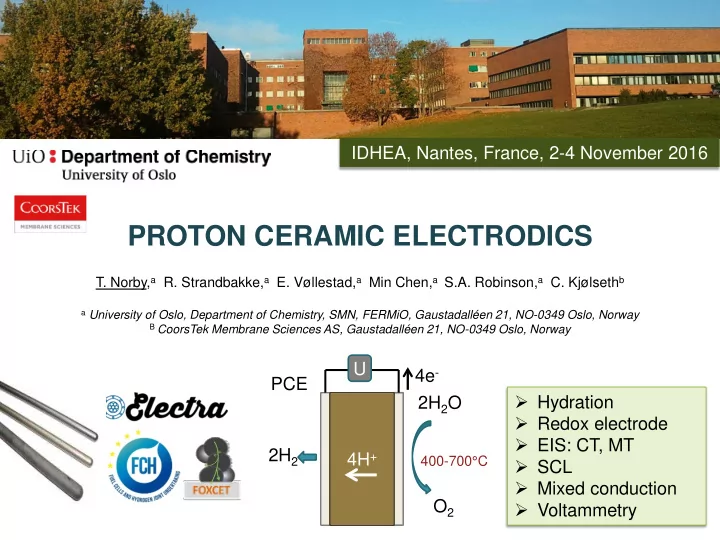
IDHEA, Nantes, France, 2-4 November 2016 PROTON CERAMIC ELECTRODICS T. Norby, a R. Strandbakke, a E. Vllestad, a Min Chen, a S.A. Robinson, a C. Kjlseth b a University of Oslo, Department of Chemistry, SMN, FERMiO, Gaustadallen 21, NO-0349


slide-1
SLIDE 1

PROTON CERAMIC ELECTRODICS

  • T. Norby,a R. Strandbakke,a E. Vøllestad,a Min Chen,a S.A. Robinson,a C. Kjølsethb

a University of Oslo, Department of Chemistry, SMN, FERMiO, Gaustadalléen 21, NO-0349 Oslo, Norway B CoorsTek Membrane Sciences AS, Gaustadalléen 21, NO-0349 Oslo, Norway

  • Hydration
  • Redox electrode
  • EIS: CT, MT
  • SCL
  • Mixed conduction
  • Voltammetry

IDHEA, Nantes, France, 2-4 November 2016 U 4H+ 2H2 O2 2H2O PCE

400-700°C

4e-

slide-2
SLIDE 2

The electrolyte; example Y-doped BaZrO3

 Doping reaction  Hydration  Note: This is not an electrode redox reaction.

 The charge carriers do not enter via an electrode reaction  They are present in equilibrium with H2O(g) x O O / Zr BaZrO 3 2

5O v 2Y O Y 2BaO

3

+ +   →  +

  • =

+ +

O x O O 2

OH 2 O v ) g ( O H

slide-3
SLIDE 3

Electrode redox reactions

 H2-side reaction  O2+H2O-side reaction

− − −

+ ↔ + 2e 2OH 2O (g) H

O 2 O 2 − − −

+ ↔ + +

2 O 2 O 2

4O O(g) 2H 4e 4OH (g) O

slide-4
SLIDE 4

Electrode reaction pathways

slide-5
SLIDE 5

H2-side

2 | H H 2 | v H v H H 2 v H H v (g) H

int i, i ads i i ads ads ads ads 2, ads 2, ads 2

↔ + ↔ + ↔ + ↔ +

2 | H H H 2 v H H v (g) H

tpb ads, ads ads ads ads 2, ads 2, ads 2

↔ ↔ + ↔ + 2 | e OH v O H

O int tpb/i, ads, 2 O int tpb/i, ads, − − −

+ + ↔ +

Diffusion Diffusion CT

slide-6
SLIDE 6

O2+H2O side

2 | v O(g) H O H 2 | O H O OH OH 2 | OH OH 2 | O O O 2 v O O v (g) O

ads 2 ads 2 ads 2 2 O O ads ads tpb ads, tpb ads, ads ads ads ads , 2 ads , 2 ads 2

+ ↔ + ↔ + ↔ ↔ ↔ + ↔ +

− − − − −

2 | O OH v e 2 OH O

2 O tpb ads, tpb ads, O tpb ads, − − − −

+ + ↔ + +

Diffusion CT Diffusion

slide-7
SLIDE 7

Charge transfer (CT)

− − −

+ + ↔ + e OH v O H

O int tpb/i, ads, 2 O int tpb/i, ads,

O OH v e 2 OH O

2 O tpb ads, tpb ads, O tpb ads, − − − −

+ + ↔ + +

red red

red prod red react red ct red red red eq red ct

Q Q k RT F n RT Fi n G

β β −

= =

1 , , , 2 , ,

) (

  • x
  • x
  • x

prod

  • x

react

  • x

ct

  • x
  • x
  • x

eq

  • x

ct

Q Q k RT F n RT Fi n G

β β −

= =

1 , , , 2 , ,

) (

pH2- (and pH2O?)- dependencies pO2- and pH2O- dependencies

slide-8
SLIDE 8

Cu and Pt point electrodes on BZCY in H2+H2O

S.A. Robinson, C. Kjølseth, T. Norby, “Comparison of Cu and Pt point-contact electrodes on proton conducting BaZr0.7Ce0.2Y0.1O3−d“, in pub.

slide-9
SLIDE 9

Cu and Pt point electrodes on BZCY in H2+H2O

S.A. Robinson, C. Kjølseth, T. Norby, “Comparison of Cu and Pt point-contact electrodes on proton conducting BaZr0.7Ce0.2Y0.1O3−d“, in pub.

slide-10
SLIDE 10

Mass transfer (MT)

 Adsorption  Dissociation  Dissolution  Diffusion

2 / 1 , 2 ,

2

) 2 (

H red mt eq red mt

p K RT F G =

m O H n O

  • x

mt eq

  • x

mt

p p K RT F G

2 2

, 2 ,

) 4 ( =

slide-11
SLIDE 11

Cu and Pt point electrodes on BZCY in H2+H2O

CT MT

− − −

+ + ↔ + e OH v O H

O int tpb/i, ads, 2 O int tpb/i, ads,

2 / 1 , 2 ,

2

) 2 (

H red mt eq red mt

p K RT F G =

red red

red prod red react red ct red red red eq red ct

Q Q k RT F n RT Fi n G

β β −

= =

1 , , , 2 , ,

) (

S.A. Robinson, C. Kjølseth, T. Norby, “Comparison of Cu and Pt point-contact electrodes on proton conducting BaZr0.7Ce0.2Y0.1O3−d“, in pub.

slide-12
SLIDE 12

Electrode space charge layer (SCL)

      ∆ ∆ ≈       ∆ =

+ + + +

RT F RT F u Fc dx RT x F u Fc G

red red H H H H eq red scl

) ( exp ) ( 2 ) ( exp

,

ϕ λ ϕ ϕ

λ

slide-13
SLIDE 13

B+GB+SCL+CT for nanograined Ni on BZY in H2+H2O

Min Chen, T. Norby, “Space Charge Layer Effect at the Ni/BaZr0.9Y0.1O3-δ Electrode Interface in Proton Ceramic Electrochemical Cells”, under publication

slide-14
SLIDE 14

Typical PCFC cathode Typical

  • xide H+

conductor

Mixed conduction – example O2+H2O-side electrode

O2 4e- 2H2O 4H+ O2 4H+ 4e- 2H2O

Model PCFC cathode Ideal H+ conductor

2O2- 2O2- O2 4e- e- e-

Ideal PCFC cathode

O2 4H+ 4e- 2H2O 4H+

Ideal H+ conductor

slide-15
SLIDE 15

PCFC oxygen electrodes (cathodes)

 Mixed conductivity: protons, oxide ions, electrons (holes)

  • R. Strandbakke, V. Cherepanov, A. Zuev, D.S. Tsvetkov, C. Argirusis, G. Sourkouni-Argirusis,
  • S. Prünte, T. Norby, “Gd- and Pr-based double perovskite cobaltites as oxygen side electrodes

for proton ceramic fuel cells and electrolyser cells”, Solid State Ionics, 278 (2015) 120.

Typical PCFC cathode Typical

  • xide H+

conductor

O2 4e- 2H2O 4H+ 2O2- 2O2- O2 4e- e- e-

slide-16
SLIDE 16

Perovskite electrode on BaZr0.7Ce0.2Y0.1O3 (BZCY)

 Impedance spectra yield apparent

electrode polarisation resistances

14.0 14.5 15.0 0.0

  • 0.2
  • 0.4
  • 0.6
  • 0.8
  • 1.0
  • 1.2

Rp2 Z//(Ωcm2) Z

/(Ωcm 2)

Rp1 S0 S1 S2

Electrolyte Electrode

slide-17
SLIDE 17

Perovskite electrode on BaZr0.7Ce0.2Y0.1O3 (BZCY)

 …but a more correct treatment is required  needs more input parameters and assumptions

14.0 14.5 15.0 0.0

  • 0.2
  • 0.4
  • 0.6
  • 0.8
  • 1.0
  • 1.2

Rp2 Z//(Ωcm2) Z

/(Ωcm 2)

Rp1 S0 S1 S2

Electrolyte Electrode

Recipe: Get individual Rv’s from conductivity data Calibrate to Rv at S0 Calculate properly Rv+Rp,1 at S1 Calculate properly Rv+Rp,1+Rp,2 at S2 Express and fit 4 unknown Rp’s to variations in T, pO2, pH2O

slide-18
SLIDE 18

Perovskite electrode on BaZr0.7Ce0.2Y0.1O3 (BZCY)

 Modelling by fitting all data  Protons vs oxide ions  Effect of electronic conduction  CT and MT(d)

1.0 1.2 1.4 1.6

  • 2
  • 1

1 Rp,O

2-

Rp,H

+

Rp,d,H

+

Rp,ct,H

+

Rp Rp,app 700 600 500 400 0.01 0.1 1 10

T (°C) 1000/T (K

  • 1)

log(R(Ωcm

2))

R(Ωcm

2)

slide-19
SLIDE 19

Voltammetry

 Tafel plot displays the

kinetics of only the forward or backward reaction

 Yields β, n, i0  May require EIS to

deconvolute R’s and η’s

 Example: Ni on BZY

slide-20
SLIDE 20

Summary

 Hydration  Redox-reactions  Reaction paths and CT  EIS

 Separate into G+GB, (SCL?), CT, MT  Pre-exponential: Microstructure  Activation energy: Kinetics  pH2, pH2O, pO2 dependencies: Mechanistics

 Mixed conduction  Voltammetry

  • =

+ +

O x O O 2

OH 2 O v ) g ( O H

− − −

+ ↔ + 2e 2OH 2O (g) H

O 2 O 2

− − −

+ + ↔ + e OH v O H

O int tpb/i, ads, 2 O int tpb/i, ads,

  • D. Poetzsch, R. Merkle, J. Maier, J.
  • Electrochem. Soc., 162 [9] (2015) F939.
slide-21
SLIDE 21

Acknowledgements

The research leading to these results has received funding from the European Union's Seventh Framework Programme (FP7/2007-2013) for the Fuel Cells and Hydrogen Joint Technology Initiative under grant agreement n° 621244, and from the Research Council of Norway through the PROTON (225103), FOXCET (228355), and ROMA (219194) projects.