
SLIDE 1
Cities
- f all sizes
Are Hot!
30 Years in the Making “an overnight success”
David T. Downey, President & CEO
International Downtown Association
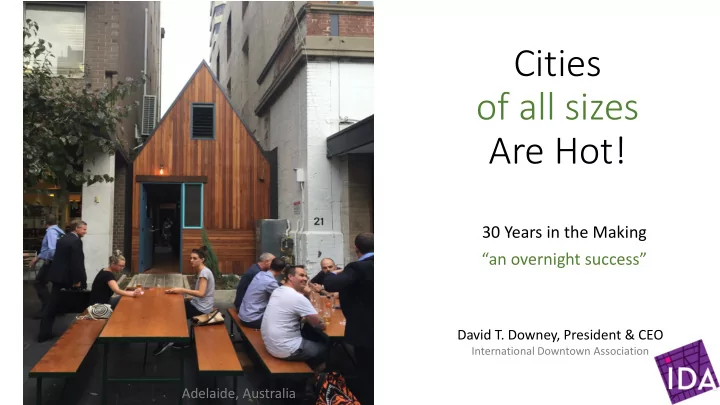
Adelaide, Australia
Cities of all sizes Are Hot! 30 Years in the Making an overnight - - PowerPoint PPT Presentation
Cities of all sizes Are Hot! 30 Years in the Making an overnight success David T. Downey, President & CEO International Downtown Association Adelaide, Australia Warrenton, Virginia Vancouver, BC Detroit Hudsons Building,
30 Years in the Making “an overnight success”
David T. Downey, President & CEO
International Downtown Association
Adelaide, Australia
Warrenton, Virginia
Vancouver, BC
Detroit
Hudson’s Building, Detroit
Detroit, MI
Detroit, MI
Downtowns: live/work nodes.
employment centers within them contain 18.7 million jobs.
have achieved densities in excess of 100 jobs per acre, while another 24 have between 75-99 jobs per acre.
mile area of the top 10 downtowns grew 17.2% between 2000-2010, while national population grew by just 9.7%.
workers.
culture.
business partners.
business outcomes.
Morning Commuter Patterns – Baltimore, Maryland
Find your Local Districts
Services
… and Growing World Wide England, Scotland, Ireland South Africa Singapore, Japan Australia, New ZeelandGermany Sweden, Norway, Netherlands Spain, Italy, France Serbia, Poland El Salvador
2017 IDA Emerging Leader Fellowship
~ Professional Urban Place Management
Government Genius in the Middle Private Sector
Urban P Place ace Mana nage gement nt
Lea Leader dership ip Dev evel elopm pment Organ ganizat ational al Management
Plann nning ng, Inf nfrastruct cture & S Str trateg egic Dev evel elopmen ent
Policy & & Advoca
cy
Public blic Sp Space & e & Pla lace e Manage gemen ent
Communi nicatio ion, n, Marketi eting & & Events ts
Econ
Develop
nt: Strate ategi gies & & Planni nning
Urban Place Management Knowledge Domains
Central Business District (Census Definition) Central Business District (COSA Definition) Greater Downtown Public Improvement District
re M Miles
0.3% 3% of San Antonio’s total land mass
Down wntown wn Vital alit ity Economy Inclusio ion Vibranc ncy Identi tity ty Resili lience
Downt wntown S SA per square mile:
1,676 residential units 2,443 residents 49,367 jobs 8,759,124 square feet of
2,919,708 square feet of retail space 10,302 hotel rooms
City o ty of San Anton
per square mile:
1,090 residential units 2,879 residents 1,647 jobs 61,491 square feet of
97,963 square feet of retail space 94 hotel rooms
1.5x .85x 30x 140x 30x 109x per square mile
Within their regions, downtowns have substantial economic importance. As tradition
centers o
ce, transportation
educa cation
and go gover ernment, do downtowns ar are fr e freq equently ec economic an anchors of f their region
Because of a relatively high density of economic activity, investment in downtown generally provides a high level of return per dollar of economic output.
ECONOMY
For every $1 generated per square mile in the City of S an Antonio, downtown generates 15-18 times more per square mile
Residential Growth (2009-2015)
Downtown: 29% vs. City: 7%
Downtown Employment
Downtown: 8% of city’s jobs
ECONOMY
2011 Jobs per acre-
2014 Jobs per acre-
Commercial D Down
79
Downtown S an Antonio
From “ Emerging Live-Work Area” to “ High Live-Work Quotient”
17.3% in 2011; 20.5% i in 2014 Live-Work Quotient: Percentage of workers living within commercial downtown and one-mile area who work within commercial downtown or one-mile area.
Due to their expansive and dense base of users, downtowns can support a variety of unique retail, infrastructural, and institutional uses that offer cross-cutting benefits to the region. Many unique regional cultural institutions, businesses, centers of innovation, public spaces, and activity can only be located downtown. The variety and diversity of offerings reflect the regional market and density of development. As downtowns grow, the density of spending, users, institutions, businesses, and knowledge allows them to support critical infrastructure, be it public parks, transportation, affordable housing, or major retailers that cannot be supported elsewhere in the region.
VIBRANCY
Downtown San Antonio’s spending potential:
retail expenditures
retail b businesses per square mile
workers s per square mile earning $ $40,000+
$40,000+
The city of San Antonio’s spending potential:
retail expenditures
square mile
earning $40,000+
pay $40,000+
VIBRANCY
Downtown wn M Mixe xed-La Land U d Use:
mixed-use building stock and central location further its vibrancy beyond a central employment hub (which it is)
commercial)
Downtowns inv nvit ite a and w welc lcome all r l resid ident nts of the region (as well as visitors from elsewhere) by providing access to opportunity, essential services, culture, recreation, entertainment, and participation in civic activities. Downtowns are inherently e equitable b because they e enable a a diverse ran ange ge o
f user ers from across the region to access essential elements of urban life. These elements include high-quality jobs, essential services, recreation, culture, public space, and civic participation, among others. Though the specific offerings of each downtown may vary, their attributes (density, accessibility, diversity) should enable a wide degree of potential and actual access. Perhaps more importantly, do downtowns ar are e the e pl plac aces w wher ere w we e ex expe pect to ex expe perience t the di e diversity o
f a a regi egion, where we consciously seek out that diversity, and where diversity is welcomed.
INCLUS ION
Downtown San Antonio is home to:
Mille lennia ials 25-34 year-olds
Bachelor degree or more
The city of San Antonio is home to:
Mille lennia ials 25-34 year-olds
degree or more
INCLUS ION
Per Squ er Square Mil ile…
Res esilience i is br broad adly defi defined as d as the abi ability fo for a a pl plac ace to withstand sh shoc
stresse ses. Because of the di diversity an and den density of resources and services, downtowns and their inhabitants can better absorb economic, social, and environmental, shocks and stresses. Downtowns are bet better equ equippe ped to adapt adapt t to ec economic an and s d social s shocks than communities which are more homogenous. Consequently, they can also suppor
the r resilience ce of the r region
Downtowns are better positioned to make the investments to withstand inc ncreasing ingly-fr frequ quen ent e environmen mental al shocks and stresses.
RES ILIENCY
Downtown San Antonio:
The City of San Antonio:
RES ILIENCY
Downtowns preserve the heritage of a place, provide a common point of physical connection for regional residents, and contribute positively to the brand of the regions they represent. Whether from a historical event, or personal memory, downtowns have intrinsic cultural value which is important to preserving and promoting the brand of the region. Downtowns offer a place for regional residents to come together, participate in civic life, and celebrate their region, which in turn promotes tourism and civil society. Likewise, the “postcard view” visitors associate with a region is virtually always of an attribute of the downtown.
IDENTITY
Downtown San Antonio has:
Bexar County)
Giving residents 322 322 opportunities to engage with downtown’s built environment, attracting:
#DowntownSanA nAnt ntonio nio Instagr agram p am posts
IDENTITY
30 Years in the Making “an overnight success”
David T. Downey, President & CEO
International Downtown Association
Adelaide, Australia