CIS 330: Applied Database Systems Lecture 10: Stored Procedures, - - PDF document

cis 330 applied database systems
SMART_READER_LITE
LIVE PREVIEW

CIS 330: Applied Database Systems Lecture 10: Stored Procedures, - - PDF document

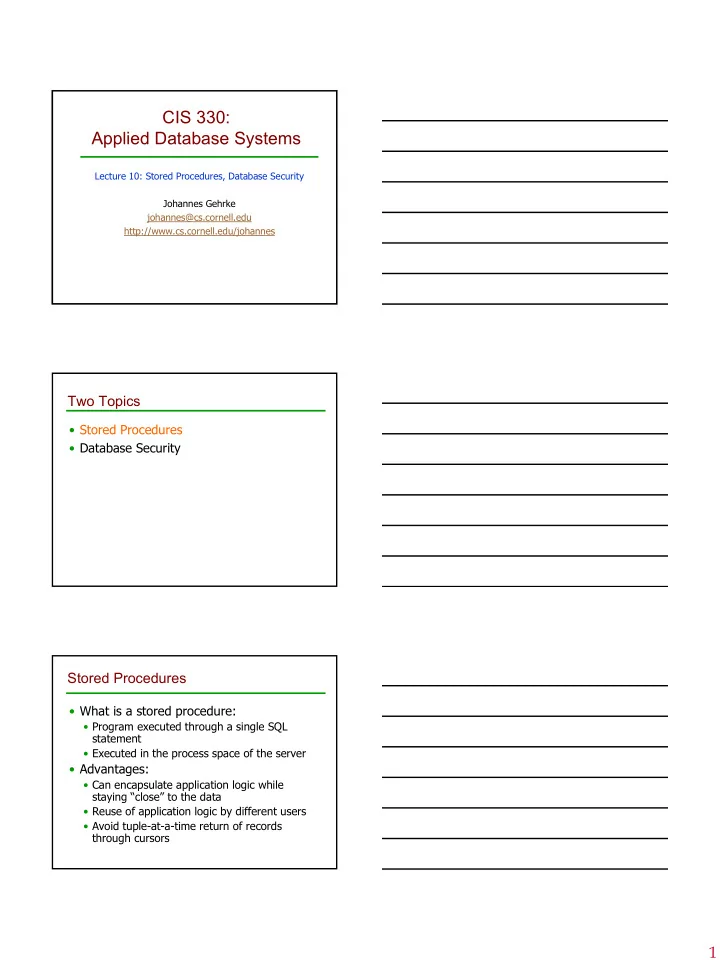
CIS 330: Applied Database Systems Lecture 10: Stored Procedures, Database Security Johannes Gehrke johannes@cs.cornell.edu http://www.cs.cornell.edu/johannes Two Topics Stored Procedures Database Security Stored Procedures What


slide-1
SLIDE 1

1

CIS 330: Applied Database Systems

Lecture 10: Stored Procedures, Database Security Johannes Gehrke johannes@cs.cornell.edu http://www.cs.cornell.edu/johannes

Two Topics

  • Stored Procedures
  • Database Security

Stored Procedures

  • What is a stored procedure:
  • Program executed through a single SQL

statement

  • Executed in the process space of the server
  • Advantages:
  • Can encapsulate application logic while

staying “close” to the data

  • Reuse of application logic by different users
  • Avoid tuple-at-a-time return of records

through cursors

slide-2
SLIDE 2

2

Stored Procedures: Examples

CREATE PROCEDURE ShowNumReservations SELECT S.sid, S.sname, COUNT(*) FROM Sailors S, Reserves R WHERE S.sid = R.sid GROUP BY S.sid, S.sname Stored procedures can have parameters:

  • Three different modes: IN, OUT, INOUT

CREATE PROCEDURE IncreaseRating( IN sailor_sid INTEGER, IN increase INTEGER) UPDATE Sailors SET rating = rating + increase WHERE sid = sailor_sid

Stored Procedures: Examples (Contd.)

Stored procedure do not have to be written in SQL:

CREATE PROCEDURE TopSailors( IN num INTEGER) LANGUAGE JAVA EXTERNAL NAME “file:///c:/storedProcs/rank.jar”

Calling Stored Procedures

EXEC SQL BEGIN DECLARE SECTION Int sid; Int rating; EXEC SQL END DECLARE SECTION // now increase the rating of this sailor EXEC CALL IncreaseRating(:sid,:rating);

slide-3
SLIDE 3

3

Calling Stored Procedures (Contd.)

JDBC: CallableStatement cstmt= con.prepareCall(“{call ShowSailors}); ResultSet rs = cstmt.executeQuery(); while (rs.next()) { … } SQLJ: #sql iterator ShowSailors(…); ShowSailors showsailors; #sql showsailors={CALL ShowSailors}; while (showsailors.next()) { … }

SQL/PSM

Most DBMSs allow users to write stored procedures in a simple, general-purpose language (close to SQL) SQL/PSM standard is a representative Declare a stored procedure: CREATE PROCEDURE name(p1, p2, …, pn) local variable declarations procedure code; Declare a function: CREATE FUNCTION name (p1, …, pn) RETURNS sqlDataType local variable declarations function code;

Main SQL/PSM Constructs

CREATE FUNCTION rate Sailor (IN sailorId INTEGER) RETURNS INTEGER DECLARE rating INTEGER DECLARE numRes INTEGER SET numRes = (SELECT COUNT(*) FROM Reserves R WHERE R.sid = sailorId) IF (numRes > 10) THEN rating =1; ELSE rating = 0; END IF; RETURN rating;

slide-4
SLIDE 4

4

Main SQL/PSM Constructs (Contd.)

  • Local variables (DECLARE)
  • RETURN values for FUNCTION
  • Assign variables with SET
  • Branches and loops:
  • IF (condition) THEN statements;

ELSEIF (condition) statements; … ELSE statements; END IF;

  • LOOP statements; END LOOP
  • Queries can be parts of expressions
  • Can use cursors naturally without “EXEC SQL”

Two Topics

  • Stored Procedures
  • Database Security

Introduction to DB Security

  • Secrecy: Users should not be able to see

things they are not supposed to.

  • E.g., A student can’t see other students’

grades.

  • Integrity: Users should not be able to

modify things they are not supposed to.

  • E.g., Only instructors can assign grades.
  • Availability: Users should be able to see

and modify things they are allowed to.

slide-5
SLIDE 5

5

Access Controls

  • A security policy specifies who is

authorized to do what.

  • A security mechanism allows us to enforce

a chosen security policy.

  • Two main mechanisms at the DBMS level:
  • Discretionary access control
  • Mandatory access control

Discretionary Access Control

  • Based on the concept of access rights or

privileges for objects (tables and views), and mechanisms for giving users privileges (and revoking privileges).

  • Creator of a table or a view automatically gets

all privileges on it.

  • DMBS keeps track of who subsequently gains and

loses privileges, and ensures that only requests from users who have the necessary privileges (at the time the request is issued) are allowed.

GRANT Command

The following privileges can be specified:

SELECT: Can read all columns (including those added later via

ALTER TABLE command).

INSERT(col-name): Can insert tuples with non-null or non-

default values in this column.

INSERT means same right with respect to all columns.

DELETE: Can delete tuples. REFERENCES (col-name): Can define foreign keys (in other

tables) that refer to this column.

If a user has a privilege with the GRANT OPTION, can pass privilege on to other users (with or without passing on the GRANT OPTION). Only owner can execute CREATE, ALTER, and DROP.

GRANT privileges ON object TO users [WITH GRANT OPTION]

slide-6
SLIDE 6

6

GRANT and REVOKE of Privileges

  • GRANT INSERT, SELECT ON Sailors TO Horatio
  • Horatio can query Sailors or insert tuples into it.
  • GRANT DELETE ON Sailors TO Yuppy WITH GRANT

OPTION

  • Yuppy can delete tuples, and also authorize others to do so.
  • GRANT UPDATE (rating) ON Sailors TO Dustin
  • Dustin can update (only) the rating field of Sailors tuples.
  • GRANT SELECT ON ActiveSailors TO Guppy, Yuppy
  • This does NOT allow the ‘uppies to query Sailors directly!
  • REVOKE: When a privilege is revoked from X, it is also

revoked from all users who got it solely from X.

GRANT/REVOKE on Views

  • If the creator of a view loses the SELECT

privilege on an underlying table, the view is dropped! (Example: Why is having access to a SELECT privilege on a view important?)

  • If the creator of a view loses a privilege

held with the grant option on an underlying table, (s)he loses the privilege

  • n the view as well; so do users who were

granted that privilege on the view!

Example

Joe: GRANT SELECT ON Sailors TO Art WITH GRANT OPTION Art: GRANT SELECT ON Sailors TO Bob WITH GRANT OPTION Joe: REVOKE SELECT ON Sailors FROM Art CASCADE CASCADE versus RESTRICT:

  • CASCADE: All abandoned privileges are also

revoked

  • RESTRICT: Command is rejected if abandoned

privileges would result

slide-7
SLIDE 7

7

Another Example

Joe: GRANT SELECT ON Sailors TO Art WITH GRANT OPTION Joe: GRANT SELECT ON Sailors TO Bob WITH GRANT OPTION Art: GRANT SELECT ON Sailors TO Bob WITH GRANT OPTION Joe: REVOKE SELECT ON Sailors FROM Art CASCADE Bob retains his privilege.

Another Example

Joe: GRANT SELECT ON Sailors TO Art WITH GRANT OPTION Joe: GRANT SELECT ON Sailors TO Art WITH GRANT OPTION Joe: REVOKE SELECT ON Sailors FROM Art CASCADE Art’s privilege is revoked. Note: We can just revoke the GRANT OPTION:

  • REVOKE GRANT OPTION ON Sailors FROM Art

CASCADE

Authorization Graphs

Example: Joe: GRANT SELECT ON Sailors TO Art WITH GRANT OPTION Art: GRANT SELECT ON Sailors TO Bob WITH GRANT OPTION Bob: GRANT SELECT ON Sailors TO Art WITH GRANT OPTION Joe: GRANT SELECT ON Sailors TO Cal WITH GRANT OPTION Cal: GRANT SELECT ON Sailors TO Bob WITH GRANT OPTION Joe: REVOKE SELECT ON Sailors FROM Art CASCADE

slide-8
SLIDE 8

8

Views and Security

  • Views can be used to present necessary

information (or a summary), while hiding details in underlying relation(s).

  • Given ActiveSailors, but not Sailors or Reserves, we

can find sailors who have a reservation, but not the bid’s of boats that have been reserved.

  • Creator of view has a privilege on the view if

(s)he has the privilege on all underlying tables.

  • Together with GRANT/REVOKE commands, views

are a very powerful access control tool.

Role-Based Authorization

  • In SQL-92, privileges are actually assigned to

authorization ids, which can denote a single user or a group of users.

  • In SQL:1999 (and in many current systems),

privileges are assigned to roles.

  • Roles can then be granted to users and to other

roles.

  • Reflects how real organizations work.
  • Illustrates how standards often catch up with “de

facto” standards embodied in popular systems.

Security to the Level of a Field!

  • Can create a view that only returns one

field of one tuple. (How?)

  • Then grant access to that view

accordingly.

  • Allows for arbitrary granularity of control
  • A bit clumsy to specify.
  • Can be hidden under a good UI.
slide-9
SLIDE 9

9

Mandatory Access Control

  • Based on system-wide policies that cannot be

changed by individual users.

  • Each DB object is assigned a security class.
  • Each subject (user or user program) is assigned a

clearance for a security class.

  • Rules based on security classes and clearances

govern who can read/write which objects.

  • Most commercial systems do not support

mandatory access control. Versions of some DBMSs do support it; used for specialized (e.g., military) applications.

Why Mandatory Control?

  • Discretionary control has some flaws, e.g., the

Trojan horse problem:

  • Dick creates Horsie and gives INSERT privileges to

Justin (who doesn’t know about this).

  • Dick modifes the code of an application program

used by Justin to additionally write some secret data to table Horsie.

  • Now, Justin can see the secret info.
  • The modification of the code is beyond the

DBMSs control, but it can try and prevent the use of the database as a channel for secret information.

Bell-LaPadula Model

  • Objects (e.g., tables, views, tuples)
  • Subjects (e.g., users, user programs)
  • Security classes:
  • Top secret (TS), secret (S), confidential (C),

unclassified (U): TS > S> C > U

  • Each object and subject is assigned a class.
  • Subject S can read object O only if class(S) >=

class(O) (Simple Security Property)

  • Subject S can write object O only if class(S) <=

class(O) (*-Property)

slide-10
SLIDE 10

10

Intuition

  • Idea is to ensure that information can never

flow from a higher to a lower security level.

  • E.g., If Dick has security class C, Justin has

class S, and the secret table has class S:

  • Dick’s table, Horsie, has Dick’s clearance, C.
  • Justin’s application has his clearance, S.
  • So, the program cannot write into table Horsie.
  • The mandatory access control rules are applied

in addition to any discretionary controls that are in effect.

Multilevel Relations

  • Users with S and TS clearance will see both

rows; a user with C will only see the 2nd row; a user with U will see no rows.

  • If user with C tries to insert <101,Pasta,Blue,C>:
  • Allowing insertion violates key constraint
  • Disallowing insertion tells user that there is another
  • bject with key 101 that has a class > C!
  • Problem resolved by treating class field as part of key.

C Brown Pinto 102 S Red Salsa 101 class color bname bid

Statistical DB Security

  • Statistical DB: Contains information about

individuals, but allows only aggregate queries (e.g., average age, rather than Joe’s age).

  • New problem: It may be possible to infer some

secret information!

  • E.g., If I know Joe is the oldest sailor, I can ask

“How many sailors are older than X?” for different values of X until I get the answer 1; this allows me to infer Joe’s age.

  • Idea: Insist that each query must involve at

least N rows, for some N. Will this work? (No!)

slide-11
SLIDE 11

11

Why Minimum N is Not Enough

  • By asking “How many sailors older than X?”

until the system rejects the query, can identify a set of N sailors, including Joe, that are older than X; let X=55 at this point.

  • Next, ask “What is the sum of ages of sailors
  • lder than X?” Let result be S1.
  • Next, ask “What is sum of ages of sailors other

than Joe who are older than X, plus my age?” Let result be S2.

  • S1-S2 is Joe’s age!

Summary

  • Three main security objectives: secrecy,

integrity, availability.

  • DB admin is responsible for overall security.
  • Designs security policy, maintains an audit trail, or

history of users’ accesses to DB.

  • Two main approaches to DBMS security:

discretionary and mandatory access control.

  • Discretionary control based on notion of privileges.
  • Mandatory control based on notion of security classes.
  • Statistical DBs try to protect individual data by

supporting only aggregate queries, but often, individual information can be inferred.