Cirrhosis: Management of Speakers Bureau/Honoraria : None Key - - PDF document

cirrhosis management of
SMART_READER_LITE
LIVE PREVIEW

Cirrhosis: Management of Speakers Bureau/Honoraria : None Key - - PDF document

2/4/2019 Conflict of Interest Disclosure Dr. Shah Cirrhosis: Management of Speakers Bureau/Honoraria : None Key Complications Part 2 Consulting Fees: Abbvie, Gilead, Merck, Intercept, Lupin, Bristol- Myers Squibb Dr. Feld Hemant


slide-1
SLIDE 1

2/4/2019 1

Cirrhosis: Management of Key Complications – Part 2

Hemant Shah MD MScCH HPTE

Twitter: @hepatoMD

Jordan Feld MD MPH

Conflict of Interest Disclosure

  • Dr. Shah
  • Speakers Bureau/Honoraria: None
  • Consulting Fees: Abbvie, Gilead, Merck, Intercept, Lupin, Bristol-

Myers Squibb

  • Dr. Feld
  • Research: Abbvie, Gilead, Janssen, Merck
  • Consulting: Abbvie, Contravir, Enanta, Gilead

Key Learning Objectives

After this presentation, you may be able to:

  • Update your knowledge on management of major

complications of cirrhosis

  • Recognize opportunities for screening to prevent

complications

  • Appreciate management strategies when complications arise

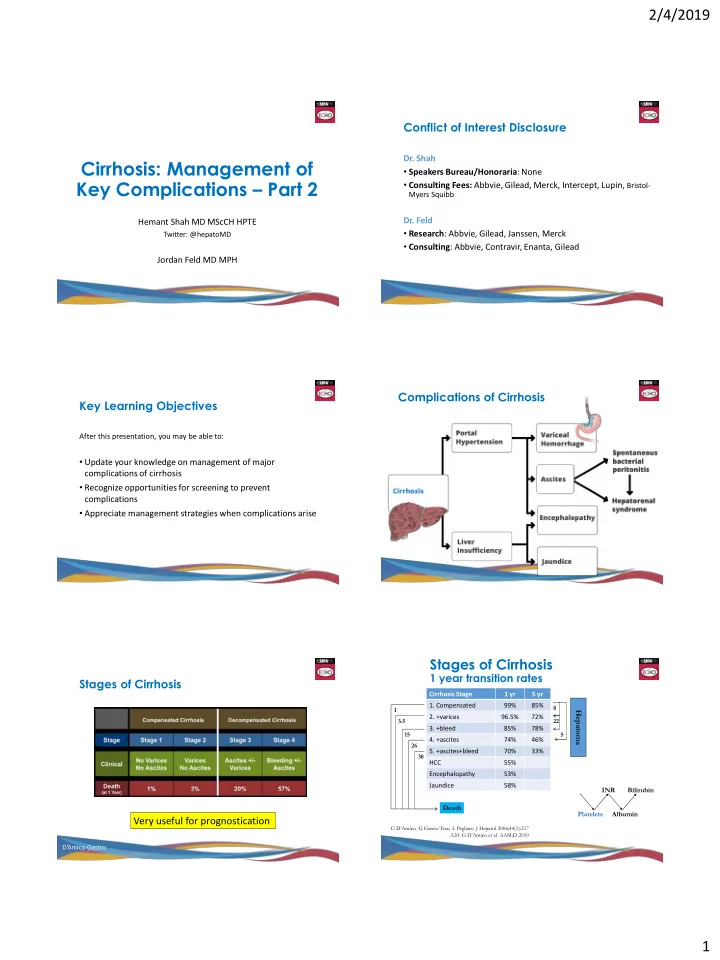
Complications of Cirrhosis Stages of Cirrhosis

D’Amico Gastro

Very useful for prognostication

Stages of Cirrhosis

1 year transition rates

Cirrhosis Stage 1 yr 5 yr

  • 1. Compensated

99% 85%

  • 2. +varices

96.5% 72%

  • 3. +bleed

85% 78%

  • 4. +ascites

74% 46%

  • 5. +ascites+bleed

70% 33% HCC 55% Encephalopathy 53% Jaundice 58%

G D’Amico, G Garcia-Tsao, L Pagliaro. J Hepatol 2006;44(1):217 A20: G D’Amico et al. AASLD 2010

Death

30 26 15 3.5 1 22 8 5

Platelets INR Albumin Bilirubin

Hepatoma

slide-2
SLIDE 2

2/4/2019 2

Issues in Cirrhosis Management

  • Ascites
  • SBP Prophylaxis
  • Varices
  • Encephalopathy
  • Hepatocellular Cancer
  • Others

Ascites Management of Ascites

1) Salt restriction - (66 mmol/d – 1.5-2 g/d) 2) Salt restriction – dietitian available – EatRight Ontario 3) Salt restriction! 4) Avoid Doctors -- NSAIDs, surgery, saline 5) Diuretics 6) Fluid restriction – only once hyponatremic 7) Paracentesis 8) TIPS 9) Transplant - All patients should be evaluated

Sodium Balance

Intake Output 100-150 mmol/d Typical No Added Salt Diet <20 mmol/d Typical Urinary Na+ Excretion of ascitic Pt on no diuretics

Result? Daily positive Na+ Balance

  • f 80-130 mmol/d = 600-1000ml fluid/d

Diuretics

  • International Ascites Club
  • Recommend combo therapy:

Spironolactone 100 mg/d + Furosemide 40 mg/d

  • With stepwise increase to max 400 + 160mg/d
  • Check lytes/creat with every change
  • If issues with gynecomastia – change spironolactone

to amiloride (10 mg = 100 mg)

Aim = 0.3-0.5 kg/d (1lb/d) without edema 0.8-1 kg/d (2lb/d) w/ edema

Urine electrolytes

  • Useful if refractory ascites despite ‘adhering’ to low salt diet or on

lots of diuretics

  • Goal is to measure sodium output, and then compare to sodium

input

  • Two ways to measure:
  • Spot Urine:
  • Sodium-potassium ratio >1 is 90% predictive of Na excretion greater than

78mmol/d

  • 24hr Urine:
  • If done correctly, accurate sodium-excretion
slide-3
SLIDE 3

2/4/2019 3

Interpreting Urine Sodium

If ascites difficult to manage (high-dose diuretics) and: Low urine sodium  Sodium-retainer, stop diuretics, may need paracentesis Moderate-High urine sodium  Sodium-excreter, consuming too much sodium, work on diet

Refractory Ascites

  • Occurs 5-10% of patients with ascites
  • Definition:

No response to Spironolactone 400 mg + Furosemide 160 mg/d or diuretic intolerance

  • Check compliance
  • if excreting > 78 mmol/d and gaining wt  CHEATING!
  • Rule out other causes -- tumor, PV thrombosis etc

Bad Prognosis

Gines NEJM 2004

Worse than almost any cancer!

Options in Refractory Patients

1. Repeated large volume paracentesis + albumin 2. TIPS 3. Peritonvenous shunt

  • Abandoned due to high complications

Gines NEJM 1991

Large volume taps

  • Effective but high rate of recurrence
  • Patients often prefer paracentesis to diet + diuretics
  • Complications of protein/complement loss, infection

etc  prove diuretic resistant!!

  • Replace albumin if >5L removed
  • If require > 8L q 2 weeks -- non-compliant
  • Low risk of SBP if no symptoms, therefore cell count,

but cultures not necessa

Spontaneous Bacterial Peritonitis - SBP

  • Key is remember to check!
  • 50% have no symptoms – no fever, no pain
  • Rule: If someone with ascites presents to medical attention for

ANY reason…they need a tap to r/o SBP

  • This is VERY poorly done at ALL hospitals
  • Can be literally life-saving
  • Cell count (neutrophils>250 or WBC>500) + culture in blood culture bottles
  • After an episode of SBP – long-term prophylaxis
  • Norfloxacin 400 mg daily or
  • Ciprofloxacin 750 mg once per week
slide-4
SLIDE 4

2/4/2019 4

Albumin and SBP

  • Excellent evidence that giving high-dose albumin in

setting of SBP decreases mortality (19% @ 3 months)

  • Dose:
  • 1.5mg/kg on day 1
  • 1 mg/kg on day 3
  • A lot of albumin!
  • For 70kg person, that’s 7 bottles of 25% albumin

Sort et al. NEJM. 1999; 341:403-409.

Varices Variceal screening

  • Guidelines recommend every 2-3 years once cirrhosis diagnosed
  • Not required if primary disease taken away e.g. HCV after SVR – no

need for endoscopy if no varices prior to SVR

  • Once present – may consider increasing to annual surveillance
  • If being selective:
  • Fibroscan< 20 Kpa AND Platelets > 150  very low risk of varices that

require treatment and can forego endoscopy

Beta blockers vs Banding for Primary Prophylaxis

  • Multiple trials - both better than placebo
  • Mostly methodologically flawed (often significantly)
  • Generally show a small benefit of banding over beta

blockers for patients with big varices (grade 3 or 4)

  • Guidelines still suggest beta blockers – cost + safety
  • If beta blockers not tolerated or very big varices 

band first

  • Once on a beta blocker  no need to keep scoping!
  • Aim for HR<60 bpm

When they do Bleed - Managing Varices

  • Banding superior to beta blockers – repeat sessions q 4 weeks until

eradicated

  • TIPS is an effective rescue therapy for bleeding
  • Methods:
  • Group 1: EBL + Medical Mgt w TIPS as rescue
  • Group 2: Diagnostic Endo + TIPS w/in 72hrs
  • e-PTFE-covered stents (dilated to 8 mm)
  • If portal-pressure gradient >12 mmHg  stent dilated to 10

mm

  • Primary Endpoint: Failure to control bleeding or re-bleeding within 1

year

Garcia-Pagan et al. 2010

slide-5
SLIDE 5

2/4/2019 5

A clear benefit for early TIPS

Variceal bleed randomized to early TIPS (<72 h) vs standard care after octreotide + banding

  • Very strong effect on rebleeding and survival
  • Under-utilized in Toronto!

Garica-Pagan NEJM 2010 61% 86%

12 MONTHS ARR=25%; NNT=4.0 (CI 2.1-50.0) 42 DAYS ARR=30%; NNT=3.3 CI 2.1-8.3)

97% 67%

Encephalopathy Encephalopathy

  • ‘Brain fog’ from liver disease
  • Liver clears nitrogenous waste
  • With shunting – waste products to the brain
  • Mild to severe symptoms
  • Asterixis – rarely focal neuro deficits, Parkinsonism
  • Treatment:
  • Avoid precipitants – meds, infection, bleeding
  • Lactulose
  • Laxative – changes rectal pH to change bacterial flora to decrease

ammonia producing bugs

  • Others may work – recent study with PEG – I’m skeptical
  • Rifaxamin
  • Non-absorbable antibiotic – similar effect, no diarrhea
  • Now covered by ODB (LU code)
  • Driving…you don’t want them on the road…

Bass et al. NEJM. 2010; 326: 1071-1081.

Primary Outcome – Breakthrough First HE

Hazard Ratio 0.42, p<0,001

Other Issues for Cirrhotics

  • Hepatocellular cancer screening
  • US q 6months
  • AFP recommendation back to equivocal
  • Caveats: High if active hepatitis, often low in small HCCs – limits

sensitivity and specificity but still may be useful

  • Particularly: Post-SVR for HCV, if you don’t trust your ultrasound!
  • Vaccinations – ALL (remember annual flu)
  • Infections
  • low threshold to treat…sepsis is VERY common cause of

death…renal function very tenuous

  • Findings may be subtle (normal WBC but high for cirrhosis)
  • Statins and Anticoagulation - Emerging

Summary

  • Main complications:
  • Ascites
  • Salt restriction, diuretics, screen for SBP!
  • Varices
  • Can avoid screening if FS<20 & Plt>150
  • Encephalopathy
  • Reverse ppt, lactulose, rifaximin, driving
  • Cancer
  • Surveillance with US +/- AFP
  • Screen for problems and try not to precipitate them!