Circumpolar Arctic greening: Relationships to summer sea-ice - - PowerPoint PPT Presentation

circumpolar arctic greening
SMART_READER_LITE
LIVE PREVIEW

Circumpolar Arctic greening: Relationships to summer sea-ice - - PowerPoint PPT Presentation

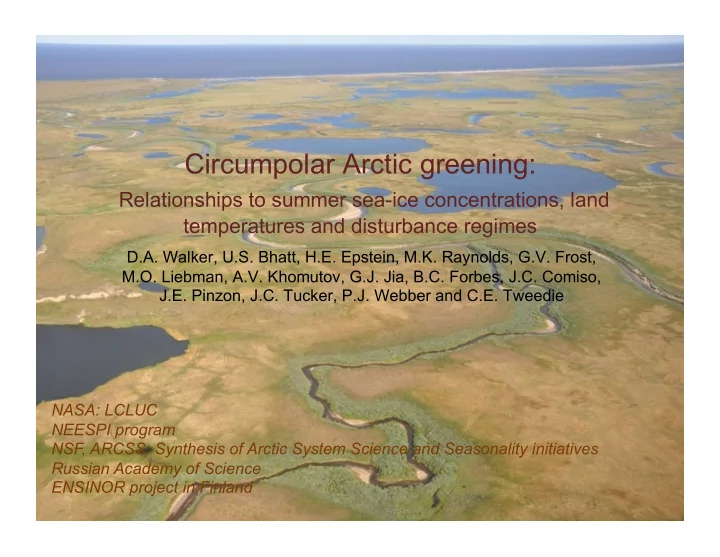
Circumpolar Arctic greening: Relationships to summer sea-ice concentrations, land temperatures and disturbance regimes D.A. Walker, U.S. Bhatt, H.E. Epstein, M.K. Raynolds, G.V. Frost, M.O. Liebman, A.V. Khomutov, G.J. Jia, B.C. Forbes, J.C.


slide-1
SLIDE 1

Circumpolar Arctic greening: Relationships to summer sea-ice concentrations, land

temperatures and disturbance regimes

D.A. Walker, U.S. Bhatt, H.E. Epstein, M.K. Raynolds, G.V. Frost, M.O. Liebman, A.V. Khomutov, G.J. Jia, B.C. Forbes, J.C. Comiso, J.E. Pinzon, J.C. Tucker, P.J. Webber and C.E. Tweedie NASA: LCLUC NEESPI program NSF, ARCSS: Synthesis of Arctic System Science and Seasonality initiatives Russian Academy of Science ENSINOR project in Finland

slide-2
SLIDE 2

Does the presence of summer sea ice affect tundra vegetation productivity?

Arctic Tundra Vegetation March Sea-Ice Extent

Sea Ice: http://www.arctic.noaa.gov/reportcard/figures/seaice2009fig1.jpg

Vegetation and NDVI: http://www.arcticatlas.org/maps/themes/cp/cpvg

  • 80% of Arctic tundra is within 100 km of ice-covered seas (100% is within 350 km).
  • Models have shown that melting the sea ice will affect land temperatures and permafrost even at

great distances from the Arctic Ocean. Max NDVI

slide-3
SLIDE 3

Circumpolar MaxNDVI

< 0.03 0.4‐0.26 0.27‐0.38 0.39‐0.50 0.51‐0.56 0.57‐0.62 >0.62

Maximum NDVI

  • NDVI is a measure of the photosynthetic capacity of the surface.
  • Chlorophyll absorbs red light for photosynthesis and reflects near infrared light. The difference in

the reflectance in these two channels is an index of vegetation abundance.

  • NDVI = (NIR-R)/(NIR + R). The difference between the reflectance in the NIR and R portions of

the spectrum is divided by the sum of the reflectances to adjust for variations in reflectance due to slopes and shadows.

Plants absorb red light and reflect NIR radiation.

The Normalized Difference Vegetation Index (NDVI)

Reflectance spectra for common landcover types.

slide-4
SLIDE 4

Study Framework: Division of Arctic Ocean and associated land masses

Uma Bhatt, D.A. Walker, M.K. Raynolds, J. Comiso, H.E. Epstein, G.J., Jia, J. Pinzon, and C.J. Tucker, 2009 submitted, Earth Interactions.

  • Russian Arctic Atlas for

seas.

  • CAVM Florist provinces for

land masses.

  • Analysis of 50-km buffers

seaward and landward along each sea coast and also for entire non-alpine tundra area.

  • New GIMMS3g

NDVI data set.

slide-5
SLIDE 5

Circumpolar changes to early summer coastal sea ice, and summer land temperatures (1982-2008)

  • Coastal sea ice: strongly decreasing throughout the Arctic except coastal areas of the

Greenland Sea and parts of the Bering Sea. The strongest most significant trends are in the E. Siberian to Chukchi, and E. Kara regions (-40 to -44%).

  • Summer warmth: increasing most strongly in the Canadian High Arctic and Greenland and in

the Beringian region between the E. Siberian Sea and the E. Chukchi. Relatively small increases are seen between the Kara and Laptev seas.

Bhatt et al. 2009 submitted, Earth Interactions.

slide-6
SLIDE 6

Percentage MaxNDVI change (1982-2008)

  • Arctic wide: +5%
  • Much greater change in North America (+9%) than in Eurasia (+3%).
  • Large increases in (10-15%) in the High Arctic (northern Canada and Greenland) and the

Beaufort Sea area.

  • Other analyses (not shown) revealed strong positive correlations between NDVI and land

temperatures and strong negative correlations with the percentage of coastal sea ice.

Bhatt et al. 2009 submitted, Earth Interactions and AGU poster

slide-7
SLIDE 7

Bioclimate subzones as mapped by CAVM Team 2003

Through all 5 Arctic bioclimate subzones

Sub- zone MJT Shrubs A 1-3 ˚C none B 3-5 ˚C prostrate dwarf- shrubs C 5-7 ˚C hemi- prostrate dwarf shrubs D 7-9 ˚C erect dwarf- shrubs E 9-12 ˚C low-shrubs

Ground observations study framework: mainly along two Arctic transects

Along the tundra bioclimate gradient there is a 10˚ C change in the MJT, a 10‐ fold difference in zonal vegetaPon biomass, 10‐fold increase in producPvity, and a 5 to 10‐fold increase in the diversity

  • f vascular plants.
slide-8
SLIDE 8
  • Values are generally higher at

low temperatures along the Yamal transect.

  • Disturbance appears to be raising

the NDVI values over large regions.

  • Much more homogeneous

substrates on the Yamal.

Epstein et al. 2009 AGU poster and in prep.

NDVI/biomass observations along 2 Arctic transects

  • Strong correlation between

summer temperature and NDVI along NAAT.

  • Deceptive because there is also

strong relationship to glacial history.

slide-9
SLIDE 9

High Arctic (Subzone B): Rapid vegetation succession in polar desert landscapes near the Barnes Ice Cap

  • Webber and Tweedie 2009:
  • Repeat photographs of permanent

vegetation 46 years after the initial studies.

  • Vegetation is increasing most strongly

along ponds and streams (where there is water and nutrients).

  • Lichen communities are rapidly

changing in the upland boulder fields.

  • Helps explain the very large

percentage NDVI changes seen in northern Canada and Greenland.

1963 2009

Webber and Tweedie 2009 Back to the Future project

slide-10
SLIDE 10

Low Arctic (Bioclimate Subzone D): the effect of landslides on greenness and productivity patterns, central Yamal Pen.

Photos D.A. Walker

Strong greening on landslide slopes.

  • 20+ years of information on permafrost-

vegetation-nutrient relationships on landslides near Vaskiny Dachi.

Key: A – stable areas B – shear surface C – landslide body 1 – young landslide 2 – old landslide 3 – very old landslide Before landslides AYer landslides

Low-willow shrublands develop on landslides during 200-yr succession, greatly changing biomass and NDVI.

Ukraintseva and Leibman et

  • al. 2000, 2007, 2008

Biomass

slide-11
SLIDE 11

Nenets camp on Yamal in Salix low shrub tundra Reindeer grazing Salix thickets in Nenets Okrug. If they grow over ≈ 2 m high, herders can lose sight of animals.

The changes in willow growth are affecting reindeer management.

Forbes et al. 2009 PNAS, ENSINOR project

slide-12
SLIDE 12

B B C C D D

Corona – August 1968 Quickbird – July 2003

A A

slide-13
SLIDE 13

Complex of factors affecting NDVI patterns

Walker et al. Environmental Research Le`ers, 2009

  • Climate change is one
  • f several disturbance

factors affecting tundra productivity and NDVI patterns.

  • Immediate plant

environment controls plant production and composition.

  • A wide variety of social

factors affect many tundra disturbance regimes.

  • A wide variety of

vegetation-related factors affect NDVI.

slide-14
SLIDE 14

Sensitivity of soil N to warming, grazing, and differences in soils

Models are helping to unravel the effects of various types of disturbance (H. Epstein and students):

Yu, Q. et al. 2009 AGU poster: Simulating the effects of soil organic nitrogen and grazing on arctic tundra vegetation dynamics on the Yamal Peninsula, Russia

  • Grazing suppresses

vegetation response to warming.

  • Herbivory has greater

effect in clayey (nutrient- rich) sites.

Clayey sites Sandy sites

Warmer climate Time Time Soil N Soil N Soil N

Low grazing High grazing

slide-15
SLIDE 15

Summary

  • At the circumpolar scale, NDVI is increasing and is temporally

correlated to changes in sea ice and summer land temperatures.

  • At the regional and landscape levels the most rapid changes in NDVI

are occurring where there are disturbances and the disturbance types vary along the bioclimate gradient.

  • Modeling studies are helping unravel the complex effects of climate

change and disturbance.