
SLIDE 1
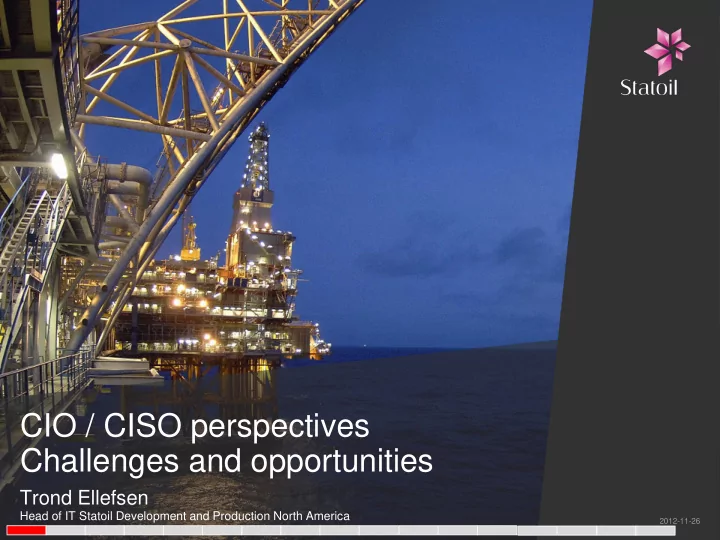
CIO / CISO perspectives Challenges and opportunities
Trond Ellefsen
Head of IT Statoil Development and Production North America
2012-11-26
CIO / CISO perspectives Challenges and opportunities Trond Ellefsen - - PowerPoint PPT Presentation
CIO / CISO perspectives Challenges and opportunities Trond Ellefsen Head of IT Statoil Development and Production North America 2012-11-26 CISO keynote 1 Content and perspective 2 Common threats and the new Art of war 3 Weapons of mass
CIO / CISO perspectives Challenges and opportunities
Trond Ellefsen
Head of IT Statoil Development and Production North America
2012-11-26
CISO keynote
2012-11-26 2
The cloud, devices and OT Q & A
2 5 4 6 1 Content and perspective 7
Common threats and the new Art of war CISO role of 2013 and onwards “Weapons of mass destruction”
3
Weapons of mass collaboration
2012-11-26
2012 – a truly connected world with challenges
2012-11-26 3
Almost everything and everyone is connected Devices are more prone to loss and theft containing potentially sensitive business data Enterprise applications & data must learn to coexist with personal apps & data The exposure is growing as a function of the speed of change and the “IT skills gap” The Bottom Line from Sun Tzu: Victorious warriors win first then go to ware, while defeated warriors go to war and then seek to win. Much Strategy prevails over little strategy !
2012-11-26
Our planet is getting more Instrumented, Interconnected, and “Intelligent”
2012-11-26 4
250 million Almost 250 million smartphones were sold world-wide in 2010, surpassing laptop sales. 90% Nearly 90% of innovation in automobiles is related to software and electronics systems. 10 billion At the entrance to 2013, we expect there are 10 billion connected devices in the world, constituting an “internet of things.” 683 exabytes now, Cloud traffic in 2016 will be 4,3 zeta bytes
2012-11-26
Some spectacular cyber events
Stuxnets great gradfather – one of the alphabet agencies managed to blow up a Russian gas pipeline in Siberia by planting code that lead to systems overload and finally one of the largest non-nuclear detonations in the history.
Radar hack 1 – Allied forces hacked Serbian air defense systems blindfolding them so that air strikes against Kosovo became easier.
Code Red – July 2001 computer worm infected more than 300.000 computers in the US
Operation titan rain – Coordinated attack on public and private computer centers possibly with defense or industrial espionage background
Radar-hack 2 – A targeted hacker attack towards Syrian air defense and radar system made it possible to bomb a military installation
Web war 1 - A Russian and Estonian disagreement led to almost all net based systems in Estonia to stop
Centcom A number of “unused” pin drives laying around led to a computer worm infected deep inside US military central command. The cleanup took 14 months
GhostNet Spy software believed to be coordinated from the east systematically collected information from 103 countries IT systems .
Stuxnet The manifestation of first real sophisticated cyber attack with addressing Siemens SCADA systems and producers of drivers.
RSA secureID RSA secureID hacked to attack Lockheed Martin
Shady RAT Attack hit 72 organizations. Global cooperations, UN, IOC and weapons manufacturers.
Duqu Stuxnets cousin, Mainly for information gathering.
SaudiAramco and RasGas
2012-11-26 5 2012-11-26
information also from Statoil
in spam and phishing e-mails, Facebook, IRS, eBay, FedEx.
6
2012-11-26
Critical national infrastructure is at risk when everything is becoming connected to everything else.
2012-11-26 7 2012-11-26
The new weapons of mass destruction
now becoming a true military warzone.
not scale to protect anymore.
can implement fit for purpose security. Compartmentalization when lightning strikes is on brick in the puzzle.
The new weapons of mass collaboration
speed up the pace of technology change and increase our ability to solve some of the big challenges of our time.
share information and will determine our ability to innovate and crack more of the remaining puzzles.
and value creation facilitated by collaboration and social networks.
creation.
2012-11-26 9 2012-11-26
Classification: Internal 2012-11-26 10
No time to talk we are moving our data to the cloud…
2012-11-26
protecting is a difficult engineering task in this
environment reliably provides stated levels of confidentiality, integrity and availability is even harder.
Risk / Exposure tolerance for the data you want out there. Not everything belongs out there (yet)
deployment of mission critical services until the required services, standards and controls are in place. However a lot can already be put out there.
2012-11-26
phenomenon as the mobile device is increasingly a device that the user identifies themselves by. It is opening up the potential of productivity gains, serving as a stimulus for employee satisfaction and seeding innovation, while exposing the enterprise to data and device management risks.
Segmenting users into groups and apply access, awareness and support according to business risk profile.
personal ! Awareness building based upon peoples personal exposure gets their attention.
2012-11-26
are converging, and IT leaders must manage their transition to converging, aligning and integrating IT and OT environments
technology (OT) introduces new IT security issues for OT organizations.
CISO authority may in need of planning and coordinating a new generation of operational technologies alongside existing information- and administration-focused IT systems.
OT organization in establishing the new common security perspective.
2012-11-26
predominantly be staffed by IT security people as pure IT takes over the proprietary “black box domain”
consistent, structured manner.
architectural exposure. Mind the IT skills gap !
2012-11-26
strategic as enterprise security matures and security functions become both more standardized and commoditized.
are increasingly managerial, collaborative and communicative, rather than primarily
through translate it all into business risk and influence decisions is critical.
and cyber risk from tribal IT language to business language risk and business impact.
grows architectural resources to support CISO and translate the full risk picture and exposure is essential
Trusted and engaged HSE DRIVEN
OPERATOR
Dynamic and strategic
PORTFOLIO OPTIMIZATION
Identify, prioritize and expedite
TECHNOLOGY SOLUTIONS
300,000+
BOEPD IN 2020
Profitable development of
ONSHORE ASSETS
20/80 Focus on your crown jewels. Protect what is most important
Differentiation The “vault”
20 % of the data should maybe not be in the cloud for now
Balance
Balance security and rules and don’t let our fear come in the way of letting us utilizing the reservoir of knowledge
Architecture
Holistic understanding is required for understanding the full technological risk
architecture skillset
FIT FOR PURPOSE SECURITY
Awarness
Make it personal
BUSINESS VALUE
2012-11-26
Q
Trond Ellefsen BA CIO Development & Production Statoil North America trell@statoil.com Tel: +1 713 966 9240 www.statoil.com
Presentation title Trond Ellefsen BA CIO trell@statoil.com Tel: +1 713 966 9240 www.statoil.com