Sustainable Development (2018-2030) Japan Bangkok, Thailand 31 - - PDF document

sustainable development
SMART_READER_LITE
LIVE PREVIEW

Sustainable Development (2018-2030) Japan Bangkok, Thailand 31 - - PDF document

Drafting Committee for the Asia-Pacific Plan of Action for Space Applications for Sustainable Development (2018-2030) Japan Bangkok, Thailand 31 May - 1 June 2018 1 Scope: This presentation is focusing to following themes and action


slide-1
SLIDE 1

Drafting Committee for the ‘Asia-Pacific Plan of Action for Space Applications for Sustainable Development (2018-2030) Japan

Bangkok, Thailand 31 May - 1 June 2018

1

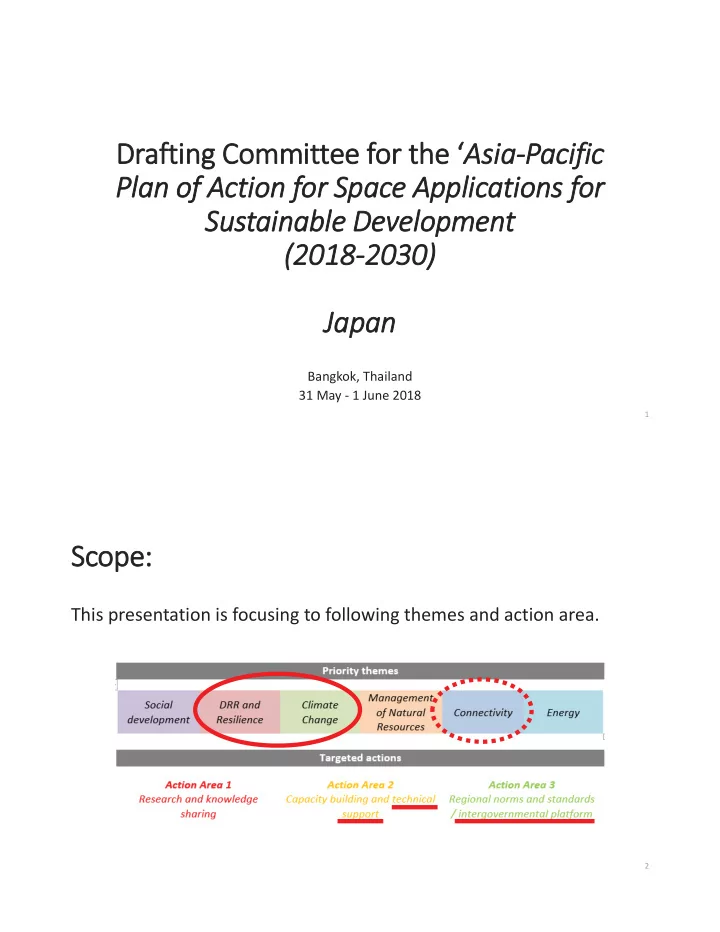
Scope:

This presentation is focusing to following themes and action area.

2

slide-2
SLIDE 2

JAXA’s Satellite pr

  • gr

am

Targets (JFY) 2014 2015 2016 2017 2018 2019 2020 2021 2022 2023 2024

Disasters & Resources Climate Change & Water Cycle

  • Water Cycle
  • Climate Change
  • GHGs

Technology Demonstration

Communications

Study On o rbit Missio n status:

[L and and disaste r mo nito r ing] [Ve ge tatio n, ae ro so l, c lo ud, SST , o c e an c o lo r] [CO2, Me thane ] [Wind, SST , wate r vapo r, pre c ipitatio n,] [Pre c ipitatio n 3D struc ture ] [CO2, Me thane , CO]

De velo pme nt

ALOS-2 / PALSAR-2 GPM / DPR GCOM-W / AMSR2 GOSAT /FTS, CAI GCOM-C / SGLI EarthCARE / CPR

[CO2

OM C / SG GLI G rth

[C

OM-C / SG Ear ALOS-3 (Optical) ALO A LO AL AL AL AL AL A ALOS-4 (SAR)

[Ve g ge g

GC CO CO C

[

GC G

cle

GC G

e

GP

e

G

e

G

[Clo ud and ae ro so l 3D struc ture ]

[19972015] [2012] GOSAT-2 [2009] GOSAT-3 OS ALO A LO O ALO ALO O ALO O ALO ALO O ALO LO O LO O ALO ALO ALO LO O ALO ALO O ALO LO O ALO O ALO O ALO LO LO LO ALO LO LO LO LO AL AL L AL L AL L AL L AL L AL AL L AL L AL L AL AL L AL L AL L AL A O A SLATS

(Supe r L

  • w Attitude T

e st Sate llite ) (Wideband InterNetworking engineering test and Demonstration Satellite)

E xte nde d L ife Pe rio d

Japanese Data Relay System (JDRS) ETS-9 (Engineering Test Satellite No.9)

e

[1 TRMM / PR WINDS [2008] AMSR2’s successor sensor

GCOM-W (Water) “SHIZUKU”

*Extended Operation

GCOM-C (Climate) ater)

tion

OM-C (Cli “SHIKISAI” HIMAWARI-8 ALOS-2

3

DRR and Resilience

4
slide-3
SLIDE 3

Government Designated Organizations Cabinet Secretariat National Police Agency Fire and Disaster Management Agency Ministry of Defense MLIT GSI JMA Japan Coast Guard

Other designated agencies

Agreement with Cabinet Office Cabinet Office Disasters

  • Disaster image data

Satellite maps Data analysis knowledge and knowhows

  • Use of satellite images

Return of feedbacks Study on use of satellite data for DMS systems Sharing of user needs for DRR

Gifu Wakayama Niigata Kochi Tokushima Mie

Concluded agreements with 8 prefectures.

Observation request /Satellite Data Emergency Map

Info sharing by Disaster WEB

  • Iwate

Yamagu chi

Collaboration with DRR organizations in Japan

Local governments plan to include the use of satellites on their disaster management plan.

5

JAXA participates in local government’s DRR drills by providing satellite image data for rapid damage assessment demonstration. 2811 Provision of satellite images Information sharing Deployment of actions 21030 Display of satellite images Presentation to governor Damage assessment

Use of Satellite Images for DRR Drills in Japan

6

slide-4
SLIDE 4

Int’l collaboration: APRSAF / Sentinel Asia

Sentinel Asia is a voluntary initiative by a collaboration between space agencies and disaster management agencies, applying remote sensing and Web-GIS technologies to assist disaster management in the Asia-Pacific region.

In Oct 2005, APRSAF-12, in Kitakyushu, Japan, the plan to initiate the pilot project was approved.

http://www.aprsaf.org/data/aprsaf12_data/day3/5_sswg%20sumrepo.pdf

In Feb 2006, Joint Project Team (JPT) was organized and Sentinel Asia has started. Sentinel Asia is the first initiative under APRSAF.

http://sentinel.tksc.jaxa.jp/

7

Member Status

APRSAF

Space Community

Satellite Image

Disaster Reduction Community

ADRC Member Countries

(30 member countries)

UNESCAP, UNOOSA ASEAN, AIT and

International Disaster Charter

etc.

International Community Joint Project Team (JPT)

SENTI NEL ASI A

Promotion of Utilization Capacity Building International Cooperation Disaster Information Utilization (User)

9 1 organizations from

m 2 8 countries & regions and

2 8

d d 1 5 international organizations I n total: tional or : 1 0 6 organizations

*Three members are increased from last meeting

(As of May 11, 2018)

8

slide-5
SLIDE 5

THEOS KOMPSAT-1 I SRO KARI FORMOSAT-5

Sentinel Asia Sentinel Asia Constellation

XSAT CRI SP RESOURCESAT-2, OCEANSAT-2/OCM IMS-1, CARTOSAT-1&2, RISAT-1 ALOS-2 JAXA TH ALOS-2 JAXA THEOS escalation from Sentinel Asia I nternational Charter STI / VAST VNREDSat-1A

Sentinel Asia Constellation contributing to Emergency Observations

DubaiSat-2

MBRSC GI STDA NARLabs S HEO EO EO EO EO EO EO O EO EO EO EO O EO O EO EO O EO O EO O EO O EO EO EO O EO O EO O EO O EO EO O EO EO EO EO O EO EO O EO EO EO O EO EO EO O EO O EO O EO EO EO EO EO O EO EO O EO O EO O EO EO O EO O EO EO O EO O EO EO EO O EO EO O EO O EO EO O EO O EO O EO O EO O EO O EO EO EO EO O EO EO O EO O EO EO EO O EO EO EO O EO O EO O EO EO EO O EO EO O EO O EO O EO O EO E S OS

KIBO HDTV-EF2

9

EOR Review, Responded Disaster by Geographical Distribution

Japan China Australia Solom on I sland I ndonesia Thailand Myanm ar Lao PDR Viet Nam Philippines Nepal L Bangladesh Pakistan Kazakhstan

  • Feb. 2 0 0 7 -

1 1 May 2 0 1 8

3 2 9 8 4 1 8 2 8 1 7 8 4 2 5 3 2 9

2 8 countries/ region 2 8 co 2 6 1

  • untries/ re

co 1 Disasters

9 Sri Lanka 9 Bhutan 4 Tajikistan 7 Brunei 3 I ndia 1 4 New Zealand 1 1 4 Vi t N 3 2 Cam bodia 3 Kyrgyz Republic 2 Fiji 2 Papua New Guinea 1 Tonga Malaysia 2 10 2 1 a Vanuatu 2 Korea

slide-6
SLIDE 6

Climate Change

11

  • To contribute environmental activities in Asia-Pacific region by

enhancing capability of satellite technology. Such as rice crop monitoring, oil palm monitoring, haze monitoring, flood forecasting, etc.

  • SAFE prototyping(Conducted 26 prototypes so far) and SAFE workshop

twice a year.

  • Prototype results should be put into operational and sustainable use.
  • Every activity is operated by voluntary manner.

About APRSAF and SAFE

APRSAF is the largest space-related conference in the Asia- Pacific region. Over 40 countries and regions take part in

  • APRSAF. APRSAF is enhancing space activities in the Asia-Pacific
  • region. APRSAF also supports the establishment of

international projects as solutions for common issues, such as disaster management and environmental protection, so that participating parties will benefit from mutual cooperation.

Established in 2008 One of initiatives of APRSAF Established in 1993 http://aprsaf.org Space Applications for Environment (SAFE)

12

slide-7
SLIDE 7

Concept of SAFE Prototyping

13

SAFE prototypes

  • More information at SAFE portal site: http://www.eorc.jaxa.jp/SAFE/

Country (proposal number) Agriculture (7) Drought (2) Water resource (7) Coast (3) Forest (4) Atmosphere (1) Ecosystem (1) Fishery (2) Vietnam (6)

  • Indonesia (6)
  • Sri Lanka (4)
  • Cambodia (3)
  • Malaysia (2)
  • Lao P.D.R (1)
  • Bangladesh (1)
  • Pakistan (1)
  • Thailand (1)
  • Myanmar(1)
  • International

Organization (1)

  • 21 completed, 5 completing, and 1 ongoing (as of Dec 13, 2017)
  • ngoing

completed completing

14

slide-8
SLIDE 8

15

Global Satellite Mapping of Precipitation

Global Precipitation Measurement Core satellite

Dual-Frequency Precipitation Radar Constellation satellites n itation Radar

Providing reference standard

Precipitation Radar Microwave Radiometer IR Imager

cloud motion information by IR imager on Geostationary satellite

GPM Microwave Imager

Multi-satellite Rainfall Product

  • hourly global rainfall data
  • 0.1x0.1deg. lat/lon
  • In near real time

distribution

  • 016

Rice Planted Area Identification

(Oyoshi et al., Paddy Water Env, 2016)

Planting

Rice Mapping Software (INAHOR)

  • Estimation of rice planted area and growing stage -

Growing Planted area

slide-9
SLIDE 9

Connectivity

17

Aomori Iwate Miyagi Fukushima Ibaraki Chiba

Great East Japan Earthquake and Tsunami in 2011

Otsuchi Town, Iwate

18

slide-10
SLIDE 10

Damages of Telecom Facilities on Ground

(C) NTT From Press Release of Mar 30, 2011

19

JAXA’s Support Activities w ith Communications Satellites

Tsukuba Space Center

Based upon the Support Requests by Local Governments; Deploying Ground Terminals Operating Ground Terminals Providing Satellite Internet in the Disaster Affected Area

Disaster Area

WINDS ETS-VIII

Mar 20 – Apr 24, 2011 Mar 24 – May 12, 2011

ETS-VIII

011

WIND

4, 2011

20

slide-11
SLIDE 11

Iwate Pref.

  • Ofunato City
  • Onagawa Town

City Hall (Disaster countermeasures office)

Tsukuba Space Center of JAXA

Internet Disaster information gathering and transmission of information Living Information gathering and transmission of information

Central Community Hall (Evacuation Shelter)

Personal safety confirmation and transmission of information ETS-VIII Satellite

Point-to-Point connection All IP connection Internet connected at Tsukuba Up to 768 kbps transmission

JAXA’s Support Activities w ith Communication Satellites

Takashirahama Hotel (Evacuation Shelter)

Miyagi Pref.

  • Otsuchi Town

21

Morioka City

Ofunato City Kamaishi City

  • IP Phone

Disaster countermeasures office

  • f Iwate Prefecture

Tsukuba Space Center

  • f JAXA

Internet High Definition Video Conference Disaster countermeasures branch

  • f Iwate Prefecture

Personal safety confirmation and transmission of information IP Phone IP Phone High Definition Video Conference High Definition Video Conference Disaster countermeasures branch

  • f Iwate Prefecture

Personal safety confirmation and transmission of information WINDS Satellite

Mesh type network configuration All IP connection Internet connected at Tsukuba Up to 20 Mbps transmission

JAXA’s Support Activities w ith Communication Satellites

22

slide-12
SLIDE 12

23

Connectivity of Sentinel Asia: Data distribution of Sentinel Asia was changed from Communication Satellite line to Internet line in 2017. ETS-8, Engineering test satellite for communication finished its

  • peration and WINDS is in post operation phase. Currently, JAXA doesn’t have
  • ther communication satellites on orbit.

Difficulty of disaster communication: Communication traffic concentrates in a few days after disaster occurred. JAXA has checked WINDS Earth station remotely once a month but the station has not been used so much on other calm days. Keeping the station available everyday is difficult in some countries.

JAXA’s experience

Suggestions on a way forward

24

DRR and Resilience, Climate Change: Joining to international framework such as APRSAF is a first step to use space technology for DRR and Resilience, Climate Change. Connectivity: Some space agencies have already shifted weight from satellite communication to Earth observation, space science and space exploration. Most of communication satellites and cables are operated by private companies. Therefore, some kind of agreement between disaster management organization and communication carrier which provides communication line with low cost or free of charge in emergency cases would be useful.