Chronic sinusitis: A rare presentation of Acute Myeloid Leukemia - - PDF document

chronic sinusitis a rare presentation of acute myeloid
SMART_READER_LITE
LIVE PREVIEW

Chronic sinusitis: A rare presentation of Acute Myeloid Leukemia - - PDF document

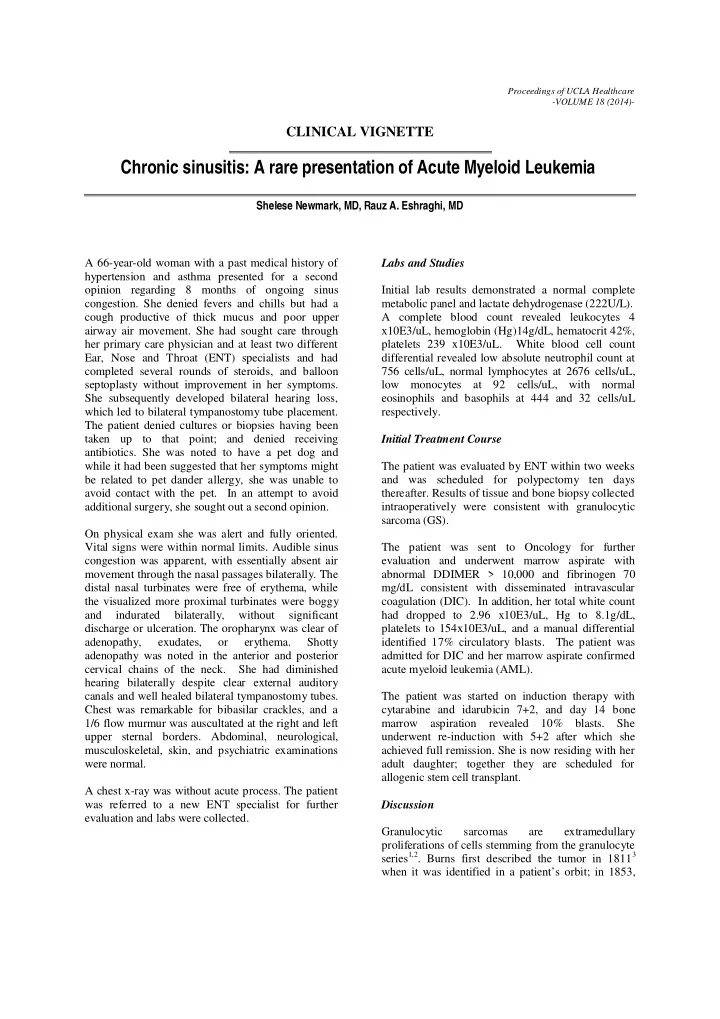
Proceedings of UCLA Healthcare -VOLUME 18 (2014)- CLINICAL VIGNETTE Chronic sinusitis: A rare presentation of Acute Myeloid Leukemia Shelese Newmark, MD, Rauz A. Eshraghi, MD A 66-year-old woman with a past medical history of Labs and Studies


slide-1
SLIDE 1

Proceedings of UCLA Healthcare

  • VOLUME 18 (2014)-

CLINICAL VIGNETTE

Chronic sinusitis: A rare presentation of Acute Myeloid Leukemia

Shelese Newmark, MD, Rauz A. Eshraghi, MD A 66-year-old woman with a past medical history of hypertension and asthma presented for a second

  • pinion regarding 8 months of ongoing sinus
  • congestion. She denied fevers and chills but had a

cough productive of thick mucus and poor upper airway air movement. She had sought care through her primary care physician and at least two different Ear, Nose and Throat (ENT) specialists and had completed several rounds of steroids, and balloon septoplasty without improvement in her symptoms. She subsequently developed bilateral hearing loss, which led to bilateral tympanostomy tube placement. The patient denied cultures or biopsies having been taken up to that point; and denied receiving

  • antibiotics. She was noted to have a pet dog and

while it had been suggested that her symptoms might be related to pet dander allergy, she was unable to avoid contact with the pet. In an attempt to avoid additional surgery, she sought out a second opinion. On physical exam she was alert and fully oriented. Vital signs were within normal limits. Audible sinus congestion was apparent, with essentially absent air movement through the nasal passages bilaterally. The distal nasal turbinates were free of erythema, while the visualized more proximal turbinates were boggy and indurated bilaterally, without significant discharge or ulceration. The oropharynx was clear of adenopathy, exudates,

  • r

erythema. Shotty adenopathy was noted in the anterior and posterior cervical chains of the neck. She had diminished hearing bilaterally despite clear external auditory canals and well healed bilateral tympanostomy tubes. Chest was remarkable for bibasilar crackles, and a 1/6 flow murmur was auscultated at the right and left upper sternal borders. Abdominal, neurological, musculoskeletal, skin, and psychiatric examinations were normal. A chest x-ray was without acute process. The patient was referred to a new ENT specialist for further evaluation and labs were collected. Labs and Studies Initial lab results demonstrated a normal complete metabolic panel and lactate dehydrogenase (222U/L). A complete blood count revealed leukocytes 4 x10E3/uL, hemoglobin (Hg)14g/dL, hematocrit 42%, platelets 239 x10E3/uL. White blood cell count differential revealed low absolute neutrophil count at 756 cells/uL, normal lymphocytes at 2676 cells/uL, low monocytes at 92 cells/uL, with normal eosinophils and basophils at 444 and 32 cells/uL respectively. Initial Treatment Course The patient was evaluated by ENT within two weeks and was scheduled for polypectomy ten days

  • thereafter. Results of tissue and bone biopsy collected

intraoperatively were consistent with granulocytic sarcoma (GS). The patient was sent to Oncology for further evaluation and underwent marrow aspirate with abnormal DDIMER > 10,000 and fibrinogen 70 mg/dL consistent with disseminated intravascular coagulation (DIC). In addition, her total white count had dropped to 2.96 x10E3/uL, Hg to 8.1g/dL, platelets to 154x10E3/uL, and a manual differential identified 17% circulatory blasts. The patient was admitted for DIC and her marrow aspirate confirmed acute myeloid leukemia (AML). The patient was started on induction therapy with cytarabine and idarubicin 7+2, and day 14 bone marrow aspiration revealed 10% blasts. She underwent re-induction with 5+2 after which she achieved full remission. She is now residing with her adult daughter; together they are scheduled for allogenic stem cell transplant. Discussion Granulocytic sarcomas are extramedullary proliferations of cells stemming from the granulocyte series1,2. Burns first described the tumor in 18113 when it was identified in a patient’s orbit; in 1853,

slide-2
SLIDE 2

Proceedings of UCLA Healthcare

  • VOLUME 18 (2014)-

the term chloroma appeared4, referencing the green color of the tumors due to the myeloperoxidase contained within them3. In 1966, the more appropriate term, granulocytic sarcoma (owing to the tumor’s mesodermal

  • rigin),

was coined3. Alternatively, the term myeloid sarcoma has also been used to describe the tumor. Granulocytic sarcomas typically exist in combination with AML and they were first associated with acute myeloid leukemia in 18935. In 1981, this association was further characterized by Neiman et al. in a study

  • f 61 cases of granulocytic sarcoma6. The most

common sites of granulocytic sarcoma occurrence were in the bone/periosteum, soft tissue, lymph nodes, and skin; but could arise in essentially any

  • tissue. Not all patients with granulocytic sarcoma

develop AML; granulocytic sarcomas are now known to be associated with other myeloproliferative diseases as well7. Our patient’s case is uncommon in several ways; first granulocytic sarcomas are rare regardless of location; being observed in only 3-9.1% of AML cases3. In

  • ne case series of hematolymphoid malignancies of

the head and neck, it was found that of 122 malignancies, only 1 was leukemoid in nature; the

  • ther 121 were lymphoid in origin8. Second, GS

rarely occurs in adults; it typically appears in patients under the age of 159. Third, GS is a highly atypical primary presentation of AML or preexisting

  • pancytopenia. In fact, less than 1% of patients with

AML present in this manner10. Finally, our patient’s GS was identified in the nasal cavity. Granulocytic sarcoma occurrence is well documented in the head and neck; however, it has a predilection for the oral cavity, as opposed to the sinuses11. We found only

  • ne other case of an initial presentation of AML

characterized by GS in the sinus cavity7. Two other cases of nasal cavity GS were identified, however they were in patients with existing diagnoses of AML12,13. Alternatively, our case is relatively “classic” in that

  • f patients identified to have a primary presentation
  • f GS, a diagnosis of acute leukemia typically

follows in the following 2 years time (average 10 months)6. Our patient was found to have AML eight months after symptom onset; and within one month

  • f initial evaluation.

Acute myeloid leukemia should always be a part of the differential when granulocytic sarcomas are

  • identified. In cases that have an initial presentation of

GS as opposed to the hallmark findings of AML such as pancytopenia, it can delay diagnosis, as was seen in our patient. Generally, granulocytic sarcomas are poor prognostic signs in patients with AML1, and it has been estimated that life expectancy in patients with AML in association with a granulocytic sarcoma is only eight months14. Granulocytic sarcomas are treated by treating the underlying AML with standard dose cytarabine and an anthracycline. For those sarcomas that cause mass effect, radiation therapy can also be considered15. REFERENCES

1. Stoopler ET, Pinto A, Alawi F, Raghavendra S, Boyce R Jr, Porter D, Sollecito TP. Granulocytic sarcoma: an atypical presentation in the oral cavity. Spec Care Dentist. 2004 Mar-Apr;24(2):65-9. PubMed PMID: 15200230. 2. Ficarra G, Silverman S Jr, Quivey JM, Hansen LS, Giannotti K. Granulocytic sarcoma (chloroma) of the oral cavity: a case with aleukemic presentation. Oral Surg Oral Med Oral Pathol. 1987 Jun;63(6):709-14. PubMed PMID: 3473396. 3. Bassichis B, McClay J, Wiatrak B. Chloroma of the masseteric muscle. Int J Pediatr Otorhinolaryngol. 2000 Jun 9;53(1):57-61. PubMed PMID: 10862926. 4. King A. A case of chloroma. Monthly J Med. 1853; 17:97. 5. Dock G. Chloroma and its relation to leukemia. Am J Med

  • Sci. 1893; 106:153-7.

6. Neiman RS, Barcos M, Berard C, Bonner H, Mann R, Rydell RE, Bennett JM. Granulocytic sarcoma: a clinicopathologic study of 61 biopsied cases. Cancer. 1981 Sep 15;48(6):1426-37. PubMed PMID: 7023656. 7. Prades JM, Alaani A, Mosnier JF, Dumollard JM, Martin C. Granulocytic sarcoma of the nasal cavity. Rhinology. 2002 Sep;40(3):159-61. PubMed PMID: 12357718. 8. Iguchi H, Wada T, Matsushita N, Oishi M, Yamane H . Anatomic distribution of hematolymphoid malignancies in the head and neck: 7 years of experience with 122 patients in a single institution. Acta Otolaryngol. 2012 Nov;132(11):1224-31. doi: 10.3109/00016489.2012.694474. Epub 2012 Oct 1. PubMed PMID: 23025415. 9. Brooks HW, Evans AE, Glass RM, Pang EM. Chloromas

  • f the head and neck in childhood. The initial manifestation
  • f myeloid leukemia in three patients. Arch Otolaryngol.

1974 Oct;100(4):306-8. PubMed PMID: 4528469. 10. Dores GM, Devesa SS, Curtis RE, Linet MS, Morton

  • LM. Acute leukemia incidence and patient survival among

children and adults in the United States, 2001-2007. Blood. 2012 Jan 5;119(1):34-43. doi: 10.1182/blood-2011-04-

  • 347872. Epub 2011 Nov 15. PubMed PMID: 22086414;

PubMed Central PMCID: PMC3251235. 11. Zhou J, Bell D, Medeiros LJ. Myeloid sarcoma of the head and neck region. Arch Pathol Lab Med. 2013 Nov;137(11):1560-8. doi: 10.5858/arpa.2012-0537-OA. Epub 2013 Mar 26. PubMed PMID: 23530613. 12. Kuo CL, Yu YB, Li WY, Lee YL. Unusual coexistence of sinonasal myeloid sarcoma and acute fulminant invasive fungal sinusitis: a diagnostic dilemma. J Laryngol Otol. 2013 Apr;127(4):415-8. doi: 10.1017/S0022215113000285. Epub 2013 Feb 28. PubMed PMID: 23448530. 13. Ferri E, Minotto C, Ianniello F, Cavaleri S, Armato E, Capuzzo P. Maxillo-ethmoidal chloroma in acute myeloid

slide-3
SLIDE 3

Proceedings of UCLA Healthcare

  • VOLUME 18 (2014)-

leukaemia: case report. Acta Otorhinolaryngol Ital. 2005 Jun;25(3):195-9. PubMed PMID: 16450777; PubMed Central PMCID: PMC2639872. 14. Mansi JL, Selby PJ, Carter RL, Powles RL, McElwain

  • TJ. Granulocytic sarcoma: a diagnosis to be considered in

unusual lymphoma syndromes. Postgrad Med J. 1987 Jun;63(740):447-9. PubMed PMID: 3481072; PubMed Central PMCID: PMC2428337. 15. Larson, R. Post remission therapy in acute myeloid leukemia in younger adults. In: UpToDate, Basow, DS(Ed), UpToDate, Waltham, MA, 2013. Submitted on January 5, 2014