Chronic Disease Monitoring EU Framework 5 funded projects, Lessons - - PDF document

chronic disease monitoring
SMART_READER_LITE
LIVE PREVIEW

Chronic Disease Monitoring EU Framework 5 funded projects, Lessons - - PDF document

Chronic Disease Monitoring EU Framework 5 funded projects, Lessons learnt from long-term doc@HOME and REALITY chronic condition monitoring Home-based monitoring of chronically ill patients Disease areas include Hypertension,


slide-1
SLIDE 1

www.docobo.co.uk 7th April 2004

Adrian Flowerday

Managing Director

Docobo Ltd

Lessons learnt from long-term chronic condition monitoring

www.docobo.co.uk 7th April 2004

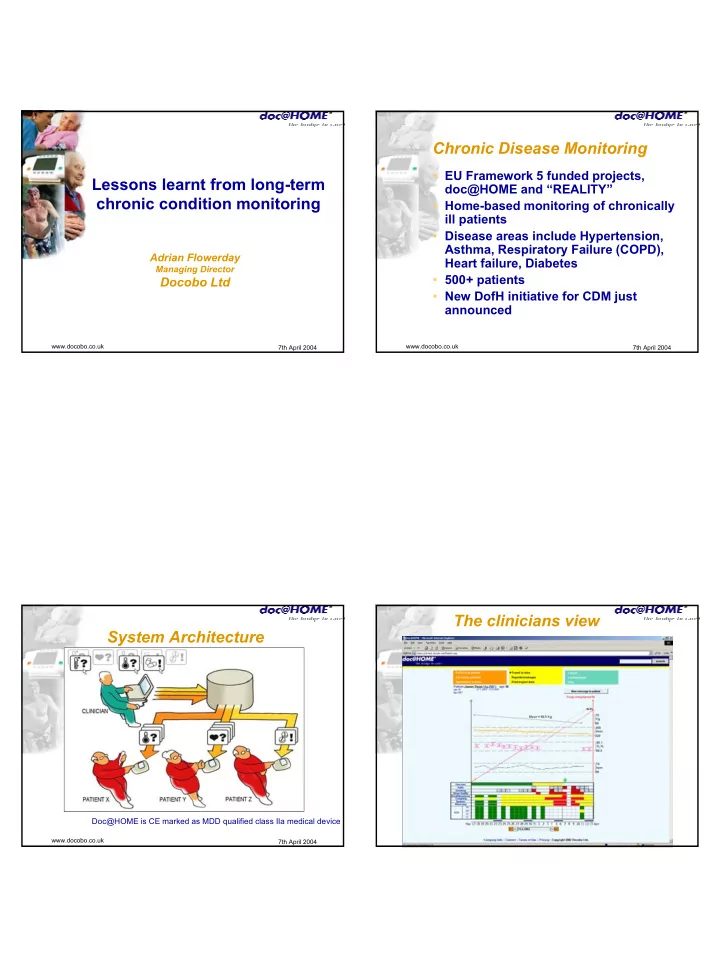
Chronic Disease Monitoring

  • EU Framework 5 funded projects,

doc@HOME and “REALITY”

  • Home-based monitoring of chronically

ill patients

  • Disease areas include Hypertension,

Asthma, Respiratory Failure (COPD), Heart failure, Diabetes

  • 500+ patients
  • New DofH initiative for CDM just

announced

www.docobo.co.uk 7th April 2004

System Architecture

Doc@HOME is CE marked as MDD qualified class IIa medical device

www.docobo.co.uk 7th April 2004

The clinicians view

slide-2
SLIDE 2

www.docobo.co.uk 7th April 2004

The need for invasion

  • Better monitoring, better

management

  • Physiological + symptoms, side

effects and quality of life

  • But how much invasion?
  • Impacts on routine
  • Too much becomes a burden
  • Leads to reduction of compliance

www.docobo.co.uk 7th April 2004

Invasion vs value

www.docobo.co.uk 7th April 2004

Disease specific benefits

  • High resolution data collection

– A “sea of data” – searching for the benefits – Trend detection; precise BP & real effects

  • f medication
  • Medication compliance benefits

– Compliance increased by >100%

  • Patient understanding and self control

www.docobo.co.uk 7th April 2004

Interaction Compliance

Months of participation 10.00 9.00 8.00 7.00 6.00 5.00 4.00 3.00 2.00 1.00 Mean lag days 6 5 4 3 2 1

10 20 30 40 50 60 70 N r

  • f

L a g s 5 10 15 Lag in days

  • Voluntary, patient initiated interaction;
  • mean lag days (days between successive interactions)

used as a measure of compliance.

  • usage levels can be optimised by employing a user

interaction refresh period of less than 3-months – design in

Peak of summer holiday season

slide-3
SLIDE 3

www.docobo.co.uk 7th April 2004

Compliance – BP Measurement #1

Osavõtt kuudes

12.00 11.00 10.00 9.00 8.00 7.00 6.00 5.00 4.00 3.00 2.00 1.00

Mean of bp_hi_rest_morning

146 144 142 140 138 136

Months Systolic Blood Pressure (mm/Hg)

Conclusions

  • Blood pressure cycles correlated

with the period of clinician consultations (approx 3 months)

  • Patients are “nagged” when they

see their consultant and this results in better drug compliance / lifestyle, which then tails off.

  • Automated / semi-automated

“nagging” could improve the situation.

www.docobo.co.uk 7th April 2004

Compliance – BP Measurement #2

Conclusions

  • BP drop from Friday evening
  • BP increase from Monday
  • Drug compliance is low over the

weekend

  • High risk caused by combination
  • f stress and lack of medication –

target intervention at high risk points

Nädalapäev 7 6 5 4 3 2 1 M e a n

  • f b

p _ h i_ re st_ m

  • rn

in g 143.5 143.0 142.5 142.0 141.5 141.0 140.5 140.0 Nädalapäev 7 6 5 4 3 2 1 M e a n

  • f b

p _ h i_ e ve n in g 143.5 143.0 142.5 142.0 141.5 141.0

Morning Evening

Monday Tuesday Wednesday Thursday Friday Saturday Sunday

www.docobo.co.uk 7th April 2004

Self Registered Compliance?

  • Self (voluntary) registration of anti-

hypertensive medication compliance by patients.

  • Very high correlation found

between self-registered compliance and BP control.

  • Results suggest that self-registered

compliance is a relatively reliable measure.

www.docobo.co.uk 7th April 2004

The need for training

  • The patient
  • Needs to understand benefits
  • the obvious
  • the long term
  • The healthcare professional
  • Needs to understand benefits
  • A new process
  • New protocols
slide-4
SLIDE 4

www.docobo.co.uk 7th April 2004

Barriers to entry

  • Recognition of benefits in clinical

community – lack of funding

  • Commercial considerations
  • Cost, reimbursment mechanisms, reliability
  • Regulatory considerations
  • MHRA/FDA
  • Data security
  • Lack of standards
  • TV industry model
  • Interoperability
  • Co-operation is key

www.docobo.co.uk 7th April 2004

In conclusion

  • Better monitoring essential to control

chronic disease

  • Level of invasion managed
  • Standards to allow inter-operability

needed

www.docobo.co.uk 7th April 2004

Thank you! Adrian Flowerday

Docobo Ltd

Lessons learnt from long-term chronic condition monitoring