SLIDE 1
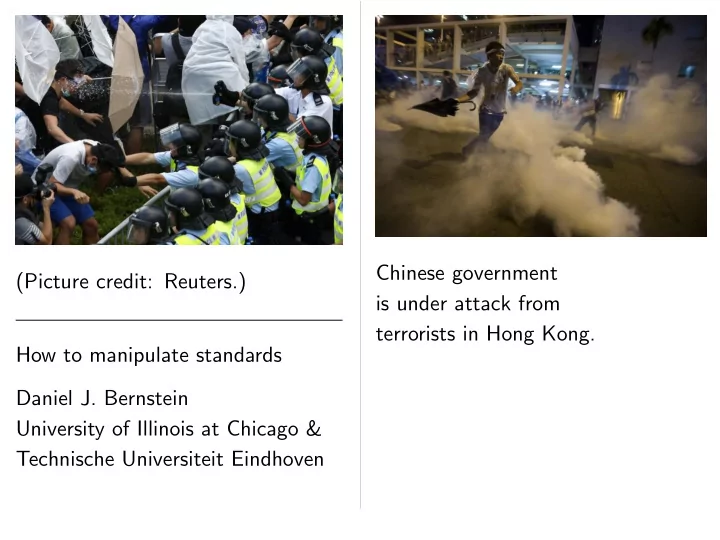
(Picture credit: Reuters.) How to manipulate standards Daniel J. Bernstein University of Illinois at Chicago & Technische Universiteit Eindhoven Chinese government is under attack from terrorists in Hong Kong.
SLIDE 2
(Picture credit: Reuters.) How to manipulate standards Daniel J. Bernstein University of Illinois at Chicago & Technische Universiteit Eindhoven Chinese government is under attack from terrorists in Hong Kong. Goal of this talk: Help the government decrypt the terrorists’ encrypted communications.
SLIDE 3 (Picture credit: Reuters.) to manipulate standards
University of Illinois at Chicago & echnische Universiteit Eindhoven Chinese government is under attack from terrorists in Hong Kong. Goal of this talk: Help the government decrypt the terrorists’ encrypted communications. Intercept (Also exploit How does relate to
SLIDE 4
Reuters.) manipulate standards Bernstein Illinois at Chicago & Universiteit Eindhoven Chinese government is under attack from terrorists in Hong Kong. Goal of this talk: Help the government decrypt the terrorists’ encrypted communications. Intercept the ciphertext. (Also exploit metadata How does the ciphertext relate to the plaintext?
SLIDE 5
rds Chicago & Eindhoven Chinese government is under attack from terrorists in Hong Kong. Goal of this talk: Help the government decrypt the terrorists’ encrypted communications. Intercept the ciphertext. (Also exploit metadata etc.) How does the ciphertext relate to the plaintext?
SLIDE 6
Chinese government is under attack from terrorists in Hong Kong. Goal of this talk: Help the government decrypt the terrorists’ encrypted communications. Intercept the ciphertext. (Also exploit metadata etc.) How does the ciphertext relate to the plaintext?
SLIDE 7
Chinese government is under attack from terrorists in Hong Kong. Goal of this talk: Help the government decrypt the terrorists’ encrypted communications. Intercept the ciphertext. (Also exploit metadata etc.) How does the ciphertext relate to the plaintext? Maybe 56-bit DES. Feasible to search all 256 possible keys, check plaintext plausibility.
SLIDE 8
Chinese government is under attack from terrorists in Hong Kong. Goal of this talk: Help the government decrypt the terrorists’ encrypted communications. Intercept the ciphertext. (Also exploit metadata etc.) How does the ciphertext relate to the plaintext? Maybe 56-bit DES. Feasible to search all 256 possible keys, check plaintext plausibility. Maybe 128-bit AES. Feasible search is unlikely to find this target’s key. (But can improve probability by batching many targets.)
SLIDE 9 Chinese government under attack from rists in Hong Kong.
the government decrypt the terrorists’ encrypted communications. Intercept the ciphertext. (Also exploit metadata etc.) How does the ciphertext relate to the plaintext? Maybe 56-bit DES. Feasible to search all 256 possible keys, check plaintext plausibility. Maybe 128-bit AES. Feasible search is unlikely to find this target’s key. (But can improve probability by batching many targets.) Are there to find plain given AES Extensively in public Doesn’t
SLIDE 10
government from Hong Kong. talk: government rists’ unications. Intercept the ciphertext. (Also exploit metadata etc.) How does the ciphertext relate to the plaintext? Maybe 56-bit DES. Feasible to search all 256 possible keys, check plaintext plausibility. Maybe 128-bit AES. Feasible search is unlikely to find this target’s key. (But can improve probability by batching many targets.) Are there better w to find plaintext given AES ciphertext? Extensively studied in public literature. Doesn’t look good
SLIDE 11
nications. Intercept the ciphertext. (Also exploit metadata etc.) How does the ciphertext relate to the plaintext? Maybe 56-bit DES. Feasible to search all 256 possible keys, check plaintext plausibility. Maybe 128-bit AES. Feasible search is unlikely to find this target’s key. (But can improve probability by batching many targets.) Are there better ways to find plaintext given AES ciphertext? Extensively studied in public literature. Doesn’t look good for us.
SLIDE 12
Intercept the ciphertext. (Also exploit metadata etc.) How does the ciphertext relate to the plaintext? Maybe 56-bit DES. Feasible to search all 256 possible keys, check plaintext plausibility. Maybe 128-bit AES. Feasible search is unlikely to find this target’s key. (But can improve probability by batching many targets.) Are there better ways to find plaintext given AES ciphertext? Extensively studied in public literature. Doesn’t look good for us.
SLIDE 13
Intercept the ciphertext. (Also exploit metadata etc.) How does the ciphertext relate to the plaintext? Maybe 56-bit DES. Feasible to search all 256 possible keys, check plaintext plausibility. Maybe 128-bit AES. Feasible search is unlikely to find this target’s key. (But can improve probability by batching many targets.) Are there better ways to find plaintext given AES ciphertext? Extensively studied in public literature. Doesn’t look good for us. Maybe we’re smarter and can find something better than what’s in the literature.
SLIDE 14
Intercept the ciphertext. (Also exploit metadata etc.) How does the ciphertext relate to the plaintext? Maybe 56-bit DES. Feasible to search all 256 possible keys, check plaintext plausibility. Maybe 128-bit AES. Feasible search is unlikely to find this target’s key. (But can improve probability by batching many targets.) Are there better ways to find plaintext given AES ciphertext? Extensively studied in public literature. Doesn’t look good for us. Maybe we’re smarter and can find something better than what’s in the literature. Maybe there are other parts of the system that have been less studied, are easier for us to break.
SLIDE 15
Intercept the ciphertext. exploit metadata etc.) does the ciphertext to the plaintext? 56-bit DES. easible to search possible keys, plaintext plausibility. 128-bit AES. easible search is unlikely this target’s key. can improve probability tching many targets.) Are there better ways to find plaintext given AES ciphertext? Extensively studied in public literature. Doesn’t look good for us. Maybe we’re smarter and can find something better than what’s in the literature. Maybe there are other parts of the system that have been less studied, are easier for us to break. Standard terrorists we see cipher Maybe terro compute Unintentionally: With our
SLIDE 16
ciphertext. metadata etc.) ciphertext plaintext? DES. rch eys, plausibility. AES. is unlikely rget’s key. rove probability many targets.) Are there better ways to find plaintext given AES ciphertext? Extensively studied in public literature. Doesn’t look good for us. Maybe we’re smarter and can find something better than what’s in the literature. Maybe there are other parts of the system that have been less studied, are easier for us to break. Standard security mo terrorists compute we see cipher output. Maybe terrorists o compute somethin Unintentionally: “bugs”. With our help: “faults”.
SLIDE 17
etc.) . robability rgets.) Are there better ways to find plaintext given AES ciphertext? Extensively studied in public literature. Doesn’t look good for us. Maybe we’re smarter and can find something better than what’s in the literature. Maybe there are other parts of the system that have been less studied, are easier for us to break. Standard security model says: terrorists compute cipher; we see cipher output. Maybe terrorists occasionally compute something different. Unintentionally: “bugs”. With our help: “faults”.
SLIDE 18
Are there better ways to find plaintext given AES ciphertext? Extensively studied in public literature. Doesn’t look good for us. Maybe we’re smarter and can find something better than what’s in the literature. Maybe there are other parts of the system that have been less studied, are easier for us to break. Standard security model says: terrorists compute cipher; we see cipher output. Maybe terrorists occasionally compute something different. Unintentionally: “bugs”. With our help: “faults”.
SLIDE 19 Are there better ways to find plaintext given AES ciphertext? Extensively studied in public literature. Doesn’t look good for us. Maybe we’re smarter and can find something better than what’s in the literature. Maybe there are other parts of the system that have been less studied, are easier for us to break. Standard security model says: terrorists compute cipher; we see cipher output. Maybe terrorists occasionally compute something different. Unintentionally: “bugs”. With our help: “faults”. Maybe we actually see more than cipher output. “Side channels”: e.g., plaintext or key is visible through power consumption
- r electromagnetic radiation.
SLIDE 20 there better ways plaintext AES ciphertext? Extensively studied public literature. esn’t look good for us. we’re smarter and find something better what’s in the literature. there are other
have been less studied, easier for us to break. Standard security model says: terrorists compute cipher; we see cipher output. Maybe terrorists occasionally compute something different. Unintentionally: “bugs”. With our help: “faults”. Maybe we actually see more than cipher output. “Side channels”: e.g., plaintext or key is visible through power consumption
- r electromagnetic radiation.
How do agree up Maybe secret-k Terrorists produce a random-numb Maybe w See Tanja Maybe the stored on and we can Lack of “k (aka “forw
SLIDE 21 ways ciphertext? ied re.
smarter and something better the literature.
system less studied, to break. Standard security model says: terrorists compute cipher; we see cipher output. Maybe terrorists occasionally compute something different. Unintentionally: “bugs”. With our help: “faults”. Maybe we actually see more than cipher output. “Side channels”: e.g., plaintext or key is visible through power consumption
- r electromagnetic radiation.
How do the terrorists agree upon an AES Maybe secret-key cryptography Terrorists Alice and produce 128-bit key a random-number Maybe we can break See Tanja Lange’s Maybe the key is still stored on Bob’s computer and we can grab computer. Lack of “key erasure” (aka “forward secrecy”).
SLIDE 22 literature. studied, Standard security model says: terrorists compute cipher; we see cipher output. Maybe terrorists occasionally compute something different. Unintentionally: “bugs”. With our help: “faults”. Maybe we actually see more than cipher output. “Side channels”: e.g., plaintext or key is visible through power consumption
- r electromagnetic radiation.
How do the terrorists agree upon an AES key? Maybe secret-key cryptography Terrorists Alice and Bob meet, produce 128-bit key using a random-number generator. Maybe we can break this RNG. See Tanja Lange’s talk. Maybe the key is still stored on Bob’s computer and we can grab computer. Lack of “key erasure” (aka “forward secrecy”).
SLIDE 23 Standard security model says: terrorists compute cipher; we see cipher output. Maybe terrorists occasionally compute something different. Unintentionally: “bugs”. With our help: “faults”. Maybe we actually see more than cipher output. “Side channels”: e.g., plaintext or key is visible through power consumption
- r electromagnetic radiation.
How do the terrorists agree upon an AES key? Maybe secret-key cryptography. Terrorists Alice and Bob meet, produce 128-bit key using a random-number generator. Maybe we can break this RNG. See Tanja Lange’s talk. Maybe the key is still stored on Bob’s computer and we can grab computer. Lack of “key erasure” (aka “forward secrecy”).
SLIDE 24 Standard security model says: rists compute cipher; cipher output. terrorists occasionally compute something different. Unintentionally: “bugs”.
we actually see than cipher output. channels”: e.g., plaintext or key is visible through power consumption electromagnetic radiation. How do the terrorists agree upon an AES key? Maybe secret-key cryptography. Terrorists Alice and Bob meet, produce 128-bit key using a random-number generator. Maybe we can break this RNG. See Tanja Lange’s talk. Maybe the key is still stored on Bob’s computer and we can grab computer. Lack of “key erasure” (aka “forward secrecy”). Maybe public-k e.g. ECDH using standa
sends aP
sends bP
- 3. Alice
- 4. Bob computes
- 5. Alice
abP into
SLIDE 25 y model says: compute cipher;
ething different. “bugs”. “faults”. actually see cipher output. channels”: e.g., is visible consumption electromagnetic radiation. How do the terrorists agree upon an AES key? Maybe secret-key cryptography. Terrorists Alice and Bob meet, produce 128-bit key using a random-number generator. Maybe we can break this RNG. See Tanja Lange’s talk. Maybe the key is still stored on Bob’s computer and we can grab computer. Lack of “key erasure” (aka “forward secrecy”). Maybe public-key cryptogra e.g. ECDHE;P key using standard point
- n an elliptic curve
- 1. Alice generates
sends aP on E.
sends bP on E.
- 3. Alice computes
- 4. Bob computes a
- 5. Alice and Bob convert
abP into AES key.
SLIDE 26 says: ccasionally different. consumption radiation. How do the terrorists agree upon an AES key? Maybe secret-key cryptography. Terrorists Alice and Bob meet, produce 128-bit key using a random-number generator. Maybe we can break this RNG. See Tanja Lange’s talk. Maybe the key is still stored on Bob’s computer and we can grab computer. Lack of “key erasure” (aka “forward secrecy”). Maybe public-key cryptography e.g. ECDHE;P key exchange using standard point P
- n an elliptic curve E:
- 1. Alice generates secret a,
sends aP on E.
- 2. Bob generates secret b,
sends bP on E.
- 3. Alice computes abP.
- 4. Bob computes abP.
- 5. Alice and Bob convert
abP into AES key.
SLIDE 27 How do the terrorists agree upon an AES key? Maybe secret-key cryptography. Terrorists Alice and Bob meet, produce 128-bit key using a random-number generator. Maybe we can break this RNG. See Tanja Lange’s talk. Maybe the key is still stored on Bob’s computer and we can grab computer. Lack of “key erasure” (aka “forward secrecy”). Maybe public-key cryptography. e.g. ECDHE;P key exchange using standard point P
- n an elliptic curve E:
- 1. Alice generates secret a,
sends aP on E.
- 2. Bob generates secret b,
sends bP on E.
- 3. Alice computes abP.
- 4. Bob computes abP.
- 5. Alice and Bob convert
abP into AES key.
SLIDE 28 do the terrorists upon an AES key? secret-key cryptography. rists Alice and Bob meet, duce 128-bit key using random-number generator. we can break this RNG. anja Lange’s talk. the key is still
e can grab computer.
“forward secrecy”). Maybe public-key cryptography. e.g. ECDHE;P key exchange using standard point P
- n an elliptic curve E:
- 1. Alice generates secret a,
sends aP on E.
- 2. Bob generates secret b,
sends bP on E.
- 3. Alice computes abP.
- 4. Bob computes abP.
- 5. Alice and Bob convert
abP into AES key. Maybe w Maybe w Hard if Alice Maybe w Hard if Bob (Not compatible Alice, Bob Maybe w compute Maybe w compute
SLIDE 29 terrorists AES key? ey cryptography. and Bob meet, key using er generator. reak this RNG. Lange’s talk. is still computer computer. erasure” secrecy”). Maybe public-key cryptography. e.g. ECDHE;P key exchange using standard point P
- n an elliptic curve E:
- 1. Alice generates secret a,
sends aP on E.
- 2. Bob generates secret b,
sends bP on E.
- 3. Alice computes abP.
- 4. Bob computes abP.
- 5. Alice and Bob convert
abP into AES key. Maybe we can break Maybe we can grab Hard if Alice discarded Maybe we can modify Hard if Bob already (Not compatible with Alice, Bob use two Maybe we can “break compute a from aP Maybe we can “break compute abP from
SLIDE 30 cryptography. meet, generator. RNG. computer. Maybe public-key cryptography. e.g. ECDHE;P key exchange using standard point P
- n an elliptic curve E:
- 1. Alice generates secret a,
sends aP on E.
- 2. Bob generates secret b,
sends bP on E.
- 3. Alice computes abP.
- 4. Bob computes abP.
- 5. Alice and Bob convert
abP into AES key. Maybe we can break RNG fo Maybe we can grab a. Hard if Alice discarded it. Maybe we can modify aP. Hard if Bob already knows it. (Not compatible with discard Alice, Bob use two DH layers.) Maybe we can “break ECDL”: compute a from aP. Maybe we can “break ECDH”: compute abP from aP; bP.
SLIDE 31 Maybe public-key cryptography. e.g. ECDHE;P key exchange using standard point P
- n an elliptic curve E:
- 1. Alice generates secret a,
sends aP on E.
- 2. Bob generates secret b,
sends bP on E.
- 3. Alice computes abP.
- 4. Bob computes abP.
- 5. Alice and Bob convert
abP into AES key. Maybe we can break RNG for a. Maybe we can grab a. Hard if Alice discarded it. Maybe we can modify aP. Hard if Bob already knows it. (Not compatible with discard ⇒ Alice, Bob use two DH layers.) Maybe we can “break ECDL”: compute a from aP. Maybe we can “break ECDH”: compute abP from aP; bP.
SLIDE 32
public-key cryptography. ECDHE;P key exchange standard point P elliptic curve E: Alice generates secret a, aP on E. Bob generates secret b, bP on E. Alice computes abP. Bob computes abP. Alice and Bob convert into AES key. Maybe we can break RNG for a. Maybe we can grab a. Hard if Alice discarded it. Maybe we can modify aP. Hard if Bob already knows it. (Not compatible with discard ⇒ Alice, Bob use two DH layers.) Maybe we can “break ECDL”: compute a from aP. Maybe we can “break ECDH”: compute abP from aP; bP. ECDL/ECDH depends How did which curve
SLIDE 33 ey cryptography. ey exchange
curve E: generates secret a, generates secret b, computes abP. computes abP. Bob convert ey. Maybe we can break RNG for a. Maybe we can grab a. Hard if Alice discarded it. Maybe we can modify aP. Hard if Bob already knows it. (Not compatible with discard ⇒ Alice, Bob use two DH layers.) Maybe we can “break ECDL”: compute a from aP. Maybe we can “break ECDH”: compute abP from aP; bP. ECDL/ECDH difficult depends on curve E How did terrorists which curve E to use?
SLIDE 34
cryptography. exchange , , Maybe we can break RNG for a. Maybe we can grab a. Hard if Alice discarded it. Maybe we can modify aP. Hard if Bob already knows it. (Not compatible with discard ⇒ Alice, Bob use two DH layers.) Maybe we can “break ECDL”: compute a from aP. Maybe we can “break ECDH”: compute abP from aP; bP. ECDL/ECDH difficulty depends on curve E. How did terrorists decide which curve E to use?
SLIDE 35
Maybe we can break RNG for a. Maybe we can grab a. Hard if Alice discarded it. Maybe we can modify aP. Hard if Bob already knows it. (Not compatible with discard ⇒ Alice, Bob use two DH layers.) Maybe we can “break ECDL”: compute a from aP. Maybe we can “break ECDH”: compute abP from aP; bP. ECDL/ECDH difficulty depends on curve E. How did terrorists decide which curve E to use?
SLIDE 36
Maybe we can break RNG for a. Maybe we can grab a. Hard if Alice discarded it. Maybe we can modify aP. Hard if Bob already knows it. (Not compatible with discard ⇒ Alice, Bob use two DH layers.) Maybe we can “break ECDL”: compute a from aP. Maybe we can “break ECDH”: compute abP from aP; bP. ECDL/ECDH difficulty depends on curve E. How did terrorists decide which curve E to use? How did terrorists decide to use ECDH instead of another public-key protocol?
SLIDE 37
Maybe we can break RNG for a. Maybe we can grab a. Hard if Alice discarded it. Maybe we can modify aP. Hard if Bob already knows it. (Not compatible with discard ⇒ Alice, Bob use two DH layers.) Maybe we can “break ECDL”: compute a from aP. Maybe we can “break ECDH”: compute abP from aP; bP. ECDL/ECDH difficulty depends on curve E. How did terrorists decide which curve E to use? How did terrorists decide to use ECDH instead of another public-key protocol? How did terrorists decide to use AES instead of another secret-key cipher?
SLIDE 38
Maybe we can break RNG for a. Maybe we can grab a. Hard if Alice discarded it. Maybe we can modify aP. Hard if Bob already knows it. (Not compatible with discard ⇒ Alice, Bob use two DH layers.) Maybe we can “break ECDL”: compute a from aP. Maybe we can “break ECDH”: compute abP from aP; bP. ECDL/ECDH difficulty depends on curve E. How did terrorists decide which curve E to use? How did terrorists decide to use ECDH instead of another public-key protocol? How did terrorists decide to use AES instead of another secret-key cipher? Did they screw up? (See TLS.) Can we influence this?
SLIDE 39 we can break RNG for a. we can grab a. f Alice discarded it. we can modify aP. f Bob already knows it. compatible with discard ⇒ Bob use two DH layers.) we can “break ECDL”: compute a from aP. we can “break ECDH”: compute abP from aP; bP. ECDL/ECDH difficulty depends on curve E. How did terrorists decide which curve E to use? How did terrorists decide to use ECDH instead of another public-key protocol? How did terrorists decide to use AES instead of another secret-key cipher? Did they screw up? (See TLS.) Can we influence this? Move tow model of e.g. proto −1. Jerry
sends aP
sends bP
- 3. Alice
- 4. Bob computes
- 5. Alice
abP into
SLIDE 40 reak RNG for a. grab a. discarded it. modify aP. already knows it. with discard ⇒ wo DH layers.) “break ECDL”: aP. “break ECDH”: from aP; bP. ECDL/ECDH difficulty depends on curve E. How did terrorists decide which curve E to use? How did terrorists decide to use ECDH instead of another public-key protocol? How did terrorists decide to use AES instead of another secret-key cipher? Did they screw up? (See TLS.) Can we influence this? Move towards more model of cryptography e.g. protocol ECDH −1. Jerry generates
- 0. Public checks V
- 1. Alice generates
sends aP on E.
sends bP on E.
- 3. Alice computes
- 4. Bob computes a
- 5. Alice and Bob convert
abP into AES key.
SLIDE 41 for a. . it. discard ⇒ ers.) ECDL”: ECDH”: . ECDL/ECDH difficulty depends on curve E. How did terrorists decide which curve E to use? How did terrorists decide to use ECDH instead of another public-key protocol? How did terrorists decide to use AES instead of another secret-key cipher? Did they screw up? (See TLS.) Can we influence this? Move towards more accurate model of cryptography. e.g. protocol ECDHV : −1. Jerry generates E; P; S.
- 0. Public checks V (E; P; S)
- 1. Alice generates secret a,
sends aP on E.
- 2. Bob generates secret b,
sends bP on E.
- 3. Alice computes abP.
- 4. Bob computes abP.
- 5. Alice and Bob convert
abP into AES key.
SLIDE 42 ECDL/ECDH difficulty depends on curve E. How did terrorists decide which curve E to use? How did terrorists decide to use ECDH instead of another public-key protocol? How did terrorists decide to use AES instead of another secret-key cipher? Did they screw up? (See TLS.) Can we influence this? Move towards more accurate model of cryptography. e.g. protocol ECDHV : −1. Jerry generates E; P; S.
- 0. Public checks V (E; P; S) = 1.
- 1. Alice generates secret a,
sends aP on E.
- 2. Bob generates secret b,
sends bP on E.
- 3. Alice computes abP.
- 4. Bob computes abP.
- 5. Alice and Bob convert
abP into AES key.
SLIDE 43 ECDL/ECDH difficulty ends on curve E. did terrorists decide curve E to use? did terrorists decide ECDH instead of another public-key protocol? did terrorists decide AES instead of another secret-key cipher? they screw up? (See TLS.) e influence this? Move towards more accurate model of cryptography. e.g. protocol ECDHV : −1. Jerry generates E; P; S.
- 0. Public checks V (E; P; S) = 1.
- 1. Alice generates secret a,
sends aP on E.
- 2. Bob generates secret b,
sends bP on E.
- 3. Alice computes abP.
- 4. Bob computes abP.
- 5. Alice and Bob convert
abP into AES key. What is Which curves
SLIDE 44 difficulty curve E. rists decide to use? rists decide instead of ey protocol? rists decide instead of ey cipher? up? (See TLS.) influence this? Move towards more accurate model of cryptography. e.g. protocol ECDHV : −1. Jerry generates E; P; S.
- 0. Public checks V (E; P; S) = 1.
- 1. Alice generates secret a,
sends aP on E.
- 2. Bob generates secret b,
sends bP on E.
- 3. Alice computes abP.
- 4. Bob computes abP.
- 5. Alice and Bob convert
abP into AES key. What is V ? Which curves will
SLIDE 45 col? TLS.) Move towards more accurate model of cryptography. e.g. protocol ECDHV : −1. Jerry generates E; P; S.
- 0. Public checks V (E; P; S) = 1.
- 1. Alice generates secret a,
sends aP on E.
- 2. Bob generates secret b,
sends bP on E.
- 3. Alice computes abP.
- 4. Bob computes abP.
- 5. Alice and Bob convert
abP into AES key. What is V ? Which curves will public accept?
SLIDE 46 Move towards more accurate model of cryptography. e.g. protocol ECDHV : −1. Jerry generates E; P; S.
- 0. Public checks V (E; P; S) = 1.
- 1. Alice generates secret a,
sends aP on E.
- 2. Bob generates secret b,
sends bP on E.
- 3. Alice computes abP.
- 4. Bob computes abP.
- 5. Alice and Bob convert
abP into AES key. What is V ? Which curves will public accept?
SLIDE 47 Move towards more accurate model of cryptography. e.g. protocol ECDHV : −1. Jerry generates E; P; S.
- 0. Public checks V (E; P; S) = 1.
- 1. Alice generates secret a,
sends aP on E.
- 2. Bob generates secret b,
sends bP on E.
- 3. Alice computes abP.
- 4. Bob computes abP.
- 5. Alice and Bob convert
abP into AES key. What is V ? Which curves will public accept? What does Jerry do? Will he accidentally help us? How robust is this protocol?
SLIDE 48 Move towards more accurate model of cryptography. e.g. protocol ECDHV : −1. Jerry generates E; P; S.
- 0. Public checks V (E; P; S) = 1.
- 1. Alice generates secret a,
sends aP on E.
- 2. Bob generates secret b,
sends bP on E.
- 3. Alice computes abP.
- 4. Bob computes abP.
- 5. Alice and Bob convert
abP into AES key. What is V ? Which curves will public accept? What does Jerry do? Will he accidentally help us? How robust is this protocol? How secure is this protocol if Jerry works for us?
SLIDE 49 Move towards more accurate model of cryptography. e.g. protocol ECDHV : −1. Jerry generates E; P; S.
- 0. Public checks V (E; P; S) = 1.
- 1. Alice generates secret a,
sends aP on E.
- 2. Bob generates secret b,
sends bP on E.
- 3. Alice computes abP.
- 4. Bob computes abP.
- 5. Alice and Bob convert
abP into AES key. What is V ? Which curves will public accept? What does Jerry do? Will he accidentally help us? How robust is this protocol? How secure is this protocol if Jerry works for us? Traditional crypto literature fails to formalize any of this. Also fails to formalize analogous questions about selecting ciphers, protocols, etc.
SLIDE 50 towards more accurate
rotocol ECDHV : Jerry generates E; P; S. Public checks V (E; P; S) = 1. Alice generates secret a, aP on E. Bob generates secret b, bP on E. Alice computes abP. Bob computes abP. Alice and Bob convert into AES key. What is V ? Which curves will public accept? What does Jerry do? Will he accidentally help us? How robust is this protocol? How secure is this protocol if Jerry works for us? Traditional crypto literature fails to formalize any of this. Also fails to formalize analogous questions about selecting ciphers, protocols, etc. Warmup: Extensive Pollard rho Pohlig–Hellman MOV/FR SmartASS V1: any public criteria
SLIDE 51
more accurate cryptography. ECDHV : generates E; P; S. V (E; P; S) = 1. generates secret a, generates secret b, computes abP. computes abP. Bob convert ey. What is V ? Which curves will public accept? What does Jerry do? Will he accidentally help us? How robust is this protocol? How secure is this protocol if Jerry works for us? Traditional crypto literature fails to formalize any of this. Also fails to formalize analogous questions about selecting ciphers, protocols, etc. Warmup: Manipulating Extensive ECDL/ECDH Pollard rho breaks Pohlig–Hellman breaks MOV/FR breaks some SmartASS breaks some V1: any curve surviving public criteria is acceptable.
SLIDE 52
accurate S. ) = 1. , , What is V ? Which curves will public accept? What does Jerry do? Will he accidentally help us? How robust is this protocol? How secure is this protocol if Jerry works for us? Traditional crypto literature fails to formalize any of this. Also fails to formalize analogous questions about selecting ciphers, protocols, etc. Warmup: Manipulating curves Extensive ECDL/ECDH literature: Pollard rho breaks small E, Pohlig–Hellman breaks most MOV/FR breaks some E, SmartASS breaks some E, etc. V1: any curve surviving these public criteria is acceptable.
SLIDE 53
What is V ? Which curves will public accept? What does Jerry do? Will he accidentally help us? How robust is this protocol? How secure is this protocol if Jerry works for us? Traditional crypto literature fails to formalize any of this. Also fails to formalize analogous questions about selecting ciphers, protocols, etc. Warmup: Manipulating curves Extensive ECDL/ECDH literature: Pollard rho breaks small E, Pohlig–Hellman breaks most E, MOV/FR breaks some E, SmartASS breaks some E, etc. V1: any curve surviving these public criteria is acceptable.
SLIDE 54
What is V ? Which curves will public accept? What does Jerry do? Will he accidentally help us? How robust is this protocol? How secure is this protocol if Jerry works for us? Traditional crypto literature fails to formalize any of this. Also fails to formalize analogous questions about selecting ciphers, protocols, etc. Warmup: Manipulating curves Extensive ECDL/ECDH literature: Pollard rho breaks small E, Pohlig–Hellman breaks most E, MOV/FR breaks some E, SmartASS breaks some E, etc. V1: any curve surviving these public criteria is acceptable. Assume that we’ve figured out how to break another curve E. Jerry standardizes this curve. Alice and Bob use it.
SLIDE 55
is V ? curves will public accept? does Jerry do? he accidentally help us? robust is this protocol? secure is this protocol Jerry works for us? raditional crypto literature formalize any of this. fails to formalize analogous questions about selecting ciphers, protocols, etc. Warmup: Manipulating curves Extensive ECDL/ECDH literature: Pollard rho breaks small E, Pohlig–Hellman breaks most E, MOV/FR breaks some E, SmartASS breaks some E, etc. V1: any curve surviving these public criteria is acceptable. Assume that we’ve figured out how to break another curve E. Jerry standardizes this curve. Alice and Bob use it. Is V1 plausible? Would terro any curve that survives
SLIDE 56
will public accept? do? accidentally help us? this protocol? this protocol for us? crypto literature any of this. rmalize questions about hers, protocols, etc. Warmup: Manipulating curves Extensive ECDL/ECDH literature: Pollard rho breaks small E, Pohlig–Hellman breaks most E, MOV/FR breaks some E, SmartASS breaks some E, etc. V1: any curve surviving these public criteria is acceptable. Assume that we’ve figured out how to break another curve E. Jerry standardizes this curve. Alice and Bob use it. Is V1 plausible? Would terrorists really any curve chosen b that survives these
SLIDE 57 accept? us?
col literature this. cols, etc. Warmup: Manipulating curves Extensive ECDL/ECDH literature: Pollard rho breaks small E, Pohlig–Hellman breaks most E, MOV/FR breaks some E, SmartASS breaks some E, etc. V1: any curve surviving these public criteria is acceptable. Assume that we’ve figured out how to break another curve E. Jerry standardizes this curve. Alice and Bob use it. Is V1 plausible? Would terrorists really accept any curve chosen by Jerry that survives these criteria?
SLIDE 58
Warmup: Manipulating curves Extensive ECDL/ECDH literature: Pollard rho breaks small E, Pohlig–Hellman breaks most E, MOV/FR breaks some E, SmartASS breaks some E, etc. V1: any curve surviving these public criteria is acceptable. Assume that we’ve figured out how to break another curve E. Jerry standardizes this curve. Alice and Bob use it. Is V1 plausible? Would terrorists really accept any curve chosen by Jerry that survives these criteria?
SLIDE 59
Warmup: Manipulating curves Extensive ECDL/ECDH literature: Pollard rho breaks small E, Pohlig–Hellman breaks most E, MOV/FR breaks some E, SmartASS breaks some E, etc. V1: any curve surviving these public criteria is acceptable. Assume that we’ve figured out how to break another curve E. Jerry standardizes this curve. Alice and Bob use it. Is V1 plausible? Would terrorists really accept any curve chosen by Jerry that survives these criteria? Example showing plausibility: French ANSSI FRP256V1 (2011) is a random-looking curve that survives these criteria and has no other justification.
SLIDE 60
Warmup: Manipulating curves Extensive ECDL/ECDH literature: Pollard rho breaks small E, Pohlig–Hellman breaks most E, MOV/FR breaks some E, SmartASS breaks some E, etc. V1: any curve surviving these public criteria is acceptable. Assume that we’ve figured out how to break another curve E. Jerry standardizes this curve. Alice and Bob use it. Is V1 plausible? Would terrorists really accept any curve chosen by Jerry that survives these criteria? Example showing plausibility: French ANSSI FRP256V1 (2011) is a random-looking curve that survives these criteria and has no other justification. Earlier example: Chinese OSCCA SM2 (2010).
SLIDE 61 rmup: Manipulating curves Extensive ECDL/ECDH literature: rho breaks small E,
- hlig–Hellman breaks most E,
V/FR breaks some E, rtASS breaks some E, etc. any curve surviving these criteria is acceptable. Assume that we’ve figured out break another curve E. standardizes this curve. and Bob use it. Is V1 plausible? Would terrorists really accept any curve chosen by Jerry that survives these criteria? Example showing plausibility: French ANSSI FRP256V1 (2011) is a random-looking curve that survives these criteria and has no other justification. Earlier example: Chinese OSCCA SM2 (2010). Manipulating V2: curve criteria, and a “seed” Examples: “selecting verifiably SEC 2 1.0 random pa some additional features”—“pa be predetermined”; 186-2 (2000); Certicom
SLIDE 62
Manipulating curves CDL/ECDH literature: reaks small E, breaks most E, some E, reaks some E, etc. surviving these acceptable. e’ve figured out another curve E. rdizes this curve. use it. Is V1 plausible? Would terrorists really accept any curve chosen by Jerry that survives these criteria? Example showing plausibility: French ANSSI FRP256V1 (2011) is a random-looking curve that survives these criteria and has no other justification. Earlier example: Chinese OSCCA SM2 (2010). Manipulating seeds V2: curve must satisfy criteria, and Jerry a “seed” s such that Examples: ANSI X9.62 “selecting an elliptic verifiably at random”; SEC 2 1.0 (2000) random parameters some additional conservative features”—“parameters be predetermined”; 186-2 (2000); ANSI Certicom SEC 2 2.0
SLIDE 63 curves literature: , most E, , etc. these acceptable.
curve E. curve. Is V1 plausible? Would terrorists really accept any curve chosen by Jerry that survives these criteria? Example showing plausibility: French ANSSI FRP256V1 (2011) is a random-looking curve that survives these criteria and has no other justification. Earlier example: Chinese OSCCA SM2 (2010). Manipulating seeds V2: curve must satisfy the public criteria, and Jerry must provide a “seed” s such that E = H Examples: ANSI X9.62 (1999) “selecting an elliptic curve verifiably at random”; Certicom SEC 2 1.0 (2000) “verifiably random parameters offer some additional conservative features”—“parameters cannot be predetermined”; NIST FIPS 186-2 (2000); ANSI X9.63 (2001); Certicom SEC 2 2.0 (2010).
SLIDE 64
Is V1 plausible? Would terrorists really accept any curve chosen by Jerry that survives these criteria? Example showing plausibility: French ANSSI FRP256V1 (2011) is a random-looking curve that survives these criteria and has no other justification. Earlier example: Chinese OSCCA SM2 (2010). Manipulating seeds V2: curve must satisfy the public criteria, and Jerry must provide a “seed” s such that E = H(s). Examples: ANSI X9.62 (1999) “selecting an elliptic curve verifiably at random”; Certicom SEC 2 1.0 (2000) “verifiably random parameters offer some additional conservative features”—“parameters cannot be predetermined”; NIST FIPS 186-2 (2000); ANSI X9.63 (2001); Certicom SEC 2 2.0 (2010).
SLIDE 65
plausible? terrorists really accept curve chosen by Jerry survives these criteria? Example showing plausibility: ANSSI FRP256V1 (2011) random-looking curve survives these criteria has no other justification. example: Chinese OSCCA SM2 (2010). Manipulating seeds V2: curve must satisfy the public criteria, and Jerry must provide a “seed” s such that E = H(s). Examples: ANSI X9.62 (1999) “selecting an elliptic curve verifiably at random”; Certicom SEC 2 1.0 (2000) “verifiably random parameters offer some additional conservative features”—“parameters cannot be predetermined”; NIST FIPS 186-2 (2000); ANSI X9.63 (2001); Certicom SEC 2 2.0 (2010). What exactly NIST defines y2 = x3 b2c = − hash is SHA-1
SLIDE 66 really accept chosen by Jerry these criteria? wing plausibility: FRP256V1 (2011)
these criteria
SM2 (2010). Manipulating seeds V2: curve must satisfy the public criteria, and Jerry must provide a “seed” s such that E = H(s). Examples: ANSI X9.62 (1999) “selecting an elliptic curve verifiably at random”; Certicom SEC 2 1.0 (2000) “verifiably random parameters offer some additional conservative features”—“parameters cannot be predetermined”; NIST FIPS 186-2 (2000); ANSI X9.63 (2001); Certicom SEC 2 2.0 (2010). What exactly is H? NIST defines curve y2 = x3 − 3x + b b2c = −27; c is a hash is SHA-1 concatenation.
SLIDE 67
accept criteria? plausibility: (2011) justification. (2010). Manipulating seeds V2: curve must satisfy the public criteria, and Jerry must provide a “seed” s such that E = H(s). Examples: ANSI X9.62 (1999) “selecting an elliptic curve verifiably at random”; Certicom SEC 2 1.0 (2000) “verifiably random parameters offer some additional conservative features”—“parameters cannot be predetermined”; NIST FIPS 186-2 (2000); ANSI X9.63 (2001); Certicom SEC 2 2.0 (2010). What exactly is H? NIST defines curve E as y2 = x3 − 3x + b where b2c = −27; c is a hash of s; hash is SHA-1 concatenation.
SLIDE 68
Manipulating seeds V2: curve must satisfy the public criteria, and Jerry must provide a “seed” s such that E = H(s). Examples: ANSI X9.62 (1999) “selecting an elliptic curve verifiably at random”; Certicom SEC 2 1.0 (2000) “verifiably random parameters offer some additional conservative features”—“parameters cannot be predetermined”; NIST FIPS 186-2 (2000); ANSI X9.63 (2001); Certicom SEC 2 2.0 (2010). What exactly is H? NIST defines curve E as y2 = x3 − 3x + b where b2c = −27; c is a hash of s; hash is SHA-1 concatenation.
SLIDE 69 Manipulating seeds V2: curve must satisfy the public criteria, and Jerry must provide a “seed” s such that E = H(s). Examples: ANSI X9.62 (1999) “selecting an elliptic curve verifiably at random”; Certicom SEC 2 1.0 (2000) “verifiably random parameters offer some additional conservative features”—“parameters cannot be predetermined”; NIST FIPS 186-2 (2000); ANSI X9.63 (2001); Certicom SEC 2 2.0 (2010). What exactly is H? NIST defines curve E as y2 = x3 − 3x + b where b2c = −27; c is a hash of s; hash is SHA-1 concatenation. But clearly public will accept
Examples: Brainpool (2005) uses c = g3=h2 where g and h are separate hashes. NIST FIPS 186-4 (2013) requires an “approved hash function, as specified in FIPS 180”; no longer allows SHA-1!
SLIDE 70 Manipulating seeds curve must satisfy the public criteria, and Jerry must provide “seed” s such that E = H(s). Examples: ANSI X9.62 (1999) “selecting an elliptic curve verifiably at random”; Certicom 1.0 (2000) “verifiably parameters offer additional conservative features”—“parameters cannot redetermined”; NIST FIPS (2000); ANSI X9.63 (2001); Certicom SEC 2 2.0 (2010). What exactly is H? NIST defines curve E as y2 = x3 − 3x + b where b2c = −27; c is a hash of s; hash is SHA-1 concatenation. But clearly public will accept
Examples: Brainpool (2005) uses c = g3=h2 where g and h are separate hashes. NIST FIPS 186-4 (2013) requires an “approved hash function, as specified in FIPS 180”; no longer allows SHA-1! 1999 Scott: possibilit
structure but we don’t. generate until they
get us to
SLIDE 71 seeds satisfy the public Jerry must provide that E = H(s). ANSI X9.62 (1999) elliptic curve dom”; Certicom (2000) “verifiably rameters offer conservative rameters cannot redetermined”; NIST FIPS ANSI X9.63 (2001); 2.0 (2010). What exactly is H? NIST defines curve E as y2 = x3 − 3x + b where b2c = −27; c is a hash of s; hash is SHA-1 concatenation. But clearly public will accept
Examples: Brainpool (2005) uses c = g3=h2 where g and h are separate hashes. NIST FIPS 186-4 (2013) requires an “approved hash function, as specified in FIPS 180”; no longer allows SHA-1! 1999 Scott: “Consider possibility that one
structure that ‘they’ but we don’t. Then generate a million until they find one
get us to use them.”
SLIDE 72 public rovide H(s). (1999) Certicom “verifiably conservative cannot FIPS (2001); (2010). What exactly is H? NIST defines curve E as y2 = x3 − 3x + b where b2c = −27; c is a hash of s; hash is SHA-1 concatenation. But clearly public will accept
Examples: Brainpool (2005) uses c = g3=h2 where g and h are separate hashes. NIST FIPS 186-4 (2013) requires an “approved hash function, as specified in FIPS 180”; no longer allows SHA-1! 1999 Scott: “Consider now the possibility that one in a million
- f all curves have an exploitable
structure that ‘they’ know ab but we don’t. Then ‘they’ simply generate a million random seeds until they find one that generates
- ne of ‘their’ curves. Then they
get us to use them.”
SLIDE 73 What exactly is H? NIST defines curve E as y2 = x3 − 3x + b where b2c = −27; c is a hash of s; hash is SHA-1 concatenation. But clearly public will accept
Examples: Brainpool (2005) uses c = g3=h2 where g and h are separate hashes. NIST FIPS 186-4 (2013) requires an “approved hash function, as specified in FIPS 180”; no longer allows SHA-1! 1999 Scott: “Consider now the possibility that one in a million
- f all curves have an exploitable
structure that ‘they’ know about, but we don’t. Then ‘they’ simply generate a million random seeds until they find one that generates
- ne of ‘their’ curves. Then they
get us to use them.”
SLIDE 74 What exactly is H? NIST defines curve E as y2 = x3 − 3x + b where b2c = −27; c is a hash of s; hash is SHA-1 concatenation. But clearly public will accept
Examples: Brainpool (2005) uses c = g3=h2 where g and h are separate hashes. NIST FIPS 186-4 (2013) requires an “approved hash function, as specified in FIPS 180”; no longer allows SHA-1! 1999 Scott: “Consider now the possibility that one in a million
- f all curves have an exploitable
structure that ‘they’ know about, but we don’t. Then ‘they’ simply generate a million random seeds until they find one that generates
- ne of ‘their’ curves. Then they
get us to use them.” New: Optimized this computation using Keccak on cluster of 41 GTX780 GPUs. In 7 hours found “secure+twist-secure” b = 0x
BADA55ECD8BBEAD3ADD6C534F92197DE B47FCEB9BE7E0E702A8D1DD56B5D0B0C.
SLIDE 75 exactly is H? defines curve E as
3 − 3x + b where
−27; c is a hash of s; is SHA-1 concatenation. clearly public will accept choices of H. Examples: Brainpool (2005) = g3=h2 where h are separate hashes. FIPS 186-4 (2013) requires “approved hash function, as ecified in FIPS 180”; longer allows SHA-1! 1999 Scott: “Consider now the possibility that one in a million
- f all curves have an exploitable
structure that ‘they’ know about, but we don’t. Then ‘they’ simply generate a million random seeds until they find one that generates
- ne of ‘their’ curves. Then they
get us to use them.” New: Optimized this computation using Keccak on cluster of 41 GTX780 GPUs. In 7 hours found “secure+twist-secure” b = 0x
BADA55ECD8BBEAD3ADD6C534F92197DE B47FCEB9BE7E0E702A8D1DD56B5D0B0C.
Manipulating Brainpool “The choice from which parameters not motivated part of the
Verifiably The [Brainp generated manner using generated comprehensive
SLIDE 76 H? curve E as b where a hash of s; concatenation. public will accept H. Brainpool (2005) where rate hashes. 4 (2013) requires hash function, as 180”; SHA-1! 1999 Scott: “Consider now the possibility that one in a million
- f all curves have an exploitable
structure that ‘they’ know about, but we don’t. Then ‘they’ simply generate a million random seeds until they find one that generates
- ne of ‘their’ curves. Then they
get us to use them.” New: Optimized this computation using Keccak on cluster of 41 GTX780 GPUs. In 7 hours found “secure+twist-secure” b = 0x
BADA55ECD8BBEAD3ADD6C534F92197DE B47FCEB9BE7E0E702A8D1DD56B5D0B0C.
Manipulating NUMS Brainpool standard: “The choice of the from which the [NIST] parameters have b not motivated leaving part of the security
Verifiably pseudo-random. The [Brainpool] curves generated in a pseudo-random manner using seeds generated in a systematic comprehensive way
SLIDE 77 s; concatenation. accept (2005) hashes. requires function, as 1999 Scott: “Consider now the possibility that one in a million
- f all curves have an exploitable
structure that ‘they’ know about, but we don’t. Then ‘they’ simply generate a million random seeds until they find one that generates
- ne of ‘their’ curves. Then they
get us to use them.” New: Optimized this computation using Keccak on cluster of 41 GTX780 GPUs. In 7 hours found “secure+twist-secure” b = 0x
BADA55ECD8BBEAD3ADD6C534F92197DE B47FCEB9BE7E0E702A8D1DD56B5D0B0C.
Manipulating NUMS numbers Brainpool standard: “The choice of the seeds from which the [NIST] curve parameters have been derived not motivated leaving an essential part of the security analysis
Verifiably pseudo-random. The [Brainpool] curves shall generated in a pseudo-random manner using seeds that are generated in a systematic and comprehensive way.”
SLIDE 78 1999 Scott: “Consider now the possibility that one in a million
- f all curves have an exploitable
structure that ‘they’ know about, but we don’t. Then ‘they’ simply generate a million random seeds until they find one that generates
- ne of ‘their’ curves. Then they
get us to use them.” New: Optimized this computation using Keccak on cluster of 41 GTX780 GPUs. In 7 hours found “secure+twist-secure” b = 0x
BADA55ECD8BBEAD3ADD6C534F92197DE B47FCEB9BE7E0E702A8D1DD56B5D0B0C.
Manipulating NUMS numbers Brainpool standard: “The choice of the seeds from which the [NIST] curve parameters have been derived is not motivated leaving an essential part of the security analysis
Verifiably pseudo-random. The [Brainpool] curves shall be generated in a pseudo-random manner using seeds that are generated in a systematic and comprehensive way.”
SLIDE 79 Scott: “Consider now the
- ssibility that one in a million
curves have an exploitable structure that ‘they’ know about, don’t. Then ‘they’ simply generate a million random seeds they find one that generates ‘their’ curves. Then they to use them.” Optimized this computation Keccak on cluster of 41 GTX780 GPUs. In 7 hours found “secure+twist-secure” b = 0x
BADA55ECD8BBEAD3ADD6C534F92197DE B47FCEB9BE7E0E702A8D1DD56B5D0B0C.
Manipulating NUMS numbers Brainpool standard: “The choice of the seeds from which the [NIST] curve parameters have been derived is not motivated leaving an essential part of the security analysis
Verifiably pseudo-random. The [Brainpool] curves shall be generated in a pseudo-random manner using seeds that are generated in a systematic and comprehensive way.” Wikipedia: nothing are any numb construction,
Microsoft “generated from the Albertini–Aumasson–Eichlseder– Mendel–Schl hashing” in hash f expected nothing-up-y
SLIDE 80 “Consider now the
have an exploitable ‘they’ know about, Then ‘they’ simply million random seeds
- ne that generates
- curves. Then they
them.” this computation cluster of 41 In 7 hours found ecure” b = 0x
D8BBEAD3ADD6C534F92197DE B47FCEB9BE7E0E702A8D1DD56B5D0B0C.
Manipulating NUMS numbers Brainpool standard: “The choice of the seeds from which the [NIST] curve parameters have been derived is not motivated leaving an essential part of the security analysis
Verifiably pseudo-random. The [Brainpool] curves shall be generated in a pseudo-random manner using seeds that are generated in a systematic and comprehensive way.” Wikipedia: “In cryptography nothing up my sleeve are any numbers which, construction, are ab
Microsoft “NUMS” “generated deterministically from the security level”. Albertini–Aumasson–Eichlseder– Mendel–Schl¨ affer “Malicious hashing” (2014): “constants in hash functions a expected to be identifiable nothing-up-your-sleeve
SLIDE 81 w the million exploitable about, simply seeds generates Then they computation
hours found
0x D8BBEAD3ADD6C534F92197DE B47FCEB9BE7E0E702A8D1DD56B5D0B0C.
Manipulating NUMS numbers Brainpool standard: “The choice of the seeds from which the [NIST] curve parameters have been derived is not motivated leaving an essential part of the security analysis
Verifiably pseudo-random. The [Brainpool] curves shall be generated in a pseudo-random manner using seeds that are generated in a systematic and comprehensive way.” Wikipedia: “In cryptography nothing up my sleeve numb are any numbers which, by their construction, are above suspicion
Microsoft “NUMS” curves (2014): “generated deterministically from the security level”. Albertini–Aumasson–Eichlseder– Mendel–Schl¨ affer “Malicious hashing” (2014): “constants in hash functions are normally expected to be identifiable as nothing-up-your-sleeve numb
SLIDE 82 Manipulating NUMS numbers Brainpool standard: “The choice of the seeds from which the [NIST] curve parameters have been derived is not motivated leaving an essential part of the security analysis
Verifiably pseudo-random. The [Brainpool] curves shall be generated in a pseudo-random manner using seeds that are generated in a systematic and comprehensive way.” Wikipedia: “In cryptography, nothing up my sleeve numbers are any numbers which, by their construction, are above suspicion
Microsoft “NUMS” curves (2014): “generated deterministically from the security level”. Albertini–Aumasson–Eichlseder– Mendel–Schl¨ affer “Malicious hashing” (2014): “constants in hash functions are normally expected to be identifiable as nothing-up-your-sleeve numbers”.
SLIDE 83 Manipulating NUMS numbers
choice of the seeds which the [NIST] curve rameters have been derived is motivated leaving an essential
: : : erifiably pseudo-random. [Brainpool] curves shall be generated in a pseudo-random manner using seeds that are generated in a systematic and rehensive way.” Wikipedia: “In cryptography, nothing up my sleeve numbers are any numbers which, by their construction, are above suspicion
Microsoft “NUMS” curves (2014): “generated deterministically from the security level”. Albertini–Aumasson–Eichlseder– Mendel–Schl¨ affer “Malicious hashing” (2014): “constants in hash functions are normally expected to be identifiable as nothing-up-your-sleeve numbers”. New: W curve “BAD with a Brai
SLIDE 84 NUMS numbers standard: the seeds [NIST] curve been derived is leaving an essential security analysis pseudo-random. curves shall be pseudo-random seeds that are systematic and ay.” Wikipedia: “In cryptography, nothing up my sleeve numbers are any numbers which, by their construction, are above suspicion
Microsoft “NUMS” curves (2014): “generated deterministically from the security level”. Albertini–Aumasson–Eichlseder– Mendel–Schl¨ affer “Malicious hashing” (2014): “constants in hash functions are normally expected to be identifiable as nothing-up-your-sleeve numbers”. New: We generated curve “BADA55-VPR-224” with a Brainpool-lik
SLIDE 85 numbers curve derived is essential analysis pseudo-random. shall be pseudo-random re and Wikipedia: “In cryptography, nothing up my sleeve numbers are any numbers which, by their construction, are above suspicion
Microsoft “NUMS” curves (2014): “generated deterministically from the security level”. Albertini–Aumasson–Eichlseder– Mendel–Schl¨ affer “Malicious hashing” (2014): “constants in hash functions are normally expected to be identifiable as nothing-up-your-sleeve numbers”. New: We generated a BADA55 curve “BADA55-VPR-224” with a Brainpool-like explana
SLIDE 86 Wikipedia: “In cryptography, nothing up my sleeve numbers are any numbers which, by their construction, are above suspicion
Microsoft “NUMS” curves (2014): “generated deterministically from the security level”. Albertini–Aumasson–Eichlseder– Mendel–Schl¨ affer “Malicious hashing” (2014): “constants in hash functions are normally expected to be identifiable as nothing-up-your-sleeve numbers”. New: We generated a BADA55 curve “BADA55-VPR-224” with a Brainpool-like explanation.
SLIDE 87 Wikipedia: “In cryptography, nothing up my sleeve numbers are any numbers which, by their construction, are above suspicion
Microsoft “NUMS” curves (2014): “generated deterministically from the security level”. Albertini–Aumasson–Eichlseder– Mendel–Schl¨ affer “Malicious hashing” (2014): “constants in hash functions are normally expected to be identifiable as nothing-up-your-sleeve numbers”. New: We generated a BADA55 curve “BADA55-VPR-224” with a Brainpool-like explanation. We actually generated >1000000 curves, each having a Brainpool-like explanation.
SLIDE 88 Wikipedia: “In cryptography, nothing up my sleeve numbers are any numbers which, by their construction, are above suspicion
Microsoft “NUMS” curves (2014): “generated deterministically from the security level”. Albertini–Aumasson–Eichlseder– Mendel–Schl¨ affer “Malicious hashing” (2014): “constants in hash functions are normally expected to be identifiable as nothing-up-your-sleeve numbers”. New: We generated a BADA55 curve “BADA55-VPR-224” with a Brainpool-like explanation. We actually generated >1000000 curves, each having a Brainpool-like explanation. Example of underlying flexibility: Brainpool generates seeds from exp(1) and primes from arctan(1); MD5 generates constants from sin(1); BADA55-VPR-224 generated a seed from cos(1).
SLIDE 89
edia: “In cryptography, nothing up my sleeve numbers ny numbers which, by their construction, are above suspicion hidden properties.” Microsoft “NUMS” curves (2014): “generated deterministically the security level”. ertini–Aumasson–Eichlseder– Mendel–Schl¨ affer “Malicious hashing” (2014): “constants hash functions are normally ected to be identifiable as nothing-up-your-sleeve numbers”. New: We generated a BADA55 curve “BADA55-VPR-224” with a Brainpool-like explanation. We actually generated >1000000 curves, each having a Brainpool-like explanation. Example of underlying flexibility: Brainpool generates seeds from exp(1) and primes from arctan(1); MD5 generates constants from sin(1); BADA55-VPR-224 generated a seed from cos(1). Most material was drawn How to manipulate a white pap Daniel J. Tung Chou Chitchanok Andreas Tanja Lange Ruben Niederhagen Christine safecurves.cr.yp.to /bada55.html
SLIDE 90 cryptography, sleeve numbers which, by their above suspicion erties.” “NUMS” curves (2014): deterministically y level”. ertini–Aumasson–Eichlseder– affer “Malicious (2014): “constants unctions are normally identifiable as
New: We generated a BADA55 curve “BADA55-VPR-224” with a Brainpool-like explanation. We actually generated >1000000 curves, each having a Brainpool-like explanation. Example of underlying flexibility: Brainpool generates seeds from exp(1) and primes from arctan(1); MD5 generates constants from sin(1); BADA55-VPR-224 generated a seed from cos(1). Most material in this was drawn from this How to manipulate curve standa a white paper for the Daniel J. Bernstein Tung Chou Chitchanok Chuengsatiansup Andreas H¨ ulsing Tanja Lange Ruben Niederhagen Christine van Vredendaal safecurves.cr.yp.to /bada55.html
SLIDE 91
cryptography, numbers y their suspicion (2014): deterministically ertini–Aumasson–Eichlseder– “Malicious “constants rmally as numbers”. New: We generated a BADA55 curve “BADA55-VPR-224” with a Brainpool-like explanation. We actually generated >1000000 curves, each having a Brainpool-like explanation. Example of underlying flexibility: Brainpool generates seeds from exp(1) and primes from arctan(1); MD5 generates constants from sin(1); BADA55-VPR-224 generated a seed from cos(1). Most material in this talk was drawn from this paper: How to manipulate curve standards: a white paper for the black hat Daniel J. Bernstein Tung Chou Chitchanok Chuengsatiansup Andreas H¨ ulsing Tanja Lange Ruben Niederhagen Christine van Vredendaal safecurves.cr.yp.to /bada55.html
SLIDE 92
New: We generated a BADA55 curve “BADA55-VPR-224” with a Brainpool-like explanation. We actually generated >1000000 curves, each having a Brainpool-like explanation. Example of underlying flexibility: Brainpool generates seeds from exp(1) and primes from arctan(1); MD5 generates constants from sin(1); BADA55-VPR-224 generated a seed from cos(1). Most material in this talk was drawn from this paper: How to manipulate curve standards: a white paper for the black hat Daniel J. Bernstein Tung Chou Chitchanok Chuengsatiansup Andreas H¨ ulsing Tanja Lange Ruben Niederhagen Christine van Vredendaal safecurves.cr.yp.to /bada55.html