ChicagoLand Glider Council Soaring Weather and Data Analysis - - PowerPoint PPT Presentation

chicagoland glider council soaring weather and data
SMART_READER_LITE
LIVE PREVIEW

ChicagoLand Glider Council Soaring Weather and Data Analysis - - PowerPoint PPT Presentation

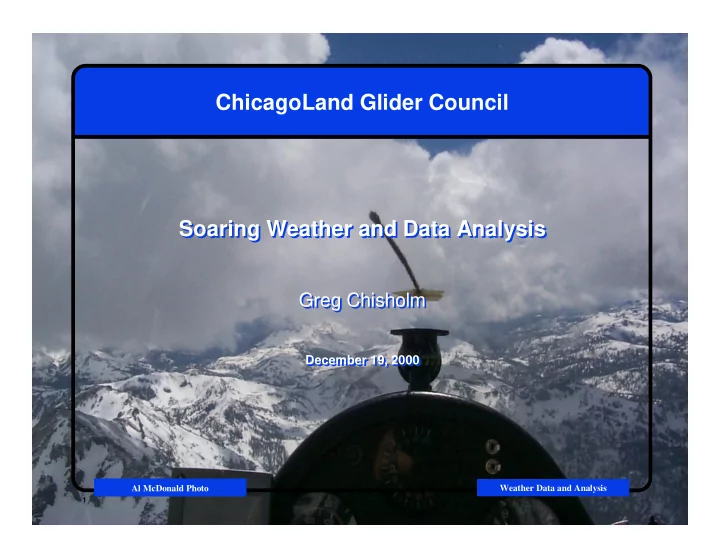
ChicagoLand Glider Council Soaring Weather and Data Analysis Soaring Weather and Data Analysis Greg Chisholm Greg Chisholm December 19, 2000 December 19, 2000 ChicagoLand Glider Council Al McDonald Photo Weather Data and Analysis 1


slide-1
SLIDE 1

1

Weather Data and Analysis ChicagoLand Glider Council

ChicagoLand Glider Council Soaring Weather and Data Analysis

Greg Chisholm

December 19, 2000

Soaring Weather and Data Analysis

Greg Chisholm

December 19, 2000

Al McDonald Photo
slide-2
SLIDE 2

2

Weather Data and Analysis ChicagoLand Glider Council

Outline

  • The internet - so much data – so little time
  • Brief introduction
  • Introduce SkewT/LogP
  • Examples
  • Discussion on how to improve our page
  • The internet - so much data – so little time
  • Brief introduction
  • Introduce SkewT/LogP
  • Examples
  • Discussion on how to improve our page
slide-3
SLIDE 3

3

Weather Data and Analysis ChicagoLand Glider Council

What’s out there! Meteo-Speak

Sounding diagrams provide a important means for determining the stability of the atmosphere above a specific location. By using the concept of an air parcel, lifting it

  • r lowering it and comparing the resulting parcel conditions to the conditions of the

surrounding environment as defined by the balloon sounding.

Parcels of unsaturated air tend to follow the dry adiabat lines as they ascend or

  • descend. The saturation adiabats lines show how parcels saturated with water

vapor will ascend or descend. Descending parcels will tend to unsaturate

  • immediately. The mixing ratio lines relate to the amount of water vapor in a parcel in

grams of water vapor per kilograms of dry air. Parcels of air attempt to maintain a constant mixing ratio as they ascend or descend. Generally, a parcel will rise, following the dry adiabat until it saturates. This occurs when dry adiabat crosses the initial mixing ratio line. This is considered the LCL. If lifting continues, the parcel cools following the saturation adiabat. If the parcel descends, it will always follow the dry adiabat as it will immediately unsaturate if saturated. By then comparing the parcel temperature to the environment, you can determine whether it is stable (parcel cooler) or unstable (parcel warmer). An unstable parcel will accelerate upwards and is the primary means for thunderstorm development. A stable parcel will decelerate and eventually descend. This is the typical atmospheric condition and it the primary condition in high pressure areas. The descending air desaturates the atmosphere and leads to clearing skies and calm conditions

Sounding diagrams provide a important means for determining the stability of the atmosphere above a specific location. By using the concept of an air parcel, lifting it

  • r lowering it and comparing the resulting parcel conditions to the conditions of the

surrounding environment as defined by the balloon sounding.

Parcels of unsaturated air tend to follow the dry adiabat lines as they ascend or

  • descend. The saturation adiabats lines show how parcels saturated with water

vapor will ascend or descend. Descending parcels will tend to unsaturate

  • immediately. The mixing ratio lines relate to the amount of water vapor in a parcel in

grams of water vapor per kilograms of dry air. Parcels of air attempt to maintain a constant mixing ratio as they ascend or descend. Generally, a parcel will rise, following the dry adiabat until it saturates. This occurs when dry adiabat crosses the initial mixing ratio line. This is considered the LCL. If lifting continues, the parcel cools following the saturation adiabat. If the parcel descends, it will always follow the dry adiabat as it will immediately unsaturate if saturated. By then comparing the parcel temperature to the environment, you can determine whether it is stable (parcel cooler) or unstable (parcel warmer). An unstable parcel will accelerate upwards and is the primary means for thunderstorm development. A stable parcel will decelerate and eventually descend. This is the typical atmospheric condition and it the primary condition in high pressure areas. The descending air desaturates the atmosphere and leads to clearing skies and calm conditions

slide-4
SLIDE 4

4

Weather Data and Analysis ChicagoLand Glider Council

What we want

  • Top and strength of the lift
  • Thermal Indices
  • Cloud base estimates
  • Perturbations, i.e.,

✸ Clamp ✸ Sea Breeze Front

  • Conditions over our airfield and changes over time

“Thermals are a product of instability - their height depends on the depth of the unstable layer and their strength depends on the degree of instability. To arrive at an estimate of the thermal height and strength, a thermal index (TI) is computed ...” (Extract from SSA's Soaring Flight Manual)

  • Top and strength of the lift
  • Thermal Indices
  • Cloud base estimates
  • Perturbations, i.e.,

✸ Clamp ✸ Sea Breeze Front

  • Conditions over our airfield and changes over time

“Thermals are a product of instability - their height depends on the depth of the unstable layer and their strength depends on the degree of instability. To arrive at an estimate of the thermal height and strength, a thermal index (TI) is computed ...” (Extract from SSA's Soaring Flight Manual)

slide-5
SLIDE 5

5

Weather Data and Analysis ChicagoLand Glider Council

Kevin Ford’s Offering - Abbreviated

slide-6
SLIDE 6

6

Weather Data and Analysis ChicagoLand Glider Council

Partial output for an ILX request

slide-7
SLIDE 7

7

Weather Data and Analysis ChicagoLand Glider Council

Introduction – SkewT/LogP

  • Temperature as a function of height (denoted

by pressure)

  • Pressure is plotted horizontally on an inverse

log scale = LogP

  • Temperature is plotted with a skew to the

right = SkewT

  • Dry and saturation adiabats are drawn to aid

analysis

  • Winds as a function of height are also plotted
  • Additional esoteric meteo-stuff is provided
  • Temperature as a function of height (denoted

by pressure)

  • Pressure is plotted horizontally on an inverse

log scale = LogP

  • Temperature is plotted with a skew to the

right = SkewT

  • Dry and saturation adiabats are drawn to aid

analysis

  • Winds as a function of height are also plotted
  • Additional esoteric meteo-stuff is provided
slide-8
SLIDE 8

8

Weather Data and Analysis ChicagoLand Glider Council

GOES SkewT

slide-9
SLIDE 9

9

Weather Data and Analysis ChicagoLand Glider Council

Thermal Soaring and the SkewT – Valley Soaring Association – P.J. Kelley

  • Want to predict height and strength of

thermals

  • Most SkewT diagrams are too complicated for
  • ur use

✸especially since we’re only interested in the bottom 25% ✸For example -- 0-50K’ + pressure/alt + temperature + dry adiabat + sat. adiabat + mixing ratio + dewpoint + hodogram + wind)

  • Note: the following is provided by soaring

pilots for soaring pilots – meteorologists be warned

  • Want to predict height and strength of

thermals

  • Most SkewT diagrams are too complicated for
  • ur use

✸especially since we’re only interested in the bottom 25% ✸For example -- 0-50K’ + pressure/alt + temperature + dry adiabat + sat. adiabat + mixing ratio + dewpoint + hodogram + wind)

  • Note: the following is provided by soaring

pilots for soaring pilots – meteorologists be warned

slide-10
SLIDE 10

10

Weather Data and Analysis ChicagoLand Glider Council

Blank Soaring SkewT

slide-11
SLIDE 11

11

Weather Data and Analysis ChicagoLand Glider Council

Building Your Own SkewT

1) Plot the forecast high temperature for the day, e.g., 86°F., at airfield elevation 2) Plot the forecast temperatures aloft, e.g.,

3,000’, 260/8, no temp

6,000’, 270/7, +12°C ≅ +53°F

9,000’, 300/15, +7°C ≅ +45°F

12,000’, 290/15, -2°C ≅ +28°F

3) Connect the dots 4) The top of the thermals is the intersection of the dry adiabat for today’s high and the temperature aloft plot (sounding) 1) Plot the forecast high temperature for the day, e.g., 86°F., at airfield elevation 2) Plot the forecast temperatures aloft, e.g.,

3,000’, 260/8, no temp

6,000’, 270/7, +12°C ≅ +53°F

9,000’, 300/15, +7°C ≅ +45°F

12,000’, 290/15, -2°C ≅ +28°F

3) Connect the dots 4) The top of the thermals is the intersection of the dry adiabat for today’s high and the temperature aloft plot (sounding)

slide-12
SLIDE 12

12

Weather Data and Analysis ChicagoLand Glider Council

Example

Forecast Hi 6K′,53°F 9K ′,45°F 12K ′,28°F 1. Forecast Hi 2. Temps aloft 3. Connect dots 4. Intersection = Top This Day’s Thermal Top

slide-13
SLIDE 13

13

Weather Data and Analysis ChicagoLand Glider Council

Thermal Strength

  • Thermal Index (RAOB based ala Kevin Ford)

✸ At any altitude below the top of the lift, the difference between ✜the dry adiabatic temperature (i.e., the intersection of the adiabat eminating from the forecast high temperature/field altitude point on the graph and the altitude of interest), for the day’s forecast high temp. and ✜the sounding temp.

  • Thermal Index (time dependant)

✸ ..., the difference between ✜the dry adiabat temperature (i.e., the intersection of the adiabat eminating from the ground temperature/field altitude point on the graph and the altitude of interest), and ✜the sounding temperature

  • Thermal Index (RAOB based ala Kevin Ford)

✸ At any altitude below the top of the lift, the difference between ✜the dry adiabatic temperature (i.e., the intersection of the adiabat eminating from the forecast high temperature/field altitude point on the graph and the altitude of interest), for the day’s forecast high temp. and ✜the sounding temp.

  • Thermal Index (time dependant)

✸ ..., the difference between ✜the dry adiabat temperature (i.e., the intersection of the adiabat eminating from the ground temperature/field altitude point on the graph and the altitude of interest), and ✜the sounding temperature

slide-14
SLIDE 14

14

Weather Data and Analysis ChicagoLand Glider Council

Kevin Ford Example

slide-15
SLIDE 15

15

Weather Data and Analysis ChicagoLand Glider Council

SkewT/LogP Example

slide-16
SLIDE 16

16

Weather Data and Analysis ChicagoLand Glider Council

SkewT/LogP Example (Earlier Time)

slide-17
SLIDE 17

17

Weather Data and Analysis ChicagoLand Glider Council

slide-18
SLIDE 18

18

Weather Data and Analysis ChicagoLand Glider Council

Clouds

  • Will there be clouds?

✸ Follow the morning dew point from the ground, along the line of constant mixing ratio. ✸ If this line never crosses the sounding, a parcel will not saturate and clouds will not form.

  • If the relative humidity is 100 percent (i.e., dew point

temperature and actual air temperature are the same), this does NOT necessarily mean that precipitation will occur. It simply means the air is holding as much moisture as it can at the particular temperature the air is at. Saturation may result in fog (at the surface) and clouds aloft (which consist of tiny water droplets suspended in the air).

  • Will there be clouds?

✸ Follow the morning dew point from the ground, along the line of constant mixing ratio. ✸ If this line never crosses the sounding, a parcel will not saturate and clouds will not form.

  • If the relative humidity is 100 percent (i.e., dew point

temperature and actual air temperature are the same), this does NOT necessarily mean that precipitation will occur. It simply means the air is holding as much moisture as it can at the particular temperature the air is at. Saturation may result in fog (at the surface) and clouds aloft (which consist of tiny water droplets suspended in the air).

slide-19
SLIDE 19

19

Weather Data and Analysis ChicagoLand Glider Council

Will there be clouds?

The LCL may have little realistic significance if the air parcels do not lift.

Therefore, it is useful to anticipate convective lifting that may be realized when the air is heated from the earth’s surface, most likely during sunshine.

This leads to the concept of convective condensation level (CCL). This is the level where the saturation mixing ratio isopleth through the surface wet-bulb temperature intersects the ambient

  • temperature. The dry adiabat through the CCL point on the

ambient temperature goes through the temperature (convective temperature) at the level po.

This is the temperature that the air at the surface must attain to form the first cumulus. In other words, if the air at the surface is heated to the convective temperature, then the convection will be deep enough to form clouds at the CCL

The LCL may have little realistic significance if the air parcels do not lift.

Therefore, it is useful to anticipate convective lifting that may be realized when the air is heated from the earth’s surface, most likely during sunshine.

This leads to the concept of convective condensation level (CCL). This is the level where the saturation mixing ratio isopleth through the surface wet-bulb temperature intersects the ambient

  • temperature. The dry adiabat through the CCL point on the

ambient temperature goes through the temperature (convective temperature) at the level po.

This is the temperature that the air at the surface must attain to form the first cumulus. In other words, if the air at the surface is heated to the convective temperature, then the convection will be deep enough to form clouds at the CCL

slide-20
SLIDE 20

20

Weather Data and Analysis ChicagoLand Glider Council

Where is cloudbase?

✸Unsaturated air rises along the dry adiabat. As it rises, its dew point follows a line of constant mixing ratio. ✸At some point, the temperature and dew point curves meet. At this point, the rising air is saturated and clouds form. ✸The level at which this occurs is known as the lifting condensation level (LCL), and it defines the cloud base, if the air is lifted from the surface ✸(Surface Max. Temp. – Surface DewPoint)/4.5 = Cloudbase Altitude (temps. n degrees F.) ✸(60°F-40°F)/4.5=4444' ✸Unsaturated air rises along the dry adiabat. As it rises, its dew point follows a line of constant mixing ratio. ✸At some point, the temperature and dew point curves meet. At this point, the rising air is saturated and clouds form. ✸The level at which this occurs is known as the lifting condensation level (LCL), and it defines the cloud base, if the air is lifted from the surface ✸(Surface Max. Temp. – Surface DewPoint)/4.5 = Cloudbase Altitude (temps. n degrees F.) ✸(60°F-40°F)/4.5=4444'

slide-21
SLIDE 21

21

Weather Data and Analysis ChicagoLand Glider Council

Where are the tops of the clouds?

■ If the air is lifted still further, both the dew point and

temperature follow a pseudoadiabat (T=Td for this saturated air).

■ If this pseudoadiabat becomes warmer than the

environmental air, the rising volume of air will be buoyant at that level and will begin to rise freely.

■ In such circumstances, cumulus clouds, or even

cumulonimbus (thunderstorms) are likely.

■ Continuing along the pseudoadiabat, the ascending air

eventually returns to meet the environmental temperature curve, and is no longer buoyant. This point is a good estimate for cloud top height

■ If the air is lifted still further, both the dew point and

temperature follow a pseudoadiabat (T=Td for this saturated air).

■ If this pseudoadiabat becomes warmer than the

environmental air, the rising volume of air will be buoyant at that level and will begin to rise freely.

■ In such circumstances, cumulus clouds, or even

cumulonimbus (thunderstorms) are likely.

■ Continuing along the pseudoadiabat, the ascending air

eventually returns to meet the environmental temperature curve, and is no longer buoyant. This point is a good estimate for cloud top height

slide-22
SLIDE 22

22

Weather Data and Analysis ChicagoLand Glider Council

http://www.arl.noaa.gov/ready-bin/metgram1.pl

slide-23
SLIDE 23

23

Weather Data and Analysis ChicagoLand Glider Council

Fig

slide-24
SLIDE 24

24

Weather Data and Analysis ChicagoLand Glider Council

CGC Wx, part 2

slide-25
SLIDE 25

25

Weather Data and Analysis ChicagoLand Glider Council

slide-26
SLIDE 26

26

Weather Data and Analysis ChicagoLand Glider Council

slide-27
SLIDE 27

27

Weather Data and Analysis ChicagoLand Glider Council

Short List

slide-28
SLIDE 28

28

Weather Data and Analysis ChicagoLand Glider Council

But what about?

■ Clamp ■ Wind ■ Inversion Layers ■ ... ■ Clamp ■ Wind ■ Inversion Layers ■ ...

slide-29
SLIDE 29

29

Weather Data and Analysis ChicagoLand Glider Council

Summary

■ The web is a wonderful source of information ■ However, distillation of information leaves more time for

flying

■ Please offer suggestions on what you’d like to see

presented on the Wx page

■ The web is a wonderful source of information ■ However, distillation of information leaves more time for

flying

■ Please offer suggestions on what you’d like to see

presented on the Wx page