Chi-square test on candidate events from CW signals coherent - - PowerPoint PPT Presentation

chi square test on candidate events from cw signals
SMART_READER_LITE
LIVE PREVIEW

Chi-square test on candidate events from CW signals coherent - - PowerPoint PPT Presentation

Chi-square test on candidate events from CW signals coherent searches (Y. Itoh, M.A.Papa,B.Krishnan-AEI, X. Siemens UWM r A large value of the detection statistic indicates a F ( f k l , ) s r candidate signal at the


slide-1
SLIDE 1

Yousuke Itoh AEI @ GWDAW8 UW Milwaukee USA 17-20 December 2003

  • A large value of the detection statistic indicates a

candidate signal at the frequency and the sky position .

  • E.g., ~100 outliers of F(f) found in 100-500 Hz.
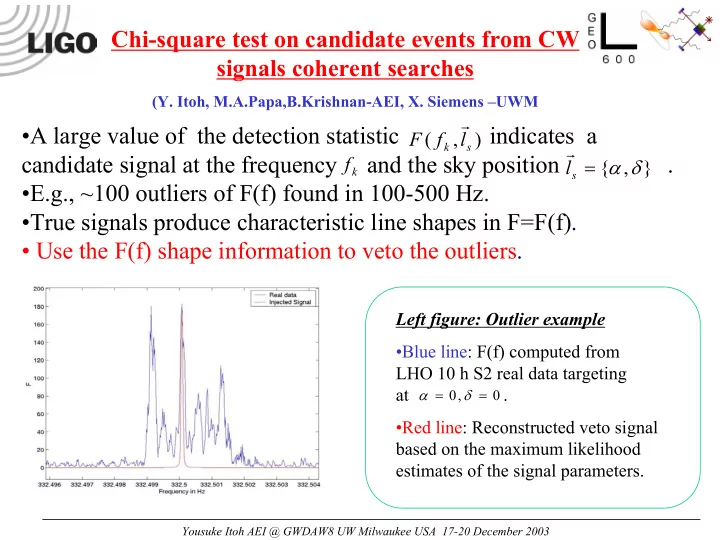
  • True signals produce characteristic line shapes in F=F(f).
  • Use the F(f) shape information to veto the outliers.

Chi-square test on candidate events from CW signals coherent searches

(Y. Itoh, M.A.Papa,B.Krishnan-AEI, X. Siemens –UWM

) , (

s k l

f F r } , { δ α =

s

l r

Left figure: Outlier example

  • Blue line: F(f) computed from

LHO 10 h S2 real data targeting at .

  • Red line: Reconstructed veto signal

based on the maximum likelihood estimates of the signal parameters.

, = = δ α

k

f

slide-2
SLIDE 2

Yousuke Itoh AEI @ GWDAW8 UW Milwaukee USA 17-20 December 2003

  • If the data=random Gaussian noise (r.g.n)
  • ( distribution)
  • If data=r.g.n + signal
  • (Non-cent. with Non-cent. param.= SNR)
  • Hypothesis: data=rand. Gaussian noise + signal
  • becomes the χ^2 dist. if our reconstruction of the signal is good!

Basic Idea(1) Basic Idea(1)

) ( ) (

k k

f n f x = ) , , ( ) ( ) (

s s k k k

l p f s f n f x r r + = ) ( 2

k

f F

The detection statistic: Jaranowski et al. Phys.Rev.D58:063001,1998

)) ( ; ( 2

k k

f x f F )) ( ; ( 2

k k

f x f F )) ( ; ( 2

k k

f y f F ) , , ( ) ( ) (

s s k k k

l p f s f x f y r r − =

2 4

χ

∑ ∈

=

} { 2

)) ( ; ( 2

  • utlier

k k k dof

f y f F χ

2 4

χ

slide-3
SLIDE 3

Yousuke Itoh AEI @ GWDAW8 UW Milwaukee USA 17-20 December 2003

Basic Idea (2) Basic Idea (2)

  • Use the maximum likelihood estimates of the signal parameters.

instead of unknown

  • Use the targeting sky position

instead of unknown signal sky position

  • If the veto statistic is extremely large, we veto out the outlier.
  • Need to be careful

SNR dependent threshold on the veto statistic. (Cf. TAMA inspiral upper limit report) } , , cos , { Φ =

s s

s s

h p s ψ ι r

MLE

p r

t

l r } , {

s s s

l δ α = r

|) | ( ) , , ( ) , , ( p SNR O l p f s l p f s

t MLE s s

r r r r r ∆ ⋅ ≈ −

slide-4
SLIDE 4

Yousuke Itoh AEI @ GWDAW8 UW Milwaukee USA 17-20 December 2003

Safety test Safety test

False dismissal

Procedure

  • Inject ~ 10^6 fake signals with

randomly chosen signal params and signal sky positions into 10 h Gaussian stationary noise.

  • Compute (~SNR) and the veto

statistic for each outlier. Targeting sky position satisfies

dof

dof

/

2

χ

F 2

The red line gives 0 % false dismissal for this experiment.

slide-5
SLIDE 5

Yousuke Itoh AEI @ GWDAW8 UW Milwaukee USA 17-20 December 2003

Efficiency test Efficiency test

False alarm

Procedure

  • Inject ~ 10^6 damped line noises

with randomly chosen params into 10 h Gaussian stationary noise.

  • Compute (~SNR) and the veto

statistic for each outlier. Targeting sky position satisfies

dof

dof

/

2

χ

F 2

The red line gives 8 % false alarm for this experiment.

slide-6
SLIDE 6

Yousuke Itoh AEI @ GWDAW8 UW Milwaukee USA 17-20 December 2003

Application to Real data Application to Real data

Procedure

  • Apply the veto method on 10 h

LHO4K S2 real data starting from GPS time 731210229.

  • Compute (~SNR) and the veto

statistic for each outlier.

  • 1200 targeting sky positions are

randomly chosen.

  • Frequency band is 100-500 Hz.

dof

dof

/

2

χ

F 2

The red line vetos 69 % of the outliers found in this data. Some of the “Arms” are due to lines with particular freqs.

465.7 Hz line 16 Hz multiples

slide-7
SLIDE 7

Yousuke Itoh AEI @ GWDAW8 UW Milwaukee USA 17-20 December 2003

Application to Real data Application to Real data

With the line noise table provided by

  • R. Berkowitz, M. Landry, D. Ottaway, R. Schofield

465.7 Hz line 16 Hz multiples

Experimentalists veto out some of the arms most efficiently! The red line now vetos 75 % of the outliers found in this data.

Procedure (yet to be examined!)

  • Remove 16 Hz multiples (+-1Hz).
  • Remove the measured lines

between 344-350 Hz.

slide-8
SLIDE 8

Yousuke Itoh AEI @ GWDAW8 UW Milwaukee USA 17-20 December 2003

Remarks and Conclusion Remarks and Conclusion

  • Our veto method is rather efficient: Even with rough

parameters tuning, it is demonstrated for some real data that adopting some threshold on our veto statistic, ~ 69 % of the

  • utliers can be vetoed out. Safety test shows that the same

threshold on the veto statistic gives effectively 0% (modulo sample variance) false dismissal rate.

  • We have performed the safety and efficiency tests on the real

data and obtained similar results.

  • There are still outliers that we might keep. While studying

parameters tuning and making the method more efficient, we study other veto methods and use combinations of various veto methods.

slide-9
SLIDE 9

Yousuke Itoh AEI @ GWDAW8 UW Milwaukee USA 17-20 December 2003

Veto the outliers in FDS Veto the outliers in FDS

Other possible veto strategies not yet studied. (a) Coincidence among other channels: F stat. outliers characteristic line noises of the instruments. Coincidence analysis among h(t) and other channels. Needs Veto channels selection. (b) Follow up: If true signal, the amplitude of F stat. varies w.r.t. time in a predictable maner (= Doppler amp./phase mod. etc.). Search the signal in the other IFOs, time periods, etc. (c) Coincidence among the IFOs. Consistency check on the MLEs of the strain that the IFOs give us.

slide-10
SLIDE 10

Yousuke Itoh AEI @ GWDAW8 UW Milwaukee USA 17-20 December 2003

465.7 Hz line 465.7 Hz line

Tuning the Veto method Left figure: 465.7 Hz line in F(f)

  • Blue line: F(f) computed from

LHO 10 h S2 real data targeting at .

  • Red line: Reconstructed veto signal

based on the maximum likelihood estimates of the signal parameters.

, = = δ α

Method and parameter tuning are being studied.

slide-11
SLIDE 11

Yousuke Itoh AEI @ GWDAW8 UW Milwaukee USA 17-20 December 2003

Histogram Histogram

Convergence of the probability at given SNR Normalized histogram as a function of the veto statistic for some selected ranges of SNR.

Safety test Efficiency test

Pdf is well estimated. Sample size in each class is ~ 10^4-5.

slide-12
SLIDE 12

Yousuke Itoh AEI @ GWDAW8 UW Milwaukee USA 17-20 December 2003

Signal Parameters Signal Parameters

Maximum Likelihood Estimates of the Signal Parameters. Signal parameters are well estimated.

Left figure: Goodness of the estimates

  • Goodness of the Maximum likelihood

estimates of the four amplitudes.

  • Injected signals are the same as those

in the safety test. Thus, ~10^6 fake signals injected into 10 h stationary Gaussian random noise.