
SLIDE 1
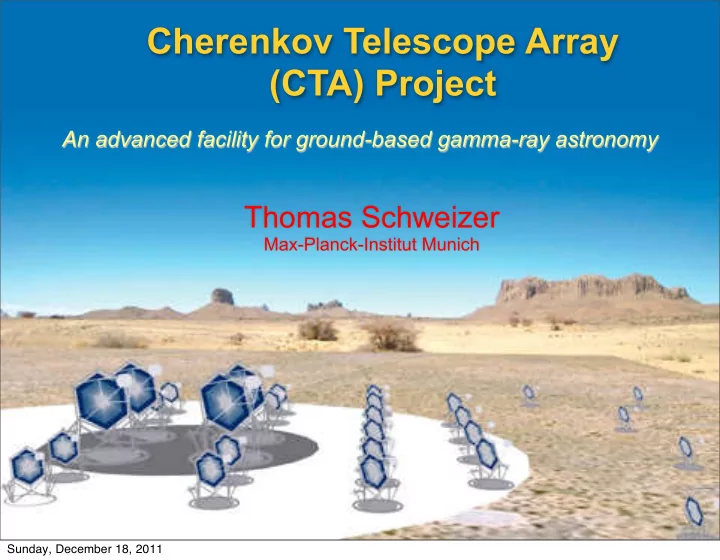
Cherenkov Telescope Array (CTA) Project
An advanced facility for ground-based gamma-ray astronomy
Thomas Schweizer
Max-Planck-Institut Munich
Sunday, December 18, 2011
Cherenkov Telescope Array (CTA) Project An advanced facility for - - PowerPoint PPT Presentation
Cherenkov Telescope Array (CTA) Project An advanced facility for ground-based gamma-ray astronomy Thomas Schweizer Max-Planck-Institut Munich Sunday, December 18, 2011 Toward CTA Next generation VHE gamma ray facility ~900 scientists / 100
An advanced facility for ground-based gamma-ray astronomy
Thomas Schweizer
Max-Planck-Institut Munich
Sunday, December 18, 2011
Next generation VHE gamma ray facility
MAGIC Phase II (MAGIC-I + MAGIC-II) HESS Phase II (HESS + 28m Telescope) in 2011
CTA JAPAN, US Astronomers in EU
~900 scientists / 100 institutions
Sunday, December 18, 2011
Sunday, December 18, 2011
Large Size Telescope (LST) in CTA Project leadership: MPI Munich
MST 10-12m LST 23m SST 4-6m
North: Canaries / Mexico / US South: Namibia / Argentina
LST 23m MST 10-12m SST 4-6m Two stations for all sky observatory
Sunday, December 18, 2011
Large Size Telescope (LST) in CTA Project leadership: MPI Munich
MST 10-12m LST 23m SST 4-6m
North: Canaries / Mexico / US South: Namibia / Argentina
LST 23m MST 10-12m SST 4-6m Two stations for all sky observatory
Sunday, December 18, 2011
Sunday, December 18, 2011
LST is optimized in the energy range between 20 - 200 GeV Low energy threshold
Trigger threshold: 15-20 GeV Analysis threshold: 20-30 GeV
Key physics cases:
High-redshift AGNs and GRBs Binaries, Pulsars and other type of transients at low energy
High redshift AGNs (z<3) GRBs (z<10) Pulsars Binaries and transients
Sunday, December 18, 2011
1’
Dec Ra
Pulsar
have high energy tails (not explained by theory)
pulsars
and pulsar wind nebula ?
Sunday, December 18, 2011
Thomas Schweizer, MPI Project review, December 2011
Sunday, December 18, 2011
CTA Monte Carlo: Expected Light curve + Spectrum for GRB at z=4.3
CTA performance study by S.Inoue, Y.Inoue, T.Yamamoto, et al
Expected spectrum
Sunday, December 18, 2011
Diameter: 23m Dish area: 400 m2 F/D = 1.2, F=28m FOV = 4.5 degrees,
Pixel size = 0.1 degrees (1800~2300ch camera)
Fast rotation: <180 deg/20 sec Dish profile: parabolic isochronicity:
<0.6 ns peak to peak
Camera sagging & oscillation:
< 1 pixels
Active oscillation damping by LAPP IN2P3
Improved understructure
Rod and knot elements
Sunday, December 18, 2011
Solutions for thick CF tubes in understructure T-Igel-Solution Endpieces Ready for Testing
MAGIC glueing tests
Sunday, December 18, 2011
8.5 tons
23m telescope SPECS:
Mirror Area: 410 m2 Focal length: 28 (f/d ≈ 1.2) Weight ≈ 50-60 tons Dish: 8 tons
Carbon fibre
Sunday, December 18, 2011
14
and from the side on the space frame
(up to 75t and about 25t uplift) !
Windshield
Sunday, December 18, 2011
Thomas Schweizer, MPI Project review, December 2011
6 Boggies/rail system Up to 60-75t load under tower 40t load for the other boggies > 0.1 rad/sec^2 acceleration without sliding Clamping and protection against uplift
Sunday, December 18, 2011
Wavelength (nm) Reflectivity (%)
Cr, Al, SiO2, HfO2 multi-coating
1.51 m FTF Hex Mirror prototype by CTA-Japan
198 Hex-shape segmented
mirrors of 1.5m size
Total area ~400m2
Sanko
Sunday, December 18, 2011
17
0.05 0.1 0.15 0.2
0.05 0.1 0.15 0.2
hAngle
Entries 199 Mean x -0.001841 Mean y 0.04859 RMS x 0.0402 RMS y 0.0652
1 2 3 4 5 6 7 8
hAngle
Entries 199 Mean x -0.001841 Mean y 0.04859 RMS x 0.0402 RMS y 0.0652
PSF degradation (mounting mirror at knots)
Sunday, December 18, 2011
Thomas Schweizer, MPI Project review, December 2011
Need to adjust mirrors for changing zenith angle Need to adjust thermal expansion Adjust minute deformations due to wind Fast response (5-10 minutes)
SCREEN ON BOTH SIDES OF CAMERA IR laser beams not interfering with photosensors
IR sensitive
mirror supporting structure + actuators
CMOS CAMERA
IR LASER, MPI
Concept of AMC, MPI Munich
CCD on each mirror + readout about 200 Euro
Sunday, December 18, 2011
Thomas Schweizer, MPI Project review, December 2011
Use infrared lasers for AMC on target next to camera AMC: Focus mirrors with respect to lasers (optical axis) continuously every 5-10 minutes, no usage of lookup tables (only as backup) Measure the focal length with a precision of better than 0.5 cm (readjust AMC with new focal length to keep the spot sharp) Measure x,y camera position with LED (in comparison with laser spot) to record camera sagging and sidewards movements due to wind gusts
camera target for AMC sagging LED LED LED LED Laser Laser Laser beam
Sunday, December 18, 2011
Thomas Schweizer, MPI Project review, December 2011
Single curves CF tubes 3-4 sections each side Stiff light weight CF cables
Sunday, December 18, 2011
Camera design, camera body and Cooling: Project lead: IFAE Barcelona, several institutes in Spain
Sealed Camera (MAGIC-II camera) CTA Camera
Size: 2.5 m Weight: 2 tons # of Ch: 1855 ch Heat: ~ 5kWatt
Cluster Prototype by CTA-Japan (R.Orito: #1091)
7PMTs CW HV system Pre-Amplifier DRS-4 readout system (4μsec) G-bit ethernet
Water cooling System MPI Munich
Masahiro Teshima, Japan
Sunday, December 18, 2011
PMT Development: Hamamatsu & ETE Razmik Mirzoyan, MPI 3 Hamamatsu & 2 ETE PMTs
Sunday, December 18, 2011
Development of Light guides: Razmik Mirzoyan, MPI
Cutoff angle New reflective foil R&D
Eckart Lorenz
Sunday, December 18, 2011
Thomas Schweizer, MPI Project review, December 2011
Baseline design report: November 2011 Prototyping of important elements until October 2012, finalizing design Prototype report: November 2012 Start of production of LST elements : November 2012 !! (Dish, understructure, arc, boggies, etc.) Final design document: August/September 2013 Factory tests until June 2014 Shipping: June/July 2014 Start of construction of prototype LST on-site: August 2014 Commissioning March 2015
Sunday, December 18, 2011
Thomas Schweizer, MPI Project review, December 2011
MPI is the leading institute for the development and construction of the large 23m telescope Collaboration with institutes in Spain and France Energy threshold 15-20 GeV Telescope shall be optimized for the lowest possible energies Start of construction August 2014
Sunday, December 18, 2011
26 Sunday, December 18, 2011
Demonstration of Active Oscillation Damping System for the LST Arch by LAPP IN2P3
Sunday, December 18, 2011
Rich physics in low energy range (>10-20 GeV): Unexplored physics !!
GRBs Clusters of galaxies Starburst galaxies Dark Matter Annihilation AGN & UHECR Sources
Arp 220 Merging spiral galaxy pair
A 3376 cluster cluster formation AGN jet termination shocks
BL LAC
LBLs high redshift BL BLAC & EBL Pulsars
Sunday, December 18, 2011
FERMI
Sunday, December 18, 2011
CTA Simulation Fermi: 1 gamma > 30 GeV
Sunday, December 18, 2011
Thomas Schweizer, MPI Project review, December 2011
Cost estimates for baseline LST structure without camera
CF Tubes for dish and undercarriage + MERO work:1.4 - 1.6 Mio Mast + damping system: 150k - 200k Drive (Bogeys, Rails, Barings, Chains, Motors, Electronics, etc.): 350-500k Foundation: 380-450k Transport + Installation + Access Tower: 200k - 380k Mirrors + Installation: 920k - 1410k AMC + Installation: 260k - 350k Site preparation + Power grid to telescopes: 200k AOB + Safety Equipment + Emergency park system: 200 - 300k Total: 4.1 - 5.4 Mio (Average 4.7 Mio) + 20% Contingency: 5.0 - 6.5 Mio (About 6.0 Mio)
Sunday, December 18, 2011
Mirrors must be cheap and good quality/ high reflectivity
HONEYCOMB REFLECTING SHEET BACKING SHEET MOLD
Replica techniques (thin glas sheet on honeycomb structure with aluminized surface), are a cheap possibility, while diamond milled surfaces have a longer life time
Diamond milling
Sunday, December 18, 2011
Hamamatsu SBA 34% QE ==> 30% PDE SiPM About 60% effective PDE will be realistic
Size 5x5 mm2 PDE~50-60%
GaAsP HPD (MPI & Hamamatsu): 50% PDE
Hamamatsu &MPI MPPC Array 4 5 m m 1 5 m m MPI-HLL SiMPL PDE~60%(target)
R9420 (QE=34%)
PDE~30-40%
High QE photosensors we need 200K PMs
Sunday, December 18, 2011
Hamamatsu SBA 34% QE ==> 30% PDE SiPM About 60% effective PDE will be realistic
Size 5x5 mm2 PDE~50-60%
GaAsP HPD (MPI & Hamamatsu): 50% PDE
Hamamatsu &MPI MPPC Array 4 5 m m 1 5 m m MPI-HLL SiMPL PDE~60%(target)
R9420 (QE=34%)
PDE~30-40%
High QE photosensors we need 200K PMs
Sunday, December 18, 2011
NECTAr project (SAMOSO chip) (development of new analog capacitor array) Dragon project (Domino Ringsampler 4 700 Mhz bandwidth, Ethernet output Fully digital camera (sampling the signal with commercial 60-200 Mhz FADC and processing with FPGAs, including the trigger)
Sunday, December 18, 2011
Below 200GeV LSTs will have a good sensitivity
Configuration E LST x 4, MST x 23, SST 32
Sunday, December 18, 2011
Sunday, December 18, 2011
~ 10 km Particle shower
~ 1o
Cherenkov light
~ 120 m
Gamma event: Signal Hadronic event: Background
Sunday, December 18, 2011
~ 1o ~ 120 m
Better background reduction Better angular resolution Better energy resolution ~ 10 km Particle shower Cherenkov light
Sunday, December 18, 2011
300 m
Single telescope
Sunday, December 18, 2011
300 m
Single telescope
Sunday, December 18, 2011
300 m
Single telescope
Sunday, December 18, 2011
Deep field Highest sensitivity
Sunday, December 18, 2011
1/3 array Deep field 1/3 array Deep field 1 telescope Monitor 4 telescopes Monitor Permanent monitoring
Sunday, December 18, 2011
Wide FOV Scan Systematic scan
part of the sky
Sunday, December 18, 2011
200 GeV - 10 TeV energy range: High sensitivity and better angular resolution: Galactic sources
PWNe SNRs Micro quasars X-ray binaries
Un-ID sources Dark Sources Galactic sources 200~400 sources with CTA
(1 mCrab)
morphology and separation Diffuse gamma radiation
Sunday, December 18, 2011
200 GeV - 10 TeV energy range: High sensitivity and better angular resolution: Galactic sources
PWNe SNRs Micro quasars X-ray binaries
Un-ID sources Dark Sources Galactic sources 200~400 sources with CTA
(1 mCrab)
morphology and separation Diffuse gamma radiation
Sunday, December 18, 2011
FERMI MAGIC Sunday, December 18, 2011
48
LAT/GBM Collaborations, Science arXiv:0908.1832
GRB 090510
30 GeV!
Low energies!
Sunday, December 18, 2011
e+ e− γEBL
γVHE
IACT
blazar
Extragalactic Background Light
Why Low Energy Threshold? Distant AGN, GRB
Sunday, December 18, 2011
Nail down gamma ray horizon up to z=2
x x x
γVHEγEBL → e+e-
30 GeV
Mrk421 Mrk501 1ES 1959+650 1ES 2344+514 Mkn 180 PKS 2155−304 PG 1553+113 PKS 2005−489 PKS 0548-332
EBL models
Blanch & Martinez 2004
M87 H2356-309 1ES 1218+304 1ES 1101-232 1ES 0347-121 1ES0229+0200 H1426+428
H.E.S.S. MAGIC HEGRA WHIPPLE 7-Tel. Array Mark IV
3C279
Lower limits from galaxy counts Red-shifted starlight Dust reemissio n Measure ments
HESS upper limit
Daniel Mazin, Martin Raue, 2007 Dust re- emission
Redshifted starlight Lower limit galaxy counts
CTA will nail down the EBL measurement using AGN up to z=2.0 !! Constrain the model for the star formation in the universe
Sunday, December 18, 2011
The extension of CTA to low energies will uncover many soft and steep spectrum AGN ~200 AGN (z<2.0) with CTA Threshold energy some 10 GeV to be free from EBL absorption
BL LAC H.E.S.S. M87
3C279
MAGIC MAGIC
Sunday, December 18, 2011
dl dz = c 1/(1 + z) H0
Blanch+Martinez 05
IACT-AGN (simulations)
Sola 99; Haber 03; Martinez 06
≈ 20 AGNs measure cutoff ≈ 10% accuracy
Sunday, December 18, 2011
Murase et al. 2008 Asano and Mezaros 2008
Sunday, December 18, 2011
Knee
∝E−2.7, mostly protons
Sunday, December 18, 2011
Wide energy range of CTA: determination of sources of hadronic cosmic rays ?
Question: In which objects do we have hadronic acceleration and in which objects leptonic acceleration ?
Sunday, December 18, 2011
Low energies in SNR Study RX J1713 HESS + Fermi
Color HESS observation Contour Suzaku X-Ray Fermi Concaved spectrum (non-linear effect)??
Sunday, December 18, 2011
Low energies in SNR Study RX J1713 HESS + Fermi
Color HESS observation Contour Suzaku X-Ray Fermi Concaved spectrum (non-linear effect)??
Sunday, December 18, 2011
Low energies in SNR Study RX J1713 HESS + Fermi
Color HESS observation Contour Suzaku X-Ray Fermi Concaved spectrum (non-linear effect)??
Sunday, December 18, 2011
At the moment we see only the tip of the iceberg
~1000 sources by CTA
VERITAS
Sunday, December 18, 2011
FERMI has seen 36 pulsars ! Most interesting physics is in the
high-end of the spectrum
Emission at high energy
excludes polar cap model
Need lowest energy threshold !!
Polar Cap or Outer gap?
Counts 515 516 517 518 519 520 521 522
3
x10
Phase
0.5 1
Phase= 11.4 h
T
MAGIC detection of Crab pulsar
MAGIC Optical MAGIC >25 GeV
6.4 Sigma 25 GeV energy threshold
Sunday, December 18, 2011
FERMI/MAGIC Crab pulsar spectrum: MAGIC sees high energy extension
Energy [MeV]
2
10
3
10
4
10
]
1
2
c g r e [ F .
2
E
10
10
EGRET Fermi
105
MAGIC FERMI Have pulsars an exponential cutoff or not ?
Sunday, December 18, 2011
FERMI/MAGIC Crab pulsar spectrum: MAGIC sees high energy extension
Energy [MeV]
2
10
3
10
4
10
]
1
2
c g r e [ F .
2
E
10
10
EGRET Fermi
105
MAGIC FERMI Have pulsars an exponential cutoff or not ?
CTA sensitivity
Sunday, December 18, 2011
Synchrotron and Inverse Compton components
Energy [MeV]
1 10
2
10
3
10
4
10
5
10
6
10
7
10
8
10
]
1 −
s
2 −
m c g r e [ F .
2
E
−12
10
−11
10
−10
10
−9
10
Fermi CGRO COMPTEL CGRO EGRET HESS MAGIC CANGAROO VERITAS HEGRA CELESTE
Sunday, December 18, 2011
Tsuboi et al. 1999
H.E.S.S.
Galactic plane
Molecular clouds Gamma rays Gamma Spectrum from diffuse radiation
Sunday, December 18, 2011
Sunday, December 18, 2011
> 2.5 TeV 1 – 1.5 TeV < 1 TeV
Sunday, December 18, 2011
> 2.5 TeV 1 – 1.5 TeV < 1 TeV > 2.5 TeV 1 – 2.5 TeV < 1 TeV
Sunday, December 18, 2011
> 2.5 TeV 1 – 1.5 TeV < 1 TeV > 2.5 TeV 1 – 2.5 TeV < 1 TeV > 2.5 TeV 1 – 2.5 TeV < 1 TeV
Sunday, December 18, 2011
Thomas Schweizer, MPI Project review, December 2011
Comparison of WIDTH parameter for F/D=1.2 (0.06 deg pixels) and F/D=1.6 (0.1 deg pixels) F/D=1.2 is good enough for this parameter
Emiliano Carmona
Sunday, December 18, 2011
Thomas Schweizer, MPI Project review, December 2011
Needed optical quality related to WIDTH (important separation parameter) Still small separation for 30-50 GeV (in stereo) Main separation parameter is Hmax
Emiliano Carmona Jim Hinton
Sunday, December 18, 2011
Thomas Schweizer, MPI Project review, December 2011
Pixel size and optical quality are related. No improvement in gamma/ hadron separation (WIDTH) with smaller pixels and better
(Size [pe])
10log 1 1.5 2 2.5 3 3.5 4 4.5 5 ] ° Width [ 0.05 0.1 0.15 0.2 0.25 0.3
° =20
° PROTONS f=37 m, D=23 m, 0.06 ° =20
° f=37 m, D=23 m, 0.06
Emiliano Carmona
Pixel 0.06 deg + F/D=1.6
(Size [pe])
10log 1 1.5 2 2.5 3 3.5 4 4.5 5 ] ° Width [ 0.05 0.1 0.15 0.2 0.25 0.3
° =20
° PROTONS f=28 m, D=23 m, 0.1 ° =20
° f=28 m, D=23 m, 0.1
Emiliano Carmona
Pixel 0.1 deg + F/D=1.2
Sunday, December 18, 2011
Thomas Schweizer, MPI Project review, December 2011
Two plots for 0.1 degree and 0.06 degree pixels: 1) Angular resolution & 2) Trigger rate Trigger threshold almost unaffected by pixel size and optical quality Angular resolution is slightly affected.
( E (GeV))
10log 1 1.5 2 2.5 3 3.5 4 Trigger Rate from Crab [Hz]
10
10
10 1 10
° =20
° f=31.2 m, D=23.4 m, 0.09 ° =20
° f=28 m, D=23 m, 0.1 ° =20
° f=37 m, D=23 m, 0.06
Energy (TeV)
10
10 1 ] ° ) [
68%Angular resolution (R 0.05 0.1 0.15 0.2 0.25 0.3 0.35 0.4 0.45 0.5
° =20
° f=31.2 m, D=23.4 m, 0.09 ° =20
° f=28 m, D=23 m, 0.1 ° =20
° f=37 m, D=23 m, 0.06
Emiliano Carmona Emiliano Carmona
] ° Offset [ 0.5 1 1.5 2 2.5 3 Trigger Rate from Crab [Hz] 2 4 6 8 10 12 14 16 18
° =20
° f=28 m, D=23 m, 0.1 ° =20
° f=37 m, D=23 m, 0.06
Emiliano Carmona Angular resolution Energy threshold Trigger vs offset
Sunday, December 18, 2011
Thomas Schweizer, MPI Project review, December 2011
For point sources the most cost effective F0V is 3.5 degrees and the best F/D=1.2 For extended sources the best FoV is between 3.8 and 4.5 degrees and the F/D=1.2-1.6 are similar All in all, the variation seems small, the distribution is rather flat.
Pierre Colin Pierre Colin
Sunday, December 18, 2011
Thomas Schweizer, MPI Project review, December 2011
Trigger efficiency decreases off angle due to the degradation of optical PSF It increases with F/D due to improvement in
Pierre Colin Pierre Colin
Sunday, December 18, 2011
69
5000 10000 15000
5000 10000 15000 hAnglePlaneY Entries 199 Mean x 2.6 Mean y -4184 RMS x 5406 RMS y 5373
0.05 0.1 0.15 0.2 hAnglePlaneY Entries 199 Mean x 2.6 Mean y -4184 RMS x 5406 RMS y 5373
mirror coordinate X in cm Y in cm
5000 10000 15000
5000 10000 15000
hAnglePlaneX Entries 199 Mean x 66.54 Mean y 773.4 RMS x 6879 RMS y 47930.02 0.04 0.06 0.08
hAnglePlaneX Entries 199 Mean x 66.54 Mean y 773.4 RMS x 6879 RMS y 4793mirror coordinate X in cm Y in cm PSF degradation for each mirror panel
Misalignment in Y (deg)
Misalingment in X (deg)
Sunday, December 18, 2011
Thomas Schweizer, MPI Project review, December 2011
Choose one point in the dish (which is rather stable) and mount a IR-laser in that point Define laser beam as optical axis Use this reference for the AMC adjustment suggest 2 lasers for cross check mount a precision inclinometer to the laser to measure azimuth angle
Laser beam
Sunday, December 18, 2011
Flange 1
11.04.2011 CTA LST Structure Meeting at MPP 3
Sunday, December 18, 2011
Flange 2
11.04.2011 CTA LST Structure Meeting at MPP 4
Sunday, December 18, 2011
Flange 3
thread)
11.04.2011 CTA LST Structure Meeting at MPP 5
Sunday, December 18, 2011
Additional test tubes from Epsilon at hand
11.04.2011 CTA LST Structure Meeting at MPP 6
Sunday, December 18, 2011
11.04.2011 CTA LST Structure Meeting at MPP 7
Sunday, December 18, 2011