
SLIDE 1
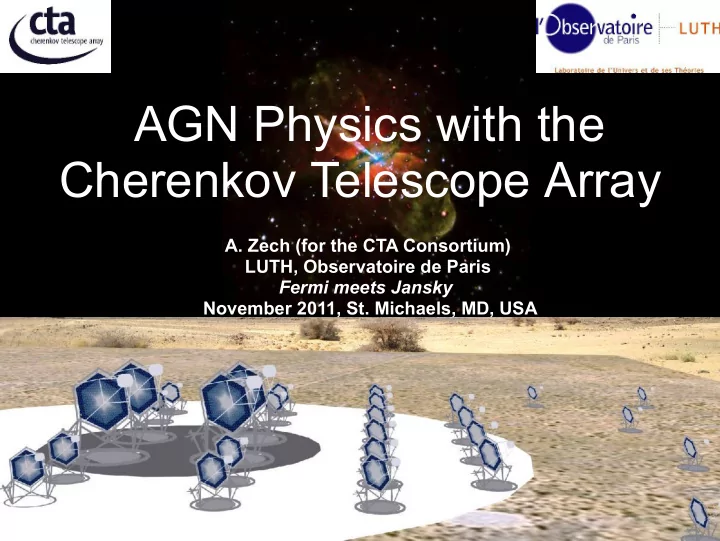
AGN Physics with the
Cherenkov Telescope Array
- A. Zech (for the CTA Consortium)
LUTH, Observatoire de Paris Fermi meets Jansky November 2011, St. Michaels, MD, USA
AGN Physics with the Cherenkov Telescope Array A. Zech (for the CTA - - PowerPoint PPT Presentation
AGN Physics with the Cherenkov Telescope Array A. Zech (for the CTA Consortium) LUTH, Observatoire de Paris Fermi meets Jansky November 2011, St. Michaels, MD, USA The CTA Consortium 25 Countries 132 Institutes >800 Persons M. Martinez
LUTH, Observatoire de Paris Fermi meets Jansky November 2011, St. Michaels, MD, USA
2
3
Fermi LAT skymap 2010, 1451 point sources EGRET skymap 1995, 271 point sources
4
(a few 10 GeV to a few 100 TeV )
=> towards 1000 VHE sources VHE skymap 2010 (TeVCat: 130 VHE sources in Nov. 2011) expected performance of CTA
H.E.S.S. Gal. Plane Scan CTA/AGIS Simulations Digel, Funk, Hinton
5
A Special Issue of the Astroparticle Physics journal dedicated to the CTA Science Case is in preparation. ( AGN Science Case:
C.Boisson et al. for CTA Consortium )
CTA Conceptual Design Report "Design Concepts for CTA", The CTA Consortium (astro-ph/1008.3703) "The status and future of ground-based TeV gamma-ray
the Division of Astrophysics of the American Physical Society", J. Buckley et al. (astro-ph/0810.0444)
6 This is only a selection of possible designs; other designs are equally pursued
7
from the Conceptual Design Report
8
US joins CTA beginning of partial operation
9
1
4
1
3
1
2
1
1
1 1 1 1
4
1
5
Crab 10% Crab 1% Crab Fermi MAGIC-I
E.F(>E) [TeV/cm2s]
High-z AGN, pulsars Population studies, extended sources, precision measurements Exploring the cutoff regime
accelerators
background limited flux limited
LSTs MSTs (+ SCTs) SSTs
10
current issues:
simulations
GRID and on local clusters under way
examples for Southern Array (without SCTs) example for Northern Array (red circles)
11
joint UK/France project for a prototype S-C SST to be built at the Paris Observatory
12
13
http://cta-observatoire.fr/agnworkshop2011 Proceedings to be published very soon ! SOC:
R.Wagner, M. Ward,
14
15
The current VHE AGN sample is
=> Difficult to
CTA will help with these issues by increasing the source statistics and the number of high redshift sources.
16
17
(using PL or log parabolic form).
– possible spectral breaks above Fermi band mostly ignored – all sources assumed at 20 deg zenith angle, configuration B
– not all TeV blazars have been detected by Fermi
("only" 39 out of 45; only 34 in clean sample !)
– does no account for flares or very active states – only sources with currently known redshift – additional SCT component not included in configuration B
(e.g. PKS0447-439, RGB J0648+152, ...)
18
per source
PRELIMINARY PRELIMINARY
should be obtained in less than 2 months
19
per source
PRELIMINARY PRELIMINARY
should be obtained in about 3 years
20
per source
PRELIMINARY PRELIMINARY
should be obtained in less than 10 years
21
Y.Inoue, T.Totani, AGN Physics in the CTA Era (FoV of 5 deg is assumed for CTA here)
Apart from targeted observations
selected sources, blank sky surveys are considered for unbiased population studies. For blank sky surveys, "wide & shallow" coverage is the fastest option to initially maximise number of sources: full-sky survey: >50 sources for 1000 h (< 1 year) With 50h/FoV, full-sky survey would take longer than expected life time of CTA of 30 years (-> ~370 sources) Serendipitous discoveries are expected.
# of detections for a total of 100h of observation:
22
Blazars with hard spectra should be detectable up to very high redshifts with CTA.
Flares will help to access even higher z.
1ES 1101-232
PRELIMINARY
Expected signal of a strong flare (comparable to the 2006 flares from PKS 2155-304) for sources at different redshifts.
23
24
Foschini et al., astro-ph 1110.5649 "... it is now possible to study an unexplored range of black hole masses and accretion rates..." Fermi detection of the NLS1 PMN J0948+0022 (and of other NLS1) => good perspectives for CTA, especially during flares
25
NGC 1068
Lenain et al., A&A 524 (2010) 72
Suggestion of γ-ray emission from the Seyfert 2 galaxy NGC 1068, based on Fermi- LAT data. => could Seyfert 2s also be targets for CTA ?
26
Centaurus A:
Even if most jets cannot be resolved, possibility of distinguishing constant jet emission from variable component.
Hardcastle & Croston, MNRAS 415 (2011) 133
27
28
Biteau, Giebels, AGN Physics in the CTA era
PKS 2155-304 (2006) H.E.S.S. collab. min t = 173 s +- 28
Extrapolation for CTA min t = 25 +- 4 s
e.g. 2006 flare of PKS 2155-304:
H.E.S.S. detected > 100 γ-rays per minute => good statistics down to the 1 min. scale => strong constraints on the size of the emission region and the Doppler factor
With CTA, the rate would be a factor of ~ 10 higher => good statistics down to a few seconds (if power spectrum continues) CTA will also allow us to test low states for the existence of rapid variability.
29
Acciari et al., Science 2009
M87 in 2008 (H.E.S.S., MAGIC, VERITAS, Chandra, VLBA)
=> TeV emission from inner jet or central core M87 in 2005 HST-1 favoured for TeV emission M87 in 2010
=> long-term MWL observations needed to pin down the VHE emission region(s) => Synergy with HAWC and LHAASO (monitoring for flares) => Radio observations play a crucial role
30
PKS 2155-304
H.E.S.S. collab., submitted to A&A
PKS 2155-304
Very large flares in 2006 occur during a very active state in the optical and radio band. They are followed by a rise in the radio band in the long-term light curve. Connection between lowest and highest energy emission in blazars ? => Need for coordinated long-term MWL campaigns (VHE data sparse !) => Need for more complete emission models that cover different time- scales
31
32
AGN Physics in the CTA Era
spectral evolution as seen with CTA (Δt=15 min.)
( simulation with scripts from D. Mazin )
PRELIMINARY PRELIMINARY
CTA toy model curves !
Spectral evolution during flares helps to distinguish different emission scenarios. SSC scenarios: injection & cooling, acceleration & cooling, beaming...
33
PKS 2155-304 (2008)
3C 279 (2006)
Certain (lepto-)hadronic scenarios predict characteristic signatures in the HE/VHE band that could be tested with CTA. (in particular muon synchrotron + cascade, pion cascades)
34
Sentürk et al., astro-ph/1111.0378
AGN Physics in the CTA Era, astro-ph/1109.0946
Some evidence for BLR absorption in Fermi (and VHE) spectra
(low energy coverage, high sensitivity and energy resolution)
35
36
– possibility of statistically meaningful population studies at VHE – variability studies down to the ~10 s scale with important consequences
for our knowledge of the emission region
– much stronger constraints on emission models – several methods to measure the EBL and put limits on the IGMF – guaranteed science return + potential to discover new types of VHE AGN
37
38
39
Ackermann et al. (Fermi-LAT Collab.), astro-ph/1108.1420 AZ et al. (for H.E.S.S. Collab.), astro-ph/1105.2548
Spectral information from Fermi-LAT and Cherenkov telescopes used in two different ways:
PKS 0447-439
40
Orr, Krennrich (for CTA), ICRC 2011
Some EBL models predict spectral breaks around ~ 1TeV in the VHE spectrum. CTA should permit to decide if these breaks exist (simulations: filled points). EBL absorption varies with energy, leaves characteristic imprint in the VHE spectrum.
Mazin, Raue, Astroparticle Ph. 34 (2010), 245
41
production on EBL + IC on CMB
Intergalactic Magnetic Fields
Dermer et al., astro-ph/1011.6660
lower limits on IGMF from GeV/TeV data:
(persistent TeV emission over >10^6 years)
(persistent TeV emission over a few years)
(from simultaneous GeV-TeV data)
=> need good continuous GeV/TeV data
42
pair halo at z=0.129
Eungwanichayapant, Aharonian,
extended pair halos, if B high enough.
data: L. Fallon (for H.E.S.S.), PoS, Texas
=> prospects for CTA (large FoV, high sensitivity)
43
44
45
46
Large Size Telescopes (LST)
~4 (both sites ?) diameter 24 m, FoV ~4-5 deg (modified) Davies-Cotton optics carbon fiber structure
Medium Size Telescopes (MST)
~ 20 (both sites) diameter 12 m, FoV ~6-8 deg (modified) Davies-Cotton optics several designs
47
Schwarzschild-Couder Telescopes (SCT)
~36 (Southern array) secondary optics; primary diameter ~10 m FoV ~ 8 deg high resolution imaging small camera plate scale allows use
but optical system more complex several designs
Small Size Telescopes (SST)
Davies-Cotton or Schwarzschild- Couder design ~30 (D-C) or 50+ (S-C) (Southern array only ?) Diameter ~7 m (D-C) or ~ 4m (S-C). FoV ~ 8 - 10 deg several designs
design: Argonne
48
Y.Inoue, T.Totani, AGN Physics in the CTA Era Predictions using the Gamma-ray luminosity function (GLF) by Inoue & Totani (2009) GLF based on "blazar sequence" SED and AGN X-ray luminosity function (Ueda et al. 2003) GLF in good agreement with EGRET and Fermi/LAT GLF for FSRQ.
49
Mirabal, Hassan, Contreras, AGN Physics in the CTA Era Fermi AGN from 1 LAC catalog ( green + red ) Fermi AGN detectable with CTA in 50h Circles: Blazars already detected at TeV => extension of the VHE blazar sample to lower fluxes and softer spectra
50
BL Lacs FSRQ
unknown type CTA sensitivity (goal)