Chemistry is the central, useful and creative Earnest Rutherford, - - PowerPoint PPT Presentation

chemistry is the central useful and creative
SMART_READER_LITE
LIVE PREVIEW

Chemistry is the central, useful and creative Earnest Rutherford, - - PowerPoint PPT Presentation

Celebrate the achievements of chemistry Improve public understanding of chemistry Champion the role of chemistry in addressing the critical challenges of our society Food and nutrition Clean water Sustainable energy


slide-1
SLIDE 1
  • Celebrate the achievements of

chemistry

  • Improve public understanding of

chemistry

  • Champion the role of chemistry in

addressing the critical challenges of

  • ur society

– Food and nutrition – Clean water – Sustainable energy – Sustainable energy – Climate change

  • Broader outreach and engagement
  • Get younger people more interested

in chemistry

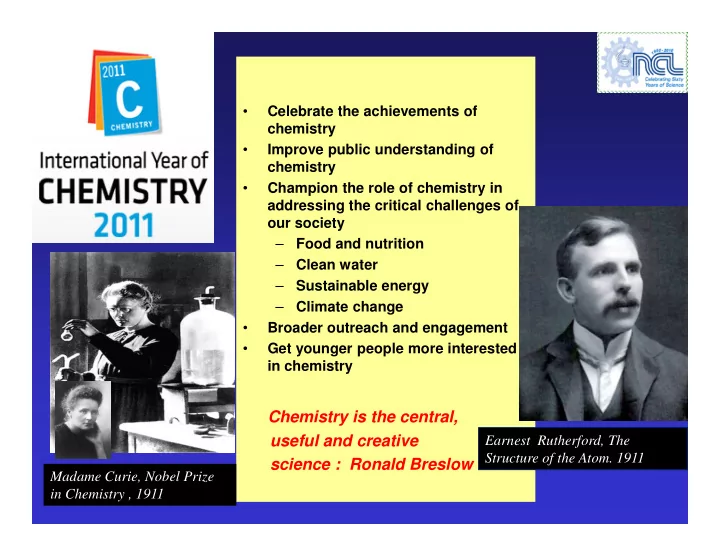
Chemistry is the central, useful and creative science : Ronald Breslow

Madame Curie, Nobel Prize in Chemistry , 1911 Earnest Rutherford, The Structure of the Atom. 1911

slide-2
SLIDE 2

THE AGES OF HUMAN KIND

Human Civilization has been marked by several ages, which are all material based

  • Stone Age
  • Stone Age
  • Bronze Age
  • Iron Age ( Steel. Aluminum)
  • Polymer Age ( Carbon based materials)
  • Age of Elements ( Silicon, Uranium, Lithium,

Indium, Gallium etc)

slide-3
SLIDE 3

Central

Underpins many other scientific disciplines Biology, geology, material science

Creative

Designs structures with new and unique properties CHEMISTRY CREATES MATTER THAT NEVER EXISTED BEFORE eg. PLASTICS, DETERGENTS, DRUGS, INSECTICIDES, ETC.

Useful

Provides many materials essential to everyday life, knowledge to better human, veternary and plant care, better food, environment

slide-4
SLIDE 4

Hennig Brandt of Hamburg (1630 -1710) Discoverer of Phosphorous

The chemical reaction Brandt stumbled on was as

  • follows. Urine contains phosphates PO4

3-, as sodium

phosphate (i.e. with Na+), and various carbon-based

  • rganics. Under strong heat the oxygens from the

phosphate react with carbon to produce carbon monoxide CO, leaving elemental phosphorus P, which comes off as a gas. Phosphorus condenses to a liquid below about 280°C and then solidifies (to the white

The Alchemist in Search of the Philosopher’s Stone ( Joseph Wright, 1771)

below about 280°C and then solidifies (to the white phosphorus allotrope) below about 44°C (depending on purity). This same essential reaction is still used today (but with mined phosphate ores, coke for carbon, and electric furnaces). The phosphorus Brandt's process yielded was far less than it could have been. The salt part he discarded contained most of the phosphate. He used about 5,500 litres of urine to produce just 120 grams of phosphorus. If he had ground up the entire residue he could have got 10 times or 100 times more (1 litre of adult human urine contains about 1.4 g phosphorus).

slide-5
SLIDE 5

CHEMICAL REVOLUTION : EARLY BEGINNINGS

Freidrich Wohler (1800 – 1882) Annalen der Physik und Chemie, 88(2), 253- 256 (1828)

slide-6
SLIDE 6

Chemistry creates its own

  • bject. This creative

power, similar to that of arts distinguishes it fundamentally from the

  • ther natural and
  • ther natural and

historical sciences

Marcellin Bertholet, 1860 (1827- 1907)

slide-7
SLIDE 7

CHEMICAL REVOLUTION : UNDERSTANDING CHEMICAL STRUCTURES

The Theory of Chemical Structure (1857-58) Structure of Benzene published in Bulletin de la Society Chimique de Paris, 3(2), 98-110 (1865) Auguste Kekule (1829 -1896)

slide-8
SLIDE 8

CHEMICAL REVOLUTION : UNDERSTANDING CHEMICAL STRUCTURES

Jacobus van’t Hoff (1852-1911) The Tetrahedral Nature of Carbon ( La Chimie dans l’espace, 1874 ) First Nobel Prize in 1901

slide-9
SLIDE 9

THE DAWN OF THE CHEMICAL INDUSTRY: THE MANUFACTURE OF BAKELITE

Baekland set out to discover a substitute for Shellac, then wholly supplied by India to the world In the process he made the first man made material, heralding the age of plastics, a discovery considered as US Patent 942, 699, December 7, 1909 plastics, a discovery considered as revolutionary Heat resistant and insulating Baekland named his new material Novolak He founded a company called Bakelite Corporation in 1910 to manufacture the product

slide-10
SLIDE 10

THE DAWN OF THE CHEMICAL INDUSTRY: THE MANUFACTURE OF BAKELITE

Leo Baekland (1863-1944) When asked why he chose to work in the field of synthetic resins, he replied” to make money”

slide-11
SLIDE 11

SYNTHETIC POLYMERS

  • !

! "## $

slide-12
SLIDE 12
slide-13
SLIDE 13

THE MOLECULE OF LIFE : DNA

slide-14
SLIDE 14
slide-15
SLIDE 15

$%

&!%'##(((

%

  • #
  • )*#*
  • #*
  • %*

*#*

slide-16
SLIDE 16
slide-17
SLIDE 17
slide-18
SLIDE 18
slide-19
SLIDE 19

!"#$%& '%(!"!)! $#!

slide-20
SLIDE 20
slide-21
SLIDE 21

*+&&'! %(#"%$%# '*!'%(*!,

  • +-.

/ 01. 2/ 3

  • /
  • /
  • /

. .

  • /3
slide-22
SLIDE 22

!4

  • 43
  • .
  • ).

../ 4 /

!4 .

  • Other materials : Silicone rubber ( foot bed),

sulfochlorinated Polyethylene ( toe drag)

slide-23
SLIDE 23
slide-24
SLIDE 24
slide-25
SLIDE 25