Charitable Foundations Impact on Canine Health Shila K. Nordone, PhD - - PowerPoint PPT Presentation

charitable foundation s
SMART_READER_LITE
LIVE PREVIEW

Charitable Foundations Impact on Canine Health Shila K. Nordone, PhD - - PowerPoint PPT Presentation

The American Boxer Club Charitable Foundations Impact on Canine Health Shila K. Nordone, PhD and Terry T. Warren, PhD, JD CSO and CEO, AKC Canine Health Foundation Overview Financial contribution Highlights of the American Boxer

slide-1
SLIDE 1

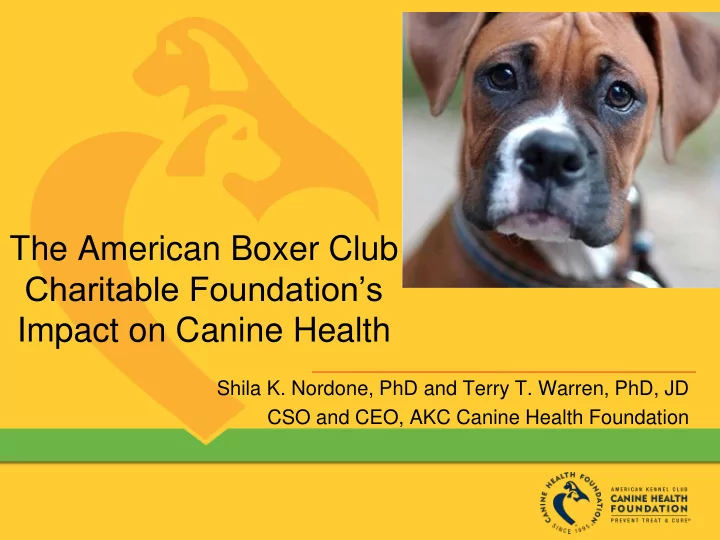
The American Boxer Club Charitable Foundation’s Impact on Canine Health

Shila K. Nordone, PhD and Terry T. Warren, PhD, JD CSO and CEO, AKC Canine Health Foundation

slide-2
SLIDE 2

Overview

  • Financial contribution
  • Highlights of the American Boxer Charitable

Foundation’s contributions to medical progress

  • Degenerative Myelopathy
  • Cancer
  • Osteosarcoma
  • Hemangiosarcoma
  • Mast cell tumors)
  • Heart Disease
  • Overview of currently funded studies
slide-3
SLIDE 3

Your Impact

slide-4
SLIDE 4

Financials

  • $803,599 on 47 grants
  • Broad & significant “footprint” in canine health
  • Musculoskeletal Disease
  • Oncology
  • Cardiac disease
  • Gastrointestinal disease
  • Impressive support of basic science
  • Long-term commitment
  • Deep understanding of research and medicine
slide-5
SLIDE 5

Degenerative Myelopathy

  • Progressive, fatal, adult-onset neurodegenerative

disease

  • 2006 funded grant 0821 (J. Coates) preliminary

data from PWC that a genetic lesion present

  • Landmark paper published in PNAS 2009

identifying SOD1

  • G to A transition, E40K missense mutation in the

SOD1 gene

  • SOD1:c.118A and SOD1:c.52T in 222 breeds
slide-6
SLIDE 6

Degenerative Myelopathy as a Model for Amyotrophic Lateral Sclerosis (ALS)

  • One Medicine Impact
  • Similar to DM, ALS (Lou Gehrig's Disease) is a

progressive neurodegenerative disease

  • Dr. Coates received an NIH R21 grant

(5R21NS078242-02): “Therapeutic development for ALS in a canine model” $223,938

  • “Characterization of Thoracic Motor and Sensory

Neurons and Spinal Nerve Roots in Canine Degenerative Myelopathy, a Potential Disease Model

  • f Amyotrophic Lateral Sclerosis”
slide-7
SLIDE 7

Oncology: Tumor Suppressor Genes

  • Genes p53, Rb, p21 (waf-1), p16 (ink-4a), and

PTEN

  • Loss of function leads to metastasis
  • Application to melanoma, osteosarcoma and

hemangiosarcoma

  • 1999 -Role in pathogenesis of canine disease

was incompletely understood

  • 2011 - Documented genomic instability in tumor

suppressor genes and DNA copy number aberrations

slide-8
SLIDE 8

Oncology: Cytogenetic Changes

  • 2002 - Chromosome aberrations play an important role in

the diagnosis, prognosis, and clinical management of human cancer – Dog?

  • Grant 119 brought molecular cytogenetic technology to the dog
  • Tumor-associated DNA copy number aberrations (CNAs), single

copy deletions and amplifications, regional aneuploidy and whole chromosome aneuploidy

  • 2013 – First documented treatment response using

molecular cytogenetic techniques in a domestic animal with spontaneous cancer

  • “Cytogenic remission” ushers in personalized medicine (Pmed) in

the dog

slide-9
SLIDE 9

Oncology: Osteosarcoma

  • 2007: Goal of grants 0137 & 1317 to identify

mutations and their functional consequence

  • 2013: Genetic lesions upstream of CDKN2A/B
  • Functional consequence is altered regulation of cell

cycle

  • Canine CDKN2A/B syntenic to the human 9p21 locus
  • Strong One Medicine Potential
  • Enhanced understanding of molecular signaling

responsible for angiogenesis

slide-10
SLIDE 10

Oncology: Mast Cell Tumors

  • 2005: Basic understanding of canine mast cells

lacking

  • Grants 179 & 678
  • Characterized mast cell function
  • Creation of mast cell tumor line (CL1)
  • Established mitotic index as a prognostic tool
  • 2007: Targeted therapeutics were unavailable
  • Grant 975 - Modulation of mast cell-derived prostaglandins

and leukotrienes impair mast cell function

  • NSAID Tepoxilan most effective
slide-11
SLIDE 11

Cardiology

  • 1997-2000
  • Familial patterns of Arrhythmogenic Right Ventricular

Cardiomyopathy (ARVC) recognized but genomics undefined

  • Clinical outcomes of ventricular arrythmias unclear
  • 2010 Discovery of striatin mutation
  • Not fully penetrant
  • 2013 – Search for genetic modifiers continues
slide-12
SLIDE 12

Restructuring of Scientific Program

slide-13
SLIDE 13

Discovery continues….

  • Conceptualize science as a “portfolio”
  • Create natural division of science to build capacity

in the science and create depth in research funding

  • RFPs that define specific Research Program Areas
  • Donors build capacity to fund in areas of importance to

them

Cardiology Oncology Dermatology Immunology

Portfolio

slide-14
SLIDE 14

Cardiology Research Program Area

Canine Cardiac Disease Mitral Valve Disease Cardiomyopathy Arrhythmia Pulmonary Hypertension Early, Accurate Diagnosis Improved Therapy Cutting Edge New Therapy Genetic markers of disease

Improved use

  • f existing drugs

Imaging & Biomarkers Gene therapy Directly through GWAS and indirectly through enhanced understanding mechanism of disease

slide-15
SLIDE 15

Oncology

  • Personalized Medicine (Pmed)
  • Heritable risk factors (genetic and epigenetic)
  • Cancer Stem Cells
  • Cytogenetics
slide-16
SLIDE 16

Gastrointestinal Disease Program Area

  • Grant 2002: Defining the Genetic Basis
  • f Inflammatory Bowel Disease
  • Principal Investigator: Dr. Karin Allenspach, DVM PhD
  • Institution: Royal Veterinary College, University of London
  • Total Grant Amount: $119,268.00
  • Grant 2050: Defining the Genetic Susceptibility to

Granulomatous Colitis, a Severe Form of Inflammatory Bowel Disease

  • Principal Investigator: Dr. Kenneth W. Simpson, BVMS, PhD
  • Institution: Cornell University
  • Total Grant Amount: $187,730.00
slide-17
SLIDE 17

Ophthalmology Program Area

  • Grant 2057: Identification of the Genetic

Cause of Corneal Ulcers (“Boxer Ulcers”)

  • Principal Investigator: Dr. Keith W Montgomery, DVM
  • Institution: North Carolina State University
  • Total Grant Amount: $27,201.00
slide-18
SLIDE 18

CCL Research

Cranial Cruciate Ligament Disease 1762: Platelet Rich Plasma Treatment 1782: Computer Modeling of Surgery and Conformation 1584: Creation of Conformation Score 1856: Stem Cell Source for Treatment Deepen our understanding of the cause and treatment of CCL disease Today’s Breeder Magazine Issue 82 “Stabilizing the Stabilizer”

slide-19
SLIDE 19

Continuing the Partnership Between ABCF and CHF

slide-20
SLIDE 20

American Boxer Charitable Foundation

Current DAF Balance $322,047.72

slide-21
SLIDE 21

2014 Request for Support from the ABCF

  • $150,000 sponsorship of the Cardiology

Research Program Area

  • $50,000 sponsorship of Oncology Research

Program Area

  • $27,000 sponsorship of Ophthalmology Research

Program Area

  • $75,000 sponsorship of Gastrointestinal Disease

Research Program Area $302,000 total research sponsorships from Boxer Donor Advised Fund in 2014

slide-22
SLIDE 22
  • ABCF research sponsorships to date:

$803,599

  • Today’s request would move the ABCF

total research sponsorships past the $1 million mark

  • ABCF would be second largest all-time

sponsor of research, less than $100,000 from the top spot 2014 Request for Support from the ABCF

slide-23
SLIDE 23

Why this unprecedented DAF transfer?

  • Active CHF research includes multiple

Boxer specific projects

  • Breed specific research must get the support of the

breed’s parent club

  • It is more difficult to leverage sponsorships from other

breeds when grants are Boxer specific

  • The need to “refill the buckets” or build capacity in

program areas, opening the door for renewed emphasis on cardiology, oncology, GI and other areas not included in 2014 RFPs

slide-24
SLIDE 24
  • Leadership
  • Act as an example to other clubs with high DAF

balances

  • The 10 largest Donor Advised Funds contain over

$1.3 million

  • DAF sponsorship of $302,000 by the ABCF will be

used to motivate and leverage other clubs

  • Unprecedented DAF transfers by most of these top 10

DAFs would increase CHFs ability to approve new research by building capacity in Research Program Areas

Why this unprecedented DAF transfer?

slide-25
SLIDE 25
  • Foster a new way of thinking about Donor

Advised Funds

  • Place more value on funds allocated to research than on funds

accumulated in DAF

  • Going forward, new donations to DAF are accompanied with

instructions on what research program area to support

  • Keep DAF balances low
  • Opportunities for Recognition
  • passing $1 million mark for sponsorship
  • largest single Donor Advised Fund transfer in CHF history
  • Newsletters, press releases, event recognition, banners

Why this unprecedented DAF transfer?

slide-26
SLIDE 26

Thank you for your longstanding, tremendous support of CHF!