Characters of degraded DNA Forensic samples are exposed to unstable - - PDF document

characters of degraded dna
SMART_READER_LITE
LIVE PREVIEW

Characters of degraded DNA Forensic samples are exposed to unstable - - PDF document

STR Typing of Degraded DNA using a Repair Enzyme and Whole Genome Amplification Jeong Eun Sim 1 , Hwan Young Lee 1 , Seung Hwan Lee 2 , Woo Ick Yang 1 , Kyoung Jin Shin 1 1 Department of Forensic Medicine and Brain Korea 21 Project for Medical


slide-1
SLIDE 1

Jeong Eun Sim1, Hwan Young Lee1, Seung Hwan Lee2, Woo Ick Yang1, Kyoung‐Jin Shin1

1Department of Forensic Medicine and Brain Korea 21 Project for Medical Science, Yonsei University

College of Medicine, Seoul, Korea

2DNA Analysis Lab., Div. of Forensic Science, Supreme Prosecutors' Office, Seoul, Korea

STR Typing of Degraded DNA using a Repair Enzyme and Whole Genome Amplification

The Korean Society for Legal Medicine

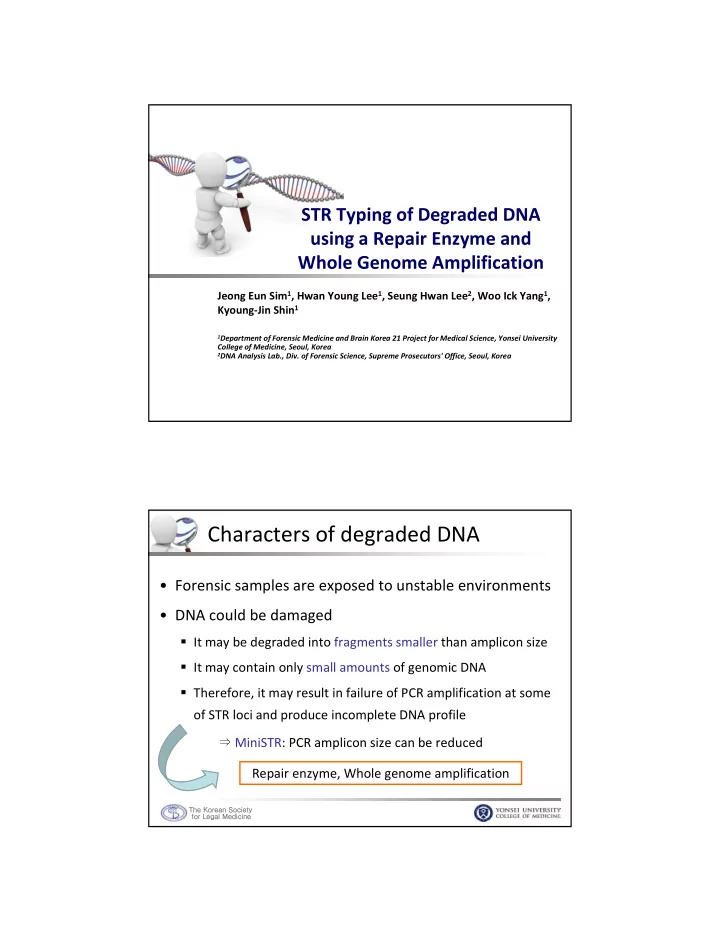
  • Forensic samples are exposed to unstable environments
  • DNA could be damaged
  • It may be degraded into fragments smaller than amplicon size
  • It may contain only small amounts of genomic DNA
  • Therefore, it may result in failure of PCR amplification at some
  • f STR loci and produce incomplete DNA profile

⇒ MiniSTR: PCR amplicon size can be reduced Repair enzyme, Whole genome amplification

Characters of degraded DNA

slide-2
SLIDE 2

The Korean Society for Legal Medicine

  • Within living cells, the integrity of DNA molecules is continually

maintained by enzymatic repair processes.

  • By using repairing enzyme, DNA repair of living cell can be

carried out in vitro.

  • Commercial reagent : PreCR Repair Mix
  • (Uracil‐DNA Glycosylase, formamidopyrimidine‐DNA

glycosylase, Endonuclease IV, Endonuclease VIII, T4 Endonuclease V, Bst DNA Polymerase, Taq DNA ligase)

  • In previous studies, only UV damaged DNA and DNA from

skeletal remains were evaluated. Repair enzyme should be evaluated in various types of damaged DNA and forensic samples

Repairing Enzyme

The Korean Society for Legal Medicine

Whole Genome Amplification (WGA)

  • WGA is a technique to specifically increase the DNA quantities
  • riginating from samples with limited DNA contents.
  • Preimplantation genetic diagnosis (PGD)

After repairing of degraded DNA, MDA based WGA method can be applied to repaired DNA.

  • Isothermal WGA method
  • MDA (Multiple Displacement Amplification)
  • Random hexamer primer
  • Phi29 DNA polymerase

Polymerization Template DNA Displacement Hyperbranched structure

(http://www.qiagen.com)

slide-3
SLIDE 3

The Korean Society for Legal Medicine

Aims of This Study

  • Validation of the availability and efficacy of repairing

enzyme in various types of degraded DNA

  • To present the possibility of application of WGA to

forensic field

  • To increase the success rate of DNA typing in

damaged sample

The Korean Society for Legal Medicine

Materials and Methods: Sample preparation

  • Artificially degraded DNA
  • 9948 standard DNA, K562 high molecular DNA
  • UV radiated DNA: UV radiation during 2 minutes by CL‐1000

Ultraviolet cross‐linker

  • Oxidized DNA: Hydroxyl radical by fenton reaction using Fe2+ , H2O2
  • Acid/heat damaged DNA: NaCl, Sodium‐Na, 70°C, 10 hours incubation
  • DNase I treated DNA: 0.006 unit DNase I treatment for 10~15 min
  • Naturally degraded DNA
  • Dried blood spot, dried saliva spot from 5 applicants: IRB approval,

10uL, sunshine exposure and air dry during 2 weeks – QIAamp DNA Investigator Kit

  • Old skeletal remains: over 60 years

– DNA extracted by Lee et al. (Forensic Sci Int Genet. 2010; In press)

  • All of the samples were prepared in quintuplicate.
slide-4
SLIDE 4

The Korean Society for Legal Medicine

  • Amplification of autosomal STR: AmpFℓSTR Identifiler Kit

In case of DNA obtained from skeletal remains, 3.5 U of Gold Taq enzyme and 2.0 uL of template DNA were used with 5 more amplification cycle.

Materials and Methods: Repair of degraded DNA

Reagents Repair Control dH20 6.0 ㎕ 1.5 ㎕ 9.0 ㎕ 2.8 ㎕ Identifiler Reaction Mix 9.5 ㎕ 3.8 ㎕ 9.5 ㎕ 3.8 ㎕ 10× NAD+ 2.5 ㎕ 1.0 ㎕ ‐ ‐ AmpliTaq Gold DNA polymerase (5 unit/㎕) 0.5 ㎕ 0.4 ㎕ 0.5 ㎕ 0.4 ㎕ PreCR Repair Mix 0.5 ㎕ 0.3 ㎕ ‐ ‐ Demaged DNA 1.0 ㎕ 1.0 ㎕ 1.0 ㎕ 1.0 ㎕ Incubation at 37°C, 20 min for repairing ‐ ‐ Identifiler Primer Set 5.0 ㎕ 2.0 ㎕ 5.0 ㎕ 2.0 ㎕ Total reaction volume 25.0 ㎕ 10.0 ㎕ 25.0 ㎕ 10.0 ㎕ Thermal cycling for PCR amplification 95°C for 11 min; 94°C for 1 min: 59°C for 1 min: and 72°C for 1 min × 28 cycles; a final extension at 60°C for 60 min.

The Korean Society for Legal Medicine

  • Sensitivity test: Serial dilution samples

(10 ng, 1 ng, 500 pg, 250 pg, 125 pg, 62.5 pg, 31.3 pg)

  • Performing of WGA: GenomiPhi V2

Amplification Kit (MDA based WGA)

  • Quantification: TBS‐380 Mini‐

Fluorometer

  • Amplification of autosomal STR:

AmpFℓSTR Identifiler Kit

(http://www.gelifesciences.com)

Materials and Methods: WGA

slide-5
SLIDE 5

The Korean Society for Legal Medicine

  • Whole volume of repaired DNA should be used for WGA
  • Combination of the repairing step and WGA
  • Using naturally degraded DNA, applicability of combining step was evaluated.
  • Quantification: TBS‐380 Mini‐Fluorometer
  • Amplification of autosomal STR: AmpFℓSTR Identifiler Kit

Materials and Methods: Combination of Repair and WGA

Process Reagents Volume DNA repairing dH20 5.7 ㎕ 10×ThermoPol Reaction Buffer 1.0 ㎕ 1mM dNTP 1.0 ㎕ 10× NAD+ 1.0 ㎕ PreCR Repair Mix 0.3 ㎕ Demaged DNA (1 ng/㎕) 1.0 ㎕ Total reaction volume 10.0 ㎕ Incubation at 37°C, 20 min for repairing Reducing volume Vacuum dry during 15 min WGA 95°C, 3 min denaturation, ice Add Reaction Buffer 9㎕, Enzyme 1㎕ Elongation: 30°C, 1.5 hour incubation Enzyme inactivation: 65°C, 10 min The Korean Society for Legal Medicine

200 400 600 800 1000 1200 D8S1179 D21S11 D7S820 CSF1PO D3S1358 TH01 D13S317 D16S539 D2S1338 D19S433 vWA TPOX D18S51 D5S818 FGA Loci Mean peak height 200 400 600 800 1000 1200 D8S1179 D21S11 D7S820 CSF1PO D3S1358 TH01 D13S317 D16S539 D2S1338 D19S433 vWA TPOX D18S51 D5S818 FGA Loci Mean peak height 1250 2500 3750 5000 6250 7500 D8S1179 D21S11 D7S820 CSF1PO D3S1358 TH01 D13S317 D16S539 D2S1338 D19S433 vWA TPOX D18S51 D5S818 FGA Loci Mean peak height 1000 2000 3000 4000 5000 6000 D8S1179 D21S11 D7S820 CSF1PO D3S1358 TH01 D13S317 D16S539 D2S1338 D19S433 vWA TPOX D18S51 D5S818 FGA Loci Mean peak height 1250 2500 3750 5000 6250 7500 D8S1179 D21S11 D7S820 CSF1PO D3S1358 TH01 D13S317 D16S539 D2S1338 D19S433 vWA TPOX D18S51 D5S818 FGA Loci Mean peak height 1000 2000 3000 4000 5000 6000 D8S1179 D21S11 D7S820 CSF1PO D3S1358 TH01 D13S317 D16S539 D2S1338 D19S433 vWA TPOX D18S51 D5S818 FGA Loci Mean peak height 1250 2500 3750 5000 6250 7500 D8S1179 D21S11 D7S820 CSF1PO D3S1358 TH01 D13S317 D16S539 D2S1338 D19S433 vWA TPOX D18S51 D5S818 FGA Loci Mean peak height 200 400 600 800 1000 1200 D8S1179 D21S11 D7S820 CSF1PO D3S1358 TH01 D13S317 D16S539 D2S1338 D19S433 vWA TPOX D18S51 D5S818 FGA Loci Mean peak height 500 1000 1500 2000 2500 3000 D8S1179 D21S11 D7S820 CSF1PO D3S1358 TH01 D13S317 D16S539 D2S1338 D19S433 vWA TPOX D18S51 D5S818 FGA Loci Mean peak height 1250 2500 3750 5000 6250 7500 D8S1179 D21S11 D7S820 CSF1PO D3S1358 TH01 D13S317 D16S539 D2S1338 D19S433 vWA TPOX D18S51 D5S818 FGA Loci Mean peak height 200 400 600 800 1000 1200 D8S1179 D21S11 D7S820 CSF1PO D3S1358 TH01 D13S317 D16S539 D2S1338 D19S433 vWA TPOX D18S51 D5S818 FGA Loci Mean peak height 500 1000 1500 2000 2500 3000 D8S1179 D21S11 D7S820 CSF1PO D3S1358 TH01 D13S317 D16S539 D2S1338 D19S433 vWA TPOX D18S51 D5S818 FGA Loci Mean peak height

Results : Repair of Degraded DNA

UV radiated DNA Oxidized DNA Acid/heat DNA

× 1.8 × 2.2 × 4.0

: Pyrimidine dimer : Guanine  8‐oxo‐Guanine, nick, fragmentation : Apurine/apyrimidine site, deamination, nick, fragmentation : Nick, fragmentation DNase I treated DNA

Control Repair Control Repair
slide-6
SLIDE 6

The Korean Society for Legal Medicine

400 800 1200 1600 D8S1179 D21S11 D7S820 CSF1PO D3S1358 TH01 D13S317 D16S539 D2S1338 D19S433 vWA TPOX D18S51 D5S818 FGA Loci Mean peak height Control Repaired 400 800 1200 1600 D8S1179 D21S11 D7S820 CSF1PO D3S1358 TH01 D13S317 D16S539 D2S1338 D19S433 vWA TPOX D18S51 D5S818 FGA Loci Mean peak height Control Repaired 500 1000 1500 2000 D8S1179 D21S11 D7S820 CSF1PO D3S1358 TH01 D13S317 D16S539 D2S1338 D19S433 vWA TPOX D18S51 D5S818 FGA Loci Mean peak height 1000 2000 3000 4000 D8S1179 D21S11 D7S820 CSF1PO D3S1358 TH01 D13S317 D16S539 D2S1338 D19S433 vWA TPOX D18S51 D5S818 FGA Loci Mean peak height 500 1000 1500 2000 D8S1179 D21S11 D7S820 CSF1PO D3S1358 TH01 D13S317 D16S539 D2S1338 D19S433 vWA TPOX D18S51 D5S818 FGA Loci Mean peak height 1000 2000 3000 4000 D8S1179 D21S11 D7S820 CSF1PO D3S1358 TH01 D13S317 D16S539 D2S1338 D19S433 vWA TPOX D18S51 D5S818 FGA Loci Mean peak height

× 1.3 × 2.3

Peak imbalance was decreased (50%)

Control Repaired

Non‐specific peak

Results : Repair of Degraded DNA

Dried blood spot Dried saliva spot ; UV damage, desiccation,

  • xidation

; UV damage, desiccation,

  • xidation

Skeletal remains

The Korean Society for Legal Medicine

Input DNA for WGA 10 ng 1 ng 500 pg 250 pg 125 pg 62.5 pg 31.3 pg Concentrations (ng/uL) 191.9 179.8 148.5 112.7 34.7 46.4 18.8

Results : Sensitivity Test of WGA

Peak imbalance was shown

  • between loci
  • between alleles
  • Mean concentration of amplified DNA by WGA in sensitivity test

10 ng for WGA 1 ng for WGA 500 pg for WGA 250 pg for WGA 125 pg for WGA 62.5 pg for WGA 31.3 pg for WGA 10 ng for WGA 1 ng for WGA 500 pg for WGA 250 pg for WGA 125 pg for WGA 62.5 pg for WGA 31.3 pg for WGA

Allele drop out

slide-7
SLIDE 7

The Korean Society for Legal Medicine

Source of DNA Dried blood spots Dried saliva spots Skeletal remains DNA concentration of WGA (ng/uL) ― ― 16.1

Results : Combination of Repair and WGA

  • Establishment of combination of repair and WGA
  • Evaluation of combining method using naturally degraded DNA
  • Combining method was difficult to apply for degraded DNA.
  • MDA based WGA did not work in degraded DNA.
  • It may be due to the possibility that repair effect was not big

enough to overcome the limitation of MDA.

The Korean Society for Legal Medicine

Conclusion

  • UV damaged DNA, oxidized DNA, acid/heat damaged

DNA can be repaired by repair enzyme. Therefore, repair enzyme would be useful for analyzing forensic samples such as damaged DNA.

  • Whole genome amplification could be used for low

quantity intact DNA. However, when using very low quantity of DNA for WGA, allele drop out can be

  • bserved.
  • In the future, studies on WGA for degraded DNA will be

necessary, since MDA based WGA is difficult to apply for degraded DNA.