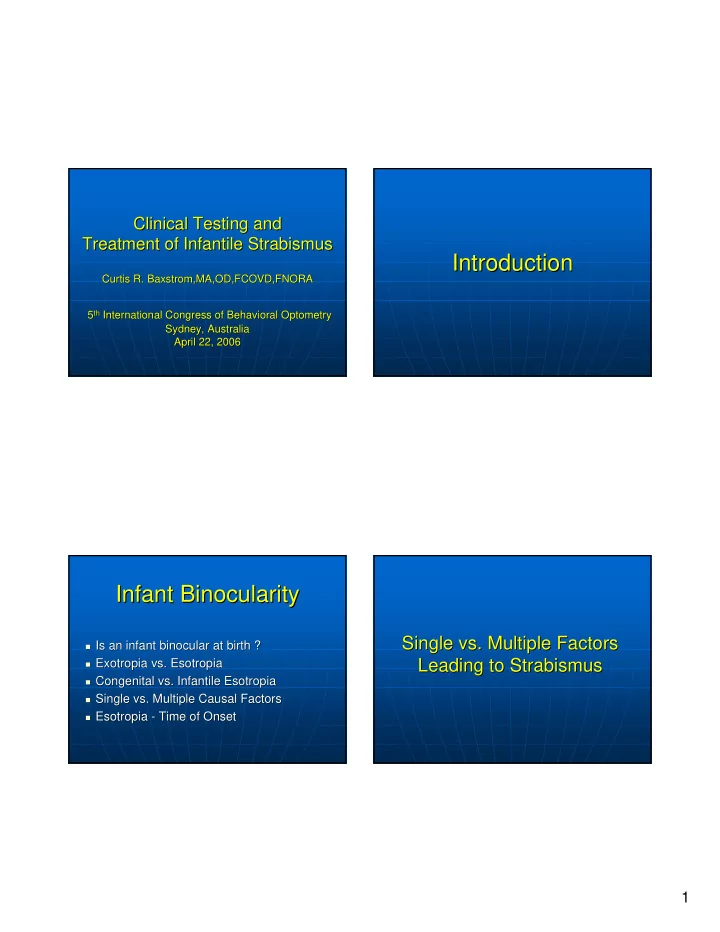
Introduction Introduction Curtis R. Baxstrom,MA,OD,FCOVD,FNORA - - PDF document

introduction introduction
SMART_READER_LITE
LIVE PREVIEW

Introduction Introduction Curtis R. Baxstrom,MA,OD,FCOVD,FNORA - - PDF document

Clinical Testing and Clinical Testing and Treatment of Infantile Strabismus Treatment of Infantile Strabismus Introduction Introduction Curtis R. Baxstrom,MA,OD,FCOVD,FNORA Curtis R. Baxstrom,MA,OD,FCOVD,FNORA th International Congress of


slide-1
SLIDE 1

1

Clinical Testing and Clinical Testing and Treatment of Infantile Strabismus Treatment of Infantile Strabismus

Curtis R. Curtis R. Baxstrom,MA,OD,FCOVD,FNORA Baxstrom,MA,OD,FCOVD,FNORA 5 5th

th International Congress of Behavioral Optometry

International Congress of Behavioral Optometry Sydney, Australia Sydney, Australia April 22, 2006 April 22, 2006

Introduction Introduction Infant Binocularity Infant Binocularity

  • Is an infant binocular at birth ?

Is an infant binocular at birth ?

  • Exotropia

Exotropia vs.

  • vs. Esotropia

Esotropia

  • Congenital vs. Infantile

Congenital vs. Infantile Esotropia Esotropia

  • Single vs. Multiple Causal Factors

Single vs. Multiple Causal Factors

  • Esotropia

Esotropia -

  • Time of Onset

Time of Onset

Single vs. Multiple Factors Single vs. Multiple Factors Leading to Strabismus Leading to Strabismus

slide-2
SLIDE 2

2

Possible Factors of Strabismus Possible Factors of Strabismus

  • Genetics

Genetics

  • Orientation and Localization

Orientation and Localization

  • Reciprocal Interweaving

Reciprocal Interweaving ( (bilaterality bilaterality, reflexes, etc.) , reflexes, etc.)

  • Accommodation

Accommodation

  • Abduction Deficits

Abduction Deficits

  • Motion Processing

Motion Processing

  • Vestibular influences

Vestibular influences

  • Cross fixation

Cross fixation

  • Effects of treatment (lenses,

Effects of treatment (lenses, etc) etc)

  • Interocular

Interocular Differences Differences and and Emmetropization Emmetropization

  • Motor to Sensory

Motor to Sensory Development Development

  • Visual Field development

Visual Field development and similarities within the and similarities within the visual fields visual fields

  • Principles of development

Principles of development

  • Attentional

Attentional Distribution Distribution

  • Systemic Disease / Trauma

Systemic Disease / Trauma

  • Monodeprivation

Monodeprivation (cornea, (cornea, lens) lens)

Time of Onset for Strabismus Time of Onset for Strabismus

  • 4 Months

4 Months -

  • supine

supine

  • 9 Months

9 Months – – sitting / standing sitting / standing

  • 18 Months

18 Months -

  • locomotion

locomotion

  • 3 Years

3 Years -

  • preschool, moving in space

preschool, moving in space

Differential Diagnosis Differential Diagnosis

  • Accommodative

Accommodative esotropia esotropia

  • Pseudoesotropia

Pseudoesotropia

  • Duane

Duane’ ’s Type I s Type I

  • Nystagmus

Nystagmus Blockage Syndrome Blockage Syndrome

  • 6

6th

th Nerve Paresis

Nerve Paresis

  • Others

Others

slide-3
SLIDE 3

3

uncommon uncommon uncommon common common common IOOA Motion Asymmetry VOR uncommon common DVD uncommon common L or ML nystagmus common uncommon Amblyopia > + 3.00 sphere < + 3.00 sphere Refraction 10 to 40 PD 25 to 60 PD Angle >6 months to 7 years Birth to 6 months Onset Accommodative Infantile

Infantile vs. Accommodative Infantile vs. Accommodative Esotropia Esotropia

Developmental Considerations Developmental Considerations and Unique Characteristics to and Unique Characteristics to Consider When Evaluating Consider When Evaluating Infants Infants

Developmental Considerations Developmental Considerations and Models and Models

  • Kraskin

Kraskin – – “ “Three Fundamental Abilities Three Fundamental Abilities” ”

  • Rethy

Rethy– –“ “Vision moves from motor to sensory Vision moves from motor to sensory” ”

  • Sutton

Sutton – – “ “Movement is learning Movement is learning” ”

  • Streff

Streff – – “ “Vision is Motor Vision is Motor” ”

  • Pepper

Pepper – – “ “Principles of Movement Principles of Movement” ”

Three Fundamental Abilities Dealing with the Space Construct

Information Processing Movement Patterns Three Fundamental Abilities Balance with Gravity Where am I? Orientation Freedom to compute Balance with Task Where is it? Localization Range to compute Manipulate Task What is it? Centering/Identification Facility to compute

slide-4
SLIDE 4

4

Rethy Rethy – – Motor to Sensory Motor to Sensory

Quantitative vs. Qualitative Quantitative vs. Qualitative Information Information -

  • RGMR

RGMR

  • Skeletal Component

Skeletal Component -

  • seek and hold image

seek and hold image

  • Visceral Component

Visceral Component -

  • discriminates and

discriminates and defines the image defines the image

  • Cortical Component

Cortical Component -

  • unifies and interprets

unifies and interprets the image the image

Visual Models and RGMR Visual Models and RGMR

  • Optical Model

Optical Model -

  • primarily skeletal

primarily skeletal

  • Reach

Reach -

  • vergence

vergence

  • Grasp

Grasp -

  • accommodation

accommodation

  • Release

Release -

  • change fixation or attention

change fixation or attention

  • Developmental Model

Developmental Model -

  • adds visceral and

adds visceral and cortical cortical

  • Manipulate

Manipulate

  • Projection

Projection -

  • as if it were

as if it were … …

  • Prehension

Prehension -

  • localize with hands, confirmation

localize with hands, confirmation

  • Locomotion

Locomotion -

  • time and space beyond reach

time and space beyond reach

Projection and Manipulation Projection and Manipulation

slide-5
SLIDE 5

5

Principles of Movement (RGMR) Principles of Movement (RGMR)

  • Can I do it ?

Can I do it ?

  • How well can I do it ?

How well can I do it ?

  • How long can I do it ?

How long can I do it ?

  • Can I accept change ?

Can I accept change ?

  • Can I problem solve ?

Can I problem solve ?

Evaluation of Infants Evaluation of Infants

slide-6
SLIDE 6

6

What is the most important What is the most important component of an infant exam? component of an infant exam?

Does the Case History tell us Does the Case History tell us everything? everything? How about motor development as an How about motor development as an indicator of visual development? indicator of visual development?

Prematurity Prematurity

Today Today

  • 30 weeks >80% live

30 weeks >80% live

  • 26 weeks 50% live

26 weeks 50% live

  • 24 weeks >25% live

24 weeks >25% live 10 Years Ago 10 Years Ago

  • 28 weeks 50% lived

28 weeks 50% lived

  • 26 weeks none lived

26 weeks none lived

Evidence for Developmental Hx Evidence for Developmental Hx

Major A, Maples WC, Toomey S, DeRosier W, Gahn D. Retrospective Major A, Maples WC, Toomey S, DeRosier W, Gahn D. Retrospective study of factors associated with infantile esotropia. Submitted study of factors associated with infantile esotropia. Submitted for for publication Optom Vis Sci. 2005. publication Optom Vis Sci. 2005.

  • Pulled Hastings Records and Looked for

Pulled Hastings Records and Looked for Infantile Esotropia Dx that had not been Infantile Esotropia Dx that had not been previously treated previously treated

  • Compared to matched to non esotropes by

Compared to matched to non esotropes by age and gender age and gender

  • Twenty Six Factors Evaluated

Twenty Six Factors Evaluated

  • Twelve were significant at .05 or better

Twelve were significant at .05 or better

slide-7
SLIDE 7

7 Evidence for Developmental Hx Evidence for Developmental Hx

Major A, Maples WC, Toomey S, DeRosier W, Gahn D. Retrospective Major A, Maples WC, Toomey S, DeRosier W, Gahn D. Retrospective study of factors associated with infantile esotropia. Submitted study of factors associated with infantile esotropia. Submitted for for publication Optom Vis Sci. 2005. publication Optom Vis Sci. 2005.

2 4 6 8 10 12 Odds Ratio Premat Fam O Hx Cardio Dis Syst Dis HBP Preg < Birth Wt Oxygen GI Dis Male Otit Med C Sect Augm Lab Resp Dis

Behavioral Observations Behavioral Observations -

  • Manipulation and Projection

Manipulation and Projection

  • Fundamental abilities to learn the

Fundamental abilities to learn the construct of space and time construct of space and time

  • Projection

Projection -

  • static or dynamic?

static or dynamic?

  • Prehension

Prehension

  • Development of Postural Control

Development of Postural Control

  • Locomotion

Locomotion

  • Don

Don’ ’t forget the factor of time t forget the factor of time

Visual Acuity Visual Acuity

  • Changing optical properties, focusing

Changing optical properties, focusing

  • Differentiation of fovea, changes in

Differentiation of fovea, changes in photoreceptors and dendrites photoreceptors and dendrites

  • Myelination

Myelination of visual pathway

  • f visual pathway
  • Increased synaptic connectivity and

Increased synaptic connectivity and pruning pruning

  • * Changes in arousal, sleep cycles

* Changes in arousal, sleep cycles

slide-8
SLIDE 8

8

Methods and Probes Methods and Probes

  • Fix and follow, resistance to occlusion

Fix and follow, resistance to occlusion

  • OKN

OKN

  • Teller cards

Teller cards

  • Face Dot paddle

Face Dot paddle

  • Other FPL cards / paddles

Other FPL cards / paddles

  • Electrodiagnostic

Electrodiagnostic – – VEP / VER VEP / VER

slide-9
SLIDE 9

9

Retinoscopy Retinoscopy and and Refractive Status Refractive Status

Special Considerations Special Considerations

  • Qualitative factors

Qualitative factors -

  • brightness, pattern,

brightness, pattern, color, equality color, equality

  • Single vs. multiple distances

Single vs. multiple distances

  • Autorefractors

Autorefractors

  • Four steps to binocularity

Four steps to binocularity-

  • Getman

Getman

  • X 180

X 180-

  • horizontal scan, X 90

horizontal scan, X 90-

  • vertical scan

vertical scan

  • X 45/135 (looking at two places at once?)

X 45/135 (looking at two places at once?)

  • Cycloplegia

Cycloplegia (dilation enough) (dilation enough)

Color of Color of Retinoscopy Retinoscopy (OEP 1958) (OEP 1958)

  • Dull Red

Dull Red-

  • low recognition or awareness

low recognition or awareness

  • Bright Pink

Bright Pink-

  • better recognition, not on spatially

better recognition, not on spatially

  • Dull Pink

Dull Pink-

  • first indication of quality reflex

first indication of quality reflex

  • White Pink

White Pink-

  • better quality, some refractory states

better quality, some refractory states

  • White

White-

  • now

now “ “set set” ” with quality and consistency with quality and consistency

slide-10
SLIDE 10

10

Development of Development of Retinoscopic Retinoscopic Reflex in Infants Reflex in Infants

  • Findings of

Findings of Getman Getman, up to 8 months , up to 8 months

  • Random Stage

Random Stage

  • Right or Left Stage

Right or Left Stage

  • Right and Left Stage

Right and Left Stage

  • Bilateral Stage

Bilateral Stage

Accommodation Accommodation

  • Gross vs. Fine

Gross vs. Fine

  • Striated vs. Smooth tissue

Striated vs. Smooth tissue

  • Center of rotation, projection ( as if )

Center of rotation, projection ( as if )

Fixation and Abduction Deficits Fixation and Abduction Deficits

  • Fixation is a volitional limitation of movement

Fixation is a volitional limitation of movement

  • Hirschberg differences

Hirschberg differences

  • Nasal retina more dominant

Nasal retina more dominant

  • Volitional abduction deficit with corresponding

Volitional abduction deficit with corresponding cross fixation pattern cross fixation pattern

  • Relative abduction deficit not present or less

Relative abduction deficit not present or less with doll with doll’ ’s eye test ( s eye test (vestibularly vestibularly driven) driven)

  • Gaze palsy

Gaze palsy

Pursuit and OKN Pursuit and OKN Asymmetries Asymmetries

slide-11
SLIDE 11

11

Asymmetry in Pursuits Asymmetry in Pursuits

Asymmetry in Motion Processing Asymmetry in Motion Processing

slide-12
SLIDE 12

12

Vestibular Ocular Evaluation Vestibular Ocular Evaluation

IOOA IOOA – – Inferior Oblique Inferior Oblique Overaction Overaction DVD DVD – – Dissociated Vertical Dissociated Vertical Deviation Deviation and the Dorsal Light Reflex and the Dorsal Light Reflex

slide-13
SLIDE 13

13

Stereopsis Stereopsis

Visual Fields Visual Fields -

  • binocular

binocular hemifield hemifield

  • Birth

Birth 17 17-

  • 34 degrees

34 degrees

  • 3 Months

3 Months 40 40-

  • 50 degrees

50 degrees

  • 6 Months

6 Months 70 70-

  • 84 degrees

84 degrees

slide-14
SLIDE 14

14

Treatment of Treatment of Infantile Infantile Esotropia Esotropia

Traditional Medical Approaches Traditional Medical Approaches

  • Do Nothing, Deny Everything

Do Nothing, Deny Everything

  • Lenses to

Lenses to “ “correct correct” ” refractive error refractive error

  • Unilateral patching

Unilateral patching

  • Muscle Surgery

Muscle Surgery

  • Botox

Botox injections injections

Traditional Optometric Approach Traditional Optometric Approach

  • Do Nothing

Do Nothing

  • Visual Guidance

Visual Guidance

  • Lenses, Prisms

Lenses, Prisms

  • Selective Occlusion

Selective Occlusion

  • Vision Therapy

Vision Therapy

  • Direct

Direct

  • Delayed or Passive

Delayed or Passive

slide-15
SLIDE 15

15 Procedures Should Possess Procedures Should Possess Four Characteristics Four Characteristics

  • Must be of value in itself

Must be of value in itself

  • All techniques should be related in some fashion

All techniques should be related in some fashion

  • All techniques should set the stage for what

All techniques should set the stage for what follows, or establish a better foundation follows, or establish a better foundation

  • Each technique should serve as a measuring

Each technique should serve as a measuring device (patient and therapist) device (patient and therapist)

Traditional Visual Guidance Traditional Visual Guidance

Refractive Status Refractive Status

  • Smith and Atkinson support less than full

Smith and Atkinson support less than full manifest refraction manifest refraction

  • Quality and range of visual contact

Quality and range of visual contact

  • Symmetry

Symmetry

  • Watch facial changes

Watch facial changes

Selective Occlusion Selective Occlusion

  • Complete

Complete

  • Full vs. Part Time

Full vs. Part Time

  • Selective

Selective

  • Area

Area – – sector, sector, binasal binasal, dot , dot

  • Graded to Opaque

Graded to Opaque

  • Set vs. alternating pattern

Set vs. alternating pattern

slide-16
SLIDE 16

16 Why might sector occlusion help? Why might sector occlusion help?

  • Eliminates cross fixation pattern

Eliminates cross fixation pattern

  • Prevent

Prevent amblyopia amblyopia

  • Prevent anomalous correspondence

Prevent anomalous correspondence

  • Promote alternation of eyes

Promote alternation of eyes

  • Decrease confusion / strabismus

Decrease confusion / strabismus

  • Modify visual field relationships

Modify visual field relationships

  • Modify amount and quality of light between eyes

Modify amount and quality of light between eyes (suppression) (suppression)

  • Easier adaptation versus full occlusion

Easier adaptation versus full occlusion

Treatment of Infants Treatment of Infants Beyond the Optical Model Beyond the Optical Model

  • Extended Visual Guidance

Extended Visual Guidance

  • Cranial Osteopathy / Cranial

Cranial Osteopathy / Cranial-

  • Sacral

Sacral

  • Abduction Deficit / Cross Fixation

Abduction Deficit / Cross Fixation

  • Motion Asymmetries

Motion Asymmetries

  • Vestibular Considerations

Vestibular Considerations

  • Later influences of accommodation

Later influences of accommodation

  • Do developmental delays and conditions

Do developmental delays and conditions affect our outcomes ? affect our outcomes ?

What is the single greatest What is the single greatest factor impeding our success factor impeding our success with infantile with infantile esotropia esotropia ? ?

Extended Visual Guidance Extended Visual Guidance

  • Basics

Basics-

  • change crib, viewing positions, inform regarding

change crib, viewing positions, inform regarding johnny johnny jump ups, walkers, etc. jump ups, walkers, etc.

  • Bilaterality

Bilaterality, Reciprocal Interweaving (Rowley) , Reciprocal Interweaving (Rowley)

  • Arousal state should be considered

Arousal state should be considered

  • Attentional

Attentional Distribution Distribution

  • Breaking of

Breaking of esotropia esotropia pattern pattern

  • McCarthy(4mo) and

McCarthy(4mo) and Nasopalpebral Nasopalpebral Reflex, blink Reflex, blink

  • Watch for occlusion factors

Watch for occlusion factors

  • Increase lateral viewing and vestibular rotational

Increase lateral viewing and vestibular rotational activities activities

  • Biochemical and nutritional considerations

Biochemical and nutritional considerations

  • Others

Others

slide-17
SLIDE 17

17 Cross Fixation and Abduction Cross Fixation and Abduction Deficits Deficits

  • Cross Fixation

Cross Fixation-

  • binasals

binasals, sector , sector

  • Abduction Deficit

Abduction Deficit

  • Cranial Osteopathy/Cranial Sacral

Cranial Osteopathy/Cranial Sacral

  • Pursuits/Saccades

Pursuits/Saccades -

  • Ludlam

Ludlam

  • OKN

OKN

  • Doll

Doll’ ’s Eye s Eye -

  • vary speed and range

vary speed and range

  • Vestibular

Vestibular -

  • Rotational Therapy

Rotational Therapy

Cranial Osteopathy / Cranial Osteopathy / Cranial Sacral Therapy Cranial Sacral Therapy

  • Cranial pulse or rhythm

Cranial pulse or rhythm

  • Cranial molding and movement

Cranial molding and movement

  • Petrosphenoidal

Petrosphenoidal Ligament / Ligament Ligament / Ligament

  • f Gruber
  • f Gruber

See See www.cranialacademy.com www.cranialacademy.com

slide-18
SLIDE 18

18

Motion Processing Asymmetry Motion Processing Asymmetry

  • Pursuits

Pursuits -

  • slow to faster (N to T)

slow to faster (N to T)

  • OKN

OKN -

  • slow to faster (N to T)

slow to faster (N to T)

  • Watch for changes in

Watch for changes in stereopsis stereopsis

slide-19
SLIDE 19

19

Vestibular Ocular Considerations Vestibular Ocular Considerations

  • What keeps an infants eyes straight at

What keeps an infants eyes straight at birth ? birth ?

  • Vertical strabismus prior to age one?

Vertical strabismus prior to age one?

  • Self stimulation for improving

Self stimulation for improving bilaterality bilaterality

  • Arousal

Arousal

Vestibular Protocol Vestibular Protocol

  • Reason for vestibular stimulation

Reason for vestibular stimulation

  • Child likes it

Child likes it

  • Arousal

Arousal

  • Symmetrical ocular motor tone

Symmetrical ocular motor tone

  • Increase ROM, change pattern of gaze palsy

Increase ROM, change pattern of gaze palsy

  • Combined with prism compensation, for angle

Combined with prism compensation, for angle reduction reduction

Vestibular Protocol Vestibular Protocol

  • Eyes closed or in dark room

Eyes closed or in dark room

  • In lap, chair or held

In lap, chair or held

  • Head position for lateral SC canals

Head position for lateral SC canals

  • Rotations

Rotations-

  • minimum 1, maximum 10

minimum 1, maximum 10

  • Fixation activity post rotation, also can use

Fixation activity post rotation, also can use mirror if single caregiver mirror if single caregiver

  • Uncover or lights on for fixation

Uncover or lights on for fixation

  • Speed

Speed – – just under 1 cycle per second just under 1 cycle per second

  • PREVENTION/GUIDANCE

PREVENTION/GUIDANCE-

  • lateral swings

lateral swings

slide-20
SLIDE 20

20

Infantile Infantile Esotropia Esotropia Cases Cases

Treatment Summary Treatment Summary

  • Case History and Evaluation

Case History and Evaluation

  • Visual Hygiene

Visual Hygiene

  • Appropriate Lenses

Appropriate Lenses

  • Selective Occlusion for Cross Fixation

Selective Occlusion for Cross Fixation

  • Range of Movement for Abduction Deficit and/or

Range of Movement for Abduction Deficit and/or Cranial Osteopathy Cranial Osteopathy

  • Once binocularity established, consider

Once binocularity established, consider removing tools removing tools

  • Appropriate follow

Appropriate follow-

  • up care

up care

Thank you for your Thank you for your interest in this special interest in this special population ! population !