Chapter 6 Dynamic Programming CS 573: Algorithms, Fall 2013 - - PDF document

chapter 6 dynamic programming
SMART_READER_LITE
LIVE PREVIEW

Chapter 6 Dynamic Programming CS 573: Algorithms, Fall 2013 - - PDF document

Chapter 6 Dynamic Programming CS 573: Algorithms, Fall 2013 September 12, 2013 6.1 Maximum Weighted Independent Set in Trees 6.1.0.1 Maximum Weight Independent Set Problem Input Graph G = ( V, E ) and weights w ( v ) 0 for each v V


slide-1
SLIDE 1

Chapter 6 Dynamic Programming

CS 573: Algorithms, Fall 2013 September 12, 2013

6.1 Maximum Weighted Independent Set in Trees

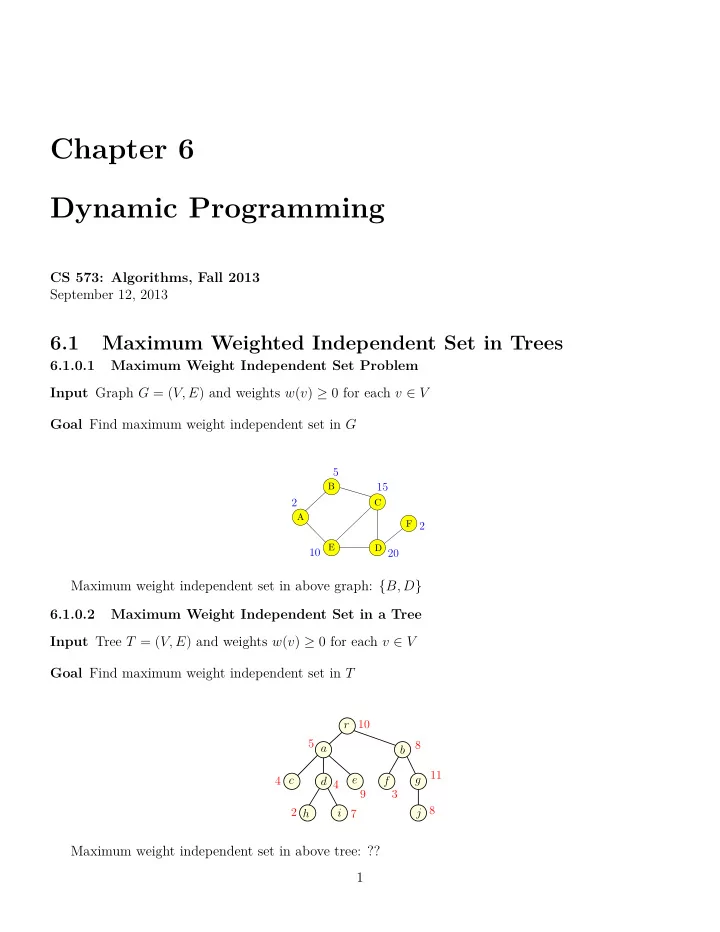
6.1.0.1 Maximum Weight Independent Set Problem Input Graph G = (V, E) and weights w(v) ≥ 0 for each v ∈ V Goal Find maximum weight independent set in G

A B C D E F

20 5 2 2 10 15

Maximum weight independent set in above graph: {B, D} 6.1.0.2 Maximum Weight Independent Set in a Tree Input Tree T = (V, E) and weights w(v) ≥ 0 for each v ∈ V Goal Find maximum weight independent set in T

r a b c d e f g h i j 10 5 8 4 4 9 2 7 8 11 3

Maximum weight independent set in above tree: ?? 1

slide-2
SLIDE 2

6.1.0.3 Towards a Recursive Solution For an arbitrary graph G: (A) Number vertices as v1, v2, . . . , vn (B) Find recursively optimum solutions without vn (recurse on G − vn) and with vn (recurse on G − vn − N(vn) & include vn). (C) Saw that if graph G is arbitrary there was no good ordering that resulted in a small number of subproblems. What about a tree? Natural candidate for vn is root r of T? 6.1.0.4 Towards a Recursive Solution Natural candidate for vn is root r of T? Let O be an optimum solution to the whole problem. Case r ̸∈ O : Then O contains an optimum solution for each subtree of T hanging at a child of r. Case r ∈ O : None of the children of r can be in O. O − {r} contains an optimum solution for each subtree of T hanging at a grandchild of r. Subproblems? Subtrees of T hanging at nodes in T. 6.1.0.5 A Recursive Solution T(u): subtree of T hanging at node u OPT(u): max weighted independent set value in T(u) OPT(u) = max

   ∑

v child of u OPT(v),

w(u) + ∑

v grandchild of u OPT(v)

6.1.0.6 Iterative Algorithm (A) Compute OPT(u) bottom up. To evaluate OPT(u) need to have computed values of all children and grandchildren of u (B) What is an ordering of nodes of a tree T to achieve above? Post-order traversal of a tree. 6.1.0.7 Iterative Algorithm

MIS-Tree(T): Let v1, v2, . . . , vn be a post-order traversal of nodes of T

for i = 1 to n do

M[vi] = max ( ∑

vj child of vi M[vj],

w(vi) + ∑

vj grandchild of vi M[vj]

)

return M[vn] (* Note:

vn is the root of T *)

Space: O(n) to store the value at each node of T Running time: (A) Naive bound: O(n2) since each M[vi] evaluation may take O(n) time and there are n evaluations. (B) Better bound: O(n). A value M[vj] is accessed only by its parent and grand parent. 2

slide-3
SLIDE 3

6.1.0.8 Example

r a b c d e f g h i j 10 5 8 4 4 9 2 7 8 11 3

6.1.0.9 Dominating set Definition 6.1.1. G = (V, E). The set X ⊆ V is a dominating set, if any vertex v ∈ V is either in X or is adjacent to a vertex in X.

r a b c d e f g h i j 10 5 8 4 4 9 2 7 8 11 3

Problem 6.1.2. Given weights on vertices, compute the minimum weight dominating set in G. Dominating Set is NP-Hard!

6.2 DAGs and Dynamic Programming

6.2.0.10 Recursion and DAGs Observation 6.2.1. Let A be a recursive algorithm for problem Π. For each instance I of Π there is an associated DAG G(I). (A) Create directed graph G(I) as follows... (B) For each sub-problem in the execution of A on I create a node. (C) If sub-problem v depends on or recursively calls sub-problem u add directed edge (u, v) to graph. (D) G(I) is a DAG. Why? If G(I) has a cycle then A will not terminate on I.

6.2.1 Iterative Algorithm for...

6.2.1.1 Dynamic Programming and DAGs Observation 6.2.2. An iterative algorithm B obtained from a recursive algorithm A for a problem Π does the following: For each instance I of Π, it computes a topological sort of G(I) and evaluates sub-problems according to the topological ordering. 3

slide-4
SLIDE 4

(A) Sometimes the DAG G(I) can be obtained directly without thinking about the recursive algorithm A (B) In some cases (not all) the computation of an optimal solution reduces to a shortest/longest path in DAG G(I) (C) Topological sort based shortest/longest path computation is dynamic programming!

6.2.2 A quick reminder...

6.2.2.1 A Recursive Algorithm for weighted interval scheduling Let Oi be value of an optimal schedule for the first i jobs.

Schedule(n):

if n = 0 then return 0 if n = 1 then return w(v1)

Op(n) ←Schedule(p(n)) On−1 ←Schedule(n − 1)

if (Op(n) + w(vn) < On−1) then

On = On−1

else

On = Op(n) + w(vn)

return On

6.2.3 Weighted Interval Scheduling via...

6.2.3.1 Longest Path in a DAG Given intervals, create a DAG as follows: (A) Create one node for each interval, plus a dummy sink node 0 for interval 0, plus a dummy source node s. (B) For each interval i add edge (i, p(i)) of the length/weight of vi. (C) Add an edge from s to n of length 0. (D) For each interval i add edge (i, i − 1) of length 0. 6.2.3.2 Example

30 70 80 20 10 1 2 3 4 5 p(5) = 2, p(4) = 1, p(3) = 1, p(2) = 0, p(1) = 0

1 2 3 4 5 s

30 20 70 80 10

4

slide-5
SLIDE 5

6.2.3.3 Relating Optimum Solution Given interval problem instance I let G(I) denote the DAG constructed as described. Claim 6.2.3. Optimum solution to weighted interval scheduling instance I is given by longest path from s to 0 in G(I). Assuming claim is true, (A) If I has n intervals, DAG G(I) has n + 2 nodes and O(n) edges. Creating G(I) takes O(n log n) time: to find p(i) for each i. How? (B) Longest path can be computed in O(n) time — recall O(m + n) algorithm for shortest/longest paths in DAGs. 6.2.3.4 DAG for Longest Increasing Sequence Given sequence a1, a2, . . . , an create DAG as follows: (A) add sentinel a0 to sequence where a0 is less than smallest element in sequence (B) for each i there is a node vi (C) if i < j and ai < aj add an edge (vi, vj) (D) find longest path from v0

6 3 5 2 7 8 1 a0 6 3 5 2 7 8 1 a0

6.3 Edit Distance and Sequence Alignment

6.3.0.5 Spell Checking Problem Given a string “exponen” that is not in the dictionary, how should a spell checker suggest a nearby string? What does nearness mean? Question: Given two strings x1x2 . . . xn and y1y2 . . . ym what is a distance between them? 5

slide-6
SLIDE 6

Edit Distance: minimum number of “edits” to transform x into y. 6.3.0.6 Edit Distance Definition 6.3.1. Edit distance between two words X and Y is the number of letter insertions, letter deletions and letter substitutions required to obtain Y from X. Example 6.3.2. The edit distance between FOOD and MONEY is at most 4: FOOD → MOOD → MONOD → MONED → MONEY 6.3.0.7 Edit Distance: Alternate View Alignment Place words one on top of the other, with gaps in the first word indicating insertions, and gaps in the second word indicating deletions. F O O D M O N E Y Formally, an alignment is a set M of pairs (i, j) such that each index appears at most once, and there is no “crossing”: i < i′ and i is matched to j implies i′ is matched to j′ > j. In the above example, this is M = {(1, 1), (2, 2), (3, 3), (4, 5)}. Cost of an alignment is the number of mismatched columns plus number of unmatched indices in both strings. 6.3.0.8 Edit Distance Problem Problem Given two words, find the edit distance between them, i.e., an alignment of smallest cost. 6.3.0.9 Applications (A) Spell-checkers and Dictionaries (B) Unix diff (C) DNA sequence alignment . . . but, we need a new metric 6.3.0.10 Similarity Metric Definition 6.3.3. For two strings X and Y , the cost of alignment M is (A) [Gap penalty] For each gap in the alignment, we incur a cost δ. (B) [Mismatch cost] For each pair p and q that have been matched in M, we incur cost αpq; typically αpp = 0. Edit distance is special case when δ = αpq = 1. 6.3.0.11 An Example Example 6.3.4.

  • c

u r r a n c e

  • c

c u r r e n c e Cost = δ + αae Alternative:

  • c

u r r a n c e

  • c

c u r r e n c e Cost = 3δ Or a really stupid solution (delete string, insert other string):

  • c

u r r a n c e

  • c

c u r r e n c e Cost = 19δ. 6

slide-7
SLIDE 7

6.3.0.12 Sequence Alignment Input Given two words X and Y , and gap penalty δ and mismatch costs αpq Goal Find alignment of minimum cost

6.3.1 Edit distance

6.3.1.1 Basic observation Let X = αx and Y = βy α, β: strings. x and y single characters. Think about optimal edit distance between X and Y as alignment, and consider last column of alignment of the two strings: α x β y

  • r

α x βy

  • r

αx β y Observation 6.3.5. Prefixes must have optimal alignment! 6.3.1.2 Problem Structure Observation 6.3.6. Let X = x1x2 · · · xm and Y = y1y2 · · · yn. If (m, n) are not matched then either the mth position of X remains unmatched or the nth position of Y remains unmatched. (A) Case xm and yn are matched. (A) Pay mismatch cost αxmyn plus cost of aligning strings x1 · · · xm−1 and y1 · · · yn−1 (B) Case xm is unmatched. (A) Pay gap penalty plus cost of aligning x1 · · · xm−1 and y1 · · · yn (C) Case yn is unmatched. (A) Pay gap penalty plus cost of aligning x1 · · · xm and y1 · · · yn−1 6.3.1.3 Subproblems and Recurrence Optimal Costs Let Opt(i, j) be optimal cost of aligning x1 · · · xi and y1 · · · yj. Then Opt(i, j) = min

      

αxiyj + Opt(i − 1, j − 1), δ + Opt(i − 1, j), δ + Opt(i, j − 1) Base Cases: Opt(i, 0) = δ · i and Opt(0, j) = δ · j 6.3.1.4 Dynamic Programming Solution

for all i do M[i, 0] = iδ for all j do M[0, j] = jδ for i = 1 to m do for j = 1 to n do

M[i, j] = min      αxiyj + M[i − 1, j − 1], δ + M[i − 1, j], δ + M[i, j − 1]

7

slide-8
SLIDE 8

. . . . . . . . . . . . . . . . . . ... ... i, j

m, n

αxixj δ δ

0, 0

Figure 6.1: Iterative algorithm in previous slide computes values in row order. Optimal value is a shortest path from (0, 0) to (m, n) in DAG. Analysis (A) Running time is O(mn). (B) Space used is O(mn). 6.3.1.5 Matrix and DAG of Computation 6.3.1.6 Sequence Alignment in Practice (A) Typically the DNA sequences that are aligned are about 105 letters long! (B) So about 1010 operations and 1010 bytes needed (C) The killer is the 10GB storage (D) Can we reduce space requirements? 6.3.1.7 Optimizing Space (A) Recall M(i, j) = min

      

αxiyj + M(i − 1, j − 1), δ + M(i − 1, j), δ + M(i, j − 1) (B) Entries in jth column only depend on (j − 1)st column and earlier entries in jth column (C) Only store the current column and the previous column reusing space; N(i, 0) stores M(i, j − 1) and N(i, 1) stores M(i, j) 6.3.1.8 Computing in column order to save space 6.3.1.9 Space Efficient Algorithm

for all i do N[i, 0] = iδ for j = 1 to n do

N[0, 1] = jδ (* corresponds to M(0, j) *)

for i = 1 to m do

N[i, 1] = min      αxiyj + N[i − 1, 0] δ + N[i − 1, 1] δ + N[i, 0]

for i = 1 to m do

Copy N[i, 0] = N[i, 1]

8

slide-9
SLIDE 9

. . . . . . . . . . . . . . . . . . ... ... i, j

m, n

αxixj δ δ

0, 0

Figure 6.2: M(i, j) only depends on previous column values. Keep only two columns and compute in column order. Analysis Running time is O(mn) and space used is O(2m) = O(m) 6.3.1.10 Analyzing Space Efficiency (A) From the m × n matrix M we can construct the actual alignment (exercise) (B) Matrix N computes cost of optimal alignment but no way to construct the actual alignment (C) Space efficient computation of alignment? More complicated algorithm — see text book. 6.3.1.11 Takeaway Points (A) Dynamic programming is based on finding a recursive way to solve the problem. Need a recursion that generates a small number of subproblems. (B) Given a recursive algorithm there is a natural DAG associated with the subproblems that are generated for given instance; this is the dependency graph. An iterative algorithm simply evaluates the subproblems in some topological sort of this DAG. (C) The space required to evaluate the answer can be reduced in some cases by a careful examination

  • f that dependency DAG of the subproblems and keeping only a subset of the DAG at any time.

6.4 All Pairs Shortest Paths

6.4.0.12 Shortest Path Problems Shortest Path Problems Input A (undirected or directed) graph G = (V, E) with edge lengths (or costs). For edge e = (u, v), ℓ(e) = ℓ(u, v) is its length. (A) Given nodes s, t find shortest path from s to t. (B) Given node s find shortest path from s to all other nodes. (C) Find shortest paths for all pairs of nodes. 6.4.0.13 Single-Source Shortest Paths Single-Source Shortest Path Problems Input A (undirected or directed) graph G = (V, E) with edge lengths. For edge e = (u, v), ℓ(e) = ℓ(u, v) is its length. 9

slide-10
SLIDE 10

(A) Given nodes s, t find shortest path from s to t. (B) Given node s find shortest path from s to all other nodes. Dijkstra’s algorithm for non-negative edge lengths. Running time: O((m + n) log n) with heaps and O(m + n log n) with advanced priority queues. Bellman-Ford algorithm for arbitrary edge lengths. Running time: O(nm). 6.4.0.14 All-Pairs Shortest Paths All-Pairs Shortest Path Problem Input A (undirected or directed) graph G = (V, E) with edge lengths. For edge e = (u, v), ℓ(e) = ℓ(u, v) is its length. (A) Find shortest paths for all pairs of nodes. Apply single-source algorithms n times, once for each vertex. (A) Non-negative lengths. O(nm log n) with heaps and O(nm+n2 log n) using advanced priority queues. (B) Arbitrary edge lengths: O(n2m). Θ(n4) if m = Ω(n2). Can we do better? 6.4.0.15 Shortest Paths and Recursion (A) Compute the shortest path distance from s to t recursively? (B) What are the smaller sub-problems? Lemma 6.4.1. Let G be a directed graph with arbitrary edge lengths. If s = v0 → v1 → v2 → . . . → vk is a shortest path from s to vk then for 1 ≤ i < k: (A) s = v0 → v1 → v2 → . . . → vi is a shortest path from s to vi Sub-problem idea: paths of fewer hops/edges 6.4.0.16 Hop-based Recur’: Single-Source Shortest Paths Single-source problem: fix source s. OPT(v, k): shortest path dist. from s to v using at most k edges. Note: dist(s, v) = OPT(v, n − 1). Recursion for OPT(v, k): OPT(v, k) = min

  

minu∈V (OPT(u, k − 1) + c(u, v)). OPT(v, k − 1) Base case: OPT(v, 1) = c(s, v) if (s, v) ∈ E otherwise ∞ Leads to Bellman-Ford algorithm — see text book. OPT(v, k) values are also of independent interest: shortest paths with at most k hops 10

slide-11
SLIDE 11

6.4.0.17 All-Pairs: Recursion on index of intermediate nodes (A) Number vertices arbitrarily as v1, v2, . . . , vn (B) dist(i, j, k): shortest path distance between vi and vj among all paths in which the largest index of an intermediate node is at most k i 4 1 100 1 10 2 j 3 5 1 1 2 i 4 1 100 1 10 2 j 3 5 1 1 2 i 4 1 100 1 10 2 j 3 5 1 1 2 i 4 1 100 1 10 2 j 3 5 1 1 2 i 4 1 100 1 10 2 j 3 5 1 1 2 dist(i, j, 0) = 100 dist(i, j, 1) = 9 dist(i, j, 2) = 8 dist(i, j, 3) = 5 6.4.0.18 All-Pairs: Recursion on index of intermediate nodes

i j k dist(i, k, k − 1) dist(k, j, k − 1) dist(i, j, k − 1)

dist(i, j, k) = min

  

dist(i, j, k − 1) dist(i, k, k − 1) + dist(k, j, k − 1) Base case: dist(i, j, 0) = c(i, j) if (i, j) ∈ E, otherwise ∞ Correctness: If i → j shortest path goes through k then k occurs only once on the path — otherwise there is a negative length cycle. 11

slide-12
SLIDE 12

6.4.1 Floyd-Warshall Algorithm

6.4.1.1 for All-Pairs Shortest Paths

Check if G has a negative cycle // Bellman-Ford: O(mn) time

if there is a negative cycle then return ‘‘Negative cycle’’ for i = 1 to n do for j = 1 to n do

dist(i, j, 0) = c(i, j) (* c(i, j) = ∞ if (i, j) / ∈ E, 0 if i = j *)

for k = 1 to n do for i = 1 to n do for j = 1 to n do

dist(i, j, k) = min { dist(i, j, k − 1), dist(i, k, k − 1) + dist(k, j, k − 1)

Correctness: Recursion works under the assumption that all shortest paths are defined (no negative length cycle). Running Time: Θ(n3), Space: Θ(n3).

6.4.2 Floyd-Warshall Algorithm

6.4.2.1 for All-Pairs Shortest Paths Do we need a separate algorithm to check if there is negative cycle?

for i = 1 to n do for j = 1 to n do

dist(i, j, 0) = c(i, j) (* c(i, j) = ∞ if (i, j) / ∈ E, 0 if i = j *) not edge, 0 if i = j *)

for k = 1 to n do for i = 1 to n do for j = 1 to n do

dist(i, j, k) = min(dist(i, j, k − 1), dist(i, k, k − 1) + dist(k, j, k − 1))

for i = 1 to n do if (dist(i, i, n) < 0) then

Output that there is a negative length cycle in G

Correctness: exercise 6.4.2.2 Floyd-Warshall Algorithm: Finding the Paths Question: Can we find the paths in addition to the distances? (A) Create a n × n array Next that stores the next vertex on shortest path for each pair of vertices (B) With array Next, for any pair of given vertices i, j can compute a shortest path in O(n) time. 12
slide-13
SLIDE 13

6.4.3 Floyd-Warshall Algorithm

6.4.3.1 Finding the Paths

for i = 1 to n do for j = 1 to n do

dist(i, j, 0) = c(i, j) (* c(i, j) = ∞ if (i, j) not edge, 0 if i = j *) Next(i, j) = −1

for k = 1 to n do for i = 1 to n do for j = 1 to n do if (dist(i, j, k − 1) > dist(i, k, k − 1) + dist(k, j, k − 1)) then

dist(i, j, k) = dist(i, k, k − 1) + dist(k, j, k − 1) Next(i, j) = k

for i = 1 to n do if (dist(i, i, n) < 0) then

Output that there is a negative length cycle in G

Exercise: Given Next array and any two vertices i, j describe an O(n) algorithm to find a i-j shortest path. 6.4.3.2 Summary of results on shortest paths Single vertex No negative edges Dijkstra O(n log n + m) Edges cost might be negative But no negative cycles Bellman Ford O(nm) All Pairs Shortest Paths No negative edges n * Dijkstra O(n2 log n + nm) No negative cycles n * Bellman Ford O(n2m) = O(n4) No negative cycles Floyd-Warshall O(n3)

6.5 Knapsack

6.5.0.3 Knapsack Problem Input Given a Knapsack of capacity W lbs. and n objects with ith object having weight wi and value vi; assume W, wi, vi are all positive integers Goal Fill the Knapsack without exceeding weight limit while maximizing value. Basic problem that arises in many applications as a sub-problem. 6.5.0.4 Knapsack Example Example 6.5.1. Item I1 I2 I3 I4 I5 Value 1 6 18 22 28 Weight 1 2 5 6 7 If W = 11, the best is {I3, I4} giving value 40. Special Case When vi = wi, the Knapsack problem is called the Subset Sum Problem. 13

slide-14
SLIDE 14

6.5.0.5 Greedy Approach (A) Pick objects with greatest value (A) Let W = 2, w1 = w2 = 1, w3 = 2, v1 = v2 = 2 and v3 = 3; greedy strategy will pick {3}, but the optimal is {1, 2} (B) Pick objects with smallest weight (A) Let W = 2, w1 = 1, w2 = 2, v1 = 1 and v2 = 3; greedy strategy will pick {1}, but the optimal is {2} (C) Pick objects with largest vi/wi ratio (A) Let W = 4, w1 = w2 = 2, w3 = 3, v1 = v2 = 3 and v3 = 5; greedy strategy will pick {3}, but the optimal is {1, 2} (B) Can show that a slight modification always gives half the optimum profit: pick the better

  • f the output of this algorithm and the largest value item. Also, the algorithms gives better

approximations when all item weights are small when compared to W. 6.5.0.6 Towards a Recursive Solution First guess: Opt(i) is the optimum solution value for items 1, . . . , i. Observation 6.5.2. Consider an optimal solution O for 1, . . . , i Case item i ̸∈ O O is an optimal solution to items 1 to i − 1 Case item i ∈ O Then O − {i} is an optimum solution for items 1 to n − 1 in knapsack of capacity W − wi. Subproblems depend also on remaining capacity. Cannot write subproblem only in terms of Opt(1), . . . , Opt(i 1). Opt(i, w): optimum profit for items 1 to i in knapsack of size w Goal: compute Opt(n, W) 6.5.0.7 Dynamic Programming Solution Definition 6.5.3. Let Opt(i, w) be the optimal way of picking items from 1 to i, with total weight not exceeding w. Opt(i, w) =

          

if i = 0 Opt(i − 1, w) if wi > w max

  

Opt(i − 1, w) Opt(i − 1, w − wi) + vi

  • therwise

6.5.0.8 An Iterative Algorithm

for w = 0 to W do

M[0, w] = 0

for i = 1 to n do for w = 1 to W do if (wi > w) then

M[i, w] = M[i − 1, w]

else

M[i, w] = max(M[i − 1, w], M[i − 1, w − wi] + vi)

Running Time 14

slide-15
SLIDE 15

(A) Time taken is O(nW) (B) Input has size O(n + log W + ∑n

i=1(log vi + log wi)); so running time not polynomial but “pseudo-

polynomial”! 6.5.0.9 Knapsack Algorithm and Polynomial time (A) Input size for Knapsack: O(n) + log W + ∑n

i=1(log wi + log vi).

(B) Running time of dynamic programming algorithm: O(nW). (C) Not a polynomial time algorithm. (D) Example: W = 2n and wi, vi ∈ [1..2n]. Input size is O(n2), running time is O(n2n) arith- metic/comparisons. (E) Algorithm is called a pseudo-polynomial time algorithm because running time is polynomial if numbers in input are of size polynomial in the combinatorial size of problem. (F) Knapsack is NP-Hard if numbers are not polynomial in n.

6.6 Traveling Salesman Problem

6.6.0.10 Traveling Salesman Problem Input A graph G = (V, E) with non-negative edge costs/lengths. c(e) for edge e Goal Find a tour of minimum cost that visits each node. No polynomial time algorithm known. Problem is NP-Hard. 15

slide-16
SLIDE 16

6.6.0.11 Drawings using TSP 16

slide-17
SLIDE 17

6.6.0.12 Example: optimal tour for cities of a country (which one?) 6.6.0.13 An Exponential Time Algorithm How many different tours are there? n! Stirling’s formula: n! ≃ √n(n/e)n which is Θ(2cn log n) for some constant c > 1 Can we do better? Can we get a 2O(n) time algorithm? 6.6.0.14 Towards a Recursive Solution (A) Order vertices as v1, v2, . . . , vn (B) OPT(S): optimum TSP tour for the vertices S ⊆ V in the graph restricted to S. Want OPT(V ). Can we compute OPT(S) recursively? (A) Say v ∈ S. What are the two neighbors of v in optimum tour in S? (B) If u, w are neighbors of v in an optimum tour of S then removing v gives an optimum path from u to w visiting all nodes in S − {v}. Path from u to w is not a recursive subproblem! Need to find a more general problem to allow recursion. 6.6.0.15 A More General Problem: TSP Path Input A graph G = (V, E) with non-negative edge costs/lengths(c(e) for edge e) and two nodes s, t Goal Find a path from s to t of minimum cost that visits each node exactly once. 17

slide-18
SLIDE 18

Can solve TSP using above. Do you see how? Recursion for optimum TSP Path problem: (A) OPT(u, v, S): optimum TSP Path from u to v in the graph restricted to S (here u, v ∈ S).

6.6.1 A More General Problem: TSP Path

6.6.1.1 Continued... What is the next node in the optimum path from u to v? Suppose it is w. Then what is OPT(u, v, S)? OPT(u, v, S) = c(u, w) + OPT(w, v, S − {u}) We do not know w! So try all possibilities for w. 6.6.1.2 A Recursive Solution OPT(u, v, S) = minw∈S,w̸=u,v

(

c(u, w) + OPT(w, v, S − {u})

)

What are the subproblems for the original problem OPT(s, t, V )? OPT(u, v, S) for u, v ∈ S, S ⊆ V . How many subproblems? (A) number of distinct subsets S of V is at most 2n (B) number of pairs of nodes in a set S is at most n2 (C) hence number of subproblems is O(n22n) Exercise: Show that one can compute TSP using above dynamic program in O(n32n) time and O(n22n) space. Disadvantage of dynamic programming solution: memory! 6.6.1.3 Dynamic Programming: Postscript Dynamic Programming = Smart Recursion + Memoization (A) How to come up with the recursion? (B) How to recognize that dynamic programming may apply? 6.6.1.4 Some Tips (A) Problems where there is a natural linear ordering: sequences, paths, intervals, DAGs etc. Recursion based on ordering (left to right or right to left or topological sort) usually works. (B) Problems involving trees: recursion based on subtrees. (C) More generally: (A) Problem admits a natural recursive divide and conquer (B) If optimal solution for whole problem can be simply composed from optimal solution for each separate pieces then plain divide and conquer works directly (C) If optimal solution depends on all pieces then can apply dynamic programming if inter- face/interaction between pieces is limited. Augment recursion to not simply find an optimum solution but also an optimum solution for each possible way to interact with the other pieces. 6.6.1.5 Examples (A) Longest Increasing Subsequence: break sequence in the middle say. What is the interaction between the two pieces in a solution? (B) Sequence Alignment: break both sequences in two pieces each. What is the interaction between the two sets of pieces? 18

slide-19
SLIDE 19

(C) Independent Set in a Tree: break tree at root into subtrees. What is the interaction between the sutrees? (D) Independent Set in an graph: break graph into two graphs. What is the interaction? Very high! (E) Knapsack: Split items into two sets of half each. What is the interaction? 19

slide-20
SLIDE 20

20

slide-21
SLIDE 21

Bibliography

21