Chapter 4: Network Layer Chapter goals: Overview: understand - - PowerPoint PPT Presentation

chapter 4 network layer
SMART_READER_LITE
LIVE PREVIEW

Chapter 4: Network Layer Chapter goals: Overview: understand - - PowerPoint PPT Presentation

Chapter 4: Network Layer Chapter goals: Overview: understand principles network layer services behind network layer routing principles: path services: selection routing (path selection) hierarchical routing dealing with scale IP how a


slide-1
SLIDE 1

Network Layer 4-1

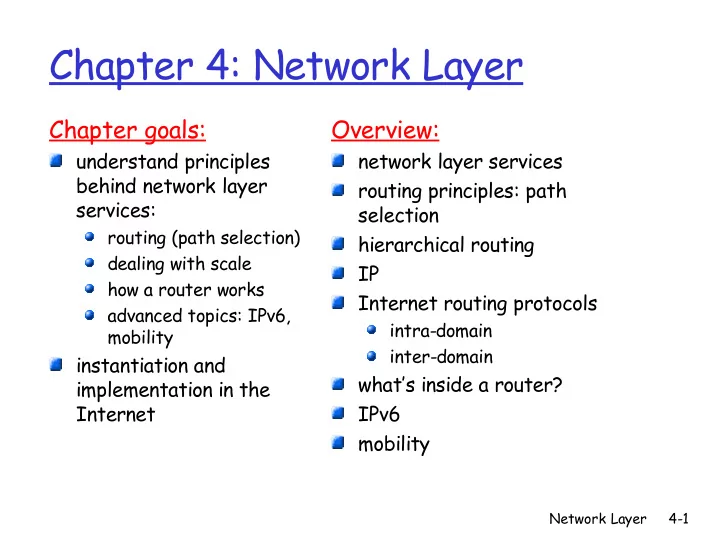
Chapter 4: Network Layer

Chapter goals:

understand principles behind network layer services:

routing (path selection) dealing with scale how a router works advanced topics: IPv6, mobility

instantiation and implementation in the Internet

Overview:

network layer services routing principles: path selection hierarchical routing IP Internet routing protocols

intra-domain inter-domain

what’s inside a router? IPv6 mobility

slide-2
SLIDE 2

Network Layer 4-2

Network layer functions

transport packet from sending to receiving hosts network layer protocols in every host, router three important functions: path determination: route taken by packets from source to dest. Routing algorithms forwarding: move packets from router’s input to appropriate router output call setup: some network architectures require router call setup along path before data flows

network data link physical network data link physical network data link physical network data link physical network data link physical network data link physical network data link physical network data link physical application transport network data link physical application transport network data link physical

slide-3
SLIDE 3

Network Layer 4-3

Network service model

Q: What service model for “channel” transporting packets from sender to receiver?

guaranteed bandwidth? preservation of inter-packet timing (no jitter)? loss-free delivery? in-order delivery? congestion feedback to sender?

? ? ?

virtual circuit

  • r

datagram? The most important

abstraction provided by network layer:

service abstraction

slide-4
SLIDE 4

Network Layer 4-4

Virtual circuits

call setup, teardown for each call before data can flow each packet carries VC identifier (not destination host ID) every router on source-dest path maintains “state” for each passing connection

transport-layer connection only involved two end systems

link, router resources (bandwidth, buffers) may be allocated to VC

to get circuit-like perf.

“source-to-dest path behaves much like telephone circuit”

performance-wise network actions along source-to-dest path

slide-5
SLIDE 5

Network Layer 4-5

Virtual circuits: signaling protocols

used to setup, maintain teardown VC used in ATM, frame-relay, X.25 not used in today’s Internet

application transport network data link physical application transport network data link physical

  • 1. Initiate call
  • 2. incoming call
  • 3. Accept call
  • 4. Call connected
  • 5. Data flow begins
  • 6. Receive data
slide-6
SLIDE 6

Network Layer 4-6

Datagram networks: the Internet model

no call setup at network layer routers: no state about end-to-end connections

no network-level concept of “connection”

packets forwarded using destination host address

packets between same source-dest pair may take different paths application transport network data link physical application transport network data link physical

  • 1. Send data
  • 2. Receive data
slide-7
SLIDE 7

Network Layer 4-7

Network layer service models:

Network Architecture Internet ATM ATM ATM ATM Service Model best effort CBR VBR ABR UBR Bandwidth none constant rate guaranteed rate guaranteed minimum none Loss no yes yes no no Order no yes yes yes yes Timing no yes yes no no Congestion feedback no (inferred via loss) no congestion no congestion yes no Guarantees ? Internet model being extended: Intserv, Diffserv Chapter 6

slide-8
SLIDE 8

Network Layer 4-8

Datagram or VC network: why?

Internet

data exchange among computers “elastic” service, no strict timing req. “smart” end systems (computers) can adapt, perform control, error recovery simple inside network, complexity at “edge” many link types different characteristics uniform service difficult

ATM

evolved from telephony human conversation: strict timing, reliability requirements need for guaranteed service “dumb” end systems telephones complexity inside network

slide-9
SLIDE 9

Network Layer 4-9

Routing

Graph abstraction for routing algorithms: graph nodes are routers graph edges are physical links

link cost: delay, $ cost,

  • r congestion level

Goal: determine “good” path (sequence of routers) thru network from source to dest.

Routing protocol

A E D C B F

2 2 1 3 1 1 2 5 3 5

“good” path:

typically means minimum cost path

  • ther def’s possible
slide-10
SLIDE 10

Network Layer 4-10

Routing Algorithm classification

Global or decentralized information?

Global: all routers have complete topology, link cost info “link state” algorithms Decentralized: router knows physically- connected neighbors, link costs to neighbors iterative process of computation, exchange of info with neighbors “distance vector” algorithms

Static or dynamic?

Static: routes change slowly

  • ver time

Dynamic: routes change more quickly periodic update in response to link cost changes

slide-11
SLIDE 11

Network Layer 4-11

A Link-State Routing Algorithm

Dijkstra’s algorithm

net topology, link costs known to all nodes accomplished via “link state broadcast” all nodes have same info computes least cost paths from one node (“source”) to all other nodes gives routing table for that node iterative: after k iterations, know least cost path to k destinations

Idea:

at each iteration increase spanning tree by the node that has least cost path to it A E D C B F

2 2 1 3 1 1 2 5 3 5

slide-12
SLIDE 12

Network Layer 4-12

A Link-State Routing Algorithm

Notation: c(i,j): link cost from node i

to j. cost infinite if not direct neighbors

D(v): current value of cost

  • f path from source to
  • dest. V

p(v): predecessor node

along path from source to v, that is next v

N: set of nodes already in

spanning tree (least cost path known) A E D C B F

2 2 1 3 1 1 2 5 3 5

Examples: c(B,C) = 3 D(E) = 2 p(B) = A N = { A, B, D, E }

slide-13
SLIDE 13

Network Layer 4-13

Dijsktra’s Algorithm

1 Initialization: 2 N = {A} 3 for all nodes v 4 if v adjacent to A 5 then D(v) = c(A,v) 6 else D(v) = infinity 7 8 Loop 9 find w not in N such that D(w) is a minimum 10 add w to N 11 update D(v) for all v adjacent to w and not in N: 12 D(v) = min( D(v), D(w) + c(w,v) ) 13 /* new cost to v is either old cost to v or known 14 shortest path cost to w plus cost from w to v */ 15 until all nodes in N

slide-14
SLIDE 14

Network Layer 4-14

Dijkstra’s algorithm: example

Step 1 2 3 4 5 N D(B),p(B) D(C),p(C) D(D),p(D) D(E),p(E) D(F),p(F)

2 2 1 3 1 1 2 5 3 5

A 2,A 5,A 1,A infinity,- infinity,- AD 2,A 4,D 1,A 2,D infinity,- ADE 2,A 3,E 1,A 2,D 4,E ADEB 2,A 3,E 1,A 2,D 4,E ADEBC 2,A 3,E 1,A 2,D 4,E ADEBCF 2,A 3,E 1,A 2,D 4,E E D C B F A

slide-15
SLIDE 15

Network Layer 4-15

Spanning tree gives routing table

B C D E F B,2 D,3 D,1 D,2 D,4

Outgoing link to use, cost destination

Result from Dijkstra’s algorithm Routing table:

Step N D(B),p(B) D(C),p(C) D(D),p(D) D(E),p(E) D(F),p(F) ADEBCF 2,A 3,E 1,A 2,D 4,E

2 2 1 3 1 1 2 5 3 5

E D C B F A

slide-16
SLIDE 16

Network Layer 4-16

Dijkstra’s algorithm performance

Algorithm complexity (n nodes and l links)

Computation

n iterations each iteration: need to check all nodes, w, not in N n*(n+1)/2 comparisons: O(n2) more efficient implementations possible: O(n log n)

Messages

network topology and link cost known to all nodes each node broadcasts its direct link cost O(l) messages per broadcast announcement O(n l)

slide-17
SLIDE 17

Network Layer 4-17

Dijkstra’s algorithm discussion

Oscillations are possible dynamic link cost

e.g., link cost = amount of carried traffic by link c(i,j) != c(j,i)

Example:

A D C B

1 1+e e e 1 1

A D C B

2+e 1+e 1

A D C B

2+e 1+e 1 0 0

A D C B

2+e e 1+e 1

initially … recompute routing … recompute … recompute

slide-18
SLIDE 18

Network Layer 4-18

Distance Vector Routing Algorithm

iterative:

continues until no nodes exchange info. self-terminating: no “signal” to stop

asynchronous:

nodes need not exchange info/iterate in lock step! distributed: each node communicates only with directly-attached neighbors

Distance Table data structure

each node has its own row for each possible destination column for each directly-attached neighbor to node example: in node X, for dest. Y via neighbor Z:

D (Y,Z)

X distance from X to Y, via Z as next hop c(X,Z) + min {D (Y,w)}

Z w

= =

slide-19
SLIDE 19

Network Layer 4-19

Distance Table: example

A D C B

7 8 1 2 1 2

D () A B C D A 1 7 6 4 B 14 8 9 11 D 5 5 4 2

E cost to destination via destination

D (C,D)

E c(E,D) + min {D (C,w)}

D w

= = 2+2 = 4

D (A,D)

E c(E,D) + min {D (A,w)}

D w

= = 2+3 = 5

D (A,B)

E c(E,B) + min {D (A,w)}

B w

= = 8+6 = 14

loop! loop!

E

slide-20
SLIDE 20

Network Layer 4-20

Distance table gives routing table

D () A B C D A 1 7 6 4 B 14 8 9 11 D 5 5 4 2

E cost to destination via destination

A B C D A,1 D,5 D,4 D,4

Outgoing link to use, cost destination

Distance table Routing table

slide-21
SLIDE 21

Network Layer 4-21

Distance Vector Routing: overview

Iterative, asynchronous:

each local iteration triggered by: local link cost change message from neighbor: its least cost path change from neighbor Distributed: each node notifies neighbors

  • nly when its least cost path to

any destination changes

neighbors then notify their neighbors if necessary

wait for (change in local link

cost of msg from neighbor)

recompute distance table

if least cost path to any dest has changed, notify neighbors

Each node:

slide-22
SLIDE 22

Network Layer 4-22

Distance Vector Algorithm:

1 Initialization: 2 for all adjacent nodes v: 3 D (*,v) = infinity /* the * operator means "for all rows" */ 4 D (v,v) = c(X,v) 5 for all destinations, y 6 send min D (y,w) to each neighbor /* w over all X's neighbors */

X X X w

At all nodes, X:

slide-23
SLIDE 23

Network Layer 4-23

Distance Vector Algorithm (cont.):

8 loop 9 wait (until I see a link cost change to neighbor V 10 or until I receive update from neighbor V) 11 12 if (c(X,V) changes by d) 13 /* change cost to all dest's via neighbor v by d */ 14 /* note: d could be positive or negative */ 15 for all destinations y: D (y,V) = D (y,V) + d 16 17 else if (update received from V wrt destination Y) 18 /* shortest path from V to some Y has changed */ 19 /* V has sent a new value for its min DV(Y,w) */ 20 /* call this received new value is "newval" */ 21 for the single destination y: D (Y,V) = c(X,V) + newval 22 23 if we have a new min D (Y,w) for any destination Y 24 send new value of min D (Y,w) to all neighbors 25 26 forever

w X X X X X w w

slide-24
SLIDE 24

Network Layer 4-24

Distance Vector Algorithm: example

X Z

1 2 7

Y

slide-25
SLIDE 25

Network Layer 4-25

Distance Vector Algorithm: example

X Z

1 2 7

Y

D (Y,Z)

X

c(X,Z) + min {D (Y,w)}

w

= = 7+1 = 8

Z

D (Z,Y)

X

c(X,Y) + min {D (Z,w)}

w

= = 2+1 = 3

Y

slide-26
SLIDE 26

Network Layer 4-26

Distance Vector: link cost changes

Link cost changes:

node detects local link cost change updates distance table (line 15) if cost change in least cost path, notify neighbors (lines 23,24) X Z

1 4 50

Y

1

algorithm terminates

“good news travels fast”

slide-27
SLIDE 27

Network Layer 4-27

Distance Vector: link cost changes

Link cost changes:

good news travels fast bad news travels slow - “count to infinity” problem! X Z

1 4 50

Y

60

algorithm continues

  • n!
slide-28
SLIDE 28

Network Layer 4-28

Distance Vector: poisoned reverse

If Z routes through Y to get to X :

Z tells Y its (Z’s) distance to X is infinite (so Y won’t route to X via Z) will this completely solve count to infinity problem? X Z

1 4 50

Y

60

algorithm terminates

slide-29
SLIDE 29

Network Layer 4-29

Comparison of LS and DV algorithms

Message complexity

LS: with n nodes, E links, O (nE) msgs sent each DV: exchange between neighbors only convergence time varies

Speed of Convergence

LS: O(n2) algorithm requires O(nE) msgs may have oscillations DV: convergence time varies may be routing loops count-to-infinity problem

Robustness: what happens if router malfunctions? LS:

node can advertise incorrect link cost each node computes only its own table

DV:

DV node can advertise incorrect path cost each node’s table used by

  • thers
  • error propagate thru

network

slide-30
SLIDE 30

Network Layer 4-30

Hierarchical Routing

scale: with 200 million destinations:

can’t store all dest’s in routing tables! routing table exchange would swamp links!

administrative autonomy

internet = network of networks each network admin may want to control routing in its own network

Our routing study thus far - idealization all routers identical network “flat” … not true in practice

slide-31
SLIDE 31

Network Layer 4-31

Hierarchical Routing

aggregate routers into regions, “autonomous systems” (AS) routers in same AS run same routing protocol

“intra-AS” routing protocol routers in different AS can run different intra- AS routing protocol special routers in AS run intra-AS routing protocol with all other routers in AS also responsible for routing to destinations

  • utside AS

run inter-AS routing protocol with other gateway routers

gateway routers

slide-32
SLIDE 32

Network Layer 4-32

Intra-AS and Inter-AS routing

Gateways:

  • perform inter-AS

routing amongst themselves

  • perform intra-AS

routers with other routers in their AS

inter-AS, intra-AS routing in gateway A.c network layer link layer physical layer

a b b a a C A B d A.a A.c C.b B.a c b c

slide-33
SLIDE 33

Network Layer 4-33

Intra-AS and Inter-AS routing

Host h2 a b b a a C A B d c A.a A.c C.b B.a c b Host h1 Intra-AS routing within AS A Inter-AS routing between A and B Intra-AS routing within AS B

We’ll examine specific inter-AS and intra-AS Internet routing protocols shortly