
SLIDE 1
Fall 2019: Chapter 4 ASTR/PHYS 1060: The Universe
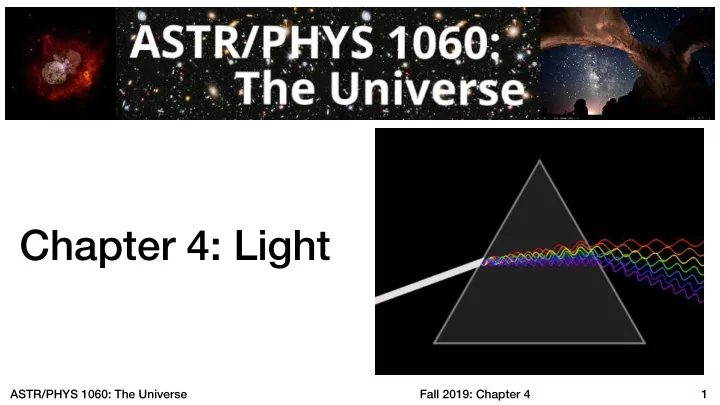
Chapter 4: Light
1
Chapter 4: Light ASTR/PHYS 1060: The Universe Fall 2019: Chapter 4 - - PowerPoint PPT Presentation
Chapter 4: Light ASTR/PHYS 1060: The Universe Fall 2019: Chapter 4 1 Tacoma Narrows Light is a wave Bridge, 1940 https://www.youtube.com/watch?v=XggxeuFDaDU ASTR/PHYS 1060: The Universe Fall 2019: Chapter 4 2 ASTR/PHYS 1060: The
Fall 2019: Chapter 4 ASTR/PHYS 1060: The Universe
1
ASTR/PHYS 1060: The Universe Fall 2019: Chapter 4
2
Tacoma Narrows Bridge, 1940
https://www.youtube.com/watch?v=XggxeuFDaDU
ASTR/PHYS 1060: The Universe Fall 2019: Chapter 4 3
ASTR/PHYS 1060: The Universe Fall 2019: Chapter 4
4
ASTR/PHYS 1060: The Universe Fall 2019: Chapter 4 5
ASTR/PHYS 1060: The Universe Fall 2019: Chapter 4
6
ASTR/PHYS 1060: The Universe Fall 2019: Chapter 4
7
ASTR/PHYS 1060: The Universe Fall 2019: Chapter 4
8
Fall 2019: Chapter 4 ASTR/PHYS 1060: The Universe
9
If you will miss class, email astr1060absence@gmail.com BEFORE the start of that class Midterm 1 Exam on Sept. 19th (1 week from Thursday)
ASTR/PHYS 1060: The Universe Fall 2019: Chapter 4
10
ASTR/PHYS 1060: The Universe Fall 2019: Chapter 4
11
ASTR/PHYS 1060: The Universe Fall 2019: Chapter 4
12
ASTR/PHYS 1060: The Universe Fall 2019: Chapter 4
13
Wavelength [nm] Intensity/Brightness
ASTR/PHYS 1060: The Universe Fall 2019: Chapter 4
14
Wavelength [nm] A B Intensity/Brightness
ASTR/PHYS 1060: The Universe Fall 2019: Chapter 4
15
Emission sticks up Absorption sticks down
ASTR/PHYS 1060: The Universe Fall 2019: Chapter 4 16
ASTR/PHYS 1060: The Universe Fall 2019: Chapter 4 17
ASTR/PHYS 1060: The Universe Fall 2019: Chapter 4
18
Works like a refractor amount of refraction depends on the wavelength of light — cannot focus red and blue light at the same time!
ASTR/PHYS 1060: The Universe Fall 2019: Chapter 4
19
ASTR/PHYS 1060: The Universe Fall 2019: Chapter 4
20
ASTR/PHYS 1060: The Universe Fall 2019: Chapter 4 21
xkcd.com
ASTR/PHYS 1060: The Universe Fall 2019: Chapter 4
22
ASTR/PHYS 1060: The Universe Fall 2019: Chapter 4
23
ASTR/PHYS 1060: The Universe Fall 2019: Chapter 4
24
ASTR/PHYS 1060: The Universe Fall 2019: Chapter 4
25
Charged Coupled Devices (CCDs)
ASTR/PHYS 1060: The Universe Fall 2019: Chapter 4 26
ASTR/PHYS 1060: The Universe Fall 2019: Chapter 4 27
“True” Color “False” Color
ASTR/PHYS 1060: The Universe Fall 2019: Chapter 4 28
False color images can be made using light at any wavelength, from radio to gamma ray “True” Color
Fall 2019: Chapter 4 ASTR/PHYS 1060: The Universe
large/small FOV? large/small mirrors (collecting area)? 1 big telescope vs. several smaller telescopes? a refracting or reflecting design? Discuss in small groups!
29
ASTR/PHYS 1060: The Universe Fall 2019: Chapter 4
30
low energy high energy
ASTR/PHYS 1060: The Universe Fall 2019: Chapter 4
31
Jupiter Captured charged particles from the Sun Centaurus A Galaxy Jets accelerated by a supermassive black hole
ASTR/PHYS 1060: The Universe Fall 2019: Chapter 4
32
Hydrogen gas through emission line at 21 cm Visible light (stars - images at the same scale) Spiral Galaxy
ASTR/PHYS 1060: The Universe Fall 2019: Chapter 4
33
Visible Light Infrared Light (1-2 μm)
ASTR/PHYS 1060: The Universe Fall 2019: Chapter 4
34
M81
ASTR/PHYS 1060: The Universe Fall 2019: Chapter 4
35
X-ray (Chandra) Infrared (Hubble)
ASTR/PHYS 1060: The Universe Fall 2019: Chapter 4 36
(Remains of a supernova, with a pulsar at the middle)
Crab Nebula supernova explosion left a pulsar at the center that energizes surrounding gas
ASTR/PHYS 1060: The Universe Fall 2019: Chapter 4
37
Red = Radio Yellow = Visible Blue = X-ray
ASTR/PHYS 1060: The Universe Fall 2019: Chapter 4
38
ASTR/PHYS 1060: The Universe Fall 2019: Chapter 4 39