Chapter 20 (Answers are all A's) 1. Find the displacement of a - - PDF document

chapter 20 answers are all a s 1 find the displacement of
SMART_READER_LITE
LIVE PREVIEW

Chapter 20 (Answers are all A's) 1. Find the displacement of a - - PDF document

Chapter 20 (Answers are all A's) 1. Find the displacement of a simple harmonic wave of amplitude 6.44 m at t = 0.71 s. Assume that the wave number is 2.34 m -1 , the angular frequency is 2.88 rad/s, and that the wave is propagating in the +x


slide-1
SLIDE 1

Chapter 20 (Answers are all A's)

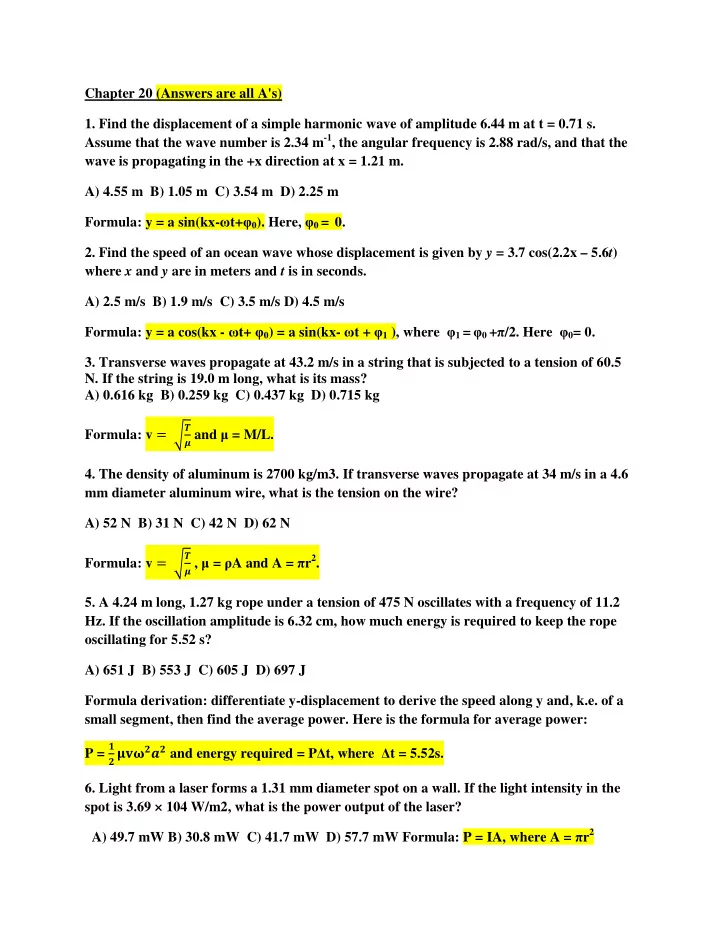
  • 1. Find the displacement of a simple harmonic wave of amplitude 6.44 m at t = 0.71 s.

Assume that the wave number is 2.34 m-1, the angular frequency is 2.88 rad/s, and that the wave is propagating in the +x direction at x = 1.21 m. A) 4.55 m B) 1.05 m C) 3.54 m D) 2.25 m Formula: y = a sin(kx-t+0). Here, 0 = 0.

  • 2. Find the speed of an ocean wave whose displacement is given by y = 3.7 cos(2.2x – 5.6t)

where x and y are in meters and t is in seconds. A) 2.5 m/s B) 1.9 m/s C) 3.5 m/s D) 4.5 m/s Formula: y = a cos(kx - t+ 0) = a sin(kx- t + 1 ), where 1 = 0 +/2. Here 0= 0.

  • 3. Transverse waves propagate at 43.2 m/s in a string that is subjected to a tension of 60.5
  • N. If the string is 19.0 m long, what is its mass?

A) 0.616 kg B) 0.259 kg C) 0.437 kg D) 0.715 kg Formula: v =

  • and = M/L.
  • 4. The density of aluminum is 2700 kg/m3. If transverse waves propagate at 34 m/s in a 4.6

mm diameter aluminum wire, what is the tension on the wire? A) 52 N B) 31 N C) 42 N D) 62 N Formula: v =

  • , = A and A = r2.
  • 5. A 4.24 m long, 1.27 kg rope under a tension of 475 N oscillates with a frequency of 11.2
  • Hz. If the oscillation amplitude is 6.32 cm, how much energy is required to keep the rope
  • scillating for 5.52 s?

A) 651 J B) 553 J C) 605 J D) 697 J Formula derivation: differentiate y-displacement to derive the speed along y and, k.e. of a small segment, then find the average power. Here is the formula for average power: P =

  • and energy required = Pt, where t = 5.52s.
  • 6. Light from a laser forms a 1.31 mm diameter spot on a wall. If the light intensity in the

spot is 3.69 × 10⁴ W/m2, what is the power output of the laser? A) 49.7 mW B) 30.8 mW C) 41.7 mW D) 57.7 mW Formula: P = IA, where A = r2

slide-2
SLIDE 2

Chapter 21

  • 1. A 0.335 m string is clamped at both ends. If the lowest standing wave frequency in the

string is 326 Hz, what is the wave speed? A) 218 m/s B) 270 m/s C) 331 m/s D) 412 m/s Formula: f1 = v/2L

  • 2. A standing wave is oscillating at 690 Hz on a string, as shown in the figure. What is the

wave speed? A) 280 m/s B) 410 m/s C) 210 m/s D) 140 m/s Formula: v = f

  • 3. A violin with string length 32 cm and string density 1.5 g/cm resonates with the first
  • vertone of an organ pipe with one end closed. The pipe length is 2 m. What is the tension

in the string? A) 1000 N B) 110 N C) 450 N D) 4100 N Formula: fviolin = fpipe (resonance phenomena), f2pipe = 3*f1pipe= 3vsound/4L, v =

  • 4. A simple harmonic wave described by the equation y(t) = 0.54 cos(3.1x – 2.3t) reflects

from both ends of a string that is clamped at each end, resulting in a standing wave that is the sum of y(t) and and its reflection. What is the amplitude of the standing wave at x = 0.22 m? The quantities x and y are in meters, and t is in seconds. A) 0.84 m B) 0.57 m C) 0.67 m D) 0.77 m Formula: A(x) = 2acos(kx)

  • 5. Two stereo speakers mounted 4.52 m apart on a wall emit identical sound waves. You

are standing at the opposite wall of the room at a point directly between the two speakers. You walk 2.11 m parallel to the wall, to a location where you first notice that the sound intensity is much less. If the wall along which you are walking is 10.7 m from the wall with the speakers, what is the wavelength of the sound waves? A) 1.71 m B) 2.05 m C) 2.57 m D) 2.91 m Please look at the example we did in class. Chapter 22

  • 1. A double slit illuminated with light of wavelength 588 nm forms a diffraction pattern on

a screen 11 cm away. The slit separation is d = 2464 nm. What is the distance x between

  • rders m = 6 and m = 4? A) 5.25 × 10⁷ nm B) 92.19 × 10⁷ nm C) 10.5 × 10⁷ nm D) 2.63 ×

107 nm Formula: dsinm = m and tanm = ym/L, x = ym2- ym1

slide-3
SLIDE 3
  • 2. Two sources of light illuminate a double slit simultaneously. One has wavelength 570 nm and the

second has an unknown wavelength. The m = 5 bright fringe of the unknown wavelength overlaps the m = 4 bright fringe of the light of 570 nm wavelength. What is the unknown wavelength? A)

456 nm B) 326 nm C) 380 nm D) 713 nm Formula: dsinm = m, and m11 = m22

  • 3. A grating with 316 lines/mm is illuminated with light of wavelength 531 nm. What is the

angular separation between the two lines formed in order m = 2? A) 39.2° B) 19.6° C) 42.2° Formula: dsinm = m and tanm = ym/L

  • 4. A single slit with width 820 nm is illuminated with light of wavelength 555 nm. How

many minima occur in the angular range from = 0° to = 26

±

? A) 1.3 minima B) 0.65 minima C) 1.16 minima D) 0.59 minima Formula: asinp = p

  • 5. Light from a He-Ne laser of wavelength 633 nm passes through a circular aperture. It is observed
  • n a screen 4.0 m behind the aperture. The width of the central maximum is 5.4 cm. What is the

diameter of the hole? A) 110 m B) 2.0 m C) 6600 m D) 960 m

Formula: asinp = 1.22

  • 6. It is observed that moving a mirror of a Michelson interferometer a distance of 100 m

causes 990 bright-dark-bright fringe shifts. What is the wavelength of the light? A) 202 nm B) 101 nm C) 404 nm D) 303 nm Formula: L = m /2