Chapter 18: Life in the Universe All EC & Dark Energy assignment - - PowerPoint PPT Presentation

chapter 18 life in the universe
SMART_READER_LITE
LIVE PREVIEW

Chapter 18: Life in the Universe All EC & Dark Energy assignment - - PowerPoint PPT Presentation

Chapter 18: Life in the Universe All EC & Dark Energy assignment due December 5th Check your grades in Canvas! Complete feedback survey to get grade early! Mirna: no office hours today, but will be around longer tomorrow (3pm to 5 or 6pm)


slide-1
SLIDE 1

ASTR/PHYS 1060: The Universe Fall 2019: Chapter 18

Chapter 18: Life in the Universe

1
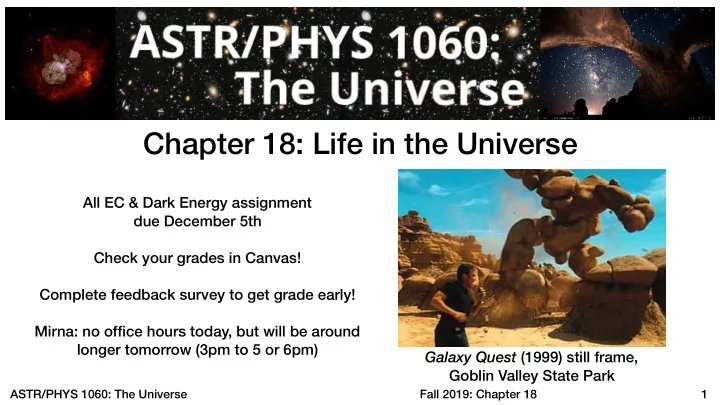
All EC & Dark Energy assignment due December 5th Check your grades in Canvas! Complete feedback survey to get grade early! Mirna: no office hours today, but will be around longer tomorrow (3pm to 5 or 6pm) Galaxy Quest (1999) still frame, Goblin Valley State Park

slide-2
SLIDE 2

Fall 2019: Chapter 18 ASTR/PHYS 1060: The Universe

The Deep Future (maybe?)

2

Primordial Era Stelliferous Era Degenerate Era Black Hole Era Dark Era 105 yr 1014 yr 1039 yr 10100 yr infinity?

slide-3
SLIDE 3

Fall 2019: Chapter 18 ASTR/PHYS 1060: The Universe

Why this universe? An anthropic perspective

3

slide-4
SLIDE 4

Fall 2019: Chapter 18 ASTR/PHYS 1060: The Universe

Life in the Stelliferous Era

4

What is life? What are the conditions necessary for life? How does life become more complex? Only have 1 example to work from (so far) — life on Earth

slide-5
SLIDE 5

Fall 2019: Chapter 18 ASTR/PHYS 1060: The Universe

Origin of life unclear, but arises quickly

5

Miller-Urey Experiment: amino acids created from simple molecules (methane, ammonia, water) and simulated lightning strikes Panspermia: life delivered by comets,

  • r ancient aliens?
slide-6
SLIDE 6

Fall 2019: Chapter 18 ASTR/PHYS 1060: The Universe

Self-replicating molecules spread, compete

6

slide-7
SLIDE 7

Fall 2019: Chapter 18 ASTR/PHYS 1060: The Universe

Alternative view: life is a catalyst to convert CO2 to hydrocarbons

7

http://www.preposterousuniverse.com/blog/2010/03/10/free-energy-and-the-meaning-of-life/

slide-8
SLIDE 8

Fall 2019: Chapter 18 ASTR/PHYS 1060: The Universe

Early life pollutes the Earth with oxygen

8

Cyanobacteria thought to have started release

  • f oxygen in the

atmosphere Xiong & Bauer 2002

slide-9
SLIDE 9

ASTR/PHYS 1060: The Universe Fall 2019: Chapter 18 9

Olbers 2012

slide-10
SLIDE 10

Fall 2019: Chapter 18 ASTR/PHYS 1060: The Universe

Complex life is likely to be carbon-based

10

Water Solvent! Life needs:

  • organic molecules
  • water
  • energy
slide-11
SLIDE 11

Fall 2019: Chapter 18 ASTR/PHYS 1060: The Universe

Actively searching for life elsewhere in the solar system

11

Martian meteorite Oceans under ice of Jupiter’s moons Europa and Enceladus

slide-12
SLIDE 12

Fall 2019: Chapter 18 ASTR/PHYS 1060: The Universe

Beginning the search outside the solar system

12

Where should we look? What determines the size of the habitable zone?

slide-13
SLIDE 13

ASTR/PHYS 1060: The Universe Fall 2019: Chapter 18 13

slide-14
SLIDE 14

Fall 2018: Chapter 5 ASTR/PHYS 1060: The Universe

Biosignatures of Life in an Exoplanet Atmosphere

14

slide-15
SLIDE 15

Fall 2019: Chapter 18 ASTR/PHYS 1060: The Universe

What if we find a nearby planet with life?

15

  • Current world energy consumption:

4.7x10²⁰ joules/year

  • Energy = 1/2 * mass * velocity2
  • Energy to get a spaceship with 50

people moving at 10% the speed of light: 4.5x10²⁰ joules.

  • To transport a functioning civilization,

however, requires many more people (all the specializations needed to keep the ship going and the people alive — think of an aircraft carrier crew, but bigger and with families)

The Nauvoo: a generation ship

slide-16
SLIDE 16

ASTR/PHYS 1060: The Universe Fall 2019: Chapter 18

Why is it important to discover life beyond Earth?

16

slide-17
SLIDE 17

ASTR/PHYS 1060: The Universe Fall 2019: Chapter 2 17

I believe that intelligent extraterrestrials exist I believe Earth has been visited by aliens

slide-18
SLIDE 18

ASTR/PHYS 1060: The Universe Fall 2019: Chapter 18 18

Credit: U. Rochester

The Drake Equation

slide-19
SLIDE 19

ASTR/PHYS 1060: The Universe Fall 2019: Chapter 18 19

R* —> rate of formation of long-lived stars (F, G, K, M types) in the galaxy: ~ 7 per year fp —> fraction of those stars with planets: less than, but close to, 1 ne —> number of planets, per solar system, with an environment suitable for life (habitable zone, right mass, right composition): a few? 1-10?

slide-20
SLIDE 20

ASTR/PHYS 1060: The Universe Fall 2019: Chapter 18 20

fe —> fraction of suitable planets on which life actually appears fi —> fraction of life-bearing planets on which intelligent life emerges

slide-21
SLIDE 21

Fall 2019: Chapter 18 ASTR/PHYS 1060: The Universe

What do you think is the fraction of planets is that host any kind of life?

21

A) 1: all planets that can host life form life B) 0.1: it happens about 10% of the time C) 0.01: it happens about 1% of the time D) 0.001: it happens 1/1000 times

slide-22
SLIDE 22

Fall 2019: Chapter 18 ASTR/PHYS 1060: The Universe

What do you think is the fraction of life-bearing planets on which intelligent life emerges?

22

A) 1: all planets form intelligent life B) 0.01: it happens about 1% of the time C) 0.0001: it happens 1/10,000 times.

slide-23
SLIDE 23

ASTR/PHYS 1060: The Universe Fall 2019: Chapter 18 23

fc —> fraction of civilizations that develop a technology that releases detectable signs of their existence into space L —> length of time such civilizations release those signals (their lifetime)

slide-24
SLIDE 24

Fall 2019: Chapter 18 ASTR/PHYS 1060: The Universe

What do you think is the fraction of civilizations that develop a technology that releases detectable signs of their existence into space?

24

A) 1: all civilizations develop this technology B) 0.01: it happens about 1% of the time C) 0.0001: it happens 1/10,000 times.

slide-25
SLIDE 25

Fall 2019: Chapter 18 ASTR/PHYS 1060: The Universe

How long do these civilizations live?

25

A) 100 years —> 10-8 B) 1,000 years —> 10-7 C) 100,000 years —> 10-5 D) 10,000,000 years —> 10-3

fraction of technological civilizations around: lifetime of civilization/1010 years

slide-26
SLIDE 26

ASTR/PHYS 1060: The Universe Fall 2019: Chapter 18

Chapter 18: Life in the Universe

26

All EC & Dark Energy assignment due NOW! Check your grades in Canvas! Complete feedback survey to get grade early! Mirna review session: tomorrow from 3-6pm in AEB 320 Galaxy Quest (1999) still frame, Goblin Valley State Park

slide-27
SLIDE 27

ASTR/PHYS 1060: The Universe Fall 2019: Chapter 18

So, where are they? The Fermi Paradox

27

slide-28
SLIDE 28

ASTR/PHYS 1060: The Universe Fall 2019: Chapter 18 28

https://www.youtube.com/watch?v=sNhhvQGsMEc

slide-29
SLIDE 29

ASTR/PHYS 1060: The Universe Fall 2019: Chapter 18

What are some solutions to the Fermi Paradox?

29

slide-30
SLIDE 30

ASTR/PHYS 1060: The Universe Fall 2019: Chapter 18 30

https://www.youtube.com/watch?v=1fQkVqno-uI

slide-31
SLIDE 31

Fall 2019: Chapter 18 ASTR/PHYS 1060: The Universe

‘Oumuamua: alien comet or space probe?!?

31

Artist’s impression of the object: ESO/M. Kornmesser On an unbound orbit, about the speed stars move relative to each other Size uncertain, but likely more cigar shaped spheroidal Found to be accelerating away from the Sun as it left the solar system Could it be an alien probe checking us

  • ut? Using a solar sail as propulsion?

Or is it just a rock from another star system (possibly carrying microscopic life)?

slide-32
SLIDE 32

Fall 2019: Chapter 18 ASTR/PHYS 1060: The Universe

Dyson Spheres

32 Artist’s conception of a Dyson Sphere (CapnHack) https://earthsky.org/space/what-is-a-dyson-sphere

More correctly called a Stapleton Sphere, after Olaf Stapleton whose 1937 novel Star Maker inspired Freeman Dyson to propose the search for such objects Kardeshev Type II civilization: harnesses all the power

  • f its star

Can search for galaxies with “too much” IR light: sphere would emit waste heat — no evidence of substantial structures yet found Tabby’s star (discovered with Kepler) — alien megastructures or dust? (spoiler, dust) Kardeshev Type III+ civilization could capture stars with these spheres, out to a distance of 10s of millions of light years away, in an attempt to forestall lack of resources due to dark energy

slide-33
SLIDE 33

ASTR/PHYS 1060: The Universe Fall 2019: Chapter 18

SETI: Search for Extraterrestrial Intelligence

33

Contact (1997) movie still frame

slide-34
SLIDE 34

Fall 2018: Chapter 1 ASTR/PHYS 1060: The Universe 34