Chapter 13 13.1 Detecting Extrasolar Planets Other Planetary - - PDF document

chapter 13
SMART_READER_LITE
LIVE PREVIEW

Chapter 13 13.1 Detecting Extrasolar Planets Other Planetary - - PDF document

Chapter 13 13.1 Detecting Extrasolar Planets Other Planetary Systems The New Science of Distant Worlds Our goals for learning Why is it so difficult to detect planets around other stars? How do we detect planets around other


slide-1
SLIDE 1

1

Chapter 13 Other Planetary Systems

The New Science of Distant Worlds

13.1 Detecting Extrasolar Planets

  • Our goals for learning
  • Why is it so difficult to detect planets

around other stars?

  • How do we detect planets around other

stars?

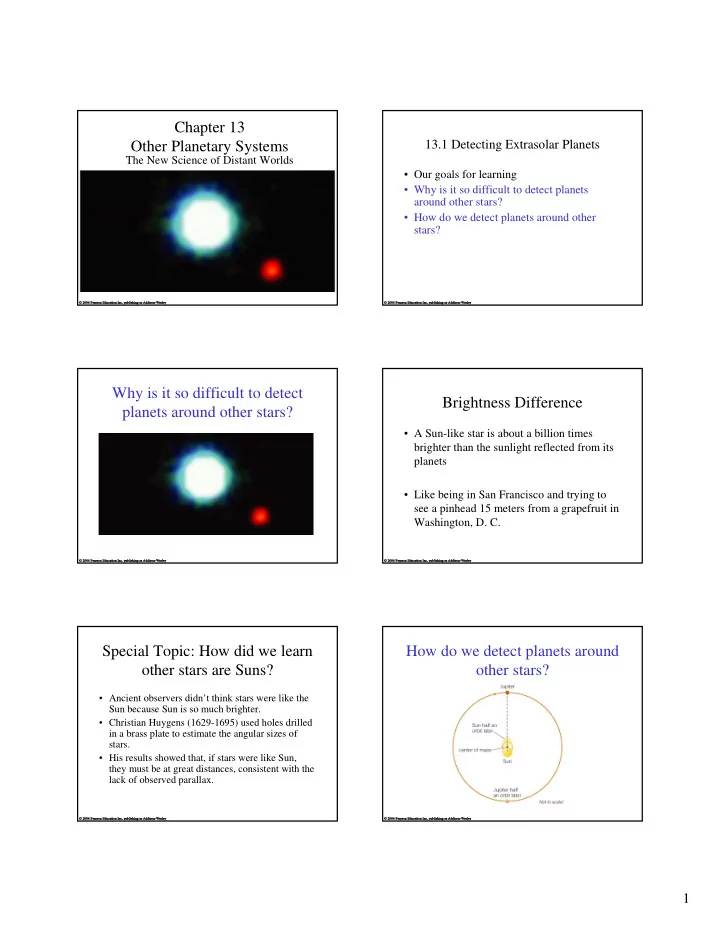
Why is it so difficult to detect planets around other stars? Brightness Difference

  • A Sun-like star is about a billion times

brighter than the sunlight reflected from its planets

  • Like being in San Francisco and trying to

see a pinhead 15 meters from a grapefruit in Washington, D. C.

Special Topic: How did we learn

  • ther stars are Suns?
  • Ancient observers didn’t think stars were like the

Sun because Sun is so much brighter.

  • Christian Huygens (1629-1695) used holes drilled

in a brass plate to estimate the angular sizes of stars.

  • His results showed that, if stars were like Sun,

they must be at great distances, consistent with the lack of observed parallax.

How do we detect planets around

  • ther stars?
slide-2
SLIDE 2

2

Planet Detection

  • Direct: Pictures or spectra of the planets

themselves

  • Indirect: Measurements of stellar

properties revealing the effects of orbiting planets

Gravitational Tugs

  • Sun and Jupiter orbit

around their common center of mass

  • Sun therefore

wobbles around that center of mass with same period as Jupiter

Gravitational Tugs

  • Sun’s motion around

solar system’s center

  • f mass depends on

tugs from all the planets

  • Astronomers around
  • ther stars that

measured this motion could determine masses and orbits of all the planets

Astrometric Technique

  • We can detect planets

by measuring the change in a star’s position on sky

  • However, these tiny

motions are very difficult to measure (~0.001 arcsecond)

Doppler Technique

  • Measuring a star’s

Doppler shift can tell us its motion toward and away from us

  • Current techniques

can measure motions as small as 1 m/s (walking speed!)

First Extrasolar Planet

  • Doppler shifts of star

51 Pegasi indirectly reveal a planet with 4-day orbital period

  • Short period means

small orbital distance

  • First extrasolar planet

to be discovered (1995)

slide-3
SLIDE 3

3

First Extrasolar Planet

  • Planet around 51 Pegasi has a mass similar to

Jupiter’s, despite its small orbital distance

Other Extrasolar Planets

  • Doppler data curve tells us about a planet’s mass and

the shape of its orbit

Large planet mass Highly eccentric

  • rbit

Planet Mass and Orbit Tilt

  • We cannot measure an exact mass for a planet without

knowing the tilt of its orbit, because Doppler shift tells us only the velocity toward or away from us

  • Doppler data gives us lower limits on masses

Transits and Eclipses

  • A transit is when a planet crosses in front of a star
  • The resulting eclipse reduces the star’s apparent

brightness and tells us planet’s radius

  • No orbital tilt: accurate measurement of planet mass

Spectrum during Transit

  • Change in spectrum during transit tells us about

composition of planet’s atmosphere

Direct Detection

  • Special techniques can eliminate light from brighter
  • bjects
  • These techniques are enabling direct planet detection
slide-4
SLIDE 4

4

Other Planet-Hunting Strategies

  • Gravitational Lensing: Mass bends light in

a special way when a star with planets passes in front of another star.

  • Features in Dust Disks: Gaps, waves, or

ripples in disks of dusty gas around stars can indicate presence of planets.

What have we learned?

  • Why is it so difficult to detect planets

around other stars?

– Direct starlight is billions of times brighter than starlight reflected from planets

  • How do we detect planets around other

stars?

– A star’s periodic motion (detected through Doppler shifts) tells us about its planets – Transiting planets periodically reduce a star’s brightness – Direct detection is possible if we can block the star’s bright light

13.2 The Nature of Extrasolar Planets

  • Our goals for learning
  • What have we learned about extrasolar

planets?

  • How do extrasolar planets compare with

those in our solar system?

What have we learned about extrasolar planets? Measurable Properties

  • Orbital Period, Distance, and Shape
  • Planet Mass, Size, and Density
  • Composition

Orbits of Extrasolar Planets

  • Most of the detected

planets have orbits smaller than Jupiter’s

  • Planets at greater

distances are harder to detect with Doppler technique

slide-5
SLIDE 5

5

Orbits of Extrasolar Planets

  • Orbits of some

extrasolar planets are much more elongated (greater eccentricity) than those in our solar system

Multiple-Planet Systems

  • Some stars

have more than one detected planet

Multiple-Planet Systems

  • Special techniques can eliminate light from brighter
  • bjects
  • These techniques are enabling direct planet detection

Orbits of Extrasolar Planets

  • Most of the detected

planets have greater mass than Jupiter

  • Planets with smaller

masses are harder to detect with Doppler technique

How do extrasolar planets compare with those in our solar system? Surprising Characteristics

  • Some extrasolar planets have highly

elliptical orbits

  • Some massive planets orbit very close to

their stars: “Hot Jupiters”

slide-6
SLIDE 6

6

Hot Jupiters What have we learned?

  • What have we learned about extrasolar

planets?

– Detected planets are all much more massive than Earth – They tend to have orbital distances smaller than Jupiter’s – Some have highly elliptical orbits

  • How do extrasolar planets compare with

those in our solar system?

– Some “Hot Jupiters” have been found

13.3 The Formation of Other Solar Systems

  • Our goals for learning
  • Can we explain the surprising orbits of

many extrasolar planets?

  • Do we need to modify our theory of solar

system formation?

Can we explain the surprising

  • rbits of many extrasolar planets?

Revisiting the Nebular Theory

  • Nebular theory predicts that massive

Jupiter-like planets should not form inside the frost line (at << 5 AU)

  • Discovery of “hot Jupiters” has forced

reexamination of nebular theory

  • “Planetary migration” or gravitational

encounters may explain “hot Jupiters”

Planetary Migration

  • A young planet’s

motion can create waves in a planet- forming disk

  • Models show that

matter in these waves can tug on a planet, causing its orbit to migrate inward

slide-7
SLIDE 7

7

Gravitational Encounters

  • Close gravitational encounters between two

massive planets can eject one planet while flinging the other into a highly elliptical

  • rbit
  • Multiple close encounters with smaller

planetesimals can also cause inward migration

Orbital Resonances

  • Resonances between

planets can also cause their orbits to become more elliptical

Do we need to modify our theory

  • f solar system formation?

Modifying the Nebular Theory

  • Observations of extrasolar planets have

shown that nebular theory was incomplete

  • Effects like planet migration and

gravitational encounters might be more important than previously thought

Planets: Common or Rare?

  • One in ten stars examined so far have

turned out to have planets

  • The others may still have smaller (Earth-

sized) planets that current techniques cannot detect

What have we learned?

  • Can we explain the surprising orbits of

many extrasolar planets?

– Original nebular theory cannot account for “hot Jupiters” – Planetary migration or gravitational encounters may explain how Jupiter-like planets moved inward

  • Do we need to modify our theory of solar

system formation?

– Migration and encounters may play a larger role than previously thought

slide-8
SLIDE 8

8

13.4 Finding New Worlds

  • Our goals for learning
  • How will we search for Earth-like planets?

How will we search for Earth-like planets? Transit Missions

  • NASA’s Kepler

mission is scheduled to begin looking for transiting planets in 2008

  • It is designed to

measure the 0.008% decline in brightness when an Earth-mass planet eclipses a Sun- like star

Astrometric Missions

  • GAIA: A European mission planned for 2010 that

will use interferometry to measure precise motions

  • f a billion stars
  • SIM: A NASA mission planned for 2011 that will

use interferometry to measure star motions even more precisely (to 10-6 arcseconds)

Direct Detection

  • Determining whether

Earth-mass planets are really Earth-like requires direct detection

  • Missions capable of

blocking enough starlight to measure the spectrum of an Earth-like planet are being planned

Mission concept for NASA’s Terrestrial Planet Finder (TPF)

What have we learned?

  • How will we search for Earth-like planets?

– Transit missions will be capable of finding Earth-like planets that cross in front of their stars (Kepler to launch in 2008) – Astrometric missions will be capable of measuring the “wobble” of a star caused by an

  • rbiting Earth-like planet

– Missions for direct detection of an Earth-like planet will need to use special techniques (like interferometry) for blocking starlight