Chapter 1: roadmap 1.1 What is the Internet? 1.2 Network edge end - - PowerPoint PPT Presentation

chapter 1 roadmap
SMART_READER_LITE
LIVE PREVIEW

Chapter 1: roadmap 1.1 What is the Internet? 1.2 Network edge end - - PowerPoint PPT Presentation

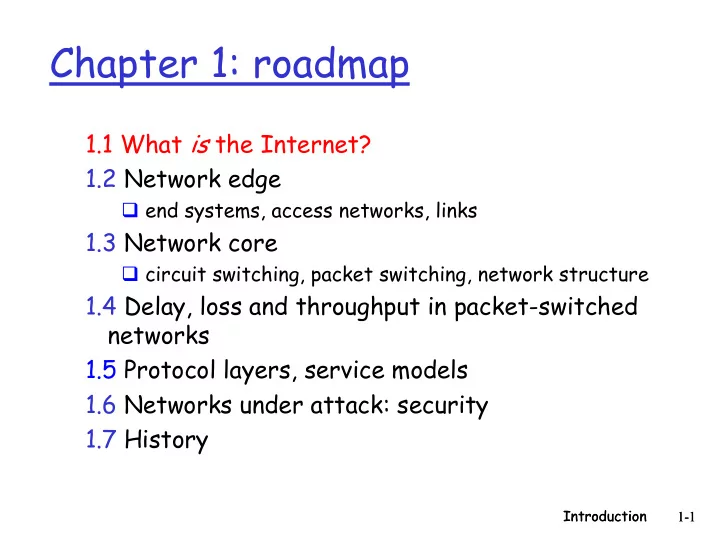
Chapter 1: roadmap 1.1 What is the Internet? 1.2 Network edge end systems, access networks, links 1.3 Network core circuit switching, packet switching, network structure 1.4 Delay, loss and throughput in packet-switched networks 1.5

slide-1
SLIDE 1

Introduction 1-1 Introduction 1-1

Chapter 1: roadmap

1.1 What is the Internet? 1.2 Network edge

end systems, access networks, links

1.3 Network core

circuit switching, packet switching, network structure

1.4 Delay, loss and throughput in packet-switched networks 1.5 Protocol layers, service models 1.6 Networks under attack: security 1.7 History

slide-2
SLIDE 2

Introduction 1-2

Kinds of networks

Local Area Network – LAN

Individual nodes know about each

  • thers' existence

Typically managed by a single

administrative entity

Each node's configuration is known

  • Nodes often have a common, shared

configuration – all MS

  • Windows, for example
slide-3
SLIDE 3

Introduction 1-3

Other networks

PSTN – Public S

witched Telephone Network

Landlines, mobile/ cellphone

networks

Usually interconnected Owned/ operated by "telcos"

Cable TV networks

High capacity Privately-owned infrastructure

Ham Radio

Informal, transient

slide-4
SLIDE 4

Introduction 1-4

Individual computer networks

ARPAnet Csnet, BITnet, NS

Fnet, Minitel

S

pecific uses and members

Compuserve, AOL

Network services Depended on PS

TN landlines and modems for physical connections

These are Wide Area Networks - WANs

slide-5
SLIDE 5

Introduction 1-5

BITnet, 1990

slide-6
SLIDE 6

Introduction 1-6

NS Fnet, 1991

slide-7
SLIDE 7

Introduction 1-7

Compuserve, 1983

slide-8
SLIDE 8

Introduction 1-8

Connecting the networks - 1982

slide-9
SLIDE 9

Introduction 1-9

Connecting the networks

ARPAnet, NS

Fnet, BITnet all connected sites that maintained local area networks.

They evolved into the Internet .

Common set of rules for transmitting information packets

between sites

Packet contents can be anything that both sender and

recipient understand

The Internet is a "network of networks". Edge networks that use Internet rules internally are

known as "intranets"

slide-10
SLIDE 10

Introduction 1-10 Introduction 1-10

What’s the Internet: “nuts and bolts” view

millions of connected

computing devices: hosts = end systems

running network

apps

Home network Institutional network Mobile network Global ISP Regional ISP

router PC server wireless laptop cellular handheld wired links access points

communication links

fiber, copper,

radio, satellite

transmission

rate = bandwidth

routers: forward

packets (chunks of data)‏

slide-11
SLIDE 11

Introduction 1-11 Introduction 1-11

What’s the Internet: a service view

communication

infrastructure enables distributed applications:

Web, VoIP, email, games,

e-commerce, file sharing

communication services

provided to apps:

reliable data delivery

from source to destination

“best effort” (unreliable)

data delivery

slide-12
SLIDE 12

Introduction 1-12 Introduction 1-12

What’s a protocol?

human protocols:

“what’s the time?” “I have a question” introductions

… specific msgs sent … specific actions taken when msgs received,

  • r other events

network protocols:

machines rather than

humans

all communication

activity in Internet governed by protocols protocols define format,

  • rder of msgs sent and

received among network entities, and actions taken on msg transmission, receipt

slide-13
SLIDE 13

Introduction 1-13 Introduction 1-13

What’s a protocol?

a human protocol and a computer network protocol: Q: Other human protocols? Hi Hi

Got the time?

2:00

TCP connection request TCP connection response

Get http://www.awl.com/kurose-ross

<file> time