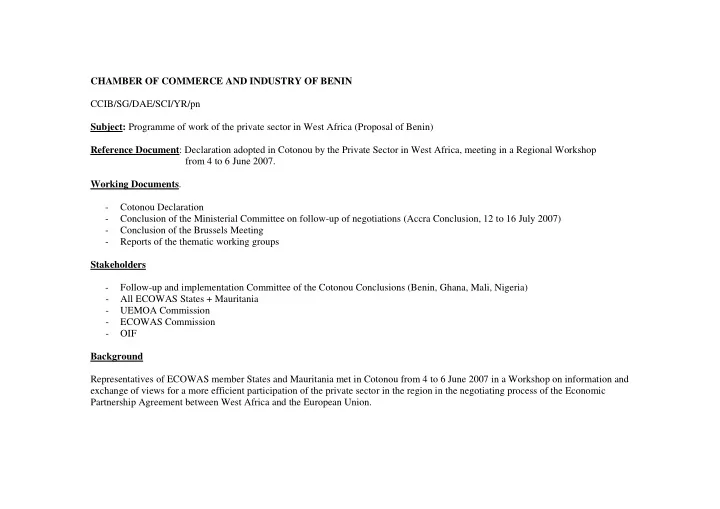
SLIDE 1 CHAMBER OF COMMERCE AND INDUSTRY OF BENIN CCIB/SG/DAE/SCI/YR/pn Subject: Programme of work of the private sector in West Africa (Proposal of Benin) Reference Document: Declaration adopted in Cotonou by the Private Sector in West Africa, meeting in a Regional Workshop from 4 to 6 June 2007. Working Documents.
- Cotonou Declaration
- Conclusion of the Ministerial Committee on follow-up of negotiations (Accra Conclusion, 12 to 16 July 2007)
- Conclusion of the Brussels Meeting
- Reports of the thematic working groups
Stakeholders
- Follow-up and implementation Committee of the Cotonou Conclusions (Benin, Ghana, Mali, Nigeria)
- All ECOWAS States + Mauritania
- UEMOA Commission
- ECOWAS Commission
- OIF
Background Representatives of ECOWAS member States and Mauritania met in Cotonou from 4 to 6 June 2007 in a Workshop on information and exchange of views for a more efficient participation of the private sector in the region in the negotiating process of the Economic Partnership Agreement between West Africa and the European Union.
SLIDE 2 2 At the end of this important Workshop during which participants examined the major economic and trade implications of the on-going negotiations between the ACP States and the European Union, as well as the international trade climate, several important recommendations were made. In order to ensure the implementation and follow-up of these recommendations, a working group comprising Benin, Ghana, Mali and Nigeria was set up. The group was to organize, in collaboration with the ECOWAS and UEMOA Commissions, a brainstorming session on the private sector in West Africa on the following thematic points, among others:
- regional integration and trade liberalization;
- improvement of competitiveness of the economy;
- funding;
- etc.
Also examined were the context of EPA negotiation between West Africa and the European Union and the current level of the involvement of the private sector in the negotiating process, and recommends that the private sector should be permanently and effectively involved in order to ensure that these concerns are taken into account and useful measures put in place for the implementation of the Agreement. In order to give concrete expression to the recommendations of the Cotonou Workshop, the Chamber of Commerce and Industry of Benin proposes the following draft Working programme: Problem: Regional integration and trade liberalization Ref: Cotonou decl item 5 to 11 Objectives Activities Programming of activities/period of implementation Participants Cost Free movement of goods within ECOWAS/Strengthening of regional
- integration. Ensure that customs and
administrative formalities at an entry point in the Union allow for free movement in Diagnosis of the implementation of the ECOWAS Common External Tariff and its impact on the existence
- f enterprises.
- 1st. Stage: appointment
- f a consultant for the
diagnosis
SLIDE 3 3 all the other member States without any [tariff and non tariff] problems and [without other unessential and administrative formalities] and controls at the borders and inside the States. Current stage of harmonization of customs and administrative formalities and other forms of checks at the borders and within the States. Consideration of the compensation scheme applicable among the States and proposal for improvement Proposals to enhance the functioning
Workshop of the private sector/public sector for approval 3rd Stage: Submission of conclusions to ECOWAS Free movement of goods within ECOWAS/make operational the establishment of the second monetary zone and the process leading to the single currency (in order to eliminate overheads and difficulties inherent in the diversity of currencies in the ECOWAS Zone (F CFA, Naira, Cedi, Silly, Dallassi, Cape Verd) Diagnosis of progress in the establishment of the second monetary zone and identification of constraints. Brainstorming on how to facilitate financial transactions in the ECOWAS Zone cheaply and within the shortest possible time. Brainstorming on how to promote intra-regional trade in West Africa through facilitation of financial transactions. Brainstorming on establishment of legal guarantees to safeguard BCEAO credits for Banks for enterprises (to specify within the framework of credits for enterprises).
Committee informs the private sectors of all member States to list difficulties encountered in financial transactions in the zone. 2nd Stage: Regional Workshop of Banking institutions:
Banks
Associations of Banks
- f Member States
- Representatives of the
private sector (Import- Export, Industrialists,
SLIDE 4 4 Make recommendations to speed up the process and to propose an indicative time frame, taking into account the context of EPA. Submit conclusions to ECOWAS. Traders)
representatives Free movement of persons within ECOWAS Examine the various existing reports (observatories, project corridor, Community institutions, independent bodies, States) Identify the real existing obstacles Propose measures to eliminate
1st Stage: Bring together authorities responsible for transport in the region (police, customs, gendarmerie, Water and Forest resources, transport unions). 2nd Stage: Put together recommendations, approved by the private sector and forward conclusions and recommendations to ECOWAS. 3d Stage: Follow p on implementation. Regional integration and rate of liberalization/Capacity building of stakeholders of the private sector. List studies conducted on the needs of capacity building of the private sector at the regional and national levels (with emphasis on needs of capital interest). Summarize capacity building needs of the private sector
consultant to prepare the programme 2nd Stage: Place the report of the consultant at the disposal of the private sector.
SLIDE 5
5 Summarize recommendations and update them Prepare a capacity building programme of the private sector within ECOWAS, to be submitted to regional and national authorities (FCC/WA). Identify technical and financial partners for implementation. 3rd Stage: Organize a regional workshop to approve the conclusions and recommendations. 4th Stage: Submit to governments of the States and regional institutions (ECOWAS- UEMOA)for implementation and follow-up’ Regional integration and rhythm of liberalization/Trade facilitation Ref: Cotonou declaration, point 7 Bring together the private sector in West Africa to examine the Common External Tariff System in relation to need to strengthen trade with the European Union and the need to protect existing industries and promote their commercial activities. Gather proposals to improve the system (ECOWAS CET)like the UEMOA CET) Organize a regional workshop for the CET Committee/ECOWAS-UEMOA, customs department and the private sector (Industry, Trade, Agriculture, Cottage industry) Regional integration and rhythm of List constraints and handicaps
SLIDE 6 6 liberalization/trade facilitation Ref: Cotonou declaration, points 8, 9 identified in the target sectors (energy, telecommunications, transport) and the business climate. List current recommended solutions Identify inadequacies Prepare a report to be studied by the follow-up Committee on Conclusions
Study the report/make recommendations/follow up on implementation 1st Stage 2nd Stage 3rd Stage Regional integration and rhythm of liberalization/trade facilitation Ref: Cotonou declaration, point 12 To be guided by TDR of the study on fiscal development in Benin to propose activities.
SLIDE 7 7 Statement of problem: Improvement of competitiveness in West Africa Put in place a Community investment and competition framework to improve competitiveness in the region Ref: Cotonou declaration, point 13 Attention: comply with on-going work in ECOWAS within the framework of EPA negotiations on the area of investment and competition Effective implementation of the updating programme latest by the first semester of 2008 Ref: Cotonou declaration, points 6, 9, 14 Ensure that the expert appointed to prepare the updating programme within ECOWAS has prepared a project which integrates the general and specific needs of the private sector of States Take a national inventory of enterprises may be updated or restructured. In anticipation of a sub-regional workshop to examine the report of the Expert responsible for the preparation
- f the updating programme of
ECOWAS, and under the responsibility of the Directorates of Industry of member States, the Follow-up Committee recommend that the private sector of each State [through the CCR/UEMOA ou the FCC/ECOWAS]should list
SLIDE 8 8 enterprises by sector and by branch of activity likely to be updated. Ensure that all ECOWAS States have produced the list and approved the various lists to ensure their assessment. Propose a consolidated list of enterprises at the level of ECOWAS Receive and study the report to be proposed by the expert and make improvements at a regional workshop. Measures to be taken: List obstacles to sale of products of enterprises on the (national, regional and international) markets with regard to standards, manufacturing processes,
Find support programmes to eliminate the constraints Get interested also in the situation of distressed industrial enterprises that need rehabilitation [for several reasons, including particularly aspects relating to quality standards, costs, technology, etc.]by sector and by 2nd Stage 3rd Stage
SLIDE 9
9 branch. Brainstorming on rehabilitation and make a diagnosis of needs and constraints Assess measures to be implemented and their impacts, identify resources at the national, regional and international levels to ensure implementation Identify partners for rehabilitation (technical partners, financial partners). Eliminate constraints associated with standards. Ensure availability of accredited laboratories in the sub-region. Availability of human resources at the regional and national structures capable of training and supporting directly producers to cope with constraining standards in the EU market and other parts of the world. Ref: Cotonou declaration, points 14, 15 Assess on-going work in the sub- region in the area of laboratory accreditation and quality control certification as well as metrology structures. Identify needs and constraints of producers to conform to standards in force on international markets. Encourage, if need be, on-going work to be completed as early as possible and make proposals accordingly, particularly in line with the rhythm of the negotiating time-table [to be determined] 1st Stage 2nd Stage
SLIDE 10
10 Propose training and refresher sessions for the staff of enterprise and civil servants to ensure smooth running of structures put in place. Disseminate the information at the level of CCR/UEMOA and FCC/ECOWAS
SLIDE 11 11 Statement of Proble: Funding Ref: Cotonou declaration, point 19 Facilitate access to funding for the private sector in West Africa Prepare an updating programme for the Bankson risk management to finance the activities of enterprises/acquisition of production equipment Facilitate access guarantees to make sources of funding accessible Involvement of the private sector in the List real difficulties encountered in research or mobilization of funds and formulate approaches to solutions to be discussed with the banking sector. Summarize suggestions made by States and circulate them to interested parties Organize a regional Workshop for the private sector in West Africa on the problem of access to funding and the search for solutions. Organize a regional symposium for the private sector and banking and financial institutions to examine the following aspects:
- updating
- development of potential
- funding of priority sectors
- etc.
Recommend solutions to eliminate constraints relating to problems raised i.e. access to funding. Establish a Management Committee 1st Stage: at the national level 2nd Stage
SLIDE 12 12 management of the EPA Special Regional Fund yet to be established Ref: Cotonou declaration, point 20 Institute banking reforms through the introduction of new financial instruments in the existing monetary zones to promote the private sector, including deregulation
- f foreign exchange accounts for
enterprises Speed up the establishment of the 2nd monetary zone in West Africa for the Fund, involving interested parties Involvement of the (regional and national) private sector in the management of the Fund (CCR/UEMOA, FCC/ECOWAS) Make proposals and
implementation Bring together players in the banking sector to examine the problem Propose mechanisms Approve EU’s approach to ensure funding Asses progress made in the establishment of the 2nd monetary zone Identify handicaps and constraints and propose solutions for improvement
SLIDE 13 13 Identify difficulties encountered in financial transactions in the zone Speed up the process and indicate a time frame in conformity with the rhythm of liberalization and integration] Organize a regional Workshop for stakeholders concerned (Representatives of the private sector
- f the West African zone: importers,
exporters, BCEAO, Banks, non-CFA
- States. Representatives of
professional associations of Banks of each country, ECOWAS, UEMOA. 1st Stage Statement of Problem: Enhancing the involvement of the private sector in trade negotiations Ref: Cotonou declaration, point Enhancing the involvement of the private sector in trade negotiations Organize and sensitize national associations and professional associations of the private sector on topics of interest for the enterprises in trade negotiations Put in place a consultation framework
SLIDE 14 14 Infuse dynamism into FCC/ECOWAS among the private sector and national trade negotiating Committees to take into account concerns of the private sector (improvement for countries already experimenting it /establishment of a framework for countries that do not have any), Review the composition of national trade negotiating Committees in order to improve the competitiveness of the private sector Establish in future specialized sub- committees on specific issues in order to define national priorities of the private sector. Prepare national and regional sensitization and information programmes for economic operators
- n multilateral trade negotiations and
- ther forms of trade negotiations.
Initiate, in collaboration with Chambers of Commerce and Industry
- f member States of ECOWAS in
- rder to infuse dynamism into the
Structure (put together proposals for improvement) [on-going activities] Important Observation As part of the process to follow up the conclusions of the Cotonou Workshop and infuse more dynamism into the structures of the private sector of ECOWAS, a preliminary stage, a meeting had been planned to take place in
SLIDE 15 15 Bring together CCI that are members
- f FCC/ECOWAS to establish organs
- f the structure
Accra among member States of the working
was to approve the current programme of wok and all other relating to it . Likewise, the meeting scheduled for Accra from 29 to 31 October is part of this plan. Jointly assess annually the public sector- private sector partnership Prepare a TDR for implementation Ref: Cotonou declaration, point 24 Prepare a TDR for the framework and the functioning modalities of SP/SP Partnership end specify activities to be undertaken The assessment would be possible on the basis of the assessment of States (participative approach\0 Determine the time- table with CCR/UEMOA, FCC/ECOWAS.