Challenges ? skills mismatches H H L I I L H O Which - - PowerPoint PPT Presentation

challenges skills mismatches
SMART_READER_LITE
LIVE PREVIEW

Challenges ? skills mismatches H H L I I L H O Which - - PowerPoint PPT Presentation

PART 1 Role of education European growth strategy Gracienne Lauwers (Prof. dr.) ET2020 education policy levers What qualifications will Europe need by 2020? Challenges ? skills mismatches H H L I I L H O Which skills? G G I L


slide-1
SLIDE 1

Gracienne Lauwers (Prof. dr.)

PART 1 Role of education European growth strategy ET2020 education policy levers

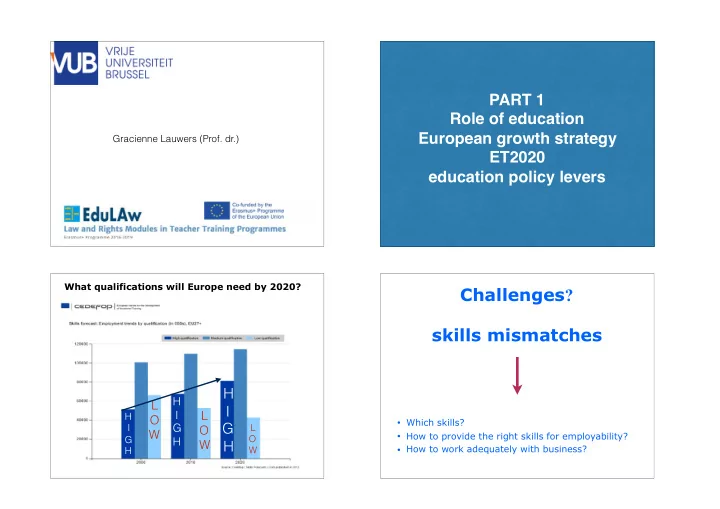
What qualifications will Europe need by 2020?

H I G H

H I G H

H I G H

L O W L O W

L O W

  • Which skills?
  • How to provide the right skills for employability?
  • How to work adequately with business?

skills mismatches Challenges?

slide-2
SLIDE 2

at least 95%

participate in early childhood education

at least 82%

share of employed graduates (aged 20-34 with at least upper secondary education attainment and having left education 1-3 years ago)

  • 3. fewer than 15%

under-skilled in reading, mathematics, science

  • 1. rate of early

leavers below 10%

  • 2. at least 40%

completed higher education

  • 5. at least 15%

in lifelong learning

at least 20% of higher education graduates

and 6% of 18-34 year-olds with an initial vocational qualification should have spent some time studying or training abroad

KEY OUTCOMES FOR EDUCATION

  • 4. Key transversal

competences

  • 1. revise teaching professions
  • 2. strengthen transversal skills

(1)entrepreneurial initiative (2)digital skills (3)foreign languages

  • 4. improve performance of students at risk of early school leaving

(1)increasing inclusiveness (2)low-skilled adults

  • 4. develop world-class vocational education and training
  • 6. promote work based learning

(1)quality traineeships, (2)apprenticeships (3)dual learning models

  • 4. increase the efficiency of funding in education

What to do?

Focussing on the teaching profession a priority for the next years Teachers are an ageing profession in most countries
slide-3
SLIDE 3

ICT skills levels vary greatly between countries Key transversal competences Combine innovative pedagogies with an effective use of digital tools and content How to become more entrepreneurial?

!

Basic skills levels are still lacking in many countries

VET, work-based learning and apprenticeships key role in tackling youth unemployment and facilitating the transition to the labour marke = linking more closely education and work

slide-4
SLIDE 4

Work-Based Learning is still an exception Learn foreign languages Continued learning after initial education crucial for

  • raising productivity levels of working-age

population

  • tackling skill mismatches and bottlenecks on the

labour market

NATIONAL education policy response: Flemish Community of Belgium

Academic year 2019-2020

slide-5
SLIDE 5

AIM? to improve the quality of students entering teacher education HOW?

  • bligatory non binding entrance exam

„strengthen the study choice not to limit the inflow” WHY? + no students with insufficient abilities larger percentage earn a diploma more recognition for the teaching profession Critics? some students being excluded fear for a shortage of teachers, especially in urban areas

IMPROVING TEACHER EDUCATION

IMPROVING STUDENTS

  • qualitative education
  • qualitative research
  • qualitative staff
  • quality infrastructure

Why reforms were/are needed?

Initial teacher training professional bachelor

Level 6 in the Flemish Qualification Framework / EQF trained at university colleges

  • secondary education teachers - university trained
  • secondary teacher-training centers - integrated in universities / no longer exist

autonomous post-secondary non-university institutions

  • diploma awarded equals an educative master - before specialist subject teachers

needed a postgraduate diploma in education including a traineeship in a school

  • courses include:
  • thorough pedagogical training,
  • thorough didactic training,
  • large amount of practical training
  • teaching of a philosophical or ideological vision on education, education law,
  • r other additional subjects
  • no postgraduate training for mentors of future teachers
  • not any special career track for coaches or mentors of teachers
  • non-binding entrance examination

Educative master

Level 7 Flemish Qualification Framework/EQF university-trained teachers

Post-graduate education for secondary education

Level 5 Flemish Qualification Framework/EQF

  • inflow of students with a particular technical professional expertise
  • students have a secondary education diploma and can demonstrate at

least three years of useful professional experience

  • focus the training is solely on the basic competences of teacher
  • no subject content in the training program
slide-6
SLIDE 6

PART 3 Critical remarks about the reforms

1. Classroom placement in the educative master starts at master level

  • more collaboration
  • be drilled in the craft of the classroom
  • techniques practised, coached and relentlessly assessed

2. No didactics on teaching common values

  • equality, integrity, respect for others, …

3. No mentorship training of teacher training staff by outsiders

  • Mentoring by an outsider in particular to view the wider context of

change in which teaching is operating

slide-7
SLIDE 7

4. No didactics on project based learning

  • to teach systematically problem solving using tools rather than just

about the tools

5. No course on understanding cultures

  • to teach to understand other cultures
  • to teach to think globally

6.

No didactics in flexible and mastery-based learning

  • to cater the education to match the aptitudes and abilities of students
  • to make the actual classroom again a place for Socratic dialogue

7. No didactics in new ways of providing teaching and providing education for adaptive-learning techniques

  • the rise of artificial intelligence could transform educational practices and

with adaptive learning, offering a way of doing so

slide-8
SLIDE 8

8. Often no basic law course in teacher education

To conclude train teachers for the world we live in, not the world we grew up in & improve good lawyer-educator collaboration