
SLIDE 1
18TH INTERNATIONAL CONFERENCE ON COMPOSITE MATERIALS
1 Introduction In recent years, flywheel technology has received much attention for industrial energy storage
- applications. Due to advances in power electronics,
loss reduction techniques such as magnetic bearings and vacuum enclosures, and the utilisation of enhanced high-strength/low-density materials, economical flywheel energy storage (FES) has become a fact. There are numerous application
- pportunities envisioned for those kind of flywheels,
including transport systems and uninterruptible power supplies. They present many advantages compared to conventional energy storage systems based on battery technology, as fast charge and discharge
- perations, higher energy density (energy storage
per unit weight), longer durability and minor environmental concerns. However, less experience with this technology has led to great research efforts in design optimisation aiming at the enhancement of the efficiency of FES systems [1]. The design of a composite flywheel brings along many challenges. Most of them are related to manufacturing and assembling issues and considerations on what might occur during operation. The present paper describes the parameters that have to be taken into account when designing a composite
- flywheel. The parameters include material properties,
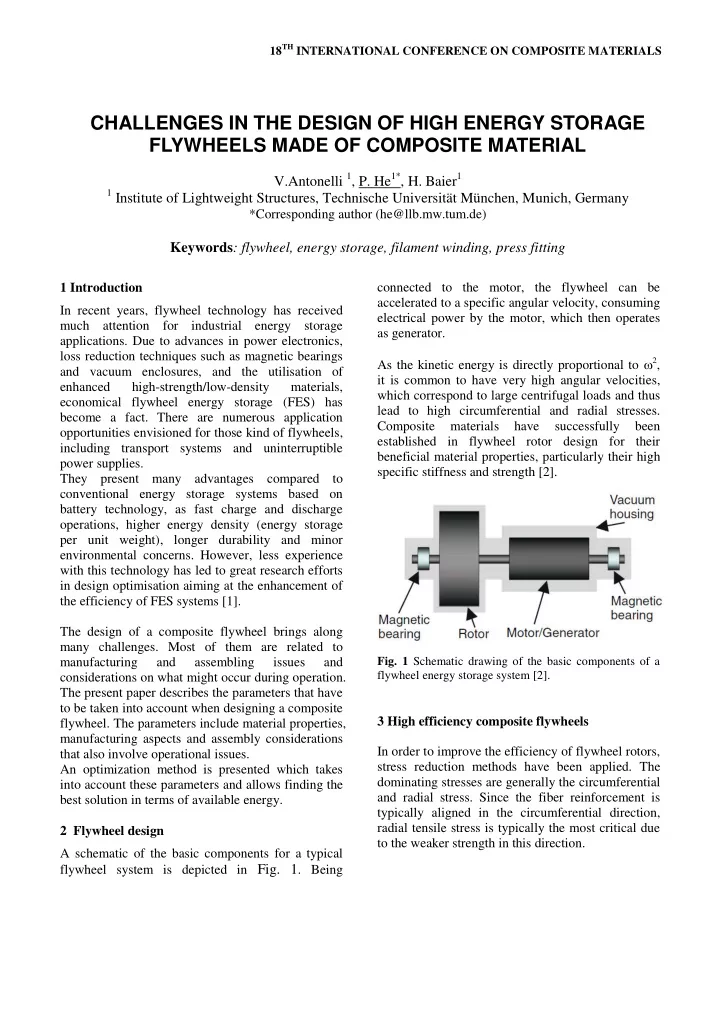
manufacturing aspects and assembly considerations that also involve operational issues. An optimization method is presented which takes into account these parameters and allows finding the best solution in terms of available energy. 2 Flywheel design A schematic of the basic components for a typical flywheel system is depicted in Fig. 1. Being connected to the motor, the flywheel can be accelerated to a specific angular velocity, consuming electrical power by the motor, which then operates as generator. As the kinetic energy is directly proportional to 2, it is common to have very high angular velocities, which correspond to large centrifugal loads and thus lead to high circumferential and radial stresses. Composite materials have successfully been established in flywheel rotor design for their beneficial material properties, particularly their high specific stiffness and strength [2].
- Fig. 1 Schematic drawing of the basic components of a
flywheel energy storage system [2].
3 High efficiency composite flywheels In order to improve the efficiency of flywheel rotors, stress reduction methods have been applied. The dominating stresses are generally the circumferential and radial stress. Since the fiber reinforcement is typically aligned in the circumferential direction, radial tensile stress is typically the most critical due to the weaker strength in this direction.
CHALLENGES IN THE DESIGN OF HIGH ENERGY STORAGE FLYWHEELS MADE OF COMPOSITE MATERIAL
V.Antonelli 1, P. He1*, H. Baier1
1 Institute of Lightweight Structures, Technische Universität München, Munich, Germany