Challenges for ICT in Smart Energy and Electric Mobility Hartmut - - PDF document

challenges for ict in smart energy and electric mobility
SMART_READER_LITE
LIVE PREVIEW

Challenges for ICT in Smart Energy and Electric Mobility Hartmut - - PDF document

Challenges for ICT in Smart Energy and Electric Mobility Hartmut Schmeck Institute AI(FB) + KIT Focus COMMputation Research Center for Information Technology FZI INSTITUTE FOR APPLIED INFORMATICS (AND FORMAL DESCRIPTION METHODS ) - IAI


slide-1
SLIDE 1

KIT – University of the State of Baden-Württemberg and National Research Center of the Helmholtz Association

INSTITUTE FOR APPLIED INFORMATICS (AND FORMAL DESCRIPTION METHODS ) - IAI - AIFB

www.kit.edu

Challenges for ICT in Smart Energy and Electric Mobility

Hartmut Schmeck Institute AI(FB) + KIT Focus COMMputation

Research Center for Information Technology – FZI

2 | Hartmut Schmeck

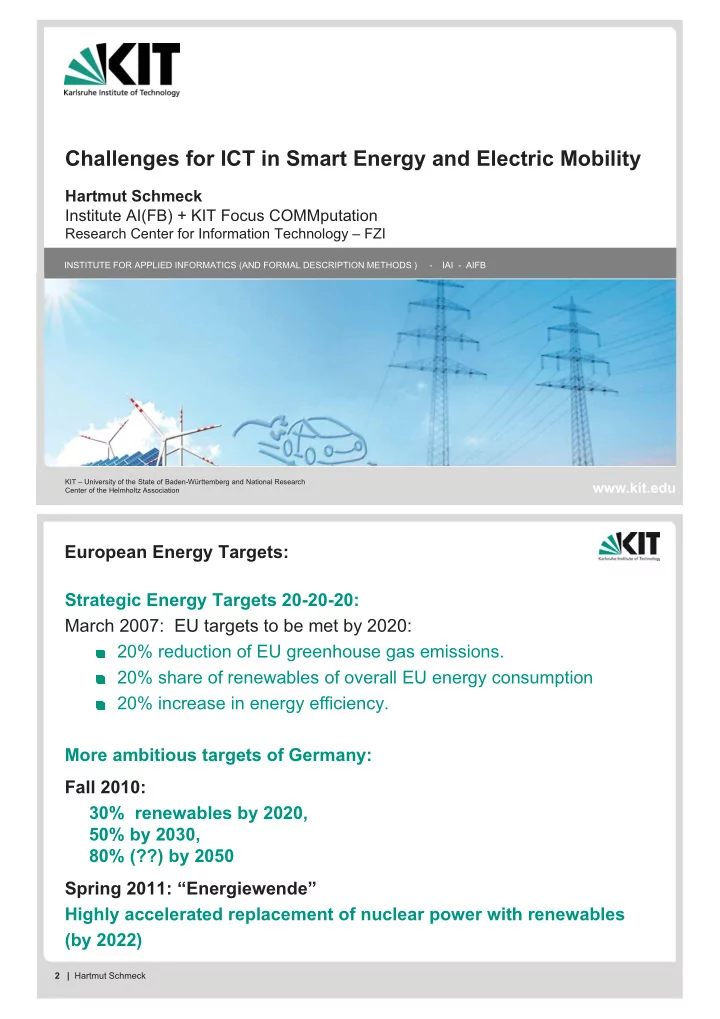
European Energy Targets: Strategic Energy Targets 20-20-20: March 2007: EU targets to be met by 2020: 20% reduction of EU greenhouse gas emissions. 20% share of renewables of overall EU energy consumption 20% increase in energy efficiency. More ambitious targets of Germany: Fall 2010: 30% renewables by 2020, 50% by 2030, 80% (??) by 2050 Spring 2011: “Energiewende” Highly accelerated replacement of nuclear power with renewables (by 2022)

slide-2
SLIDE 2

3 | Hartmut Schmeck

Problems: Fluctuations – in Demand and Supply Variations at different time scales, only partially predictable How to deal with fluctuations? demand and supply management How to compensate for a „dead calm“??

Dead Calm Small Scale Short Term Variations Mismatch

4 | Hartmut Schmeck

Problems: Power Generation on 27.6.2011, 22.1.2012

27.6.: PV 12 GW, wind 2 GW (peak), nuclear 10,3 GW (steady) 22.1.: PV . 1,8 GW, wind 22 GW (peak), nuclear 5,7 GW (steady) (source: http://www.transparency.eex.com/de/)

slide-3
SLIDE 3

5 | Hartmut Schmeck

Study on Energy Situation 2050 (Meteorological Base Year 2007)

Source: Fraunhofer IWES

Power in GW

Jan Feb Mar Apr May June July Aug Sept Oct Nov Dec

6 | Hartmut Schmeck

Problems due to decentralization: bottlenecks in the low voltage distribution grid Local voltage increase due to PV power infeed Local voltage decrease due to EV charging

These visualizations are a result of E-Energy project MeRegio.

slide-4
SLIDE 4

7 | Hartmut Schmeck

Impact of PV power input on voltage in the low power grid

Problem: all PV panels of one segment are in sync!

voltage PV power

8 | Hartmut Schmeck

Energy Management: Balancing Demand and Supply Traditional: Demand cannot be controlled. Electricity cannot be stored.

Principle: Supply follows demand

(Spinning reserve: Primary, secondary, …) Future: Supply only partially controllable and decentralized Potential reversal of power flow

New Principle:

Demand has to follow supply!

Requires more flexible demand

Supply HV MV LV Demand Supply HV MV LV Demand Supply

slide-5
SLIDE 5

9 | Hartmut Schmeck

Integrated Future Energy System

Transmission grid Distribution grid Information flow (Energy Information Network with distributed system intelligence) Energy flow (electricity)

Flaute Kurz- und längerfristige Fluktuationen Ungleich

  • gewicht

Spannungserhöhung durch PV Spannungsabfall durch E-Auto

10 | Hartmut Schmeck

Wind Power Plant

Integrated Hybrid Grids power gas heat

Power storage Power plants Power transmission grid H2 / methanation Bio-PP Steam Power Plant Gas transmission grid Gas storage Thermal storage Power distribution grid Gas distribution grid Heat distribution grid Power storage Wind CHP boiler PV E-Mobility H2- Mobility biogas Gas buffer H2 / methanation Bio-CHP Heat pump G T G T Power storage

power management gas management heat management

Gas &Steam PPP grid Gas transm stora distribution grid Gas distribution grid Heat distribution g biogas Gas buffer buffer buffer H2 / methanation Bio-CHP G T d H2 / ge

pow wer w

Wind Wind

p g agement emen man ma mana m g

biogas Ga s transmission grid st

gas g

s

management anagem anagem

biogas biogas

ent ment

Gas G

ma g

Heat distrib

heat h t he g management ag g Integrated energy management

slide-6
SLIDE 6

11 | Hartmut Schmeck

Integrated Energy Management Systems Balancing demand and supply within each grid Energy conversion in between gas, power, and heat „real conversion“ of power to gas e.g. by electrolytic methods (H2) and methanation in order to consume overflow of power supply from wind power plants „virtual conversion“ of power to gas in bivalent systems e.g. by switching between gas boiler and electric boiler Interoperability of energy management systems for power, gas, and thermal grids ( standardized interfaces?) Integrated energy information grid with distributed system intelligence in order to increase the efficiency, flexibility, and stability

  • f the combined grids.

12 | Hartmut Schmeck

Tomorrow’s Energy Management Challenges Discover and exploit degrees of freedom and leeway for demand (and supply) management. Need for autonomic/organic/MAS energy management without reducing personal comfort or industrial productivity Develop new ways of storing (electric) energy Batteries Power to gas to power Virtual storage

Strong need for intelligent demand and supply management to

increase the reliability of power supply in spite of fluctuating, decentralized and uncontrollable generation of power from renewable sources.

Strong need for load flexibility and load shifting

slide-7
SLIDE 7

13 | Hartmut Schmeck

Where should “system intelligence” be located? What do we have to communicate? Power flow Communication Power flow Communication Power provider (utility) EEX or other markets

Substation (transformer) (20kV / 0,4kV)

PV-panels E-car Power generators BGM WaMa stove

PV

CHP DSL CB IM C B PV- V

PV PV PV PV PV PV PV PV PV PV PV PV PV PV PV PV PV V PV PV PV PV PV PV PV V PV PV V PV V PV V PV V PV PV PV PV PV PV PV PV V PV V PV PV PV V PV PV PV PV PV PV PV PV V PV PV PV PV V PV PV PV PV V PV PV PV V PV V PV PV PV V PV PV PV PV PV V PV V PV PV V PV V PV V PV V PV V PV V PV PV PV V PV PV PV V PV PV V PV PV PV V PV PV V PV PV V PV PV V PV V PV PV V PV V PV V PV PV V PV PV PV PV V PV PV PV PV PV V PV PV PV PV V PV PV PV PV PV

L

14 | Hartmut Schmeck

German national development plan for electric mobility

Phase 1 Market/ Technology preparation Phase 2 Market development Phase 3 Volume market

2009 - 2011 2016 - 2020 2011 - 2016

et

Goal for 2020:

  • 1 Mio. E-Vs in DE
  • DE is lead market and

lead provider for E-Mobility

  • Development of battery technology and competence

centers in Germany

  • Provisioning of an interoperable and large-scale

charging infrastructure

  • Series production of Battery electric vehicles (BEV) and

Plug-In electric vehicles (PHEV)

  • Development of business models

2030: 6 Mio EVs

slide-8
SLIDE 8

15 | Hartmut Schmeck

Effects of electric vehicles (EVs) on power grid Typical mobility in Germany, 2008 (mobility survey):

Average daily car usage < 1 h, 94% of trips < 50 km Average net capacity of currently available EVs: 20 kWh

At 1 Million BEVs (German objective for 2020): available storage capacity of ~ 20 GWh At charging/discharging power of 3.7 kW: ~ 3.7 GW potential power Consequently: high demand for power, potentially also high supply (if power feedback is possible) Average time for charging:

Single phase 3.7 kW: 5 to 7 hours. Three phase 10 kW: ~ 2 hours (but high risk of grid overload!)

Potential of high flexibility for load shifting, but also potential of high peak load! Intelligent control leads to high potential for stabilizing the grid.

16 | Hartmut Schmeck

Integration Strategies: Load Balancing Potential

  • 50

50 100 150 00:00 06:00 12:00 18:00 00:00

Time Power P in kW

EV <-> Grid Exchange Charging/Infeed

  • 50

50 100 150 00:00 06:00 12:00 18:00 00:00

Time Power P in kW

  • riginal grid load curve

Solar power infeed

  • 50

50 100 150 00:00 06:00 12:00 18:00 00:00

Power P in kW Time

Controlled EV charging

  • 50

50 100 150 00:00 06:00 12:00 18:00 00:00

Time Power P in kW

resulting load curve

1 2 3 4

Uncontrolled EV energy charging

slide-9
SLIDE 9

17 | Hartmut Schmeck artmut Schmeck

Germany’s way to an Internet of Energy

18 | Hartmut Schmeck

Research Question / Scenario

Pilot Region with ~ 1000 Participants (Freiamt + Göppingen) 5 chairs at KIT: Energy Economics, Informatics, Telematics, Management, Law

  • Optimize power generation & usage

from producers to end consumers

  • Intelligent combination of new

generator technology, DSM and ICT

  • Price and control signals for efficient

energy allocation

  • Combined Heat and Power
  • MeRegio-Certificate: Best practice in

intelligent energy management

Objectives Partners

Moving towards Minimum Emission Regions

Energy Technology

  • Smart Metering
  • Hybrid Generation
  • Demand Side Management
  • Distribution Grid Management

Energy Markets

  • Decentralized Trading
  • Price incentives at the power plug
  • Premium Services
  • System Optimization

ICT

  • Real-time measurement
  • Safety & Security
  • System Control & Billing
  • Non Repudiable Transactions

Pilot Region 5 chairs at K Energy Ec

t

slide-10
SLIDE 10

19 | Hartmut Schmeck

Research Question / Scenario

  • Intelligent & efficient integration of

electric vehicles into the grid

  • Technology assessment &

feasibility under real life conditions

  • Seamless integration into

MeRegio pilot region

  • Center of competence at KIT

(demo and research lab)

Objectives Partners

Methodology

  • Computer Simulations
  • Field trial with about 50 BEV
  • Living Lab

thodology Computer Simulations Field trial with about 50 BEV Living Lab

11 chairs at KIT: Electrical Engineering (2), Energy Economics, Informatics (5), Telematics, Management , Law

[source: EnBW AG]

ICT for Electromobility

20 | Hartmut Schmeck

„Energy Smart Home“ –Lab at KIT Testing smart integration of EVs into the (local) grid

bedroom I bedroom II living room kitchen technical room

  • CHP

communication electricity load profile EV load profile house

  • ptimized load profile house

fridge and freezer dish washer washing machine stove standard appliances (toaster, coffee machine,..) light control light control PV control SM CB
slide-11
SLIDE 11

21 | Hartmut Schmeck

„Energy Smart Home“ –Lab at KIT Testing smart integration of EVs into the (local) grid

bedroom I bedroom II living room kitchen technical room

  • CHP

communication electricity load profile EV load profile house

  • ptimized load profile house

fridge and freezer dish washer washing machine stove standard appliances (toaster, coffee machine,..) light control light control PV control SM CB 22 | Hartmut Schmeck

Smart Home Scenario Intelligent appliances

Communicate with central control and with each other. Know (and communicate) their current state. May respond to control.

Electric car

Connected to the home as a mobile storage Bidirectional utilization (charging/discharging) Large consumer/supplier

Decentralized power generation (PV/CHP) PCM elements in ceiling (cooling) Simulation component (“4-Quadrant amplifier”) Reduced but effective interaction between human, home management, and devices Discover and exploit degrees of freedom for energy control

Home Device Human

slide-12
SLIDE 12

23 | Hartmut Schmeck

Hardware in the Loop Simulation

grid simulation (power factory) 4Q-controller data sensor

24 | Hartmut Schmeck

Human – System Interaction: Energy Management Panel Transparent information on energy consumption Discover and specify degrees of freedom for use of appliances

slide-13
SLIDE 13

25 | Hartmut Schmeck

Energy Management Panel – EMP

26 | Hartmut Schmeck

Energy Management Panel

slide-14
SLIDE 14

27 | Hartmut Schmeck

Optimized battery charging for EVs (Marc Mültin)

power [kW]

t0 teoc

EVMinPowerDischarge EVSEMaxPowerDischarge EVMaxPowerDischarge EVSEMaxPower EVMaxPower EVMinPower CPEScheduledPow er PMax EVSEMinPowe r PMaxDischarge

t0

Shifitng charging / discharging times Grey area =

  • tech. flexibility

PPreferred

Time [h]

Constrained by power grid, charging station, EV, and user (driver) towards a standardized protocol ISO 15118

28 | Hartmut Schmeck

Energy Management Panel

slide-15
SLIDE 15

29 | Hartmut Schmeck

Energy Management Panel

30 | Hartmut Schmeck

Energy Management Panel

slide-16
SLIDE 16

31 | Hartmut Schmeck

Energy Management System – EMS

Observe + Predict Learn + Control Communicate Observe + Control

32 | Hartmut Schmeck

Communication protocols

  • need of interoperability

EIB/KNX Zigbee HabiTEQ PLC Miele@home

EMS (for office and residential buildings)

REST

(XML, HTTP)

electric and thermal energy supply smart and conventional household appliances electrical and thermal energy storages flexible power consumption system services A/C user grid operator electric utility smart meter smart plugs

slide-17
SLIDE 17

33 | Hartmut Schmeck

Controlled self-organizing energy management

internet Shift imbalances to a later point Handle device restrictions decentralised

consumption production time power

Organic / Autonomic energy management Significant reduction of the need for balancing energy “elite group”

34 | Hartmut Schmeck

Challenges for ICT Energy information network with distributed system intelligence Design of appropriate distributed architectures Observation, prediction, learning of energy load profiles MM-Interfaces for discovering degrees of freedom for energy loads State estimation and control (appropriate combination of control theory, power engineering, and informatics) Design of distributed power system services (controlling active and idle power, phase shifts) Distributed optimization under real-time constraints and with reduced data availability (privacy concerns) Security and safety issues …

slide-18
SLIDE 18

35 | Hartmut Schmeck

Final remarks Tomorrow’s energy system needs an integrating approach to energy management. Essential role of ICT to cope with fluctuation of power supply and large scale decentralization. Self-organization of autonomously acting energy agents will be essential, but needs adequate methods to guarantee stability Electric vehicles will generate significant capacity for power storage and for flexible demand. An “Internet of Energy” will have to cope with similar safety and security problems as the “Internet of Data”.

Fascinating challenges for ICT, we will have to deliver solutions!

Thanks for your attention! Questions?

36 | Hartmut Schmeck

!!!!!!!!!!!!CfP!!!!!!!!!!!!CfP!!!!!!!!!!!!CfP!!!!!!!!!!!!CfP!!!!!!!!!!!!CfP!!!!!!!!! Secure Autonomous Electric Power Grids Workshop http://sites.google.com/site/saepog/ 10 September 2012, Lyon, France Collocated with the Sixth IEEE International Conference on Self- Adaptive and Self-Organizing Systems (SASO 2012) (http://saso2012.univ-lyon1.fr) Important Dates: Submission of papers and demonstration abstracts: 13 July 2012

slide-19
SLIDE 19

37 | Hartmut Schmeck

Contact Address Prof.Dr. Hartmut Schmeck KIT Campus South Institute AIFB 76128 Karlsruhe Germany hartmut.schmeck@kit.edu Phone: +49-721 608-44242 Fax: +49-721 608-46581 www.aifb.kit.edu www.commputation.kit.edu http://meregio.forschung.kit.edu/english/ http://meregiomobil.forschung.kit.edu/english/ www.fzi.de www.e-energy.de/en www.ikt-em.de/en